
How a humble Moroccan table — set with tea, bread, and honey — reveals something the modern world has quietly forgotten.
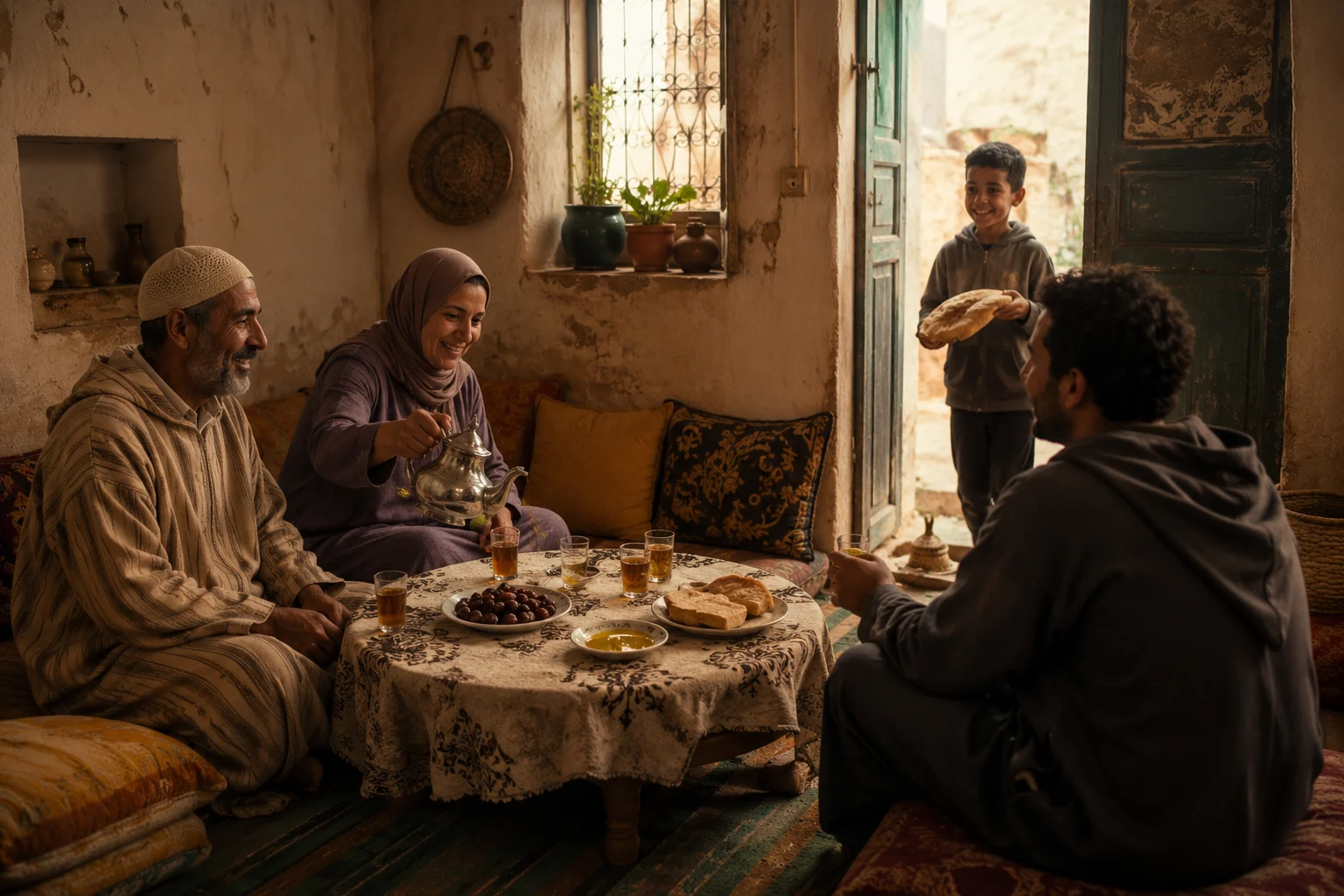
In the Arab and Islamic tradition, Moroccan hospitality is not a performance measured by wealth or preparation — it is a sacred duty. The concept of karam (كرم), rooted in Bedouin culture and reinforced by Islamic teaching, transforms even the most modest table into an act of profound generosity.
A Concept Western Culture Has Quietly Unlearned
In most of the Western world, hospitality has become a transaction. We make reservations. We plan menus weeks in advance. We apologise if the house isn’t perfectly tidy, if the wine isn’t the right vintage, if the flowers on the table are beginning to wilt. Hospitality, in its modern Western incarnation, has been quietly swallowed by performance anxiety — by the fear of not being enough.
Travel to Morocco, even briefly, and something fundamental shifts. You begin to understand that hospitality was never supposed to be a performance. It was never supposed to be a measure of wealth, of status, or of preparation. In the Moroccan tradition — as in much of the Arab and Islamic world — welcoming a guest is not an opportunity to impress. It is a moral responsibility. A duty of the heart.
And that single distinction changes everything.
In Morocco, the Guest Arrives Before the Preparation
There is a particular kind of magic that happens the moment you cross the threshold of a Moroccan home, however modest. Something shifts in the air. The household reorganises itself — not frantically, not anxiously — but with a quiet, purposeful tenderness. You, the guest, have arrived. And your arrival is not an inconvenience to be managed. It is a blessing to be honoured.
This is not rhetoric. It is lived reality, in homes from Marrakech to Beni Mellal, from Tetouan to the High Atlas. A family that owns very little will behave, in the presence of a guest, with a generosity that has nothing to do with their bank balance and everything to do with who they are.
The Child Sent to the Hanout
Ask anyone who has experienced Moroccan hospitality at the village or working-class neighbourhood level, and they will tell you the same story: the child is sent to the hanout. The little corner shop. The neighbourhood grocery. The errand is small in monetary terms — a small jar of honey, perhaps, or a packet of tea, or a few extra pieces of bread. But the intention behind it is enormous.
A family that has almost nothing will still send someone out to make the table better for you. Not because they want you to think they are wealthy. Not because they are putting on a show. But because you came. Because you crossed the city, or climbed the hill, or simply knocked on their door — and that act alone is enough to call forth the best they have to offer.
The Best Glasses Come Out of the Cabinet
There is another detail that stays with those who have witnessed it: the good glasses. Most Moroccan households have two sets of tea glasses — the everyday ones, used without ceremony, and the beautiful ones, kept carefully wrapped or placed at the back of a high cabinet. Small, delicately painted, sometimes gilded at the rim. They come out for guests.
Not for guests who matter more than others. For any guest. Because in this worldview, the very fact that someone has entered your home makes them, for that moment, the most important person in your world. The nicest glasses are not a symbol of wealth. They are a symbol of respect.
What Is Actually on That Table
The modest Moroccan table is one of the most quietly eloquent things in the world. It does not need abundance to be extraordinary. It needs only intention.
Mint Tea: Poured from Height, Offered with Both Hands
The mint tea — atay in Darija, the Moroccan Arabic dialect — is almost always the first thing offered. And it is never simply tea. The preparation is a ritual: gunpowder green tea steeped with fresh spearmint leaves and generous amounts of sugar, poured in three successive rounds from the same pot, each brew growing deeper and stronger. The tea is poured from height — sometimes as high as the arm can reach — to create a fine foam on the surface, called rghwa, which is itself a sign of care and mastery.
The Three Glasses
An old Moroccan saying: “The first glass is as gentle as life. The second is as strong as love. The third is as bitter as death.” To decline any glass is to refuse the gesture itself.
The tea is not served because the host has premium ingredients. It is served because you are there.
Bread, Olive Oil, and Honey: The Trinity of Welcome
Alongside the tea, the table often holds three things that have sustained people across North Africa and the Mediterranean for thousands of years: freshly baked bread, olive oil, and honey. This trinity of welcome — explored further in our article on dates, honey, and olive oil as sacred foods — speaks to a civilisational continuity that no luxury product can replicate.
Khobz — the round, golden Moroccan bread, soft inside and slightly crisp at the crust — is broken rather than sliced. It is shared. There is something deeply human about bread that is torn and passed hand to hand, eaten together without cutlery, without formality. It asks you to be present. It asks you to stay.
Olive oil and honey sit beside it, often in small ceramic dishes painted with geometric patterns. The olive oil may come from a family’s own tree, pressed locally, thick and green-gold. The honey may be raw, dark, harvested from mountain hives — its exact provenance known only to the family. These are not gourmet items in the Moroccan village sense. They are staples. But served to a guest, they become something else entirely. They become an offering.
In the Atlas Mountain regions, this table is sometimes completed with amlou — a thick paste of roasted almonds, argan oil, and honey — spooned slowly onto bread and eaten with a deliberate, almost meditative pleasure. It is nourishing in ways that go well beyond the nutritional. It feeds something in you that you didn’t know was hungry.
Karam — The Arabic Word That Has No English Equivalent
The Arabic concept at the heart of all of this is karam — كرم. It is usually translated as “generosity,” but the translation is inadequate. Karam is generosity elevated to a principle, a way of moving through the world. It encompasses nobility, magnanimity, honour, and the sacred duty to make another person feel cared for.
In classical Arabic culture, and in the Bedouin tradition that forms the deep root of Arab hospitality customs across the entire Arab and North African world, karam was not a virtue reserved for the wealthy. The desert demanded it of everyone. A stranger who arrived at your tent might be the difference between life and death, and you might one day be that stranger. The obligation was mutual, unconditional, and understood.
Islamic tradition reinforces this powerfully. The Prophet Muhammad, peace be upon him, is recorded in the Hadith as saying: “Whoever believes in God and the Last Day, let him honour his guest.” Not “let the wealthy honour their guests.” Not “let those who can afford to.” Whoever believes. The command is universal, and it is absolute.
This is why a modest family in Casablanca will give you their best, always. It is not about what they have. It is about who they are.
Modest Table, Immeasurable Warmth
There is a particular kind of happiness that lives in simple hospitality. It is not the satisfaction of a Michelin-starred meal. It is not the thrill of a grand hotel welcome. It is something older and quieter — the feeling of being genuinely wanted, genuinely seen, genuinely cared for by another human being who has given you what they have, fully and without calculation.
Those who have sat at a Moroccan table — even a table with nothing on it but tea, bread, and a small dish of honey — will often describe the memory years later with a kind of reverence. Not because the food was extraordinary. Because the intention was. Because someone looked at them and said, without words: you matter enough for my best.
That is a feeling that no amount of money can reliably produce. And it is a feeling that a family with almost nothing can produce entirely, every time, through nothing more than sincerity and a pot of mint tea.
The Moroccan Tradition
From the medinas of Marrakech to the villages of the High Atlas, the guest table — khobz, atay, olive oil, honey — is a universal expression of karam regardless of social standing.
Karam Across Cultures
From Bedouin desert tents to the contemporary Gulf majlis, the obligation to honour the guest runs through every Arabic-speaking culture as a shared civilisational value rooted in both tradition and Islamic teaching.
What This Tradition Asks of Us
There is something quietly challenging about this for those of us shaped by Western ideas of hospitality. If generosity is not a function of wealth, then we have no excuse. We cannot wait until the house is perfectly renovated, until the plates match, until we can afford the right wine. Karam asks something more immediate and more demanding: it asks us to give what we have, now, fully, with our whole selves.
It asks us to send the child to the hanout. To bring out the good glasses. To pour the tea from height, carefully, with both hands, and to mean it.
Give what you have
Karam is not about abundance. It is about sincerity. The humblest table, offered with a full heart, surpasses any catered reception offered without one.
Bring out the best
The good glasses, the finest honey, the freshest bread — not to impress, but to say: your presence here matters to me.
Be present
The Moroccan tea ritual demands your full attention. Poured from height, served in rounds, drunk together — it is a shared act of presence, not a transaction.
At Meski, this understanding of hospitality — not as performance, but as devotion — informs everything we do. The honeys we source, the olive oils we select, the gift boxes we assemble: they exist not to impress, but to serve. To give the person who receives them the same feeling that a traveller gets when they sit down at a modest Moroccan table and understands, perhaps for the first time, that they are welcome. Truly welcome.
That feeling is ancient. It is Arab. It is Moroccan. And in a world that has largely outsourced warmth to the hospitality industry, it may be the rarest luxury of all.
Provenance You Can Trust
Every honey and olive oil at Meski is sourced with the same rigour as a Moroccan family choosing what goes on their guest table — only the best, only the genuine.
Heritage Rooted in Karam
Our gift collections are built on a single belief: that a thoughtful gift, chosen with care, carries the spirit of Arab generosity across any distance.
Craft Over Commerce
From raw Moroccan Sidr honey to cold-pressed Tazaouia olive oil, our products exist to make every table — yours or the one you gift — worthy of a guest.
Bring the Spirit of Karam to Your Table
Discover our Moroccan honeys and olive oils — the same staples that anchor the Moroccan table of welcome, sourced with full traceability and offered with care.
Moroccan Hospitality & Arab Generosity — Your Questions Answered
Karam (كرم) is an Arabic concept that goes far beyond simple generosity. It encompasses nobility, magnanimity, honour, and the unconditional duty to make a guest feel genuinely cared for. In Bedouin tradition, karam was a survival ethic: you might one day be the stranger at someone else’s tent. In Islamic tradition, honouring the guest is a religious obligation — not conditional on wealth, but universal.
The classic Moroccan guest table centres on three elements: mint tea (atay), freshly baked round bread (khobz), and accompaniments such as olive oil, raw honey, and sometimes amlou (a paste of roasted almonds, argan oil, and honey). These are not luxury items — they are staples elevated by intention. In the Atlas Mountain regions, the same table has been set this way for centuries.
Pouring mint tea from height — sometimes at arm’s length — creates a fine foam on the surface called rghwa. This foam is considered a sign of mastery and care. It is not a trick for tourists: it is a mark of the host’s skill and attention. The ritual of the three-glass pour (each brew growing stronger) is a shared experience that asks both host and guest to be fully present.
Both are rooted in the same civilisational value of karam and the same Islamic teaching on honouring guests. The expressions differ: Morocco’s welcome table features mint tea, bread, and honey, while the Gulf majlis tradition centres on Arabic coffee (qahwa), dates, and incense. But the underlying ethic — that the guest must receive your best, unconditionally — is shared across the entire Arabic-speaking world. We explore the Gulf tradition in a forthcoming article on the evolution of Gulf hospitality from Bedouin culture to the modern majlis.