
What Is Truly Worth Seeing
A culturally intelligent guide for first-time visitors — the historic Creek, the desert, Emirati food, and an honest itinerary without clichés.
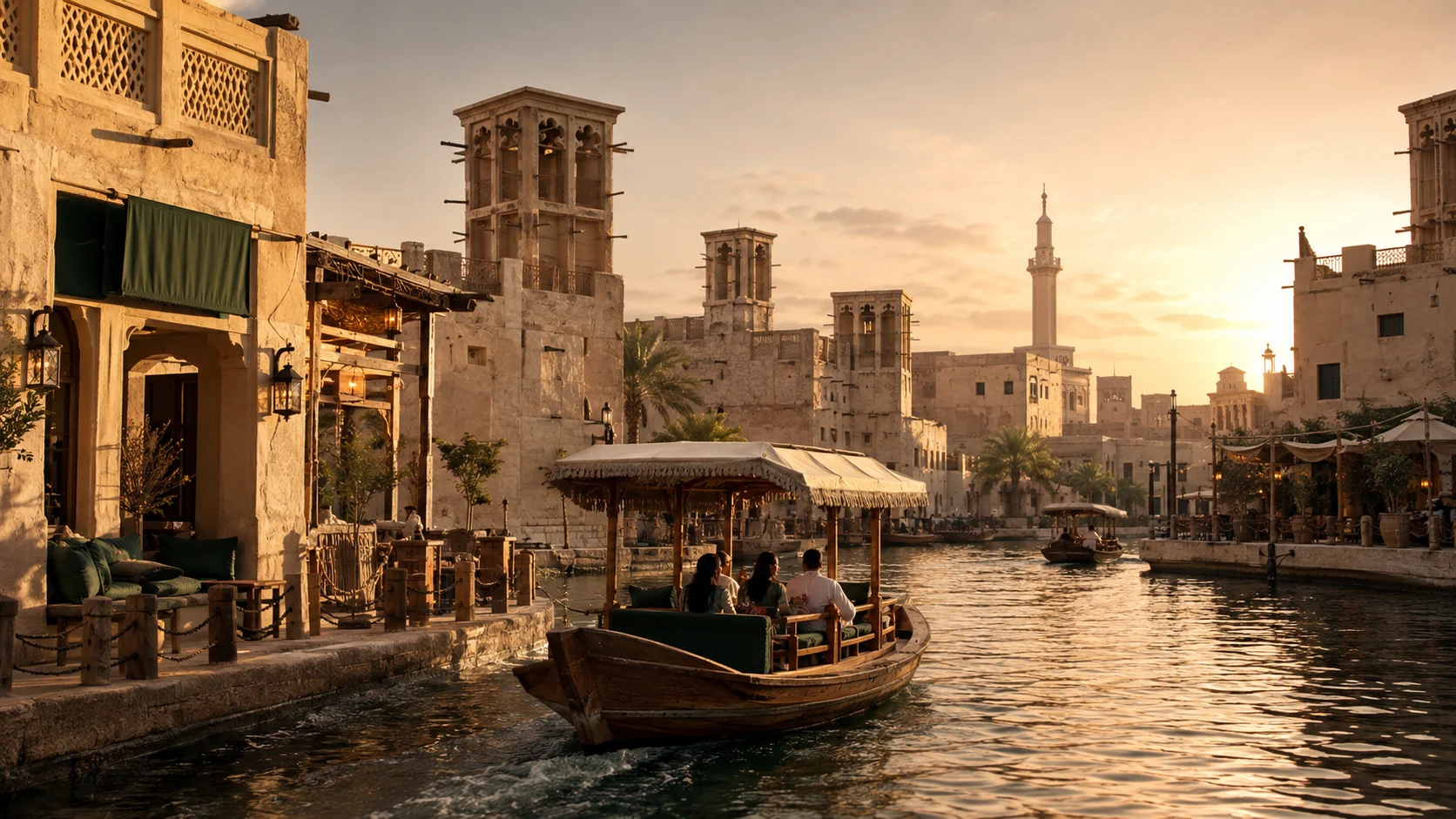
The skyline announces itself long before you are ready for it. Driving in from the airport, the towers appear in the distance like something assembled overnight — which, in historical terms, they nearly were. Most visitors spend the first hours looking up. That is understandable. But the most lasting memories of Dubai tend to begin somewhere else: in a narrow lane of whitewashed coral-and-plaster houses, on the wooden deck of a boat crossing a tidal creek for one dirham, or over a small cup of saffron-tinted coffee offered before any conversation has even begun.
This guide was written specifically for first-time visitors asking which things to do in Dubai are genuinely worth their time — and which ones can wait for a longer, second trip.
What Should a First-Time Visitor Prioritise in Dubai?
A first visit to Dubai rewards those who resist the urge to see everything. The city is large, the distances between districts are significant, and the summer heat demands respect. Three to five days, well-organised, is enough to experience the city’s contrasts without exhaustion.
Prioritise in this order: Old Dubai and Dubai Creek first, because the historic city is where the city’s character is most legible. Then Downtown Dubai for one evening, not necessarily a full day. One desert experience, chosen carefully. At least one Emirati meal. Time near the water — preferably at sunset. And at least one hour in a neighbourhood that is not on every itinerary, such as Alserkal Avenue or Al Seef.
The Museum of the Future is worth half a day if architecture and ideas interest you. The shopping malls are optional — functional, air-conditioned and spectacular in scale, but not what makes Dubai singular.
Begin with Dubai Creek and the Historic City
Before the oil discoveries of the late twentieth century transformed the Gulf, Dubai was a trading port. Merchants from India, Persia and the wider Arab world settled along the banks of a tidal inlet called the Creek — Khor Dubai in Arabic — and built a city of pearl divers, spice traders and fishing families. That city still exists, largely intact, and it is the most important place to visit first.
Al Fahidi Historical Neighbourhood
Al Fahidi — sometimes still called Al Bastakiya — is a compact district of winding lanes, coral-stone houses and wind towers. The wind towers (barjeel) are among the earliest forms of passive cooling architecture in the region: rectangular chimneys designed to catch the breeze, channel it downward through the building and cool the interior rooms without mechanical assistance. Walking between them on a quiet morning, before the organised tours arrive, gives you a sense of what urban life looked like here in the early twentieth century.
Several of the old merchant houses have been converted into courtyard cafés and small galleries. The Dubai Museum, housed in Al Fahidi Fort — the oldest surviving building in Dubai, with origins dating to around 1787 — offers a clear and engaging account of the emirate’s history from pearling to the present. It is not a grand museum by international standards, but it answers the most important question a visitor should carry: how did this city come to be?
The Abra: One Dirham, One River, One Memory
Between the Bur Dubai waterfront and the Deira side of the Creek, traditional wooden boats called abras have been crossing continuously for generations. The fare is one dirham. The crossing takes roughly five minutes. It is one of the most genuinely useful and genuinely beautiful journeys in the city.
Sit at the bow if you can. The water is the colour of pewter in the early morning and copper at dusk. On one side, the wind towers of Al Fahidi. On the other, the minarets and market buildings of Deira. Cargo dhows — large wooden trading vessels — are often moored along the Deira waterfront, still loading goods for destinations along the Gulf and across to Iran and East Africa. The scene is ordinary for those who cross every day, and extraordinary for those crossing for the first time.
Abras depart from the Bur Dubai Abra Station and Deira Old Souk Abra Station approximately every few minutes from early morning until late at night. Always confirm current schedules and any changes to the service directly through the Roads and Transport Authority of Dubai (RTA) before your visit.
Deira, the Spice Souk and the Gold Souk
Step off the abra on the Deira side and you are immediately in a different register. The streets are busier, narrower, noisier. The Spice Souk — a covered market of small stalls selling saffron, dried rose petals, frankincense, cardamom, loomi (dried limes) and dozens of other aromatic goods — is best experienced slowly. The names are worth asking about. Sellers are generally happy to explain what a spice is used for, how it is grown, or which dishes it appears in. You are not obliged to buy anything.
A short walk away, the Gold Souk is a concentrated display of jewellery workshops and retail counters selling gold and precious stones. The volume of gold on display is genuinely remarkable. Whether or not you intend to purchase anything, it is worth one pass through simply to understand the scale of the trade.
Practical note on timing
The souqs are best visited during cooler hours — early morning or after 4pm — and outside the midday heat. In the Gold Souk, prices for the metal itself are set by daily market rates; craftsmanship charges are negotiable. In the Spice Souk, gentle negotiation is normal and expected.
Experience Modern Dubai Without Spending the Entire Day in a Mall
The modern face of Dubai — the towers, the fountains, the architectural ambition — is a genuine spectacle. It should be seen. But it deserves one well-timed visit rather than an entire day that leaves you more tired than moved.
Downtown Dubai and the Burj Khalifa Area
The Burj Khalifa, at 828 metres the tallest building in the world since its completion in 2010, is best appreciated from two different positions: from a distance, particularly from the waterfront of the Dubai Fountain at dusk, and from its observation decks if you choose to ascend. The fountain — one of the largest choreographed fountain systems in the world — performs in the evenings at regular intervals. The show is free to watch from the waterfront promenade.
If you plan to ascend the Burj Khalifa, book tickets in advance through the official At the Top website. Availability changes frequently; always verify current pricing and timing directly before visiting. The view from the upper observation deck at sunset is exceptional. The queues without a pre-booked ticket are not.
Downtown Dubai is also where the Dubai Mall is located. It contains an aquarium, an ice rink and an impressive indoor waterfall, as well as several hundred retail shops. It is worth walking through at least once, partly because the scale is genuinely impressive and partly because it is one of the most thoroughly air-conditioned buildings in a city that takes air conditioning very seriously.
Museum of the Future
Opened in 2022 and located near the Emirates Towers Metro station on Sheikh Zayed Road, the Museum of the Future is one of the most architecturally distinctive buildings in the world. Its elliptical form, clad in stainless steel panels inscribed with Arabic calligraphy by the poet Mohammed Al Awar, is striking from the exterior and thought-provoking once inside.
The exhibitions imagine life in 2071, exploring themes of sustainability, space, technology and human adaptation. The experience is immersive rather than academic, and the building alone justifies the visit for those with an interest in design or ideas about the future. Allow two to three hours. Book tickets in advance through the official museum website (museumofthefuture.ae). As of the time of writing, the standard adult entry is listed at AED 169 — verify current pricing directly before visiting, as fees may change.
Choose One Meaningful Desert Experience
The desert is not far. From central Dubai, the dunes of the Lahbab area — often called the red dunes for the iron-rich colour of the sand — are accessible within roughly forty-five minutes to an hour by car. What you do when you arrive is worth thinking about before you book.
Quieter and more considered
Morning excursions tend to be cooler, calmer and more appropriate for those who want to experience the landscape itself. The light in the early morning is exceptional, and the desert feels more like itself — vast, silent, disorienting in the best possible way — when the camps have not yet assembled. Some operators offer sunrise experiences that allow you to watch the dunes change colour as the day begins.
More festive and widely available
Evening excursions typically include dune driving, a camp dinner and various activities. These can be genuinely enjoyable, particularly for families or groups. They are also more theatrical and more densely attended. The BBQ dinners and entertainment at the camps are commercial productions designed for tourism rather than authentic Bedouin culture — understanding this clearly in advance makes the experience more honest and more enjoyable.
A few things worth knowing before booking: dune bashing — high-speed driving over the dunes in 4WD vehicles — is the most popular activity. Several travel observers and ecologists have noted that repeated intensive dune bashing may damage fragile desert ecosystems and disturb local wildlife. If this concerns you, look for operators who offer calmer dune driving or who specifically promote responsible desert tourism. Whatever you choose, the experience of standing in open desert at dusk, watching the horizon flatten and the city lights disappear behind the sand, is something few cities in the world can offer within an hour of the centre.
Discover Dubai Through Food
Dubai’s food scene is genuinely one of the most international in the world. But a first visit is also an opportunity to encounter Emirati cuisine — a food culture shaped by the desert, the sea and centuries of trade — and it deserves more than a brief footnote.
Emirati Dishes Worth Knowing
| Dish | Description | When to try it |
|---|---|---|
| Machboos | Spiced rice cooked with meat or fish, scented with loomi (dried lime), saffron and warm spices. Aromatic rather than hot. | Any meal |
| Harees | Slow-cooked porridge of wheat and meat. Simple in appearance, deeply satisfying. | Ramadan and celebrations |
| Luqaimat | Small fried dough balls, crisp outside, soft within, drizzled with date syrup and sesame seeds. Best eaten fresh. | Snack or dessert |
| Chebab | Thin Emirati pancake flavoured with saffron and cardamom, served with date syrup and cream cheese. | Breakfast |
For a considered Emirati meal in a restaurant context, Al Fanar in Festival City is one of the establishments that has made Emirati cuisine consistently accessible to visitors, with a menu that explains the dishes and their origins. It is not the only option — but it is an honest one.
Arabic Coffee and Dates: The First Gesture
In much of the Gulf, a guest is offered coffee and dates before any other conversation. This is not a ceremony arranged for visitors — it is simply what hospitality looks like here. Arabic coffee (gahwa) is prepared with lightly roasted green coffee beans, cardamom and sometimes saffron or rosewater. It is pale gold in colour, mildly bitter and completely unlike the espresso or filter coffee most visitors are accustomed to. It is served in a small handleless cup called a finjan.
The correct way to receive it is with the right hand. When you have had enough, a gentle shake of the cup communicates this to the host. UNESCO included Arabic coffee on its Intangible Cultural Heritage list in 2015, recognising not just the drink but the entire social fabric around its preparation and serving.
Dates arrive alongside the coffee as a matter of course. They are not a garnish. In the Gulf, the date palm has sustained communities through extreme climates for thousands of years. The varieties differ in texture, sweetness and complexity more than most visitors expect. If you have the opportunity to taste several varieties side by side — a Medjool alongside a Sukkary, for instance — do not rush through them. They are as different as two distinct fruits.
Spend Time Near the Sea
Dubai is a coastal city, and the Arabian Gulf — warm, calm and often very clear — is present along its entire western edge. Spending time near the water offers a perspective on the city that is genuinely different from anything experienced inland.
Jumeirah Beach is one of the most accessible public beaches in the city, with a long stretch of open coastline and clear views toward the Burj Al Arab. It is free to use and requires no special arrangements. Swimwear is appropriate on the beach and at hotel pools; modest dress applies when leaving the beach area to walk through surrounding streets or enter shops. There are no topless or nude beaches in Dubai, public or private.
The best time to be at the sea is the hour before sunset. The light changes over the water in a way that makes the city’s towers — visible in the distance — appear softer and less aggressive than they do in daylight. Staying through the early evening, as the heat finally releases and a sea breeze arrives, is one of the least complicated and most restorative things you can do in this city.
Visit a Neighbourhood Beyond the Famous Landmarks
Every city has zones where its real texture becomes visible — the areas visitors miss because they are not on the official maps. Dubai has several of them.
Alserkal Avenue — Al Quoz
A cluster of repurposed warehouses now housing contemporary art galleries, independent cinemas, coffee roasters, bookshops and small restaurants. It functions as Dubai’s cultural district in the most organic sense of the term — where artists live and work, where conversations about urbanism happen, and where the creative life of the city is most visible. It does not advertise itself loudly. It rewards those who seek it out.
Al Seef — Bur Dubai waterfront
A recently developed heritage district that recreates something of the atmosphere of old trading Dubai — covered walkways, traditional architecture and waterfront cafés. It is more designed than discovered, but pleasantly so, and the evening light over the Creek from this stretch of waterfront is genuinely beautiful.
Satwa — working neighbourhood
A district of flower shops, small tailors, Pakistani and Indian restaurants and local life largely unmediated by tourism. It is not a polished experience. It is simply a neighbourhood where people live — and that is exactly why it is worth an afternoon.
A Note from The House of Meski
Dubai presents visitors with no shortage of things to carry home. Scarves, gold, spices, miniature towers in various sizes. Most of these objects will live in a drawer within a year. But flavour remembers differently. A honey chosen carefully in Dubai — one that carries the warmth and botanicals of the region — has a way of reviving a journey months later, at an ordinary breakfast, without warning. Gulf honey, chosen with knowledge rather than haste, is one of the most honest gifts the region offers. If you are curious about what Emirati or Omani honey truly tastes like, you are welcome to explore what we mean.
Common First-Time Mistakes to Avoid
Trying to see too much. Dubai is a large city spread across a linear corridor stretching roughly forty kilometres from north to south. Jumping between the Gold Souk, the Burj Khalifa and JBR in a single day is possible on paper and exhausting in practice. Choose three things per day and allow time for travel between them.
Underestimating travel time. The Dubai Metro is clean, reliable and affordable, but it does not reach every district. Taxis and ride-hailing services (Careem and Uber both operate in Dubai) fill the gaps, but traffic during morning and evening peak hours can extend journey times considerably.
Visiting outdoor attractions at the wrong hour. Between approximately May and September, the midday heat in Dubai is genuinely severe. Outdoor visits are best planned for before 10am or after 4pm. Even a fifteen-minute walk between buildings in full sun during this period is uncomfortable and drains energy for the entire day.
Spending the entire trip inside malls. The malls of Dubai are impressive. They are also not Dubai. Staying inside air-conditioned commercial environments for most of your visit means returning home with an accurate memory of global retail and a very incomplete memory of the city.
Ignoring the difference between expensive and meaningful. Dubai has a well-deserved reputation for luxury, and some visitors spend considerable sums on experiences that are generic by any standard. A dinner on a dhow cruise is not inherently more valuable than a plate of machboos in a neighbourhood restaurant. Calibrate accordingly.
Buying souvenirs without checking their origin. Much of what is sold in souvenir shops — camel figures, decorative Arabic coffee pots, small bottles of perfume — is manufactured elsewhere. If origin matters to you, ask. Locally made goods and regionally produced products exist and are worth seeking out; they are simply not always the most prominently displayed.
Confusing Emirati culture with Dubai’s international population. Emirati nationals represent a minority of Dubai’s total population, which is composed overwhelmingly of expatriates from South Asia, Southeast Asia, Africa, Europe and elsewhere. The city’s culture is consequently layered and often contradictory. What feels like local culture in one context is sometimes an import from elsewhere. This is part of what makes Dubai genuinely interesting — it is worth keeping that complexity in mind rather than flattening it.
What to Do in Dubai in Three Days
A realistic framework. Adjust based on your pace and the season.
Day One — The Historic City
Begin in Al Fahidi in the morning. Visit the Dubai Museum and walk through the lanes of the neighbourhood. Cross the Creek by abra. Spend the late morning in the Spice Souk and walk to the Gold Souk. Return to your accommodation during the midday heat. In the late afternoon, return to the Creek waterfront at Al Seef and watch the light change over the water. Eat dinner in Deira or Bur Dubai — the area around the Creek has a concentrated selection of South Asian, Emirati and Middle Eastern restaurants at varied price points.
Day Two — Modern Dubai and the Sea
Visit the Museum of the Future in the morning (book in advance). Spend the early afternoon near Jumeirah Beach. In the evening, go to Downtown Dubai for the fountain show and the view of the Burj Khalifa. Have dinner in the Downtown area or along the Canal promenade.
Day Three — Desert and Food
Book a morning desert excursion for an early start. Return to the city by early afternoon. Spend the late afternoon in Alserkal Avenue or Satwa. Have your most considered dinner of the trip — ideally Emirati food at a restaurant that takes its cuisine seriously.
What to Do in Dubai in Five Days
Five days allows you to slow down, which is when a city reveals itself.
Day One — The Historic City
Al Fahidi, the abra, the souqs, the Creek waterfront at dusk. As described above.
Day Two — Dubai Frame, Zabeel and Surrounding Districts
The Dubai Frame — a 150-metre tall picture frame structure on the edge of Zabeel Park — offers a visual contrast between Old Dubai on one side and New Dubai on the other. It is a more considered attraction than it sounds, and less crowded than the Burj Khalifa. Afternoon in Karama or Zabeel Park. Evening in Satwa.
Day Three — Modern Dubai
Museum of the Future in the morning. Downtown Dubai in the late afternoon and evening, including the fountain show.
Day Four — Sea, Coast and Culture
Morning on the beach. Afternoon at Alserkal Avenue. Evening dinner focusing on Emirati cuisine.
Day Five — Desert and Departure
Early morning desert excursion. Return to the city by noon. Final hours for a last walk along the Creek or a return to any market you want to revisit. Departure.
If five days feel short — and for many visitors they do — consider extending to include a day trip to Abu Dhabi (approximately ninety minutes by road), particularly to visit the Sheikh Zayed Grand Mosque, one of the most significant works of contemporary Islamic architecture in the world.
Frequently Asked Questions About Visiting Dubai for the First Time
Three days allow you to cover the essential contrasts: Old Dubai, modern landmarks and one desert or coastal experience. Five days allow a more measured rhythm, with room to explore less-visited districts, eat more deliberately and spend an evening simply sitting by the water. For a first visit, five days is the more comfortable choice if your schedule permits.
Old Dubai — which encompasses Al Fahidi, Dubai Creek, the Deira souqs and the surrounding waterfront — is the part of the city most first-time visitors say they wish they had spent more time in. It is where the city’s pre-oil character is still legible, where the abra crossing costs one dirham, and where the texture of daily life is most visible. It should be the first thing you visit, not an afterthought on your last morning.
The abra crossing at Dubai Creek, the lanes of Al Fahidi, the Burj Khalifa at dusk (either from below at the fountain or from the observation deck), the Museum of the Future, the Spice Souk, at least one Emirati meal and one hour in the desert. These are not the only things worth doing, but they tend to define what people remember about a first visit.
For most first-time visitors, yes — with realistic expectations. The landscape itself is the main event: vast, quiet and very different from anything visible in the city. Evening group safaris are entertaining but theatrical; they are not representations of authentic Bedouin culture. Morning excursions are calmer and more suitable for those who want to experience the desert rather than an organised show. Choose a licensed operator and decide in advance whether adventure or observation matters more to you.
Begin with Arabic coffee (gahwa) and dates — these will be offered to you in many contexts and deserve your full attention. Then try machboos (spiced rice with meat or fish), luqaimat (warm fried dough with date syrup), harees (wheat and meat slow-cooked together) and chebab (Emirati saffron pancakes) at breakfast. Emirati food is aromatic rather than spicy, and genuinely distinctive from the broader Middle Eastern cuisines many visitors are more familiar with.
Dubai can be managed across a wide range of budgets. The abra crossing costs one dirham. The Dubai Metro is affordable with a Nol card. Public beaches are free. Many souq markets and neighbourhoods require no entry fee. Costs rise significantly at hotels, fine dining restaurants, observation deck tickets and organised excursions. A first visit is neither necessarily cheap nor necessarily expensive — it depends almost entirely on how you choose to spend your time.
For a first visit, staying in or near Bur Dubai gives easy access to the historic city, the Creek and the souqs, while remaining well-connected by Metro to Downtown and the rest of the city. Dubai Marina and JBR are excellent for those prioritising the beach and a lively evening atmosphere. Downtown Dubai is convenient for the Burj Khalifa area. Each district has a different character; the right choice depends on what matters most to you.
The souqs offer saffron, cardamom, dried rose petals and frankincense — ingredients that are excellent quality and fairly priced when bought from market sellers rather than airport shops. Dates in various varieties make a considered and genuinely local gift. For those who want to bring back a flavour with real meaning — one that holds up at home, months later — honey from the Gulf region, chosen knowledgeably, is one of the region’s most honest products. Ask about origin and harvest before buying; quality varies considerably.
Discover the Honeys of the Gulf
If your visit to Dubai has awakened a curiosity about the flavours of the Gulf — the cardamom in your coffee, the weight of a date in your hand, the warmth of a place — The House of Meski carries Gulf honeys harvested with care and chosen with knowledge. From Emirati Sidr to Omani Samar, each jar carries something of the region.
A successful first visit to Dubai is not measured by the number of floors you ascended or the number of photographs taken from a rooftop at dawn. It is measured by something less quantifiable: whether you left the city knowing something you did not know when you arrived. A word in Arabic. The weight of a date in your hand. The particular quality of silence in open desert, fifteen minutes from a city of three million people. The smell of cardamom in a small cup.
Cities are not ranked by their towers. They are remembered by their gestures.
May every journey bring you encounters worth remembering long after you return home.