
A Heritage Written in Groves
From ancient Volubilis to the Atlas foothills — the story of a cultivar, a culture and a season
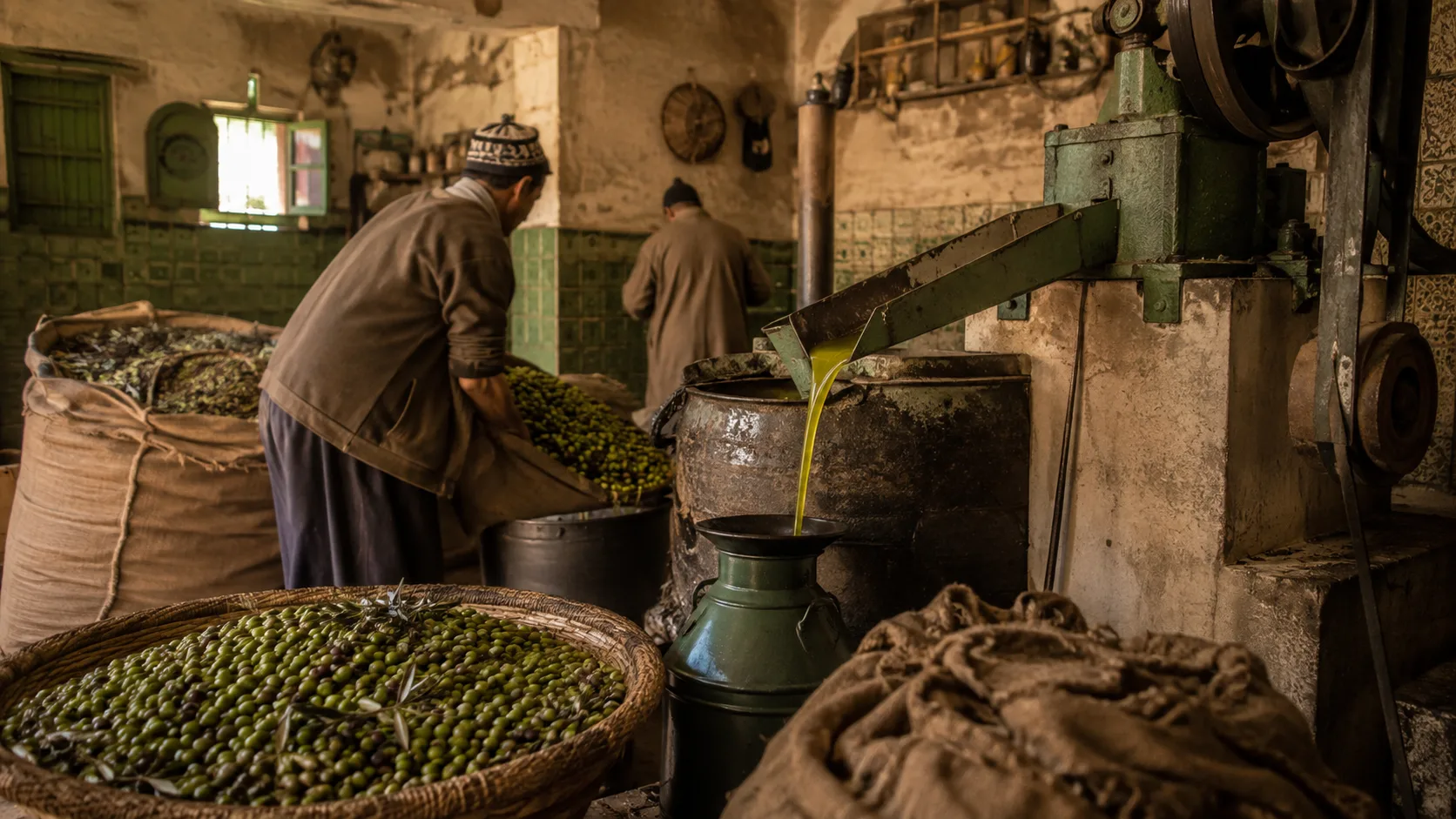
Morocco is one of the world’s five largest producers of olive oil. Its groves cover more than one million hectares, spread across regions as different from one another as the Atlantic coast is from the Atlas foothills. And yet, outside the Mediterranean food world, Moroccan olive oil has remained curiously understated — present in professional kitchens, studied by researchers, valued by those who know where to look, but rarely celebrated with the attention it deserves. That is beginning to change.
A History Rooted in the Olive Tree
There is a moment during the Moroccan olive harvest — somewhere between late November and early December, when the air carries the faint green scent of crushed leaves — when it becomes clear that olive oil here is not simply an agricultural product. It is a landscape, a season, a family gathering, a form of memory.
The olive tree arrived in Morocco through a convergence of civilisations, each of which left its mark on the landscape. Scholars debate the precise origins: some attribute the introduction of cultivated olive trees to Phoenician traders navigating the Atlantic and Mediterranean coasts around 1000 BCE. Others suggest that Berber communities may have begun domesticating wild olive trees — known as oleaster — independently, long before Phoenician contact. The distinction matters less than the conclusion: by the time the Romans consolidated their presence in North Africa, olive cultivation in Morocco was already an established practice.
The first documented olive oil mills in Morocco date to the 2nd and 3rd centuries CE, during the height of Roman civilisation in the region. The ruins of Volubilis — a city recognised today as a UNESCO World Heritage Site — still stand surrounded by ancient olive groves near Meknès, and ancient pressing stones have been found within the site itself. Some Picholine Marocaine trees growing in that landscape today are estimated to be several centuries old, though precise ages for individual trees are difficult to verify with certainty.
Through the centuries that followed — the arrival of Islam, the Almoravid and Almohad dynasties, and the long tradition of Moroccan sultanates — the olive tree remained. It appears in Moroccan cooking, in medicine, in lamps and in the preparation of leather and textiles. It is woven into the domestic calendar: the harvest begins after the first autumn rains and shapes rural life for two to three months each year.
What changed over time was not the tree, but the knowledge surrounding it. Generation by generation, Moroccan families developed a practical understanding of when to pick, how to press, when to keep the oil green and when to let it mellow. This accumulated wisdom — never fully written down, never fully lost — is still alive in Morocco’s olive-growing villages.
Morocco’s Main Olive-Growing Regions
Morocco’s olive groves do not form a single landscape. They are distributed across several distinct regions, each with its own soil, altitude, water source and microclimate. The differences between them are not merely academic: they produce noticeably different oils.
Fès-Meknès: The Heartland
The Fès-Meknès region accounts for approximately a third of Morocco’s total olive-growing area — the single largest concentration in the country. The Saiss plateau, fed by relatively reliable winter rains, and the alluvial plains around Meknès, produce conditions that olive farmers have been exploiting for at least two millennia. The oils from this region tend to be fruity and structured, with a medium peppery finish — characteristic of the Picholine Marocaine variety, which dominates here as it does across most of Morocco.
Several olive oils from Fès-Meknès have been awarded Protected Geographical Indication (PGI) status, including Zerhoune olive oil — a deep green oil with an intense, balanced fruitiness — and Lemta olive oil, which presents as a transparent golden yellow with pronounced fruity, bitter and slightly spicy notes. These designations represent formal recognition that the specific combination of soil, climate and local knowledge produces something that cannot be replicated elsewhere.
Marrakech-Safi: The Plains and the Mountains
Moving south, the olive groves of the Marrakech-Safi region spread from the Haouz plain toward the foothills of the High Atlas. This is drier, warmer country — semi-arid in places, irrigated in others. Here, the Haouzia variety has gained ground alongside Picholine Marocaine. Haouzia was developed through clonal selection within the Moroccan Picholine and is better suited to the drier conditions of the Marrakech plains. Its oil tends toward a softer profile, with good oleic acid content and a slightly rounder flavour.
Marrakech is also notable for its table olive production. Not all olives are destined for the press: the city’s souks display a remarkable variety of prepared olives — cracked, brined, seasoned with preserved lemon, cumin or harissa — that form a distinct chapter of Moroccan culinary culture.
Tanger-Tétouan-Al Hoceima: The Northern Tradition
The northern region, running from the Rif Mountains toward the Mediterranean coast, is characterised by higher rainfall and cooler temperatures than the interior plains. Olive cultivation here is ancient — the Rif communities have pressed oil in stone mills for centuries — but the region produces a smaller share of national output. The landscape is dramatic: terraced groves on steep hillsides, ancient trees growing alongside fig and almond, oil pressed in small local facilities and largely consumed within the region itself. These oils are rarely exported and almost never commercially branded, which gives them a different kind of value.
Beni Mellal-Khénifra and Beyond
The region of Beni Mellal-Khénifra sits at the feet of the Middle Atlas mountains and is irrigated in part by the snowmelt of the Atlas range. It has seen significant investment in modern olive planting in recent decades. Further south and east, the regions of Drâa-Tafilalet and Souss-Massa contribute smaller volumes, but their more extreme conditions — hot, dry, occasionally desert-adjacent — produce oils with a particular concentration and aroma that represent an important frontier in understanding how the Picholine Marocaine adapts to different environments.
The Historic Heartland
Approximately one third of Morocco’s olive groves. Structured, fruity oils with a peppery finish. Home to PGI-designated Zerhoune and Lemta oils.
Plains and Atlas Foothills
Semi-arid conditions with the Haouzia variety alongside Picholine. Rounder, softer oils. Also renowned for prepared table olives.
The Northern Rif Tradition
Higher rainfall, ancient terraced groves, small-scale stone-mill pressing. Oils rarely exported — a living tradition consumed within the region.
Traditional and Modern Production
For most of Morocco’s history, olive oil was extracted in a maâsra (المعصرة) — the traditional stone press. A large circular millstone, often pulled by a donkey or mule, crushed the whole olives, pits and all, into a thick paste. That paste was then spread onto woven mats — called scourtins — which were stacked under a beam press. The pressure extracted the oil slowly, and what ran out was collected in stone basins where oil and water separated naturally over time.
The process was slow. It was communal. Villages would share a single press, and families would arrive with their olives in woven baskets, waiting their turn, watching the oil emerge in a thin green thread.
This method is still practised in parts of rural Morocco. Some families continue bringing their harvest to a traditional maâsra not out of nostalgia but because the small-scale, slow-pressing method gives them an oil they recognise — heavy, green, intensely flavoured, almost peppery enough to make the throat catch. It is not the oil that wins international awards. But it is the oil their grandmothers used, and that gives it a meaning that cannot be standardised.
Alongside the traditional press, Morocco has developed a substantial modern processing sector. Today, the country operates a large number of semi-modern and modern extraction units, using continuous two-phase or three-phase centrifuge systems capable of processing large volumes of olives within hours of harvest. Research institutions — particularly the National Institute for Agronomic Research (INRA) — have contributed to demonstrating that two-phase extraction generally produces oils with higher polyphenol content than three-phase or hydraulic press methods, which is relevant both for flavour and for the oil’s stability over time.
Harvest
Optimally from November through December, when olives are partially green. Early harvest produces greener, more polyphenol-rich oil. Later harvest yields softer, more golden oil with higher extraction yield.
Transport
Olives should reach the press within approximately 24 hours. Delay allows oxidation and enzymatic activity that degrades oil quality.
Pressing
Traditional maâsra (stone mill) or modern cold centrifuge extraction. Cold two-phase centrifuge is associated with higher polyphenol retention.
Separation and storage
Oil separated from vegetation water, filtered if necessary, then stored in cool, dark, airtight conditions to preserve freshness and polyphenol content.
The Characteristics of Moroccan Olive Oil
The dominant variety, Picholine Marocaine, accounts for the vast majority of Morocco’s olive cultivation — figures commonly cited in agricultural literature suggest it covers approximately 95 to 96 percent of planted orchards. It is a remarkably adaptable tree: drought-resistant, productive, capable of surviving conditions that would defeat more delicate varieties. Its oil is characteristically robust: fruity with notes of green herbs and almonds, with a medium to pronounced bitterness and a peppery finish that lingers at the back of the throat.
That bitterness and pungency are not flaws. They are markers of polyphenol concentration — specifically of compounds such as oleocanthal and oleuropein, which are present in higher quantities when olives are harvested early in the season and pressed cold. Research has noted that Moroccan Picholine Marocaine oils can present notable polyphenol levels under good harvest and extraction conditions, though concentrations vary significantly depending on region, harvest date and extraction method. What can be said honestly is that the potential is genuinely high when conditions align.
Colour varies with harvest time. Early-season Moroccan extra virgin olive oil is often a deep, vivid green — intense and assertive. As the season progresses and olives ripen further, the colour shifts toward golden yellow and the flavour softens. Both have their place: the early green for raw use, over salads or bread; the more mature golden oil for cooking, for tajines, for chermoula.
About polyphenol claims
Polyphenol content in olive oil varies considerably depending on variety, region, harvest date and extraction method. It is accurate to say that Moroccan Picholine Marocaine can present high polyphenol levels under ideal conditions — it would be inaccurate to present all Moroccan olive oil as uniformly high in polyphenols. Always check harvest date on the label for the freshest oil.
Why Moroccan Olive Oil Is Appreciated Worldwide
Morocco exports olive oil to Europe, North America and the Gulf region. Much of this oil has historically been sold in bulk — absorbed into blended oils that carry other national labels — a practice common across Mediterranean producing countries and one that has long obscured Morocco’s actual contribution to global olive oil supply.
That dynamic is changing. Morocco’s Plan Maroc Vert, launched in 2008, brought significant investment in modern pressing equipment, quality certification and export infrastructure. A growing number of Moroccan producers now bottle and export under their own names.
International competition results — notably at the NYIOOC World Olive Oil Competition — have repeatedly recognised Moroccan extra virgin oils in top categories. These results represent blind assessments by panels of trained tasters. They confirm what careful observers of the olive oil world have known for some years: that Morocco’s combination of traditional cultivar, long sunshine hours, significant temperature variation between day and night, and improving extraction standards can produce oils of genuine distinction.
In the Gulf region, Moroccan olive oil carries a particular significance. Moroccan cuisine — and its central ingredient — is part of the daily life of a significant Moroccan diaspora community across the UAE, Qatar, Saudi Arabia and beyond. It is also increasingly present in gourmet food stores, in premium restaurant kitchens, and among food-conscious buyers who have begun to look beyond the familiar labels.
Preserving a Living Heritage
Morocco’s olive groves are not simply agricultural infrastructure. They are also ecological systems. The older trees support biodiversity, prevent soil erosion and stabilise hillsides in regions where rainfall is irregular and the land fragile. They also represent cultural continuity: the same groves that fed Roman cities, that supplied medieval medinas with cooking oil and lamp oil, that sustained Berber families through drought years, are still producing today.
The challenge, as with all living heritage, is transmission. Younger generations in Morocco’s olive-growing villages face the same pressures as young people everywhere: urban migration, changing work patterns, the difficulty of making a small-scale agricultural livelihood viable. The traditional maâsra requires labour that is increasingly hard to find. The knowledge of which trees produce the finest oil, of which hillside catches the right wind, of how long to wait before the harvest — this is knowledge held by older farmers, and it does not transfer automatically.
Geographical indication programmes — the PGI labels awarded to Zerhoune, Lemta, Tyout-Chiadma, Sefrou and others — are one answer. By formally linking an oil’s identity to its territory, they create an economic incentive to maintain both the landscape and the practices that shape it. They also help consumers — whether in Casablanca, Dubai or Paris — understand that the origin of an oil is not merely a location on a map. It is a set of relationships between soil, climate, variety and human knowledge that took centuries to develop.
Cooperative structures — particularly in the Marrakech-Safi region — allow small producers to pool their olives and share modern pressing equipment, gaining access to export-quality extraction without abandoning the scale of family farming. These cooperatives represent a genuine effort to keep traditional olive-growing economically viable while adapting to modern standards.
Taste Morocco from the Source
At The House of Meski, we source olive oil with the same care we apply to every product in our collection — tracing it to its origin, its season and the hands that pressed it.
Final Thoughts
The olive tree is, in many ways, the most patient of teachers. It grows slowly. It produces inconsistently — a remarkable harvest one year, a modest one the next. It asks for relatively little but rewards attentive care with oil that carries the flavour of its landscape, its season and its history.
Morocco’s relationship with the olive is old enough that it predates the country’s current borders, its languages as they are now spoken, its religious identity. The tree was there before all of it, and it will likely outlast whatever comes next. Understanding Moroccan olive oil means understanding something of that continuity — the patience of a culture that has pressed oil from the same ancient varietals, in the same autumn season, across thousands of years of change.
To taste a bottle of genuine Moroccan extra virgin olive oil — green, slightly bitter, with a pepper finish that settles slowly — is to encounter that continuity in a form more direct than any history book can offer. It is a landscape in a bottle, and a conversation that stretches back to Volubilis and beyond.
نسأل الله أن يبارك لكم فيما رزقكم
May God bless you in what He has provided.
Frequently Asked Questions about Moroccan Olive Oil
Moroccan olive oil is produced predominantly from the Picholine Marocaine variety — a cultivar unique to Morocco and not widely grown elsewhere. Compared to many Spanish and Italian oils, it tends to present stronger bitterness and pungency when harvested early, reflecting higher polyphenol potential. Morocco’s combination of long sunshine hours, significant day-to-night temperature variation, and ancient cultivar genetics produces a distinctive sensory profile. That said, olive oil varies considerably within each country depending on region, variety and harvest date, so comparisons are always approximate rather than absolute.
There is no single answer. The Fès-Meknès region produces approximately a third of Morocco’s olive oil and is widely considered the historic heartland — its oils are structured and fruity, with several receiving Protected Geographical Indication status. Marrakech-Safi produces distinctive oils suited to its drier conditions. The northern Rif region offers oils rarely seen outside Morocco. Quality depends on producer, harvest timing and extraction method at least as much as it depends on region alone.
Picholine Marocaine is the dominant olive cultivar in Morocco, covering the vast majority of the country’s olive orchards. It is a dual-purpose variety — suitable both for oil extraction and as a table olive. The tree is notably drought-resistant and well-adapted to Morocco’s semi-arid conditions. Its oil is characterised by strong fruitiness, medium to high bitterness and a peppery finish. Some trees of this variety near Volubilis are believed to be several centuries old, though precise dating of individual trees is difficult.
The optimal harvest window in Morocco typically runs from November through the end of December, though it can extend into February depending on the region, variety and that year’s conditions. Early-season harvesting — when olives are still partially green — produces oils that are more intense, greener in colour, higher in polyphenols and more assertively flavoured. Later harvests yield softer, more golden oils with higher extraction yield but lower polyphenol concentration. Most premium extra virgin olive oil producers harvest early.
The traditional Moroccan olive press is called a maâsra (المعصرة). It uses a large circular millstone — historically pulled by a donkey or mule — to crush whole olives, pits included, into a thick paste. That paste is then spread onto woven mats called scourtins and stacked under a beam or screw press. The extracted liquid separates naturally by gravity into oil and vegetation water. The process is slow, communal and labour-intensive. Traditional maâsras are still in use in parts of rural Morocco, alongside modern centrifuge facilities.
Moroccan extra virgin olive oils — particularly those produced from Picholine Marocaine harvested early in the season and extracted by cold two-phase centrifuge — can present notable polyphenol levels. Research has noted this potential, and international competitions have recognised premium Moroccan oils in top categories. However, polyphenol content varies considerably depending on region, harvest date, variety and extraction method. It is accurate to say the potential exists under the right conditions; it would be inaccurate to say all Moroccan olive oil is uniformly high in polyphenols.
Yes. Morocco has been developing a protected geographical indication (PGI) framework for its olive oils. Zerhoune olive oil — grown near the ancient hill town of Moulay Idriss in the Fès-Meknès region — has received PGI recognition, as has Lemta olive oil from the same region. Tyout-Chiadma, Sefrou and Meknès have also been part of geographical indication processes. These designations formally link the oil’s identity to its territory, incentivising the preservation of both the landscape and the traditional knowledge that shapes it.
Like all extra virgin olive oil, Moroccan olive oil should be stored away from heat, light and air. An opaque bottle or a tin is preferable to clear glass. Keep it in a cool cupboard, away from the stove. Once opened, use within two to three months for best flavour — polyphenols and aromatic compounds degrade with time and exposure. Check the harvest date on the label rather than the best-before date: fresher is generally better, particularly for early-harvest, high-polyphenol oils intended for raw use.