
Khalas, Sukkari, Ajwa or Medjool — a refined guide to one of the Gulf’s most enduring pairings
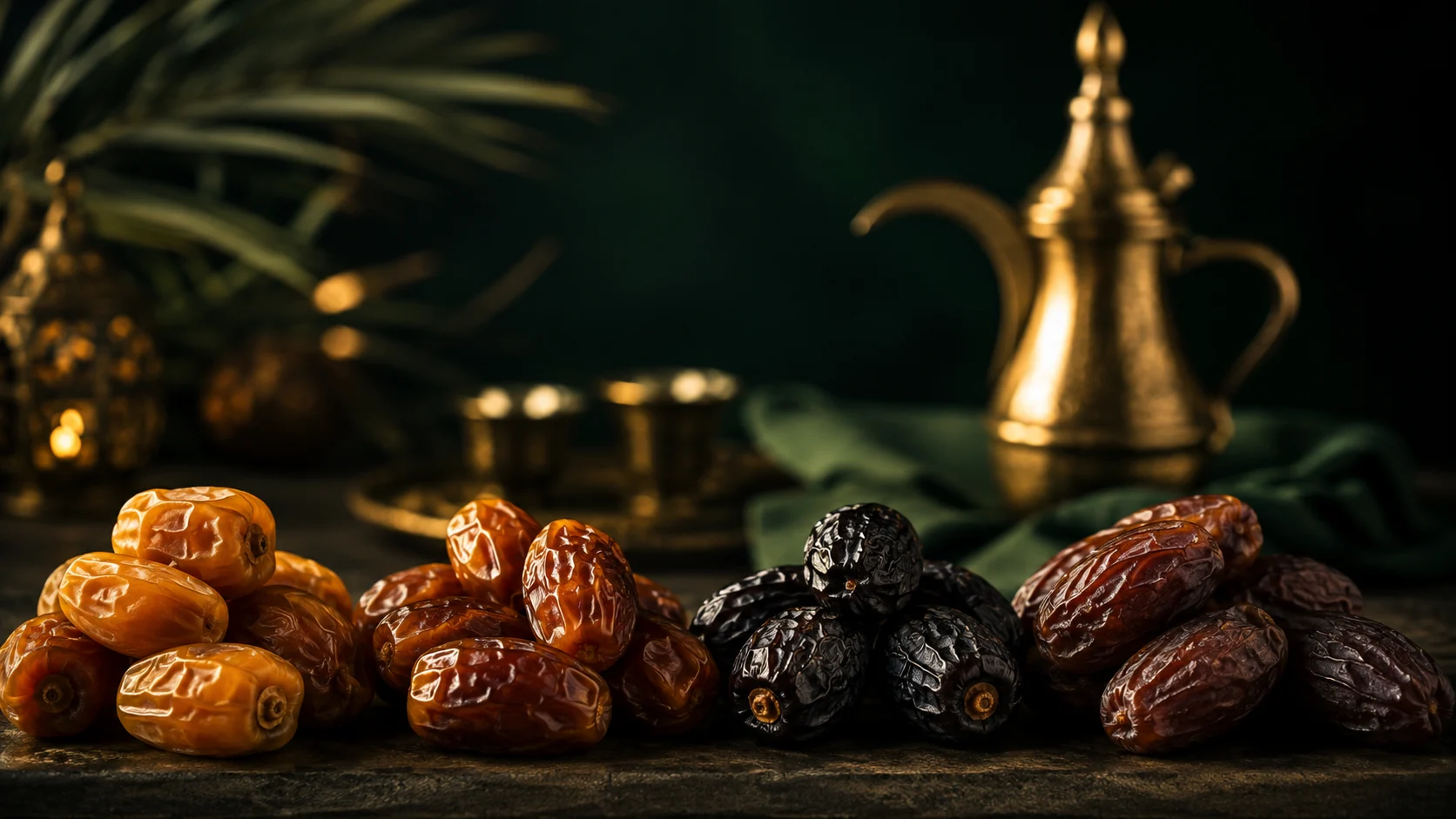
The cup arrives before any conversation begins. Small, handle-less, barely a third full — and next to it, without ceremony or explanation, a date. In Emirati homes, in Qatari majlises, in the corridors of Omani guest houses, the gesture is the same. Nobody asks which date variety was chosen. Nobody explains why. The pairing simply exists, as it has existed for centuries, as though the two were grown for each other.
But they were, in a sense. Arabic coffee — qahwa — is served without sugar. The date provides what the coffee withholds. The balance is not accidental. It is the result of a tradition refined across generations of desert hospitality, where what you offer a guest and how you offer it are among the most considered gestures a household makes.
So which date is best? The honest answer is that no single variety is universally superior. The better answer is that each variety offers something different — and understanding those differences makes the pairing far more intentional, and the experience far richer.
Quick Answer
For most formal Gulf settings, Khalas is the traditional choice — soft, caramel-rich and deeply embedded in Emirati and Gulf hospitality culture. Sukkari suits those who prefer a lighter, honey-sweet melt that dissolves effortlessly between sips. Ajwa, semi-dry and dense with meaning, suits a more meditative pairing, particularly with lightly spiced qahwa. Medjool, large and generously sweet, works well in more contemporary settings or when the coffee itself is deeply aromatic. Each has a place at the table — what matters is knowing which occasion calls for which variety.
Why Dates and Arabic Coffee Were Never Separated
The relationship between qahwa and dates is not a food trend. It is not a styled photograph. It is a functional and cultural bond that developed across the same geography: the Arabian Peninsula, where date palms have grown for at least five thousand years and where coffee arrived from the highlands of Yemen sometime in the fifteenth century, spreading northward through the peninsula and establishing itself as a symbol of welcome.
Arabic coffee — the Gulf version in particular — is deliberately unsweetened. Known as qahwa khaleeji, it is brewed from lightly roasted beans, coloured golden by saffron, perfumed by cardamom, and sometimes deepened with clove or rose water. There is no bitterness of the kind that dark espresso drinkers recognise. The flavour is aromatic, herbal, warm. What it lacks, by design, is sweetness.
Dates fill that role precisely. Rich in natural glucose and fructose, a single date eaten before or alongside a sip of qahwa softens the coffee’s spice, prolongs the aromatic finish, and satisfies the palate without ever competing with what is in the cup. The sweetness arrives, lingers, then recedes — and the next sip of coffee is cleaner for it.
In 2015, UNESCO inscribed Arabic coffee on its Representative List of the Intangible Cultural Heritage of Humanity, recognising the practice — jointly nominated by the UAE, Saudi Arabia, Oman and Qatar — as an expression of generosity, social cohesion, and cultural identity. The date was not incidental to that inscription. It was understood as part of the same ritual.
The tradition carries its own etiquette. The dallah — the long-spouted copper or brass coffee pot — is held in the left hand while the finjan is offered with the right. Coffee is poured in small amounts and refilled until the guest gently shakes the cup to signal they have had enough. The most honoured guest is served first. Dates are placed within easy reach of all. These gestures are not performances. They are the grammar of Gulf hospitality.
Understanding the Coffee Before Choosing the Date
Not all Arabic coffee is the same. The Gulf tradition differs meaningfully from the Levantine version, from the Turkish-influenced coffee of the Hejaz, and from the spiced blends of Yemen. Even within the Gulf, the roast and spice profile shift between households and regions.
In the Eastern Province of Saudi Arabia, coffee tends toward a very light roast with cardamom and saffron, producing a pale gold brew. In the Najd region of central Saudi Arabia, the roast darkens slightly, and cloves may be added. In parts of the UAE, particularly in more traditional families, saffron is generous and the coffee carries a floral warmth. In the north, the roast may be slightly heavier.
This variation matters when selecting a date variety. A very light, floral qahwa calls for a date that does not overwhelm it — something soft, quietly sweet, easy to dissolve. A richer, more spiced brew can carry a slightly chewier, more complex date without the two working against each other.
The temperature of the coffee matters too. Qahwa is served warm, not scalding. Its aromatics are volatile and delicate. Eating a very sweet, sticky date immediately before a sip can coat the palate and mute those aromatics. This is why experienced hosts choose date varieties with moderate sweetness and good texture over dates that are simply the largest or the most expensive.
Khalas — The Date That Belongs to the Gulf
If any variety could claim the title of the Gulf’s official date for qahwa, it is Khalas. Its name in Arabic — خلاص — carries connotations of completion, of something accomplished, something resolved. In practical terms, it is a small to medium date with a reddish-golden skin, a moist and yielding flesh, and a flavour that sits between butterscotch and wild honey, with a whisper of toffee in the finish.
Khalas is grown principally in the UAE — notably in the Al Ain region and the broader Eastern Province — and in Al Ahsa in Saudi Arabia, one of the largest date-producing oases in the world. The variety thrives in the particular combination of extreme heat and mineral-rich alluvial soil that the Hajar Mountains provide. This terroir gives Khalas a subtle earthiness beneath its sweetness, which prevents the flavour from tipping into cloying territory.
At the table, Khalas behaves impeccably alongside qahwa. The flesh is soft enough to dissolve between sips without effort. The sweetness is rich but measured — it satisfies the palate without smothering the cardamom or clashing with the saffron. The slight earthiness in the finish acts as a quiet bridge between the coffee’s spice and the date’s natural sugar.
Khalas is available at different stages of ripeness. The rutab stage — when the date is semi-ripe, soft and syrupy — is considered a seasonal delicacy, served at special gatherings during the harvest months. The fully dried tamr stage, which keeps well and travels easily, is the form most commonly set beside a dallah in everyday hospitality. Both versions pair well with coffee; the rutab simply offers more intensity and less shelf life.
This is the date Emirati families have placed beside coffee pots for generations. It is not celebrated because it is rare or expensive. It is celebrated because it is exactly right for the purpose.
Sukkari — Pure Sweetness from Al Qassim
Sukkari’s name needs no translation. سكري in Arabic means sugary, and the date earns the description entirely. Grown in the Al Qassim region of central Saudi Arabia, in a landscape of limestone plateaus and dry riverbeds, Sukkari is one of the most immediately appealing varieties a new guest to the Gulf is likely to encounter — partly because its sweetness is so accessible, partly because its texture is so forgiving.
At the tamr stage, Sukkari is golden-brown, with a slightly wrinkled skin and a flesh that, at optimal moisture, seems to melt rather than chew. The flavour is intensely sweet, clean, with floral undertones and very little of the deeper complexity found in Khalas. There are no earthy notes, no bitterness, nothing that requires interpretation. Sukkari simply tastes sweet and good.
This directness is both its strength and its particular characteristic. Alongside the subtle aromatics of qahwa, Sukkari works well precisely because it does not compete. It softens, it dissolves, it eases the transition between one sip and the next. For guests unfamiliar with the unsweetened nature of Gulf coffee, Sukkari is often the most welcoming choice — its sugar arrives quickly, settles the palate, and leaves room for the coffee’s spice to reassert itself.
One consideration: Sukkari’s high natural sugar content and relatively soft texture mean it can occasionally feel slightly one-dimensional over multiple servings of coffee. Seasoned hosts sometimes alternate it with Khalas during longer gatherings — Sukkari for the early cups, the richer Khalas as the conversation deepens and the dallah is refilled.
Ajwa — The Date of Madinah, with Its Own Meaning
Ajwa is not simply a date. For many Muslims, it carries a weight that no other variety does. Grown exclusively in the region around Madinah in western Saudi Arabia, Ajwa appears in authenticated hadith — narrations of the Prophet Muhammad ﷺ — and has been valued for its spiritual significance for well over a thousand years. Its cultural identity is inseparable from its place of origin.
In taste, Ajwa is a different experience from Khalas or Sukkari. It is semi-dry rather than moist, denser in texture, with a dark skin that wrinkles distinctively as it dries. The flavour is mildly sweet, earthy, with a hint of prune and a slight bitterness in the skin that actually makes it one of the most complex dates available. It does not dissolve between sips the way Sukkari does. It asks to be tasted more deliberately.
Alongside Arabic coffee, this complexity creates a different kind of pairing — less about immediate contrast, more about a slow, layered exchange. The muted sweetness of Ajwa does not overwhelm the spice of qahwa; instead, the two seem to coexist, each allowing the other its space. For a very lightly roasted, highly aromatic coffee — the pale saffron-gold variety common in parts of the UAE and Eastern Saudi Arabia — Ajwa’s earthiness can feel too assertive. With a slightly richer brew, or one where the cardamom is more pronounced, the pairing becomes more harmonious.
A note on Ajwa and health
Scientific studies, including research published in the journal Food Chemistry, have noted that Ajwa dates contain polyphenols and flavonoids at concentrations higher than many other varieties. This does not make Ajwa a treatment or a medicine — it should not be presented as such, and it does not replace professional medical advice. It does, however, reflect why this variety has attracted both traditional reverence and modern nutritional interest.
For Ramadan, for gifts of particular meaning, for moments when the act of sharing a date carries deliberate intention, Ajwa is rarely substituted. At the qahwa table, it occupies a place of honour — even if, from a purely sensory standpoint, it requires more attention from both host and guest.
Medjool — The Moroccan Traveller at the Gulf Table
Medjool is the variety most immediately recognisable to an international audience. Large, deep amber to mahogany-brown, with a soft and generously chewy flesh — it is the date most often found in European delicatessens, in high-end supermarkets from London to Los Angeles, and increasingly on Gulf tables where its size and visual generosity make it well suited to gift boxes and formal presentations.
Its origins are Moroccan. The Tafilalt region of southeastern Morocco, near the oases of Erfoud and Rissani, is the historic birthplace of the Medjool palm. A disease outbreak in the early twentieth century threatened the variety’s survival, and it was through the careful transport of offshoots to the United States in 1927 — an initiative involving American botanist Walter Swingle — that the variety survived and eventually spread globally. Today, Morocco, Jordan, Israel, California and several other regions produce Medjool commercially, though some specialists note that fruit grown closest to its ancestral oases may retain distinctive qualities.
In flavour terms, Medjool is rich, sweet and deeply caramel in character. Its texture is chewy rather than melt-in-mouth — substantial, satisfying, and slightly more persistent than Khalas or Sukkari. It pairs well with Arabic coffee when the brew is strongly aromatic, because its own flavour is robust enough to stand alongside pronounced cardamom or clove. With a very delicate, pale qahwa, however, Medjool’s sweetness can occasionally feel too assertive — the date becomes the main event rather than a quiet companion to the cup.
Medjool is not a traditional Gulf pairing in the way that Khalas is. It has arrived at the Gulf table partly through trade, partly through the growing date gift industry, and partly because its size makes it visually impressive on formal trays. None of this diminishes it. It is an extraordinary date. But understanding where it comes from — and why it is slightly different in texture and intention from the varieties that grew up alongside Gulf hospitality — helps explain why it sits alongside qahwa as a guest of honour rather than as a native resident.
A Practical Comparison: Which Variety Best Suits Arabic Coffee?
The following table is a reference, not a ranking. Each variety suits a different moment, a different coffee, a different guest. The goal is to understand, not to declare a winner.
| Variety | Origin | Texture | Flavour | With Arabic coffee | Best occasion |
|---|---|---|---|---|---|
| Khalas | UAE, Eastern Saudi Arabia | Soft, moist, slightly chewy | Buttery caramel, toffee, subtle earthiness | Excellent — the classic Gulf pairing | Everyday hospitality, formal majlis, gifting |
| Sukkari | Al Qassim, Saudi Arabia | Very soft, melt-in-mouth | Intensely sweet, honey-forward, floral, clean | Excellent — gentle and effortless | Welcoming new guests, family gatherings |
| Ajwa | Madinah, Saudi Arabia | Semi-dry, dense, chewy | Mildly sweet, earthy, pruny, slight bitterness | Good — suits richer or more spiced qahwa | Ramadan, gifting with meaning, religious occasions |
| Medjool | Morocco (origin), Jordan, global | Large, chewy, substantial | Rich caramel, deep sweetness, robust | Good — suited to aromatic, well-spiced coffee | Gift boxes, contemporary settings, formal trays |
The most commonly served variety in UAE and Gulf homes for everyday qahwa remains Khalas. Sukkari is close, particularly in Saudi households. Ajwa appears most deliberately — it is rarely placed on a tray without intention. Medjool belongs to a slightly more contemporary or formal register, where presentation matters alongside flavour.
How to Serve Dates with Arabic Coffee
The way dates are served is as considered as the choice of variety itself. In traditional Gulf etiquette, dates are placed on a shared dish within easy reach of every guest — not individually portioned, not wrapped, not hidden. The generosity is visible. The invitation is open.
Dates are typically offered before the coffee is poured, or simultaneously with the first finjan. Eating a date first prepares the palate — the sweetness settles before the spiced coffee arrives, and the contrast between the two is then at its most pleasing. Some hosts prefer to place the date alongside the cup so the guest can choose their own rhythm.
The number of times coffee is refilled carries meaning. Three refills is a traditional gesture of welcome. The guest signals they have finished by gently turning the finjan side to side — a small gesture that requires no words. In many Gulf households, this moment is one of the most practised refinements of hospitality: the host reads the cup rather than asking.
Choose the variety
Match the date to your coffee profile: Khalas or Sukkari for light floral qahwa; Ajwa or Medjool for richer, more spiced brews.
Bring to room temperature
Remove dates from the refrigerator at least 30 minutes before serving. Cold dates lose texture and aroma.
Present generously
Place dates on a shared ceramic dish — white or natural-toned — accessible to all guests. A small label indicating the variety is a thoughtful touch for guests discovering the range for the first time.
Offer alongside the first finjan
The date prepares the palate. Let the guest choose whether to eat before or between sips — both rhythms are correct.
The date palm is described in many Islamic traditions as a blessed tree. The tradition of offering its fruit alongside coffee is one of the most enduring expressions of what it means to welcome someone into your home. Whether you serve Khalas or Sukkari, Ajwa or Medjool, what the guest receives is not simply a date. It is an act of generosity shaped by centuries of attention to how people should be made to feel when they arrive.
نسأل الله أن يبارك لكم فيما رزقكم.
Explore the Flavours of Gulf Hospitality
At The House of Meski, we offer premium Emirati and Arabian honeys that share the same terroir as the great dates of the Gulf — raw, traceable, and selected with the same care that goes into every detail of a generous table. Those wishing to explore a considered gift in the spirit of Gulf hospitality are welcome to browse our collection.
Dates and Arabic Coffee: Common Questions Answered
Arabic coffee — particularly the Gulf variety known as qahwa — is served without sugar. Dates provide the natural sweetness that balances the coffee’s spiced aromatics. Their glucose and fructose soften each sip, prolong the aromatic finish, and prepare the palate for the next refill. The pairing is also deeply cultural: both the date palm and coffee have been central to Arabian hospitality for centuries, and serving them together is a gesture of welcome as much as a sensory decision.
Khalas is the variety most closely associated with Gulf coffee culture, particularly in the UAE. Grown in Al Ain and the broader Eastern Province, it has a soft, moist flesh with a buttery caramel flavour that pairs naturally with the cardamom and saffron notes of qahwa. It appears on most traditional hospitality trays and is considered the reference variety for this pairing within Emirati culture.
Yes. Medjool dates — large, chewy and caramel-rich — pair well with Arabic coffee when the brew is aromatic and well-spiced. Their substantial texture and deep sweetness suit a more formal or contemporary presentation. They are not the traditional Gulf choice, but their flavour is compatible with qahwa, particularly when the coffee has pronounced cardamom or clove. For a very light, delicate qahwa, Khalas or Sukkari may produce a more harmonious pairing.
Ajwa dates can be paired with Arabic coffee, though the combination is less immediate than Khalas or Sukkari. Ajwa is semi-dry, dense and mildly sweet, with an earthy complexity and a slight bitterness in the skin. It works best alongside a richer, more strongly spiced qahwa rather than a very delicate pale brew. Its significance in Islamic tradition makes it a considered choice for meaningful occasions — Ramadan, Eid, or gifts with deliberate intention.
Khalas is native to the UAE and Eastern Saudi Arabia. It has a reddish-golden skin, moist flesh, and a buttery-caramel flavour with subtle earthiness. Sukkari comes from the Al Qassim region of Saudi Arabia and is notably softer, almost melt-in-mouth, with an intensely sweet, honey-forward, floral flavour and very little complexity. Alongside coffee, Khalas offers more depth; Sukkari offers more immediate sweetness and a gentler mouthfeel. Both are excellent choices, and many households serve both.
There is no fixed rule. Traditional Gulf hospitality places a generous quantity of dates in a shared dish accessible to all guests, allowing each person to eat at their own pace. For personal servings, two to three dates alongside each round of coffee is a comfortable guide — enough to balance multiple refills without overpowering the palate. The act of placing dates within easy reach of guests, rather than portioning them individually, reflects the open generosity that defines the tradition.
Room temperature is strongly preferable. Chilled dates lose aromatic quality, become firmer, and offer less of the natural sweetness on the palate. Remove dates from refrigerator storage at least thirty minutes before serving. Sukkari in particular benefits from this, as its delicate melt-in-mouth quality is best experienced when the date is slightly warm. Khalas also softens noticeably at room temperature, and its caramel notes become more pronounced.
Qahwa — قهوة — is the Arabic term for coffee, but in Gulf context it refers specifically to a traditional preparation of lightly roasted beans brewed with cardamom, saffron and sometimes clove or rose water. It is served unsweetened, in small handle-less cups called finjans, from a distinctive long-spouted pot called a dallah. Its colour ranges from pale gold to green-tinged amber depending on the roast. It has no resemblance to dark espresso in either taste or intensity. UNESCO inscribed it as intangible cultural heritage in 2015, jointly nominated by the UAE, Saudi Arabia, Oman and Qatar.
May every cup you share bring warmth, good conversation, and the unhurried pleasure of a tradition that knows how to welcome.