
Arabian Lifestyle · Travel & Memory
Muscat:
The City That Did Not Need to Shout
My first arrival in Muscat remains one of my strongest travel memories. Not because the city tried to overwhelm me, but because it seemed to reveal itself slowly, between mountains, sea, old walls and a souq that still knew where it came from.
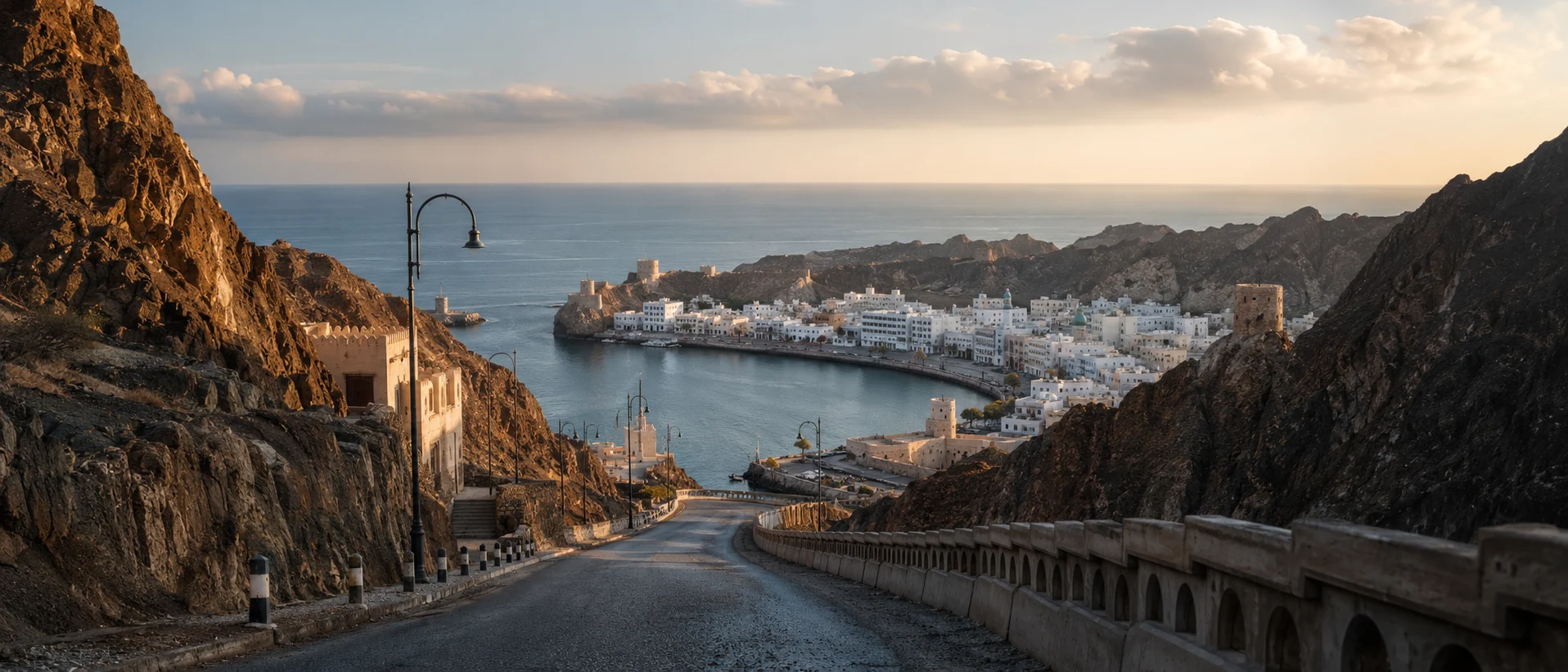
I still remember my first drive into Muscat.
The road passed between the mountains.
At first, there was almost nothing to prepare me for what was coming.
Rock on both sides. The road. The light.
Then the road began to descend.
And little by little, the landscape opened.
Not all at once.
That is important.
Muscat did not appear like a city trying to announce itself from far away.
It revealed itself in pieces.
A glimpse of the sea.
The port.
White and sand-coloured buildings.
The mountains still standing behind everything.
Then Muttrah.
I remember looking around and thinking only one thing:
wow.
“Muscat did not seem to be trying to impress me. Perhaps that is why it impressed me so much.”
Meskaoui
A City You Discover While Descending
Some cities are built around arrival. You see the skyline first. Towers rise in the distance and tell you where to look.
My first experience of Muscat was the opposite.
The mountains controlled the view. The road followed the geography instead of pretending it was not there. As we came down, the city seemed to fit between rock and sea rather than sit on top of them.
That first impression stayed with me because I had already spent time in other Gulf cities. I knew the beauty of modern skylines, wide roads and ambitious architecture. I appreciate them too.
But Muscat spoke another language.
What struck me was not only what had been built. It was what had not been allowed to disappear behind it.
Then the Port Appears
As the road brought us closer to Muttrah, the sea became part of the city.
The old harbour sits below rugged hills. Muttrah Fort still looks down over the corniche and the port, a reminder that this was not simply a pretty waterfront. It was a place that had to be watched and defended.
Experience Oman describes Muttrah Fort as a strategic stronghold protecting the harbour and city, with its position on the rocky hills giving views over the old port.
You do not need to know the dates when you first arrive. The geography already explains part of the history.
Mountains behind you. Sea in front of you. A harbour between them.
Of course people came through here. Of course ships mattered.
The landscape almost tells you before the history book does.
For the official destination background, see Experience Oman: Muttrah Fort.
Muttrah Souq Was the Moment the City Became Intimate
The harbour was beautiful. But the souq is where the city changed scale for me.
Suddenly, you are no longer looking at mountains or a coastline. You are walking through small lanes. Shops sit close to one another. The light changes. Smells arrive before you know which shop they come from. Frankincense, perfume, cloth, spices, wood, old walls.
The official Oman tourism portal still presents Muttrah Souq as one of the principal destinations in Muscat. But what stayed with me was not the fact that it was “a famous souq”.
It was that it still felt like a souq.
Not a shopping centre decorated to resemble one. Not a reconstructed street designed to produce an old photograph.
There were modern things everywhere, of course. People had smartphones. Shops accepted the present. Life had moved.
But the place had not needed to erase its shape in order to move with it.
See the official listing at Experience Oman: Muttrah Souq.
Then I Saw the Telephone Booth
Somewhere inside the souq, I noticed an old telephone booth still standing there.
It made me smile.
Today, almost everyone carries a telephone in their pocket. The booth belongs to another rhythm. Another way of waiting. Another way of calling home.
Yet there it was.
It did not feel like a museum object. It did not seem to be asking people to stop and admire “the past”. It was simply still part of the place.
And I remember thinking that this little telephone booth explained something about Muscat better than a large speech about preservation could.
“Modernity does not always need to cut the thread behind it. Sometimes it can move forward while leaving the thread unbroken.”
Meskaoui
A Telephone Booth as a Transition
Maybe I am giving too much meaning to an old booth.
I do that sometimes.
But travel becomes interesting when a small detail makes you understand a larger feeling.
For me, the booth became a transition.
Before and after. Old and new. Memory and use.
It was still there while the world around it had changed completely. No conflict. No dramatic announcement.
That is what I felt in Muscat more generally. Modernity had arrived. Roads, cars, hotels, shops, technology, new neighbourhoods.
But the relationship with what came before did not seem broken.
What I Did Not See Mattered Too
One of the strongest things about that first visit was the skyline.
Or perhaps I should say the absence of the skyline I had expected.
I did not see a wall of skyscrapers trying to dominate the mountains. The natural relief remained stronger than the buildings around it.
This was my personal impression, not a claim that Muscat has no tall buildings at all. But the visual balance was unmistakable to me.
Muscat Municipality regulates construction through local building rules that include permissible building heights, construction ratios and building materials. Current municipal planning also continues to treat building height as a regulated planning question.
I do not want to reduce Muscat’s character to one regulation. Cities are more complicated than that.
But it helps explain why urban form here feels deliberate rather than accidental.
Muscat Municipality describes these controls in its building regulation guidance.
Preservation Is Not the Same as Freezing a City
This matters to me.
I do not believe tradition means keeping everything exactly as it was. That is impossible.
A living city must change. Families change. Shops change. Roads change. Needs change.
The question is what happens during that change.
Do we add a new layer? Or do we erase the old one first?
Muscat made me think about that distinction long before I had the words for it.
Preservation, at its best, is not an order to stop. It is a way of moving without pretending the road began with us.
The Mountains Are Part of the Architecture
There is another reason Muscat feels difficult to separate from its past: the mountains are always present.
Architecture can change quickly. Mountains refuse.
They frame roads, neighbourhoods, forts and views toward the sea. In Muttrah, the fort itself sits on the rocky hills above the old harbour.
The result is that even new Muscat is constantly in conversation with something older than the city.
That may be why the place never felt artificial to me. The geography does not allow the built environment to pretend it is the entire story.
A Port Always Carries More Than Goods
Once I began learning more about Oman, the port changed meaning for me.
Oman’s history is deeply maritime. The National Museum in Muscat has an entire Maritime History Gallery, as well as an Oman and the World Gallery, reflecting the country’s long connections across the Indian Ocean.
And beyond Muscat, Oman’s archaeological record shows just how old those connections are. UNESCO describes the ancient port of Qalhat as a major commercial centre linking the Arabian Peninsula with East Africa, India, China and Southeast Asia between the eleventh and fifteenth centuries.
So when I look back at the harbour in Muttrah, I no longer see only boats beside a corniche.
I see a country whose coast has been looking outward for centuries.
For deeper historical context, see the National Museum of Oman galleries and UNESCO’s Ancient City of Qalhat.
And That Sea Led to Zanzibar
Oman did not only look toward neighbouring coasts. Its history reached deep into East Africa.
That is where another story begins.
Sayyida Salme bint Said was born in Zanzibar, daughter of Sultan Said bin Sultan, inside an Omani world that stretched across the sea. She later became Emily Ruete and wrote her memories in Europe, partly so her children would know where their mother came from.
Her story is very different from this one. But the harbour makes the connection visible.
Read it in Sayyida Salme: When Home Becomes a Memory.
Muscat Made Me Think About What Progress Means
We often describe progress as replacement.
New replaces old. Faster replaces slower. Glass replaces stone. A mall replaces a market. A smartphone replaces a telephone booth.
Sometimes that is necessary.
But Muscat showed me another possibility.
The new thing can arrive without demanding that every trace of the previous one disappear.
This is not nostalgia. I do not want to live without modern roads, hospitals, communications or technology.
The point is not to choose yesterday instead of today.
The point is to reach today without becoming unable to recognise yesterday.
Why This Stayed With Me
Many trips leave photographs.
A few leave an idea.
My first journey into Muscat left me thinking about continuity.
At the time I did not connect it to MESKI. The House of Meski did not yet exist in the form it has today.
But looking back, I recognise the same question.
What can we carry forward without turning it into decoration?
A family memory. An old recipe. A souq. A building. A telephone booth nobody needs anymore.
Maybe preservation begins when we stop asking only whether something is still useful and start asking whether it still carries meaning.
“Our ancestors lit the flame. I will do everything I can to keep it burning.”
Meskaoui
The Muscat I Remember
I remember the mountains first.
Then the descent.
The city slowly appearing. The sea. The harbour. Muttrah. The small streets of the souq.
And that old telephone booth.
It is strange what survives from a journey.
Sometimes the grand monument becomes a photograph on a phone. A tiny detail becomes the thing you carry home.
For me, that booth still stands somewhere between two times.
Perhaps Muscat does too.
Not trapped between them.
Connecting them.
Muscat, Muttrah and Omani Heritage
Muscat has its own geography and urban character, with mountains running through the city, historic districts such as Muttrah and building regulations that control factors including height and materials. This article describes the author’s personal impression of that balance rather than ranking Gulf cities against one another.
Muttrah Souq is a historic market area in Muscat near the corniche and old harbour. It remains one of the city’s best-known traditional commercial districts.
Muscat has modern multi-storey buildings, but its urban form is generally much lower-rise than the skylines associated with several other Gulf cities. Muscat Municipality regulates building heights and other architectural and construction requirements by area and use.
Muttrah developed around a protected harbour and long-standing commercial activity. Its fort occupies the rocky heights above the old port and historically served to protect the harbour and city.
Yes. Oman developed major political, commercial and family connections with East Africa, including Zanzibar. In the nineteenth century, Sultan Said bin Sultan’s realm linked Oman and Zanzibar within the Al Busaidi political world.
Oman Is More Than a Destination
Continue from the city into the people and memories carried across the sea.