
Arabian Lifestyle · Old Dubai
Naif, Deira and
the Dubai I Never Get Tired of Walking Through
Behind the skyline is another Dubai: one-dirham boats, crowded lanes, spice, perfume, food and the kind of wealth you only notice when you slow down.
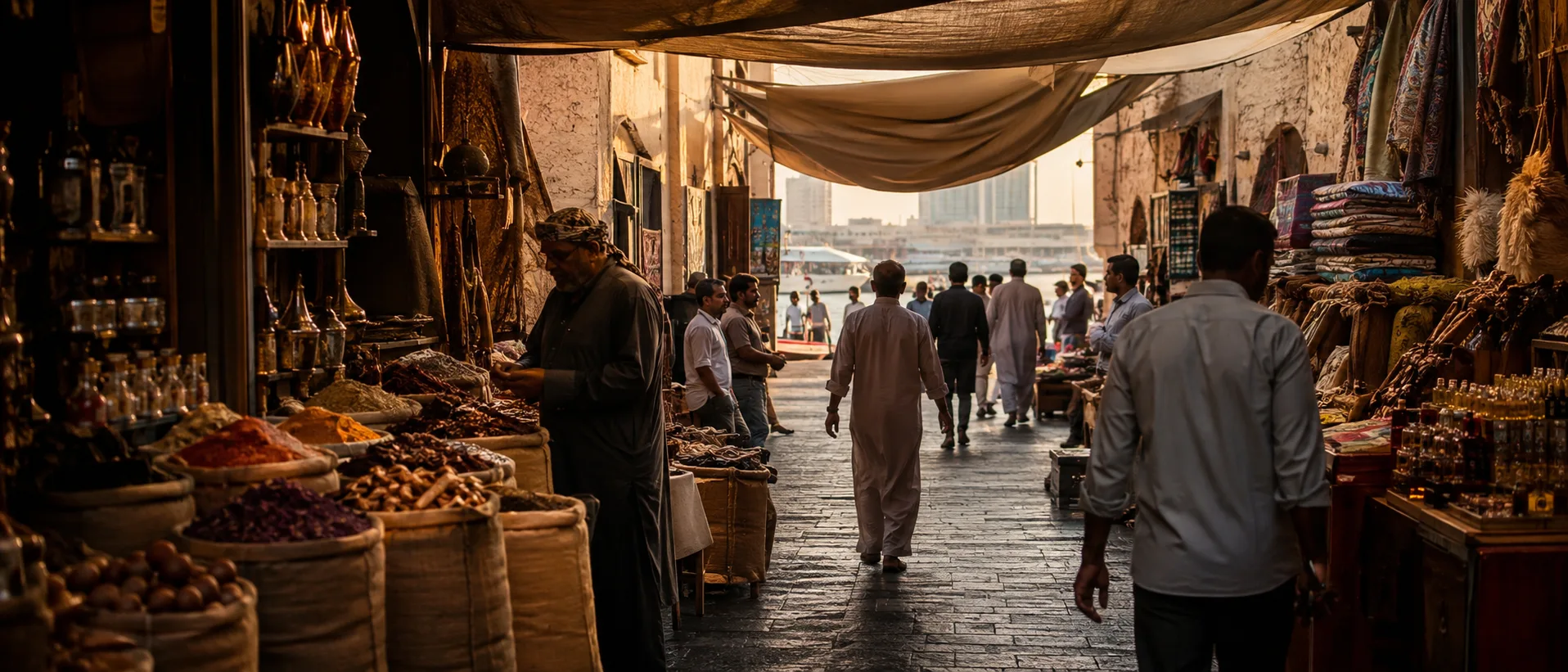
There are parts of Dubai that announce themselves from kilometres away.
Naif does not.
You have to enter it. Walk. Turn without knowing exactly where you are going. Pass a shop selling fabric, then perfume, then something practical you did not know anyone still repaired by hand. Smell a restaurant before you see it.
This is one of the parts of Dubai I never get tired of walking through, because its richness is not concentrated in one monument. It is hidden at almost every corner.
“Some cities show you their wealth from a distance. Old Dubai makes you walk close enough to smell it.”
Meskaoui
Naif Was a Market Before Dubai Became a Global Shopping Capital
Visit Dubai describes Naif Souk as one of the city’s oldest bazaars and notes that the area once functioned as a camel market. Today, more than a hundred shops and stalls sell clothing, textiles, electronics, perfumes and leather goods.
I like knowing that history, but I do not walk through Naif looking for a museum. That would miss the point.
The attraction is that commerce is still alive. People are buying things they need. Shops are opening and closing. Deliveries move through narrow streets. Someone is discussing a price. Someone else is carrying dinner home.
Old does not mean frozen.
One Dirham Can Change Your View of Dubai
One of my favourite small experiences is still the abra.
For AED 1 on the traditional Creek routes currently listed by Dubai RTA, you can move between Bur Dubai and Deira in a wooden boat that puts you almost at water level. It takes only a few minutes, but the city feels different from there.
I like that contrast. Dubai can build some of the most technologically ambitious spaces in the world and still keep a tiny boat crossing that people actually use.
The abra is not important because it is cheap. It is important because it keeps the Creek functioning as a connection rather than only a view.
I Walk Here With My Nose as Much as My Eyes
Spices are part of the pleasure. You can follow saffron, dried lime, tea, herbs and mixtures whose names you may not know yet. Visit Dubai itself describes Deira’s Spice Souk as a sensory place, and that description is accurate.
But there is another smell I always associate with these streets: perfume.
I can spend time moving from one perfume shop to another, smelling oud, musk, amber, rose and blends that change from shop to shop. The best moment is when a seller starts adjusting a perfume rather than simply handing over a finished bottle.
A little more wood. Less sweetness. Something warmer. Something that stays longer on the skin.
You leave with a scent, but also with the memory of how it was made for you.
Then I Become Hungry
This usually happens quickly.
One of the reasons I like old commercial districts is that food is mixed into everything else. You can stop in a traditional restaurant without needing the meal to become an event. You sit, eat and continue walking.
Sometimes I discover something simple and unexpected. Camel-milk ice cream is one of those pleasures I remember because it belongs perfectly to the kind of afternoon I like here: no complicated plan, just curiosity.
That is the luxury of walking without trying to complete a checklist.
Old Dubai Is Not the Opposite of Modern Dubai
I do not like the idea that you must choose between the two.
The towers are Dubai. The malls are Dubai. The new neighbourhoods are Dubai. So are the abra drivers, the small restaurants, the old trading streets, the perfume shops and the merchants who have watched Deira change around them.
A city is more interesting when its different periods can still speak to each other.
For me, Naif and Deira matter because they prevent Dubai from becoming only one image. They remind you that before the city became a global destination, it was already a place of trade, movement, bargaining, food, scent and arrival.
What I Would Actually Do on a First Walk
I would not build an hour-by-hour itinerary. I would cross the Creek by abra, walk toward the old souks, let the streets pull me a little off course, smell spices, enter at least one perfume shop and eat when something smells good.
If you want to buy something, take your time. Compare. Ask where it comes from. Let the seller explain it.
And if you buy nothing, the walk has not failed.
Old Dubai is one of those places where looking, smelling, listening and eating can already be enough.
A Walk Is Sometimes the Souvenir
Years later, I may forget the name of a shop.
I usually remember the smell.
I remember the small boat, the heat outside, the cold air when I entered a perfume shop, a plate I had not planned to eat, and the feeling that there was always another street worth turning into.
That is why I return.
Questions People Ask
Yes if you enjoy busy local commercial streets, textiles, perfumes, leather goods and a less polished side of Dubai. It is not a luxury mall experience and that is exactly its interest.
Visit Dubai describes Naif Souk as one of Dubai’s oldest bazaars and a former camel market.
Dubai RTA currently lists AED 1 per passenger on the classic motorised traditional abra routes between Bur Dubai, Deira Old Souq, Dubai Old Souq and Al Sabkha.
Cross the Creek, walk without rushing, explore the spice and perfume areas, eat in a traditional restaurant and pay attention to the working life of the neighbourhood rather than treating it only as a photo stop.