
Arabian Lifestyle · Taste of Qatar
Traditional Qatari Food:
The Dishes That Tell the Story of Qatar
Machboos, saloona, harees and the shared gestures around them tell a larger story of sea routes, family, spice and hospitality.
I can read a menu and learn the name of a dish.
That is not yet the same as understanding a meal.
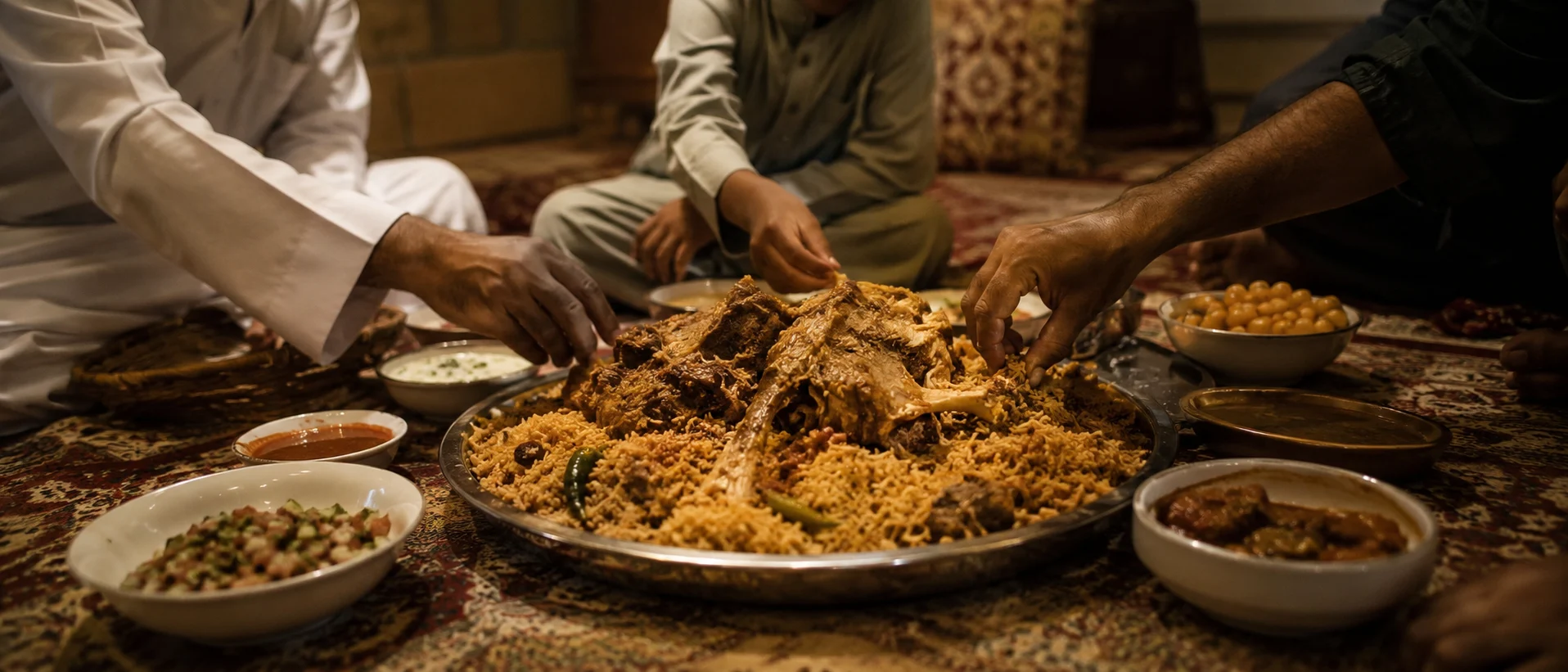
In Qatar, what stays with me most is often rice. Long grains, steam, meat, spice, the smell that escapes when the dish is opened. I love that kind of rice cooked slowly and enclosed, what I would naturally describe in French as à l’étouffée.
And when the setting allows it, I prefer eating with my fingers.
Not because a spoon is wrong. Because sometimes I want the gesture too.
Machboos Is the Place to Begin
Visit Qatar identifies machboos, also written majboos, as the national dish: rice cooked with meat and aromatic spices.
The exact preparation changes from kitchen to kitchen. Lamb or chicken are common, and the rice carries the flavour of the meat, stock and spices rather than sitting beside them as an afterthought.
This is the kind of food I naturally move toward. I like rice when it has absorbed something. Steam. Fat. Spice. Time.
When the platter arrives, I do not need decoration around it. The smell is already the invitation.
“A dish teaches me more when I stop asking only what is in it and begin noticing how it is shared.”
Meskaoui
Why I Sometimes Leave the Spoon Alone
When I am eating in a setting where it is appropriate, especially with a shared rice dish, I often prefer my fingers.
This is personal. I am not saying every Qatari eats every meal this way, and I would never turn someone else’s table into a performance of authenticity.
For me, the gesture changes the attention I give the food. I feel the rice, gather the amount I want, notice the texture differently and slow down.
It is a small form of immersion. If I travel only to reproduce exactly the way I eat at home, I leave part of the journey untouched.
Saloona: When the Spice Moves Into the Stew
Saloona is a tomato-based stew associated with cardamom, cloves, ginger and black dried lime. It can contain meat and vegetables and belongs to the comforting side of Qatari cooking.
Black lime matters because acidity in Gulf food does not always arrive as fresh lemon squeezed at the end. Dried lime gives a deeper, slightly fermented citrus character that moves through a dish rather than sitting on top of it.
It is one of those ingredients that can make a visitor recognise a flavour before knowing its name.
Margoog and Harees Explain Why Texture Matters
Margoog combines meat, vegetables and pieces of whole-wheat dough in a stew. Harees moves in another direction: wheat is cooked and worked with meat until the distinction between grain and meat becomes almost a texture rather than separate ingredients.
These are not dishes designed around visual separation. They are built through cooking together.
That tells you something important about traditional food. A dish can be generous without needing ten components placed separately on a plate.
Balaleet and Luqaimat Show Another Side of the Spice Cabinet
Qatari food is not only rice and meat.
Balaleet combines sweetened vermicelli with aromatics such as cardamom, saffron, rosewater and turmeric, often topped with egg. Luqaimat are fried sweet dumplings commonly scented with cardamom and saffron and finished with syrup.
The same spice cabinet therefore moves between savoury dishes, coffee and sweets. Cardamom does not belong to one course. Saffron does not have to choose between rice and dessert.
Qatari Cuisine Carries the History of Movement
Visit Qatar describes the cuisine as shaped by influences from India, Persia, Lebanon and North Africa. That makes sense in a peninsula connected for generations to maritime trade.
I like this because it breaks a false idea of tradition. Tradition is not always purity. Sometimes tradition is what happens when influences arrive, are adopted, adjusted and repeated long enough to become part of home.
Rice itself tells that story. So do spices.
A country’s food can be local and connected to the world at the same time.
My Palate Does Not Taste the Gulf as One Cuisine
After eating across Qatar, Oman, the Emirates and Saudi Arabia, I do not experience the spice profiles as identical.
This is only my palate, not a scientific map of national cuisines. Oman often feels a little more willing to move toward heat for me. Emirati food can feel rounder, sometimes lightly sweet-spiced. Qatar often gives me a more balanced, quieter spice profile. Saudi food can move between several of those sensations depending on the region and dish.
Someone else may describe the same meals differently.
That is fine. Taste becomes interesting precisely because memory participates in it.
Do Not Search Only for the Most Famous Dish
If you visit Qatar, eat machboos. It deserves the attention.
But also order something you do not recognise. Try a stew. Taste harees. Notice dried lime. Drink karak even if it is not a formal part of the meal. Eat something sweet after.
And pay attention to what surrounds the plate: whether the food is shared, what arrives first, what is offered again, who insists that you eat more.
Cuisine is not only a list of recipes.
It is behaviour around food.
The Dish I Remember Is Often the One I Touched
There is something very direct about rice eaten with the hand.
The heat tells you to wait. The texture tells you how much to gather. The spice stays on the fingers for a moment after the bite is gone.
Maybe that is why I remember those meals so clearly.
Seeing a tradition is not feeling it.
Sometimes feeling it begins with something as simple as deciding not to pick up the spoon.
Questions People Ask
Visit Qatar identifies machboos, or majboos, as Qatar’s national dish. It is a rice dish prepared with meat and aromatic spices.
Machboos, saloona, harees, margoog, balaleet and luqaimat are useful starting points for understanding different sides of Qatari cuisine.
It is aromatic, but heat level varies by dish and cook. Common flavours include cardamom, cumin, cloves, saffron, ginger and black dried lime. Do not assume every traditional dish is hot.
Hand-eating exists in Gulf food traditions, especially in some shared-meal settings, but practices vary by family, dish and occasion. This article’s preference for eating rice with the fingers is Meskaoui’s personal experience, not a rule for visitors.