
Arabian Lifestyle · Food & Travel
Why I Look for Traditional Restaurants
When I Travel the Gulf
I travel with an appetite for the food people actually return to: rice, slow-cooked meat, camel, spice, coffee and the unexpected combinations that stay in memory.
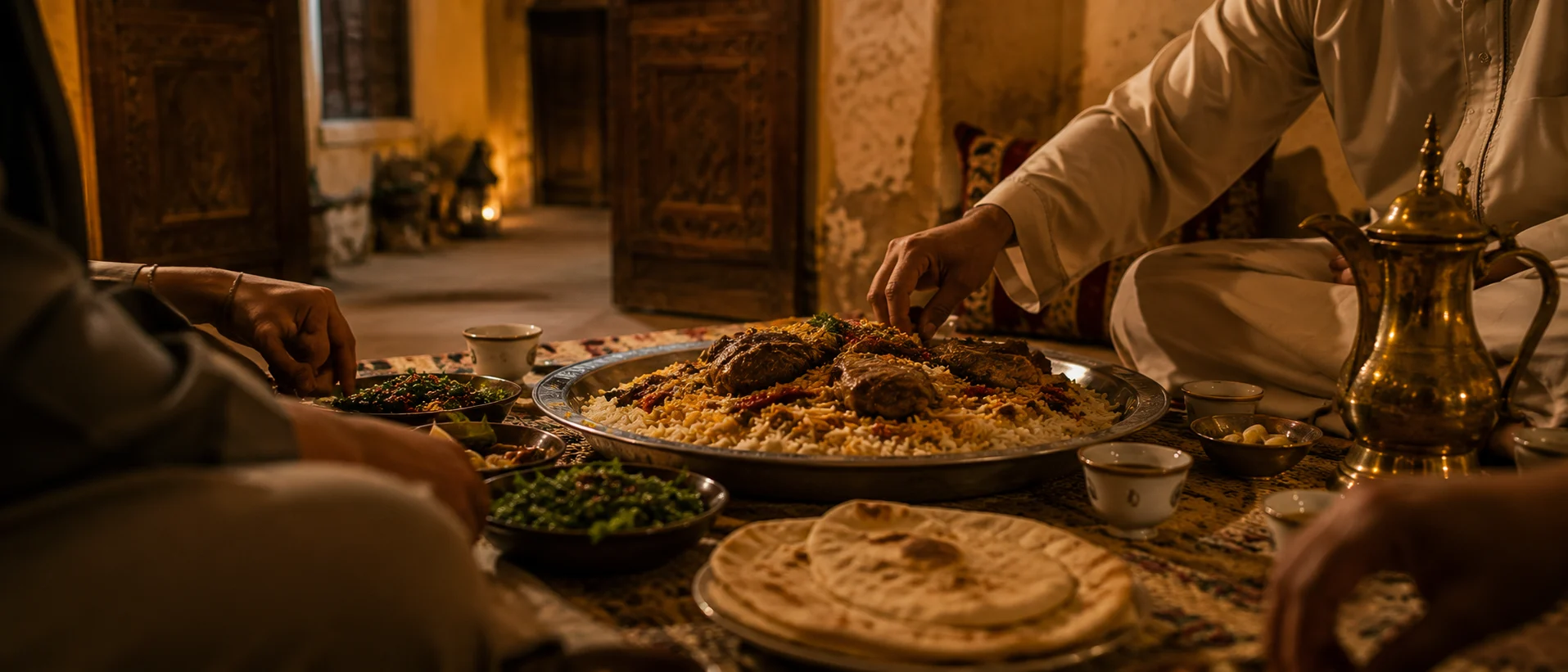
When I arrive somewhere in the Gulf, I can spend more time looking for a restaurant than looking for a monument.
Not because I need the perfect restaurant.
I am looking for the local one.
In the Emirates, Qatar, Oman or Saudi Arabia, I naturally search for the food that belongs to the place. Sometimes it is expensive. Often it is not. Sometimes the room is beautiful. Sometimes the plate is the only decoration that matters.
I want to leave having tasted something I could not have understood from a photograph.
“When I travel, I do not want only to see a country. I want to feel it. A photograph can show me a place; only its people and traditions can teach me what it feels like to be there.”
Meskaoui
The Emirati Lamb I Did Not Expect to Cover With Honey
One day I found myself in a traditional Emirati restaurant with lamb in front of me.
The meat was already excellent. Then small bowls of honey arrived.
The idea was to pour the honey over the lamb and eat them together.
I remember the surprise more than anything. Sweetness, meat, fat and spice met in a way I had not expected. The flavour was extraordinary to me.
I am careful with this story because it was one restaurant and one meal. I am not saying that pouring honey over lamb is a universal Emirati custom. I am saying that a traditional restaurant gave me a combination I still remember, and that is exactly why I seek these places out.
Camel Meat Is One of the Flavours I Actively Look For
Camel meat is probably my favourite meat experience in the region when it is cooked well.
The flavour can be more pronounced than the meats many travellers eat every week. But what surprises me is the texture when it has been cooked patiently.
It can become almost buttery.
That contrast is what I love: a strong identity in flavour, then tenderness on the plate.
The word traditional matters less to me than whether the cook knows what to do with the ingredient.
Qatar: Rice Can Be Enough to Make Me Happy
In Qatar I return again and again to rice and meat.
I love long-grain rice cooked slowly enough that steam, stock and spice move through it. When the setting is appropriate, I like eating it with my fingers rather than taking a spoon.
It changes the meal for me.
This is a personal preference, not a rule of Qatari etiquette. I do it because the gesture makes me pay closer attention to texture and heat. I want immersion, not theatre.
Visit Qatar describes machboos as the national dish and Qatari cuisine more broadly as a food culture shaped by shared dishes and old trade connections.
Oman: My Palate Often Finds a Little More Heat
Omani cooking has surprised me through its diversity. Experience Oman describes a cuisine shaped by Arabian and Indian-subcontinent influences, including dishes such as mishkak, shuwa, harees and qabooli.
To my palate, Omani spice sometimes moves a little closer toward chilli and heat than what I often experience elsewhere in the Gulf.
That is not a national formula. A family in Muscat, a restaurant in Nizwa and a kitchen in Dhofar can obviously taste very different.
But as a traveller, repeated impressions become part of memory, and this is one of mine.
The Emirates Feel Rounder to Me
When I think of many Emirati meals I have enjoyed, I often remember a rounded profile: spice, meat, rice, sometimes a quiet sweetness.
I used the word nobility when describing it once, because the flavours can feel restrained rather than aggressive.
Again, that is my palate speaking.
Cuisine is too diverse to be reduced to one national adjective. But personal writing becomes empty if I pretend I do not notice differences.
Qatar Often Feels Balanced, Saudi Arabia Moves Between Worlds
Qatari food often feels more balanced and neutral in spice intensity to me, especially in the rice and meat dishes I seek out.
Saudi food is harder for me to place under one description because the country itself contains enormous regional variety. Some meals remind me of the rounded Gulf profiles I associate with the Emirates. Others move closer to the stronger spice or heat I notice in Oman.
Saudi Arabia’s own coffee traditions change across thirteen regions, and food is no less regional.
So I keep tasting instead of trying to finish the map.
Traditional Does Not Have to Mean Expensive
One of the best parts of eating around the Gulf is the range.
There are polished heritage restaurants, hotel interpretations, family restaurants, tiny dining rooms and inexpensive places where the food arrives on a large tray with no attempt to turn tradition into luxury.
I have eaten memorable food at very different prices.
Price can pay for service, location, ingredients and design. It cannot guarantee that the meal will teach you anything.
How I Choose When There Are Too Many Restaurants
There are so many restaurants in Dubai, Doha, Muscat, Riyadh and Jeddah that choosing can become absurd.
I usually narrow the search by asking a different question: what food from this place have I not tasted yet?
Then I look for a restaurant that actually specialises in it. I read the menu. I look at what people seem to order repeatedly. I prefer places where local dishes are the centre of the menu rather than one token section beside thirty international options.
And when possible, I ask someone who lives there.
A Restaurant Is One of the Fastest Ways Into Everyday Culture
Museums explain. Restaurants repeat.
That repetition matters. A dish survives because somebody keeps cooking it and somebody keeps wanting to eat it.
The table also shows things a recipe cannot: how food is shared, what comes before it, what people drink, whether someone insists you take another piece, what is eaten with the hand and what is not.
That is why I keep searching for traditional restaurants.
I am hungry, of course.
But I am also trying to understand where I am.
The Meal Becomes Part of the Map
Years later, I may confuse the road I took to a restaurant.
I rarely confuse the dish that surprised me.
The honey on lamb. The camel meat. The rice gathered with my fingers. The spice I did not expect.
Those flavours become landmarks too.
Questions People Ask
There is no single Gulf cuisine. A useful traditional restaurant is one that gives serious space to the local or regional dishes of its country rather than using heritage only as decoration.
The UAE, Qatar, Oman and Saudi Arabia all have local restaurants at different price levels. Tourism authorities in Qatar and Oman maintain cuisine pages and restaurant suggestions, but local recommendations are also valuable.
Camel has a long regional history and appears in some Gulf dishes and restaurants, but frequency varies by country, household and establishment. This article describes Meskaoui’s personal preference, not a claim that it is eaten daily everywhere.
The article describes one Emirati restaurant experience. It does not claim that serving honey with lamb is a universal Emirati custom.