
Arabian Lifestyle · Faith & Daily Life
When the Adhan Changes
the Rhythm of the Gulf
Doha, Dubai, Muscat and Saudi cities do not share one identical clock. Yet when the call to prayer rises, I recognise the same quiet change in the day.
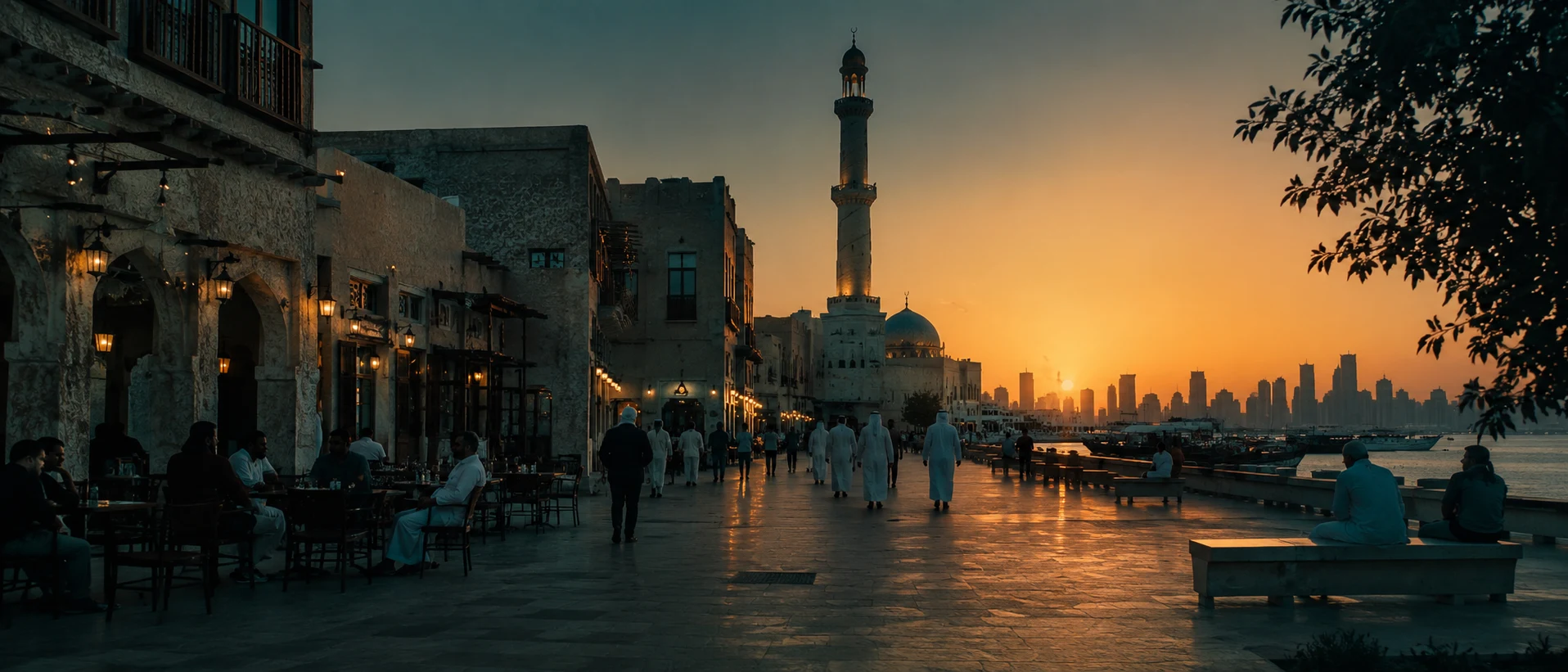
There is a moment in the Gulf when the city seems to change without stopping.
A few seconds earlier, people are eating, talking, driving, shopping, working.
Then the adhan begins.
In Qatar, the Emirates, Oman or Saudi Arabia, I have felt that shift many times. One mosque begins, another answers from farther away, then another sound reaches you from a different street.
The exact prayer times are not identical from country to country, or even from city to city. They change with location, date and the movement of the sun.
But the feeling is familiar to me.
The day suddenly remembers what time it is.
Prayer Is Not Hidden From Daily Life
One of the things that strikes me in the Gulf is how naturally prayer sits inside ordinary movement.
The adhan is not confined to a religious district. You can hear it near a restaurant, a mall, an office, a road or a market. The city does not have to become silent for the call to be present.
I have been in restaurants when the prayer time arrived and watched the rhythm change. Some people continued what they were doing. Some prepared to pray. Some moved toward a nearby mosque. In certain places, staff prayed when their work allowed.
I do not present one observation as a rule for every restaurant or every country. What stays with me is simply that prayer is visible as part of life rather than something carefully separated from it.
Five Times a Day Means Time Is Experienced Differently
For Muslims, the five daily prayers are tied to periods of the day rather than one fixed clock schedule that remains unchanged all year.
That matters if you are travelling. Fajr, Dhuhr, Asr, Maghrib and Isha move through the year, and their exact local times depend on geography and date.
Official authorities therefore publish local schedules. Qatar’s Ministry of Endowments and Islamic Affairs displays Doha prayer times. Oman’s Ministry of Endowments and Religious Affairs provides city-based schedules. Saudi Arabia’s Ministry of Islamic Affairs provides times according to the Umm al-Qura calendar, and the UAE’s General Authority of Islamic Affairs provides a prayer-time service.
For exact worship times, those official local sources matter more than a static travel article like this one.
“The adhan does not make me feel that life has stopped. It reminds me that life has a rhythm larger than my own.”
Meskaoui
What I Hear Is Not Perfect Synchrony, but a Shared Direction
From a distance, the calls can feel almost simultaneous.
In reality, small differences exist. Mosques may begin moments apart, and cities across the Gulf do not share one identical timetable.
I actually find that more beautiful.
The unity is not mechanical synchronisation. It is millions of people orienting their day around the same prayers while living in different streets, cities and landscapes.
Muscat is not Doha. Doha is not Dubai. Riyadh is not Jeddah. Yet the sequence of the day remains recognisable.
Why It Calms Me
I cannot explain this with SEO language.
The adhan simply calms me.
Maybe it is repetition. Maybe it is the reminder that whatever I am doing is not the only thing happening. Maybe it is because the sound has accompanied so many different moments of my life in the Arab world.
You can be worried, busy, hungry, late, excited or lost in thought. The call arrives without asking what kind of day you are having.
There is something peaceful in that consistency.
Restaurants Reveal the Rhythm Especially Well
I notice prayer time strongly in restaurants because food creates its own rhythm.
Plates arrive. Tea is poured. People talk. Kitchens move quickly. Then the adhan enters that space.
In some traditional places, you become more aware that eating, hospitality and prayer belong to the same daily life. They are not separate cultural exhibitions.
This is also why I prefer spending time in places where local life is actually happening. A cultural practice makes more sense when you encounter it between ordinary actions.
Ramadan Makes the Relationship With Time Even More Visible
Ramadan intensifies the way time, worship and food meet.
Visit Qatar, for example, describes how daily life changes around fasting, iftar and the evening prayers, with public spaces becoming especially active after sunset. Taraweeh prayers follow Isha during the month.
But the point of this article is not only Ramadan.
The five daily prayers remain part of the year when the decorations are gone and the special menus disappear. That ordinary continuity may be even more revealing.
A Visitor Does Not Need to Perform the Moment
If you are not Muslim and you hear the adhan while travelling, you do not need to turn the moment into a spectacle.
You can simply notice it. Lower your voice where appropriate. Respect people who are praying. Follow the rules of a mosque if you visit one.
If you are Muslim and need an exact prayer time, check an official local source rather than relying on memory from another country or another month.
Respect can be very simple.
The Gulf Has Many Clocks at Once
There is the clock of work.
The clock of traffic.
The clock of the mall.
The clock of the airport.
And there is the movement of the day marked by prayer.
What I love is that modern life has not made the last one disappear.
A phone can tell me the time. A minaret can make me feel it.
Questions People Ask
No. Prayer times depend on location, date and solar position, so they vary between cities and across the year. Use official local prayer-time services for exact times.
Qatar’s Ministry of Endowments and Islamic Affairs, Oman’s Ministry of Endowments and Religious Affairs, Saudi Arabia’s Ministry of Islamic Affairs and the UAE General Authority of Islamic Affairs all provide official or government prayer-time services.
The adhan is the Islamic call to prayer. It announces the prescribed daily prayer periods and is heard from mosques in Muslim communities around the world.
No. Daily practice varies by place, business, country and circumstance. This article describes the author’s observations of shifts in rhythm, not a rule that every activity stops.