
Before the towers wake, another UAE is already moving.
Before sunrise, the desert is already awake
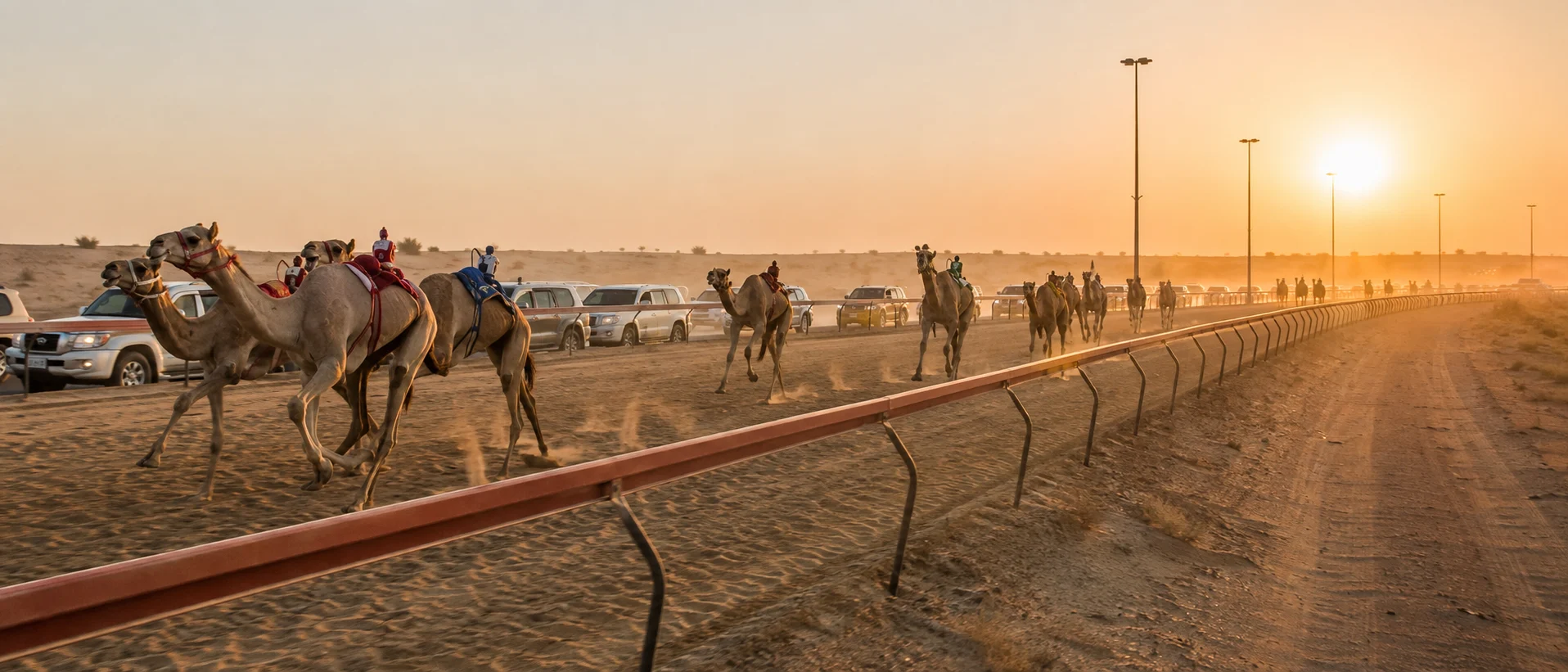
The first mistake is to arrive at a camel race expecting a show that has been arranged for visitors. The second is to arrive late. Camel racing in the UAE belongs to the early hours, when the air is cooler, the desert light is still soft and the people who know the sport have already been awake for a long time. At Al Marmoom in Dubai or Al Wathba outside Abu Dhabi, the morning can begin with trucks moving beside the track, handlers preparing animals, owners watching closely and camels that seem almost too calm for the speed they are about to produce.
There is something I like about seeing the UAE at this hour. The towers are far away, the malls have not opened, and the country is not asking to impress anyone. You hear engines, voices and the movement of animals. Coffee appears because coffee always seems to find its place in these moments, and dates are never far from the world of hospitality. The scene feels modern and old at the same time, which is perhaps the best way to understand camel racing here.
For a visitor, the first surprise is often speed. A camel at rest can look unhurried, almost philosophical. On a racing track that impression disappears very quickly. The animal stretches into a long, powerful rhythm while vehicles follow on the service road and trainers communicate with the small robot jockey fixed to its back. It is one of those UAE scenes where tradition has not been frozen in a museum. It has adapted, acquired radios, remote controls, engines and technology, and continued moving.
A sport that existed before it became an industry
Camel racing did not begin with grandstands, prize money or organised racing calendars. Camels were woven into life across the Arabian Peninsula long before the modern UAE existed. They carried people and goods, connected settlements, provided milk and represented wealth, endurance and status. Informal races could accompany weddings, gatherings and celebrations. The pleasure of comparing animals, speed and breeding existed before professional tracks turned that pleasure into a major heritage sport.
After the formation of the UAE, organised camel racing received strong institutional support and purpose-built tracks spread across the country. That development changed the scale of the sport. What had once been local competition and social entertainment became a structured racing world involving breeders, trainers, owners, festivals and valuable prizes. Yet money alone does not explain why families remain attached to it. If it did, the majlis beside the track would be difficult to explain, as would the elderly men who remember earlier races and the younger generation learning names, bloodlines and habits from them.
A living tradition survives because somebody still cares enough to wake before sunrise for it. That may be the most useful distinction between heritage and decoration. Decoration can be installed. Heritage has to be practised.
Al Marmoom: another Dubai beyond the skyline
Al Marmoom is important to me for the same reason Hatta is important when talking about Dubai: it breaks the lazy picture of the emirate. Dubai is Burj Khalifa, Sheikh Zayed Road, Marina and the Palm, of course. But Dubai is also desert, camel farms, racing tracks and mornings when the most important machine in sight is not a supercar but a pickup trying to keep pace with a racing camel.
The Dubai Camel Race Track at Al Marmoom is one of the places where visitors can encounter this heritage sport. The experience is very different from buying a ticket for a conventional stadium event. The rhythm is dictated by the racing programme and by the people involved in the sport, not by a tourist performance schedule. Arriving early matters because the preparation, gathering and atmosphere around the races are part of what makes the morning memorable.
I would not go there looking only for a photograph of a camel crossing a finish line. I would watch everything around it. The men studying the animals, the handlers, the vehicles lining up beside the course, the conversations before a heat, the sudden acceleration when the race begins and the quiet that returns afterward. The track is only the centre of a much larger social world.
Al Wathba: Abu Dhabi’s racing landscape
About 45 kilometres east of Abu Dhabi city on the road toward Al Ain, Al Wathba offers another major window into UAE camel racing. Experience Abu Dhabi recommends arriving early, and that advice makes sense even beyond practical timing. The cooler morning belongs naturally to the animals and to the culture surrounding the track. Al Maqam near Al Ain provides another place to encounter the sport, reminding us again that camel racing is not confined to one famous venue.
Al Wathba also helps explain the scale camel racing can reach. Major festivals have brought together thousands of racing camels and large numbers of owners, trainers and spectators. Yet the size should not distract from the smaller details. A trainer knows his animal. A family follows its camel. A name carries memories of previous races. A result can matter deeply because years of breeding, feeding, exercise and care sit behind a few minutes on the track.
When people describe camel racing only as an old Bedouin sport, they tell half the story. It is Bedouin heritage, but in the UAE it is also a contemporary competitive ecosystem. Tradition did not stop at the edge of the asphalt. It learned how to drive beside it.
The camel before the race
A racing camel is not simply taken from the desert and asked to run. Breeding, conditioning, diet, veterinary attention and training matter. Owners and trainers learn to read physical qualities and temperament, and the preparation of a promising animal can take years. Racing distances vary with age and category, which means the animal’s development is managed over time rather than treated as a single event.
This is where the romantic image of the camel meets the discipline of sport. The animal must be exercised, monitored and prepared. The people around it need patience. A winning morning may last only minutes, but it rests on countless ordinary mornings that nobody photographs. Feeding. Walking. Training. Checking. Waiting. Starting again.
That patience feels familiar in the desert. Date palms also ask for time. Bees ask us to wait for flowering seasons. Animals cannot be rushed simply because humans have a calendar. The environment teaches its own rhythm, and camel racing, despite all its modern technology, still depends on respecting the body and development of the animal.
The robot on the camel’s back
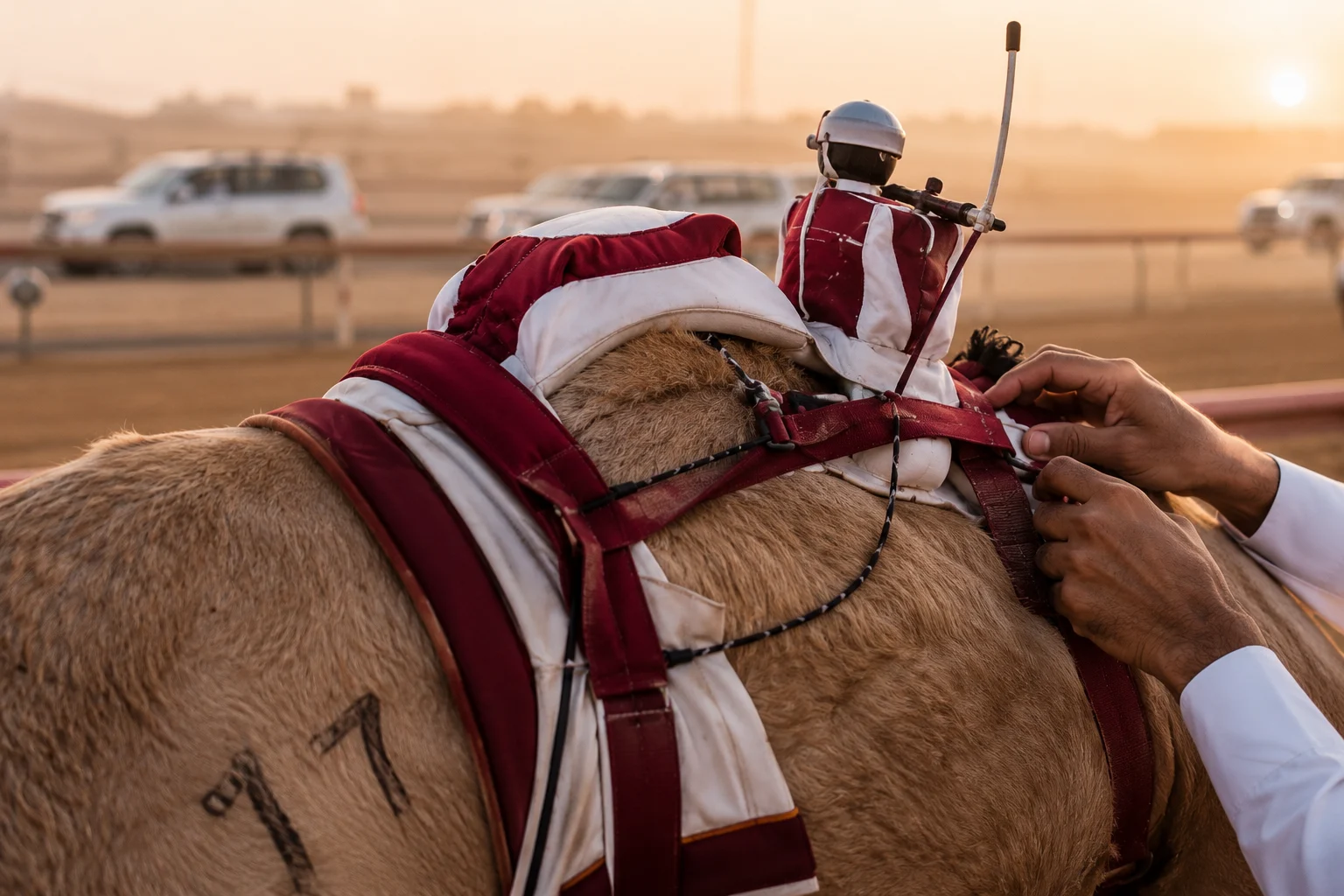
For someone seeing modern UAE camel racing for the first time, the robot jockey is probably the most unexpected detail. The small device fixed to the camel can look almost comical until the race begins and you understand its function. Operators travelling in vehicles beside the track use remote controls and voice communication while the lightweight jockey helps guide the animal during the race.
The technology is not a gimmick added to make an old sport look futuristic. It emerged from a serious change in racing practice. The UAE moved to prohibit child jockeys in the mid-2000s, and robot jockeys became the modern solution. Early prototypes were tested at Al Wathba, and the technology developed rapidly afterward. UAE workshops went on to build and supply robot jockeys across the Gulf, including to racing communities in Qatar and Saudi Arabia.
There is something deeply UAE about this transition. A tradition faced an ethical and practical problem. The answer was not to abandon the tradition, nor to pretend the problem did not exist. Technology was used to change the way the tradition operated. Today the sight of a camel carrying a compact robot while a convoy of vehicles follows beside the track has become part of the visual language of Gulf racing.
The old and the new are not always enemies. Sometimes the new is what allows the old to continue.
The race is happening on two tracks
Watch carefully and you realise there are almost two races happening at once. On the main track, the camels run. Beside them, vehicles accelerate along a parallel road carrying owners, trainers and teams. Voices come through communication systems, remotes are operated and everyone tries to keep the animal in sight. From a distance it can look chaotic. From inside the sport it is coordination.
This parallel movement is one of the reasons camel racing feels so different from horse racing viewed from a fixed grandstand. The people connected to the camel are physically moving with the race. The energy travels around the circuit. The owner is not simply sitting quietly waiting for a number to appear on a screen.
It also preserves something older in a new form. Families and supporters once moved with their animals in very different conditions. Today the pickup, the radio and the robot have changed the tools, but the desire to follow the camel, encourage it and remain close to the action is still visible.
A camel has a name, and the name matters
Spend enough time around people who love camels and the animal stops being ‘a camel’ very quickly. It has a name, lineage, temperament, history and reputation. Owners remember victories and disappointments. Breeding lines matter. Certain physical qualities are noticed immediately by experienced eyes that a visitor would miss completely.
This is important because outsiders can easily turn the camel into a symbol rather than an animal. We put it on postcards, tourism campaigns and desert photographs until it becomes shorthand for Arabia. The people who breed and race camels cannot afford that abstraction. They live with individual animals. They know which one is nervous, which one responds well, which one has potential and which one has already written its story on the track.
Perhaps this is why camel culture is so difficult to understand from a hotel desert excursion alone. Riding a camel for twenty minutes can be enjoyable, but it tells you almost nothing about the world of breeding, racing, poetry, knowledge and family memory surrounding the animal.
Family, majlis and the knowledge that is not written down
Camel racing is also a place where knowledge moves between generations. A young person can learn technical information from a trainer, but there is another kind of education that happens simply by being present. Listen to older people discuss an animal. Watch how they look at its body and movement. Notice which details matter to them. Heritage is often transmitted through repetition long before anyone decides to call it education.
The majlis is important here. Around racing areas, conversation continues after the animal has stopped running. Coffee is poured, results are discussed, stories return, opinions disagree and memories of older races enter the present. A boy who spends enough mornings listening may eventually know stories that were never written in a textbook.
This is one reason I dislike treating heritage as something belonging only to the past. If a grandfather tells a story and a grandson remembers it, the story is no longer only the grandfather’s past. It has entered somebody else’s future.
Coffee before the city wakes
There are grand places to drink Arabic coffee in the UAE. Beautiful hotels can serve it perfectly. Luxury boutiques understand the theatre of the dallah, the finjan and the date. I enjoy those places too. But coffee beside a desert track in the early morning has another flavour, even when the beans themselves have not changed.
Perhaps it is the cold air before the sun becomes strong. Perhaps it is the dust. Perhaps it is simply that nobody is performing hospitality for a brochure. Someone pours because there is coffee and you are there. You take the cup. Conversation continues. A date may follow. Then somebody looks toward the track because the next heat is beginning.
This is the kind of luxury I return to often in these stories. Not luxury as price, but luxury as a moment that does not need decoration. A desert morning, an animal running, a small coffee and people who have nowhere more important to be for the next few minutes.
The camel and the older economy of survival
Before roads and air-conditioning changed life in the Emirates, the camel had practical value that is difficult to exaggerate. Transport across long distances, milk, trade and mobility connected the animal to survival. That does not mean every romantic story told today should be accepted without question, but it does mean the camel’s place in Emirati heritage is not an invention created for tourism.
When modern racing celebrates the camel, it is celebrating an animal that helped make movement through difficult environments possible. The racing camel is specialised and the contemporary sport is very different from older everyday camel use, yet the emotional bridge between them remains. The animal that once helped people cross distance now crosses a finish line, and the community still gathers to watch.
Modernisation changed the camel’s job. It did not erase its meaning.
Poetry travelled with the camel too
The camel’s cultural world extends beyond racing. Taghrouda, the chanted Bedouin poetry traditionally exchanged by riders travelling on camels, is part of the UAE’s intangible heritage. Short lines can be improvised and answered by another voice, carrying praise, affection, humour, courage and social memory. The form has also been associated with weddings, national festivities and camel races.
I like this connection because it reminds us that travel in the desert was never only physical. People carried language with them. A camel could move a person across land while poetry moved between people. Rhythm belonged to footsteps, voices and memory.
A modern race may have engines roaring beside it, but somewhere behind that noise is a much older relationship between camel, rider, voice and landscape.
Not a museum piece
If camel racing had survived only as a demonstration performed a few times a year for tourists, it would still be interesting, but it would be something else. What makes UAE camel racing powerful is that competition remains real. Owners care who wins. Breeders invest time and money. Trainers work. Technology develops. Festivals attract racing communities from across the Gulf.
The sport therefore lives in a productive tension. It is heritage, but it is also business. It is family memory, but it is also competition. It is associated with older Bedouin life, yet it uses modern veterinary knowledge, remote controls, specialised vehicles and robotic devices. It can carry nostalgia without being trapped by nostalgia.
That complexity makes it much more interesting than the simplified sentence ‘camel racing is a traditional UAE sport.’ Yes, it is. But the important word is not only traditional. The important word is living.
What a visitor should know before going
If you want to see camel racing in Dubai or Abu Dhabi, go with curiosity rather than expecting a conventional spectator event. Race schedules can vary by season and event, so checking current information before travelling is sensible. Al Wathba is roughly 45 kilometres east of Abu Dhabi city, while Al Marmoom provides Dubai’s best-known racing setting. At Abu Dhabi tracks, official tourism guidance recommends arriving early, and entrance to races is generally free.
Dress comfortably and respectfully, remember that you are entering a working sporting environment, and do not assume every person or animal is there to become part of your photograph. The best experience comes from observing. Watch how a heat is prepared. Notice the robot jockey. Look at the vehicles. Listen to the conversations even if you do not understand every word. Let the morning reveal itself instead of trying to force it into a checklist.
And do not leave after one photograph. The finish line is only a few seconds. The culture is everything around it.
Al Marmoom and Al Wathba are not interchangeable
It is tempting in travel writing to treat every camel track as essentially the same attraction with a different pin on the map. That misses the point. Al Marmoom belongs to Dubai’s desert geography and helps reveal a side of the emirate hidden behind its global urban image. Al Wathba sits within Abu Dhabi’s larger desert and heritage landscape and connects naturally with routes toward Al Ain and other camel traditions.
The racing culture connects them, but place still matters. This is the same lesson we keep encountering with food, honey, coffee and landscapes across Arabia. Shared tradition does not mean identical experience. The Gulf is full of things that look similar from far away and become beautifully different when you come closer.
From fathers to sons, and now daughters too
Traditions survive when the next generation finds a reason to keep them, not merely when elders order them to. Camel culture in the UAE continues to be taught through families, racing communities, heritage festivals and institutions. Young people encounter the animal not only as an image from the country’s past but as something still present in sport, breeding, festivals and desert life.
The wider world of camel heritage also includes women as owners, breeders, researchers, organisers and participants in cultural transmission. The story should not be reduced to men driving beside a race track, even if that is one of the most visible racing images. Family knowledge is rarely carried by only one half of a family.
What matters is continuity without pretending continuity means nothing changes. The UAE of today is not the UAE of a grandfather’s childhood. The vehicles changed. The cities changed. The jockey changed. The camel remains, but even the way people care for, monitor and race it has evolved.
Why this matters in a country famous for the future
The UAE sells an image of the future exceptionally well. Artificial islands, vertical cities, enormous airports, technology, architecture and ambition all belong genuinely to the country. Yet a future becomes more interesting when it knows what it is carrying forward.
Camel racing is a perfect example. There is no need to choose between a robot jockey and heritage. The robot itself has become part of the heritage story because it records how the sport responded to a changing society. A remote control can sit beside an old poem. A pickup can follow an animal whose ancestors crossed the same desert without roads.
That is not contradiction. It is continuity through adaptation.
A morning worth keeping
By the time the sun rises higher, the desert has changed colour. The coolness begins to disappear. Some races are finished, vehicles leave, conversations move elsewhere and the city is fully awake again. You can drive back toward Dubai or Abu Dhabi and within an hour the camel track can feel strangely far away.
Then the towers return. Traffic lights. Offices. Hotels. Restaurants. Screens. The UAE resumes the version of itself most visitors recognise.
But something from the morning remains. Perhaps it is the sight of a camel running at a speed you did not expect. Perhaps the absurdly modern little robot on its back. Perhaps the convoy of vehicles. Perhaps the coffee. For me, it is the simple fact that none of it felt staged. People would have been there whether I came or not.
Meskaoui
“A tradition is not alive because we photograph it. It is alive because, tomorrow morning, someone will wake before sunrise and practise it again.”
— Meskaoui
The road home
If you ever go to Al Marmoom or Al Wathba, do not go only to say that you saw camel racing in the UAE. Go to understand why it is still there. Look beyond the finish line toward the farms, the families, the trainers, the technology, the coffee and the knowledge that passes quietly from one generation to another.
The camel once carried people across this land because there were few other choices. Today the Emirates have some of the fastest roads, busiest airports and most ambitious cities in the world. Nobody needs a racing camel to reach Dubai or Abu Dhabi.
And still, before sunrise, people gather to watch them run.
That may be the whole story.
Continue the Journey
If this story brought you here, continue the journey through related stories from The House of Meski.