
A Ramadan walk through Abu Dhabi, from the first date at sunset to the restaurant on the next street.
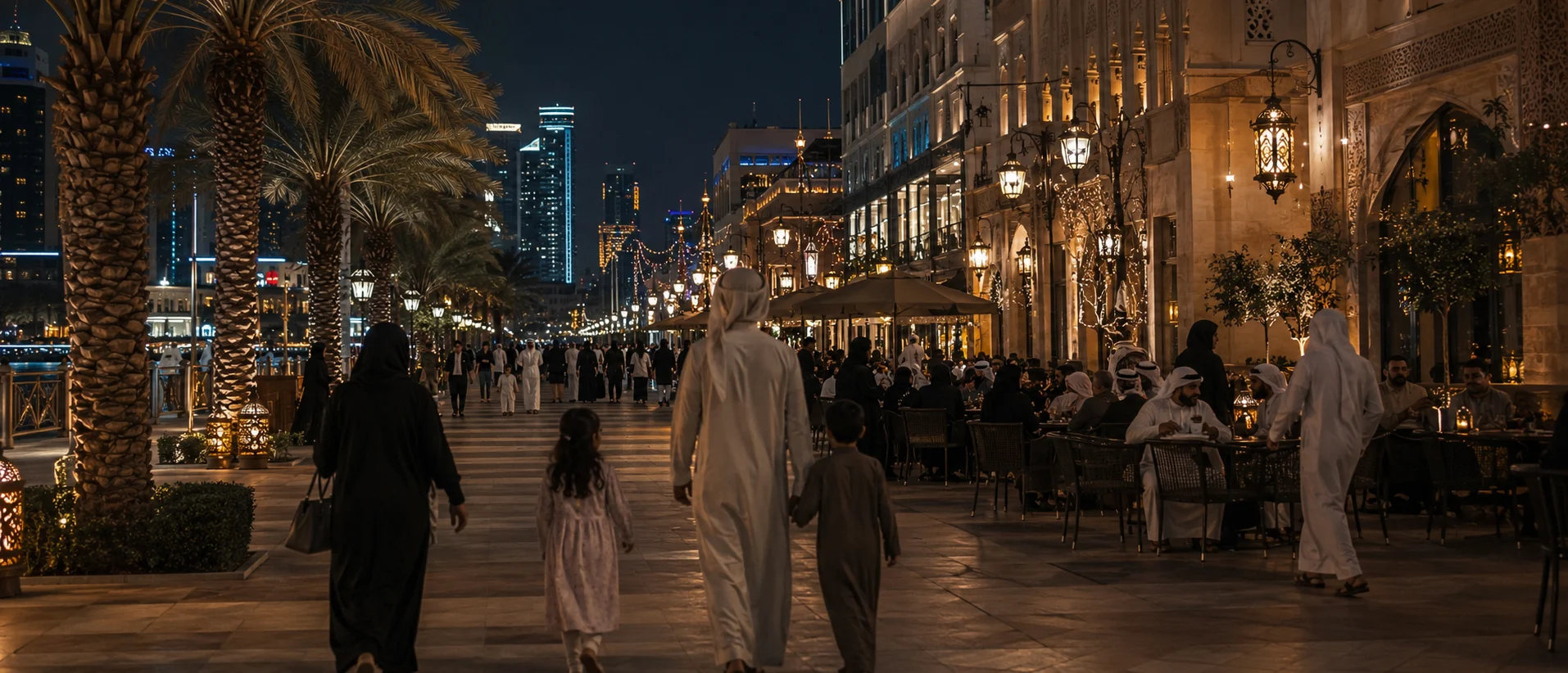
Before sunset, Abu Dhabi changes its pace
Ramadan in Abu Dhabi is not one event. It is a rhythm. You feel it before you can explain it. The afternoon begins to lean toward Maghrib, roads carry people home, kitchens are busy, tables are being prepared and the city seems to know that everyone is waiting for the same moment.
I like walking at this hour. Not because there is a checklist of Ramadan events to complete, but because ordinary streets tell you more than a programme sometimes can.
I walk because I want to see
I have never understood travelling only to repeat what I already know. If I know one street, I want to see the next one. If I know one restaurant, I want to smell what is cooking two doors farther.
This is not because I dislike my favourites. I have favourites everywhere. The point is that discovery has to remain alive.
The cannon and the first date
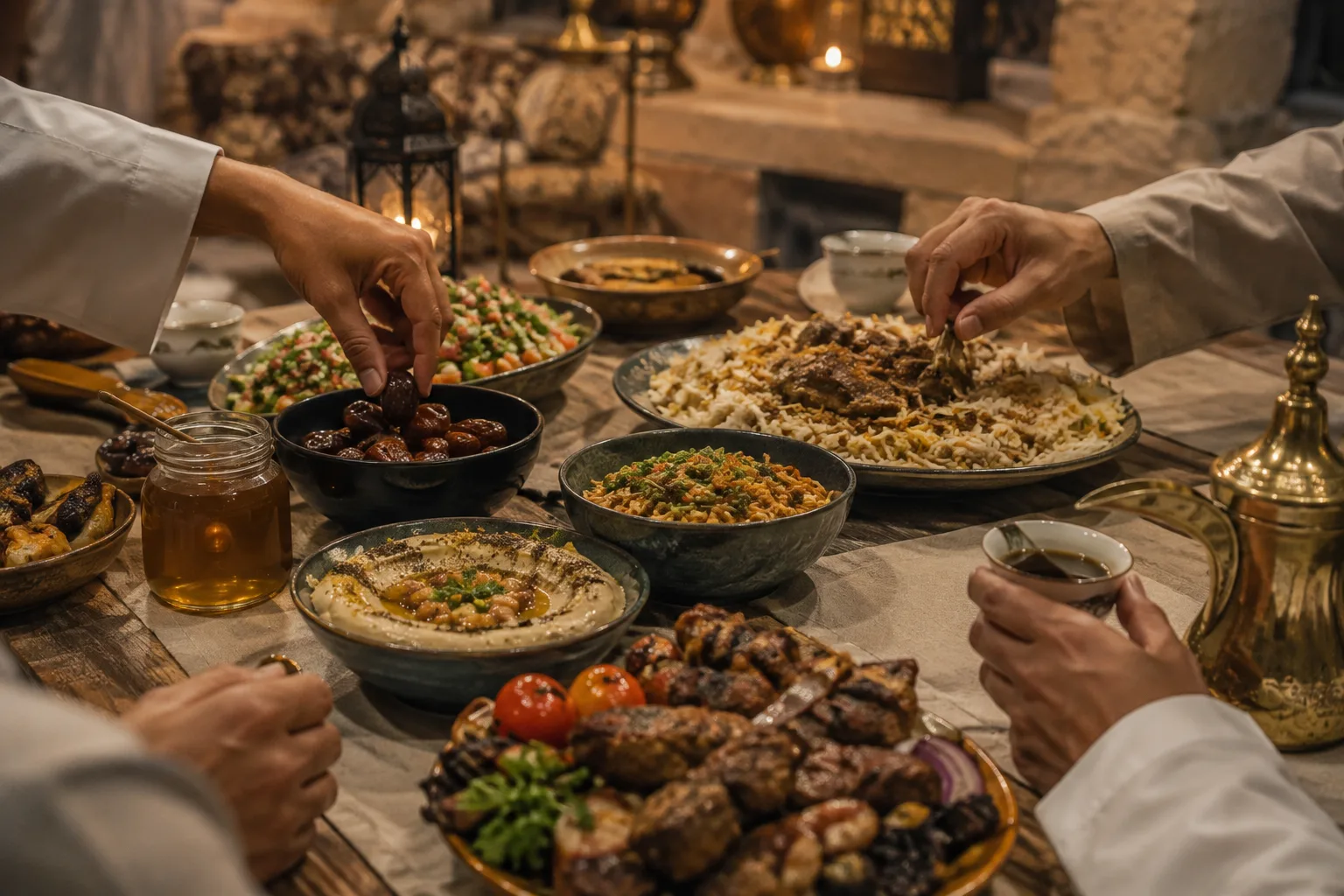
In Abu Dhabi, the traditional Ramadan cannon marks sunset and the end of the day’s fast at several locations, including the grounds of Sheikh Zayed Grand Mosque. Then comes the simple beginning many people know well: water, dates, prayer, and the first food after a long day.
That first date teaches something every enormous buffet risks making us forget. Hunger can make simplicity luxurious.
Iftar is a meal, but also a return
Iftar means breaking the fast, but around the table it can also mean returning to people. Family members arrive, friends meet, colleagues become guests, someone makes space for one more chair.
The food matters. Of course it matters. But if we remember only what was on the plate, perhaps we missed half the evening.
What is the best restaurant in Abu Dhabi?
People ask this question because Google has trained all of us to ask it. Best restaurant Abu Dhabi. Best iftar Abu Dhabi. Best buffet. Best view. Best everything.
I do not know the best restaurant in Abu Dhabi. More importantly, I do not believe one answer can remain true every night.
A chef is a person, not a ranking
A restaurant can be wonderful tonight and ordinary tomorrow. A small place can cook with extraordinary care, while an expensive room can sometimes feel like it is serving a system rather than a guest.
For me, food depends on ingredients and technique, yes, but also on attention. Is the chef trying only to sell another plate, or is there still some desire to share what he knows how to cook?
Today rice, tomorrow noodles
Today I can eat rice. Tomorrow noodles. The day after, maybe meat. Why should I eat rice every day simply because I already know that I love rice?
I laugh when I say it, but I mean it. Familiarity is comfortable. Discovery is richer.
Rice already knows me
Sometimes I stand outside a restaurant and think about returning to the place I know. Then another smell reaches the street. Indian? Pakistani? Yemeni? Filipino? Chinese? Levantine? Emirati?
Yesterday I ate rice. I love rice. But rice already knows me. Tonight I want to meet someone else.
This is richness to me
Richness is not having enough money to eat in every expensive restaurant. Richness is still having enough curiosity to enter a place you do not know.
Discovery is gold. Maybe better than gold, because what you have tasted, seen and understood becomes part of you.
Abu Dhabi gives you that luxury
The city is diverse enough to let you change table without changing city. One evening can be Emirati, another Yemeni, another Indian, another Lebanese, another something you cannot pronounce correctly until the waiter teaches you.
Why close yourself to rice?
Do not judge the restaurant by the chandelier
A beautiful dining room can be beautiful. I enjoy beautiful places too. But a chandelier has never seasoned a pot.
Price tells you what the bill will be. It does not always tell you how much love went into the cooking.
The small restaurant test
Walk into a simple place where the menu has photographs that are not perfect. Watch the bread arrive hot. Ask what the cook recommends. Let someone choose for you.
Maybe it will be average. That is allowed. Discovery includes meals you do not repeat.
Not every discovery has to become a favourite
This is important. We have become afraid of trying something unless someone has promised us it is five stars. But if every experiment must become a favourite, it is no longer discovery. It is shopping for certainty.
Try. Taste. Decide. Tomorrow is another table.
My favourite places still matter
Of course I return to places I love. Loyalty is beautiful. A waiter remembers you, the kitchen knows what you order, you know which table you prefer.
But loyalty becomes a cage if it makes every unknown place feel unnecessary.
Ramadan makes the city social
After iftar, Abu Dhabi wakes in another way. Families go out, children stay up later, coffee returns, shops and cultural spaces fill, and the evening stretches toward suhoor.
Official Ramadan programming in Abu Dhabi includes nighttime dining, cultural activities, markets and gatherings, but the atmosphere is larger than any event calendar.
The Corniche after iftar
Walking near the Corniche after iftar, you see families moving without the rush of a normal weekday. Children negotiate for one more stop. Adults carry coffee. Some people walk because they ate too much. I know this walk.
Ramadan nights give the city permission to be awake together.
Qasr Al Hosn and the majlis
During Ramadan, cultural places such as Qasr Al Hosn host storytelling, poetry, oud, crafts and open majlis gatherings. This is the kind of programming I like because it does not separate culture from people.
A majlis is not interesting because it looks traditional in a photograph. It is interesting because people sit, speak, listen and receive one another.
Sheikh Zayed Grand Mosque
At Sheikh Zayed Grand Mosque, Ramadan is not decoration. Prayer is the centre. Taraweeh, worshippers, the cannon at sunset and the movement of people remind visitors that the month is religious before it is culinary.
This matters in an article full of food. Ramadan is not a food festival with fasting attached.
Suhoor is another mood
Suhoor is quieter. It is the meal before the next fast, eaten before dawn. Some people make it social; others keep it simple at home.
By then the city has passed through several personalities in one night: anticipation, iftar, movement, coffee, conversation, then preparation for another day.
The gift enters the evening
Ramadan gifts in Abu Dhabi belong inside this social movement. Dates, sweets, perfume, coffee, honey, something for the children, something for the hosts. The object changes. The gesture remains.
A gift says: I did not arrive empty-handed. But it should never say: look how much I spent.
The best gift is not always the biggest
A family you know well may appreciate a simple food gift more than a giant luxury box. A corporate relationship may require something more formal. A VIP gift may need exceptional materials and presentation.
But every level still needs taste. Luxury without thought is only volume.
Honey at a Ramadan table
Honey fits naturally into gifting because it can be opened and shared. It can sit beside dates and coffee, return at breakfast, or remain in the house after Ramadan.
That is enough. We do not need to force honey into every Ramadan tradition. It is a guest on the table, not the owner of the month.
The smile before the gift
I keep coming back to this thought: a gift can make someone smile, but if you arrive without a smile, what was the gift for?
Hospitality begins before the ribbon is opened.
Family before the programme
Abu Dhabi can offer markets, concerts, museums, restaurants and Ramadan events. Enjoy them. I do. But do not become so busy experiencing Ramadan that you have no time for the people Ramadan was supposed to bring you closer to.
Call the relative you postponed. Visit the elder. Sit longer.
The table where someone waited for you
Maybe the best iftar in Abu Dhabi is not the most expensive one. Maybe it is not bookable. Maybe it is the table where someone kept a place for you.
Google cannot rank that table.
Forgiveness has no menu
Ramadan is also an opportunity to repair relationships. Some disagreements are serious and complicated. Others survive only because nobody wants to make the first move.
If you can make peace, do not wait for the perfect speech. Sometimes the first salaam is enough to reopen a door.
Do not send the gift instead of yourself
If you owe someone an apology, a box cannot apologise for you. Send the gift if you want, but speak too.
The most expensive honey in the world cannot say ‘I was wrong’ with your voice.
Walking without a reservation
One of my favourite ways to discover food is to walk until something makes me stop. This does not work every night, especially when restaurants are full during Ramadan, but the spirit matters.
Leave some space in the trip for what you did not plan.
The smell from the next street
A city is understood through smells as much as monuments. Grilled meat, spices, bread, coffee, sweets, rice, smoke, perfume. Abu Dhabi after iftar can move you from one country to another in a few streets.
That diversity is not confusion. It is wealth.
Emirati food and the food of everyone who lives here
Local Emirati food deserves to be discovered on its own terms, but modern Abu Dhabi is also a city built from many communities. Their kitchens are part of daily life.
To eat across the city is to learn something about who shares it.
A 40-dirham memory and a 400-dirham dinner
I have had simple meals that stayed with me longer than expensive ones. I have also had expensive meals worth every dirham. The lesson is not that cheap is good and luxury is bad.
The lesson is that price cannot do the tasting for you.
What makes a chef generous?
Generosity in cooking is not only portion size. It can be precision, patience, a broth that took hours, bread made properly, a spice balanced instead of hidden, or a waiter who notices what the table needs.
You feel when a restaurant still wants to feed people, not only process covers.
The danger of the ‘best’ list
Best-of lists are useful when you are in a hurry. They can also make every traveller follow the same route, photograph the same plate and miss the restaurant next door.
I would rather give you permission to explore than pretend I can decide your favourite before you taste it.
Try one new table
If you are in Abu Dhabi for seven nights, keep your favourite if you already have one. Return once or twice. Then give the other evenings away to curiosity.
One new restaurant is enough to change the story of a trip.
Ramadan markets and night streets
Night markets and seasonal events add another layer to Ramadan in Abu Dhabi. Food stalls, crafts, family spaces and cultural programmes keep people outside later than usual.
But I would not build the whole article around event names because events change. The deeper rhythm returns every Ramadan.
Culture is not a backdrop
Heritage Village, Qasr Al Hosn, the Cultural Foundation and other cultural spaces can become especially active during Ramadan. Visit them for more than photographs.
Listen to the poetry. Watch the craft. Ask what an object was used for. Culture becomes interesting when it stops being scenery.
Children own part of the night
Ramadan nights belong partly to children. Their energy after iftar changes public spaces. They run, ask for sweets, stay awake later, and absorb traditions without anyone giving them a lecture.
Years later, they may remember a smell or a street more clearly than an event title.
The visitor’s responsibility
If you are visiting Abu Dhabi during Ramadan, remember that you are entering a month with spiritual meaning for the people fasting around you. Curiosity is welcome; respect makes curiosity better.
Learn the rhythm rather than demanding that the rhythm adapt entirely to you.
Corporate Ramadan gifts
For companies, Ramadan gifting can become mechanical: list, budget, logo, delivery. It does not have to be. A corporate gift can still feel human if the object is chosen well and the message is restrained.
The recipient is a person before being a client.
VIP does not mean louder
A VIP gift can use rare honey, beautiful dates, fine coffee, perfume or craftsmanship. It can use gold if gold belongs to the concept. But VIP should mean more considered, not simply more crowded.
Sometimes removing one unnecessary element makes a gift feel more expensive.
Abu Dhabi and quiet luxury
Abu Dhabi can do grandeur extremely well, but some of its best moments are quiet: coffee in a majlis, a late walk, a family table, a mosque courtyard, a simple dish made properly.
That contrast is part of the city’s character.
Why I keep walking
I walk because the next street may teach me something. Maybe there is no revelation. Maybe I just find good noodles.
That is enough. Life does not need every discovery to become philosophy.
But discovery is my philosophy
Still, if I have one rule, it is this: do not close the door yourself. We already live inside habits, responsibilities and routines. When we travel, or even when we walk our own city, curiosity is one freedom we can keep.
Yes, I have my favourites. But I must discover and change. This is my life.
Richness is not money
People often use the word richness to mean expensive things. I use it differently. Richness is having several cultures within reach and being willing to meet them.
Richness is knowing your own table and still being curious about your neighbour’s.
Discovery is gold
Gold can be stored. Discovery has to be lived. You cannot inherit someone else’s taste memory. You have to sit, eat, listen and sometimes make a bad choice yourself.
That is why discovery is gold to me.
Why eat rice every day?
I will say it one last time because it makes me laugh. Why eat rice every day if tomorrow I can eat noodles, and the day after meat, and after that something I have never tried?
Love your rice. Just do not build a wall around it.
The city before dawn
Eventually the streets quiet again. Suhoor ends. Another fast approaches. The night that seemed endless suddenly has an edge.
Abu Dhabi returns to waiting.
What I would tell a visitor
Do not come only with a list of the best restaurants in Abu Dhabi. Bring the list if it helps, then be ready to abandon one line of it.
Walk. Ask. Taste. Return to what you love, but leave room for what you do not know.
And what I would tell myself
Do not become so experienced that nothing surprises you. The day I believe I already know the best table, the best honey, the best street and the best way to travel is the day I have stopped travelling.
Experience should make curiosity deeper, not smaller.
The last table
Maybe tomorrow I will return to my favourite restaurant. Maybe not. There is another street I have not walked, another table I have not tried, another person whose cooking I do not know yet.
This is richness to me. Not eating the most expensive meal. Having enough curiosity left to discover another one.
A city of many kitchens
Abu Dhabi’s food scene makes my rice joke possible. The city contains people from across the Gulf, South Asia, Southeast Asia, the Levant, North Africa, Europe and beyond. Their food is not an abstract idea of multiculturalism. It is lunch, dinner, bakery windows, delivery bikes and family recipes.
During Ramadan, that diversity becomes especially visible around iftar. Different communities break the fast with foods that carry memories of other cities and other homes.
The first spoon can take you somewhere
A dish does not need to be rare to become discovery. Sometimes it is a spice combination you have never noticed, a soup made differently, a bread you tear with your hands, or noodles prepared in a way that makes you wonder why you kept ordering the same thing.
This is why I do not want an article that tells readers where they must eat. I want an article that makes them want to taste.
Luxury hotels have their place too
I am not against luxury hotels or grand Ramadan tents. Some are beautifully executed, and a large iftar can be impressive in its variety and service. If that is what you want one evening, enjoy it completely.
My only objection is to confusing price with truth. A luxurious iftar is one experience among many, not the final examination of Abu Dhabi food.
The buffet problem
A buffet can make us behave strangely. We see abundance and suddenly want to taste everything as if the food will disappear forever. Plates become mountains. Half of them return unfinished.
Ramadan is a good month to remember that abundance does not require waste. Take what you will eat. Return if you are still hungry.
The home table
No restaurant can replace the meaning of being invited into someone’s home. The food may be simple or enormous. Someone has still prepared a place for you inside private family life.
If you receive that invitation, notice the trust before you notice the menu.
What to bring to a Ramadan invitation
People often search for Ramadan gifts Abu Dhabi because they do not want to arrive empty-handed. There is no universal rule that requires an expensive present. Consider the relationship, the household and the occasion.
Dates, sweets, coffee, perfume or honey can all work. The best choice is the one that feels like you thought about the people receiving it.
Honey, gold and restraint
We work with honey that can be presented with gold, silver or saffron, so I know the attraction of precious materials. Used well, they can create a beautiful ceremonial gift.
But gold should never be asked to rescue ordinary honey. The substance comes first. The decoration is the last sentence, not the first.
The majlis teaches a different pace
Sit in a majlis and you understand why speed is not always a virtue. Conversation moves, pauses, returns. Someone arrives. Someone leaves. Coffee circulates.
The best hospitality does not make the guest feel processed.
Poetry, oud and memory
Ramadan cultural programming at places such as Qasr Al Hosn can include poetry, oud, crafts and storytelling. I like these evenings when they allow traditions to be experienced rather than simply labelled.
A poem heard in the right place can explain a culture differently from a paragraph on a museum wall.
The mosque is not an attraction first
Sheikh Zayed Grand Mosque is one of Abu Dhabi’s great architectural landmarks, but during Ramadan especially, visitors should remember its primary identity as a mosque.
Photography can wait. Worshippers are not part of a travel backdrop.
The worker breaking the fast
Not every iftar happens at a decorated table. Across the city, people break the fast at work, in shared accommodation, in mosques, in cars between responsibilities, or with community meals.
Any article about Ramadan luxury that forgets these tables would describe only a small part of the month.
Generosity beyond people we know
Ramadan encourages giving beyond one’s immediate circle. Food distribution, charitable giving and community iftars are part of the wider spirit of the month.
The gift to a client is one form of giving. It should not make us forget the person who cannot return the favour.
Ask the waiter
One of the easiest ways to escape your habits is to ask: what do you eat here? Not what is the most expensive dish, not what tourists order. What do you recommend?
The answer may lead to the plate you remember.
What ‘best restaurant Abu Dhabi’ cannot tell you
A search result can tell you ratings, location, cuisine and perhaps whether people liked the service. It cannot tell you what mood you will be in, who will sit with you, whether the chef is inspired that night, or which smell will suddenly remind you of childhood.
That uncertainty is not a flaw in travel. It is the reason to travel.
My rule for seven nights
If I had seven Ramadan nights in Abu Dhabi, I would not eat seven versions of the same dinner. I would keep room for one Emirati meal, one South Asian table, one Yemeni or Gulf meal, one place chosen only because I passed it, perhaps one grand hotel if I wanted the spectacle, and still leave space for an invitation.
The exact list does not matter. The changing does.
Favourites are homes, discoveries are roads
My favourite restaurants are like small homes. I know what waits inside. New restaurants are roads. I do not know where they lead.
A good life needs both.
Why this belongs in the MESKI Journal
We could write a commercial page about Ramadan gifts and stop there. It might rank for a few useful searches. But MESKI was never meant to speak only when there is a jar to sell.
Honey brought us into conversations about hospitality. Hospitality brought us into homes, cities, landscapes and traditions. The Journal should be allowed to follow that road.
The honey can stay in the corner
If a jar of honey appears in this story, let it stay on the corner of the table. Maybe someone spreads it on bread at suhoor. Maybe it becomes a gift. Maybe nobody opens it tonight.
The city is bigger than our product. That is exactly why the story feels trustworthy.
Questions readers ask
Iftar begins at sunset. The exact time changes by date, so check the local prayer time for the day you are visiting.
Suhoor is the meal eaten before dawn and before the day’s fast begins.
The cannon tradition is observed at several locations, including Sheikh Zayed Grand Mosque. Current locations should be checked for the specific Ramadan you visit.
There is no single answer. Abu Dhabi ranges from family tables and small restaurants to hotel iftars; choose by cuisine, people, atmosphere and what you want to discover.
Gift-giving fits naturally into visits and hospitality. Dates, sweets, coffee, perfume and honey are among many possible choices.
Many restaurants operate with Ramadan-specific schedules and iftar or suhoor service. Hours vary, so check directly before going.
Ramadan is first a religious month. Respect local customs, prayer, fasting and the slower daytime rhythm while enjoying the cultural life of the evenings.
Continue the Journey
If this story brought you here, continue the journey through related stories from The House of Meski.