
Before the airport, the road itself was part of the pilgrimage.
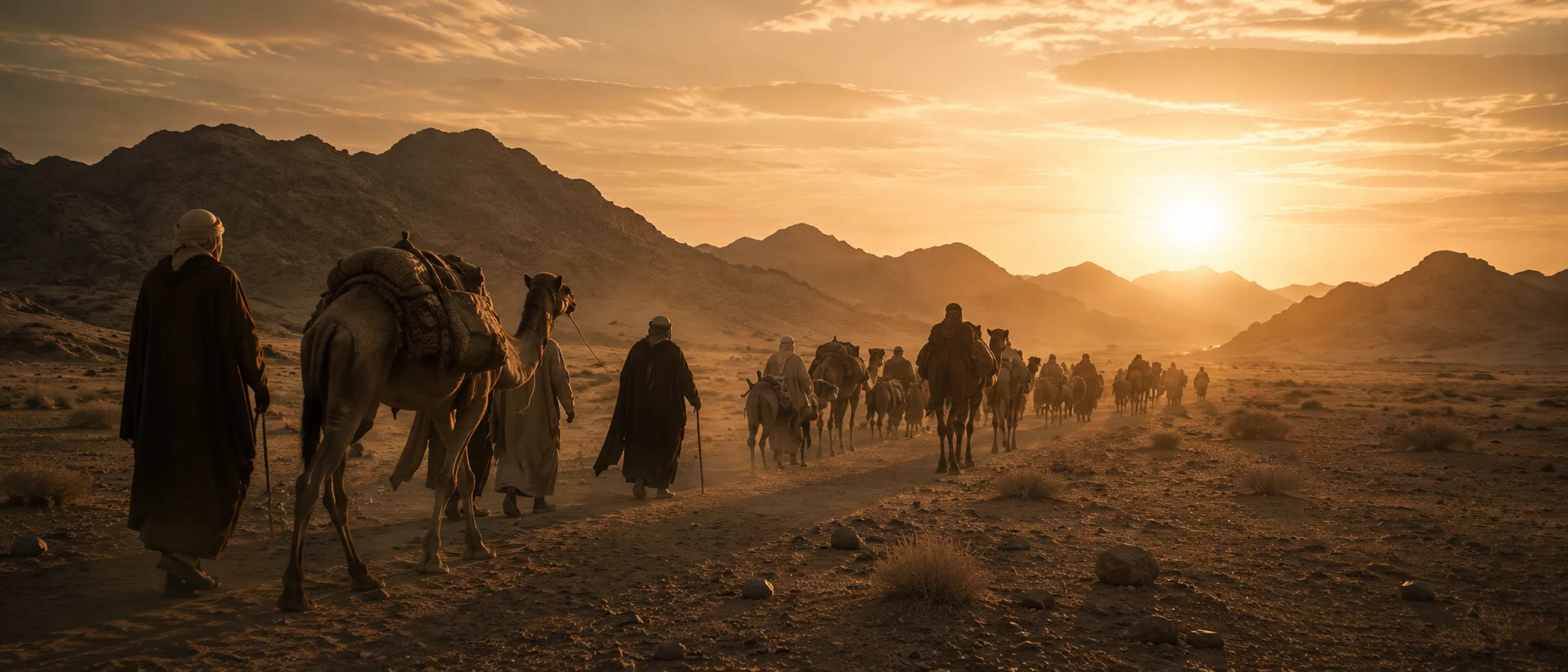
Before the airport, there was the road
The road to Makkah was once long enough to change a person before the pilgrimage even began. A pilgrim could leave home not knowing exactly when he would return. Families prepared food, money, animals and farewells. A journey from distant lands could take weeks or months, crossing deserts, ports, mountains and political borders that did not look like the borders we know today.
Today, millions of pilgrims reach Saudi Arabia through airports in a matter of hours. In 2025 alone, Saudi statistics recorded more than 1.4 million external pilgrims arriving by air. The scale of that transformation is extraordinary. But to understand what modern transport has changed, we first have to remember what the old road demanded.
The destination was one, the roads were many
There was never one single road to Makkah. Historical pilgrimage networks connected the Hijaz with Iraq, the Levant, Egypt, North Africa, Yemen, Oman and other regions. Saudipedia describes the major historical Hajj routes as a network used by pilgrims over many centuries, with wells, stations and resting places created along the way.
Each route gathered people from even farther beyond its nominal starting point. The Egyptian road was not only for Egyptians. Pilgrims from Morocco, Al-Andalus and parts of Africa could join it on their way toward the Hijaz. The route became a river fed by many smaller streams.
A Moroccan pilgrim had already travelled far before reaching Egypt
For someone leaving Morocco, the road to Makkah could begin with a journey across North Africa before the caravan even entered Egypt. The pilgrim carried more than provisions. He carried family expectations, prayer, money saved over years and the uncertainty of a road where weather, illness, delay and security could change everything.
This is the part of Hajj history that interests me most. We often speak about the sacred destination, but the journey itself became part of the spiritual preparation. Every day of distance made the intention visible. The pilgrim had left comfort behind long before seeing the Kaaba.
The Egyptian route
The Egyptian Hajj route became one of the great arteries toward Makkah. Historical sources describe both land and coastal paths, with stations, wells and religious sites along the way. Pilgrims coming from the west could pass through Egypt, Sinai and the Red Sea region before continuing toward the Hijaz.
The existence of wells and rest stations was not a luxury. Water determined whether people and animals could continue. A route without water was not a route for long. Caliphs, rulers and benefactors therefore invested in infrastructure that made pilgrimage possible for people who would otherwise face an almost impossible crossing.
The Levantine road
From Damascus, another great route moved south through the Levant toward Tabuk, AlUla, Madinah and eventually Makkah. The route gathered pilgrims from Syria and surrounding regions. Archaeological remains along the way, including inscriptions, water installations and stations, still show how much physical organisation stood behind the spiritual journey.
Imagine arriving at one of these stations after days of movement. Water for the animals. Shade. Food. News from travellers heading the other direction. The road itself became a place where the Muslim world met before reaching Makkah.
Darb Zubaydah
From Iraq came one of the most famous pilgrimage roads, the route from Kufa to Makkah known as Darb Zubaydah. UNESCO describes the route as a roughly 1,300 kilometre network linking Kufa with Makkah, with stations and infrastructure dating especially to the Abbasid period.
The route bears the name of Zubaydah bint Ja’far, wife of the Abbasid caliph Harun al-Rashid, whose patronage supported water works and facilities along the road. Her name survived not because she simply travelled, but because she helped make travel possible for others.
This is where roads become more than lines on a map. A road can be an act of charity stretched across hundreds of kilometres.
Water was the real luxury
Today we think about seats, luggage allowances, hotel transfers and air-conditioning. On the old Hajj routes, the essential question was often simpler: where is the next water?
Wells, cisterns, pools and springs gave the road structure. Humans needed them. Camels, horses, mules and donkeys needed them. A station with reliable water could mean safety. A dry point could mean danger.
When I think about those journeys, this is what I find most humbling. What we now call a difficult trip may begin with a delayed flight. For many ancestors, difficulty began with whether the next stretch of desert could be crossed alive.
The Yemeni roads
Yemen did not have a single route either. Historical sources describe coastal, inland and highland routes linking cities such as Aden, Taiz, Sana’a, Zabid and Sa’dah with the Hijaz. Geography created options and difficulties. Mountain routes, coastal paths and trade connections all shaped the movement north.
A Yemeni pilgrim leaving Sana’a did not simply travel from country A to country B as we would describe a modern flight. The road was made of stations, tribes, markets, water sources and terrain. The Hijaz was the destination, but every region crossed on the way mattered.
The Omani roads
Omani pilgrims also followed long routes toward the Two Holy Mosques. One historical route moved north toward Yabrin, Bahrain, Al-Yamamah and gathering points connected with pilgrims from Basra and Bahrain. Other paths linked Oman with routes through the Arabian Peninsula.
Today an Omani pilgrim can fly to Jeddah or Madinah in a short journey. The contrast is difficult to imagine unless we reconstruct the old distance in our minds.
Sea routes were part of the story too
Not every pilgrim came by land. Ports along the Red Sea and Arabian coasts formed part of the pilgrimage network. Sea travel could shorten some land journeys, but it brought its own uncertainty: weather, ships, delays and crowded conditions.
Jeddah became one of the great gateways to Makkah because sea and later air travel concentrated arrivals there. The road to Makkah therefore changed with technology without losing its fundamental purpose.
The caravan was a moving community
A caravan did more than protect people from travelling alone. It created a temporary society. There were guides, merchants, animals, families, officials, religious scholars and travellers who had never met before departure. People shared news, food, water and fear.
The road also carried trade. Historical Hajj routes were linked with commercial routes, which meant pilgrimage and economic exchange often moved together. A pilgrim could encounter goods, languages and customs from regions far beyond his own.
Leaving home meant accepting uncertainty
We should be careful not to romanticise the old Hajj journey. Hardship was real. Illness was real. Heat, cold, hunger, exhaustion and insecurity were real. Not everyone who left returned.
That fact changes the meaning of farewell. When a family accompanied a pilgrim to the beginning of the road, they were not simply saying see you after the holidays. The journey could last months and carried risks that modern travellers rarely face on the same scale.
What did they carry?
Provisions depended on origin and route, but the logic was practical. Food that could survive travel, water containers, clothing, money, perhaps goods for exchange, and whatever was necessary for animals and camp life. The lighter the load, the easier the movement, but being underprepared could be dangerous.
A pilgrim also carried invisible things: debts to settle, apologies to make, instructions for family, prayers requested by relatives and names to remember in Makkah.
The road was already worship before the rites began
There is something powerful in the idea that the Hajj journey began spiritually before reaching the sacred sites. The intention formed at home. Patience was tested on the road. Dependence on other people became obvious. Wealth could not guarantee perfect safety. Status mattered less when everyone was thirsty.
The road stripped away control. Perhaps that was part of its spiritual force.
Madinah on the way
For many routes, Madinah became part of the pilgrimage journey before or after Makkah. The Levantine and Egyptian routes could connect with Madinah, and pilgrims sought the city of the Prophet ﷺ as part of their journey even though visiting Madinah is not one of the rites of Hajj itself.
The emotional geography of the journey therefore extended beyond one destination. Makkah remained the centre of the rites, but Madinah carried its own longing.
The twentieth century begins to change everything
Then engines arrived. Arab News documents the gradual replacement of pack animals by motor vehicles in the twentieth century. In 1924, pilgrims were instructed to use motor vehicles rather than camels, although poor roads meant animals remained important for years. In 1948, a regulated transport service for pilgrims was established through Saudi Arabia’s General Car Syndicate.
The road did not disappear overnight. Technology arrived before infrastructure was fully ready. Camels and engines overlapped. Old routes and new roads existed together for a time.
From red trucks to buses
Early organised pilgrim transport used trucks and later buses. As roads improved and transport systems became more structured, the time required to move between pilgrimage sites and cities fell dramatically.
What had once depended on caravan pace now depended on engines, road capacity and traffic management. The problem changed from surviving a desert crossing to moving huge numbers of people efficiently.
The airplane changes the scale
Air travel transformed Hajj more radically than almost any previous transport change. A pilgrim from Morocco, Indonesia, Nigeria, France or the Gulf could now cross distances in hours that once required weeks or months.
The 2025 Saudi Hajj statistics make this transformation visible. Of more than 1.5 million pilgrims arriving from outside the Kingdom, 1,435,017 entered through airports. Only 66,465 arrived through land crossings and 5,094 through seaports.
The ancient road did not vanish from memory, but the sky became the principal route.
The Haramain train
The Haramain High Speed Railway added another chapter. Since opening in 2018, it has linked key cities including Makkah, Jeddah and Madinah with high-speed rail. A journey that once depended on caravan stages can now be measured in modern rail timetables.
This does not make Hajj spiritually smaller. It makes physical access easier for people who might otherwise struggle with long ground journeys.
The number of pilgrims grows with access
As transport, public health, roads, border systems and accommodation improved, the number of people able to perform Hajj increased dramatically over the long term. Arab News notes more than 3.1 million pilgrims in 2012, while 2025 recorded 1,673,230 pilgrims under the modern quota and organisational system.
Numbers vary from year to year for many reasons, including capacity, policy and exceptional events. But the broad historical direction is unmistakable: modern transport allowed the Muslim world to converge on Makkah at a scale the old caravans could never physically carry.
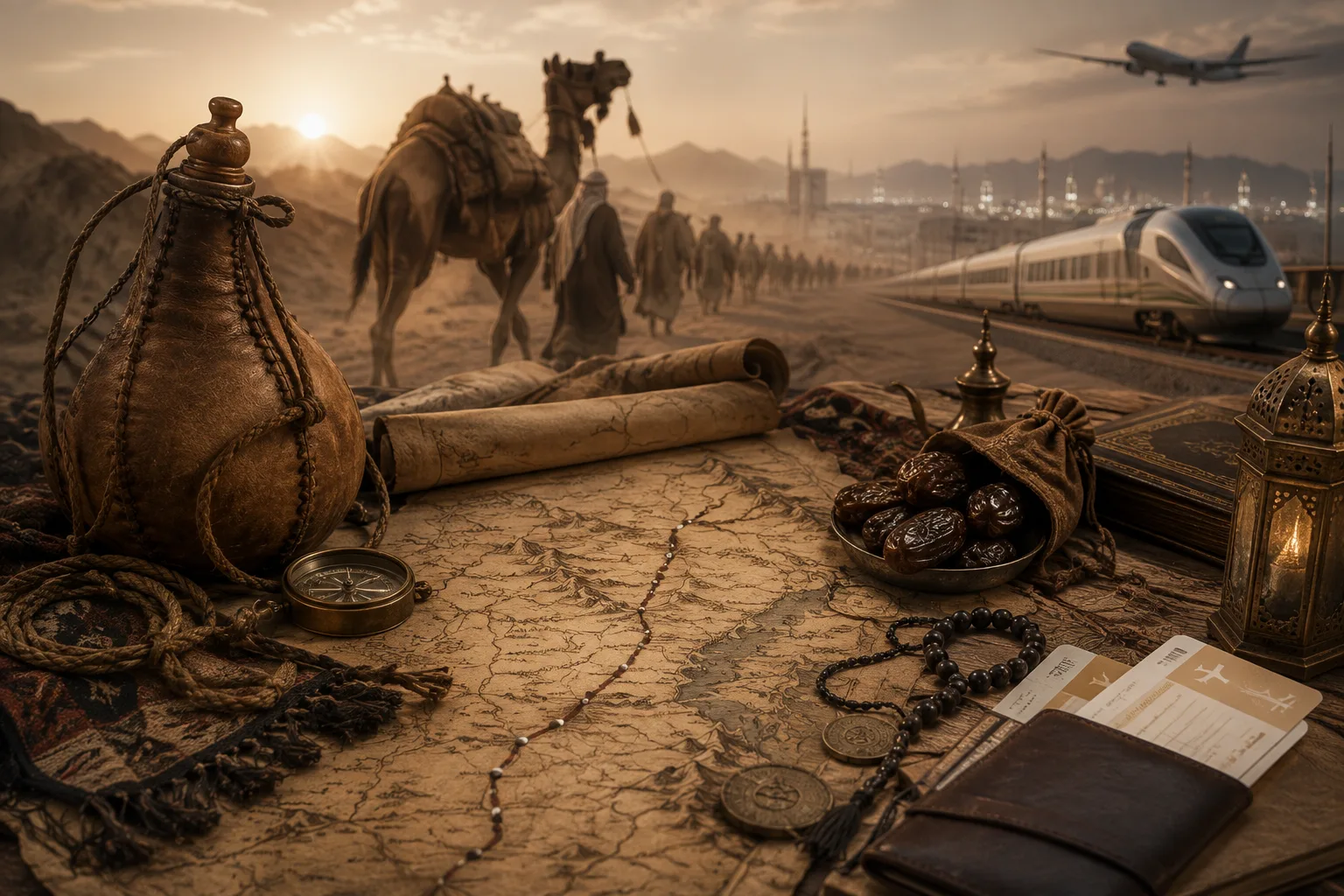
The difficulty did not disappear. It changed.
This is the chapter I wanted to reach from the beginning. It would be easy to end the story by saying that our ancestors suffered and we are lucky. We are lucky in many ways. A flight from Casablanca or Muscat to Saudi Arabia is incomparably easier than months on a caravan road. Air-conditioning, medicine, roads, trains and organised services have removed dangers that once shaped every pilgrimage.
But ease of transport does not mean every person who longs for Hajj finds the road easy today. For many, the difficulty is financial. The airplane exists, the hotel exists, the bus exists, the road exists, but the cost may still stand between a person and the journey.
Saving for years
There are people who save slowly. A little this year. A little next year. Then a family need comes first. A child needs something. Rent rises. Work changes. A parent becomes ill. The Hajj fund waits.
Someone can live only a few hours away by plane and still feel Makkah financially farther away than a much greater physical distance.
This is a different hardship from the old road. We should not pretend they are identical. Our ancestors faced physical dangers many of us will never know. But longing can still meet an obstacle, and an obstacle can still hurt.
The road today can begin with a bank account
For some people, preparation for Hajj today begins not with feeding a camel but with saving money. The list is different: visa or official package arrangements, flights, accommodation, transport, documents and spending needs.
The tools changed. The intention did not.
A road made easier for millions
We should also recognise the immense work required to receive modern Hajj numbers. Roads, tunnels, trains, buses, airports, health systems, security, crowd management, technology and thousands of workers are now part of the pilgrimage infrastructure.
In 2025, Saudi statistics recorded 420,070 workers serving the Hajj season across public and private sectors, including security. Modern Hajj is not simply easier because someone invented the airplane. It is easier because an enormous system works around the pilgrim.
What the old road can still teach us
The old roads remind us not to treat access as something ordinary. A pilgrim once crossed deserts to reach water. Another waited for a ship. Another travelled from Morocco toward Egypt before the Hijaz was even close. A Yemeni caravan moved north from cities that today are reached by modern transport. An Omani route crossed an Arabia without motorways.
Remembering this does not mean wishing for hardship. Islam does not require us to reject ease. It means understanding the gift of ease when it exists.
Meskaoui
“The old pilgrim looked for water, shade and a safe road. The pilgrim today may look at a ticket price and wonder whether the road will open for him. The obstacles changed, but the hope of reaching Makkah did not.”
— Meskaoui
From the hardship of the road to the hardship of affording it
I think about the people before us who travelled on camels, horses, mules, ships and early trucks. Then I think about someone today looking at Makkah on a screen, knowing the flight is only a few hours away, but still unable to go.
The contrast is painful because modernity has made distance smaller without making every obstacle disappear.
So I do not want to end this story with transport statistics. I want to end with a prayer.
The destination remains the same
From Morocco, Yemen, Oman, Iraq, the Levant, Africa, Asia, Europe and everywhere else, the roads changed. Camels gave way to cars. Ships gave way increasingly to airplanes. Roads widened. Buses multiplied. Trains became faster. Millions reached Makkah in ways their ancestors could barely imagine.
But the destination remains the same.
And so does the hope carried quietly by someone who has not yet been able to go.
Meskaoui
“From the hardships of the journeys faced by our ancestors to the financial difficulties faced by many today, the destination remains the same. To everyone who carries the hope of going one day, I pray that Allah makes the way easy for you, removes the difficulties from your path and grants you the journey.”
— Meskaoui
The farewell could be longer than the journey we know today
There is a scene I keep returning to: the moment before departure. A family knows that someone is going to Hajj, but nobody can promise the exact day of return. There is no flight number to track. No message saying landed safely. No photograph sent from a hotel room. The road begins with separation, and separation itself becomes part of the pilgrimage.
Perhaps that is why old travel accounts often feel heavier than modern itineraries. The traveller left with uncertainty, and the family remained with uncertainty. The distance was measured not only in kilometres but in silence between news.
Women travelled these roads too
Historical Hajj was never an exclusively male movement. Women travelled in caravans, with family groups, escorts and organised convoys according to the conditions of their time. Their experiences were shaped by the same distance and danger, but also by different social realities. Some travelled as members of large households, some as widows, mothers or women of means, and some became patrons whose names survived because they made the route easier for others.
Zubaydah bint Ja’far is the most famous example in this article, not because she represents every woman who travelled, but because her patronage became part of the physical road itself. Water infrastructure outlived the people who first paid for it. That is an extraordinary form of presence.
The pilgrim carried the prayers of people who stayed behind
Not everyone could go. That was true centuries ago and remains true today. A pilgrim could leave carrying the names of relatives, neighbours and friends who had asked to be remembered in prayer. One person’s journey became emotionally shared by people who never left the village.
This is something modern transport cannot change. We can shorten the road, but we cannot make every longing travel at the same time. There will always be people who watch someone else leave and say: pray for me there.
Markets grew around movement
Caravans needed food, animals, cloth, repairs, guides, containers and exchange. Hajj routes therefore supported markets and economic life as well as religious movement. Towns and stations could benefit from the passing season, while pilgrims encountered products and languages from regions they had never seen.
The road to Makkah became a corridor of culture. A Moroccan could hear accents from Egypt and the Levant. A Yemeni traveller could meet people from Iraq. A merchant might sell something to a pilgrim who would carry it hundreds of kilometres farther. The journey connected the Muslim world before modern communications made connection feel effortless.
Food on the road was not the food of celebration
We often associate Hajj today with meals prepared in camps, hotels and organised services. On the old road, food had to survive movement. Durability mattered. Water mattered even more. The traveller’s diet was shaped by what could be carried and what could be purchased at stations.
Dates naturally belonged to this world because they travelled well and concentrated energy in a small weight. Bread, grains and dried provisions also made sense. The road trained people to value food according to usefulness before presentation.
Animals were travellers too
The caravan’s difficulty was not only human. Camels, horses, mules and donkeys required water, rest and care. A route had to support the bodies carrying the people and their possessions. This is another reason wells and stations mattered so much.
Today we speak about transport infrastructure and usually imagine asphalt, rail and airports. On the old Hajj road, infrastructure also meant a place where an exhausted animal could drink.
Security could decide whether a route was possible
Political stability, tribal relations and protection of caravans influenced pilgrimage routes. A road might be known, but knowledge alone did not make it safe. Organised convoys and official protection mattered because travellers carried money, goods and animals across long distances.
The spiritual equality of Hajj did not erase the practical need for security. Faith did not mean ignoring danger. Pilgrims prepared because preparation was part of responsibility.
The arrival must have felt different after months on the road
We cannot truly reconstruct what it felt like to see Makkah after travelling for months from Morocco, Central Asia, Yemen or elsewhere. A modern pilgrim can be deeply moved after a few hours of flight, and that emotion is real. But the older traveller arrived carrying a physical memory of every stage behind him.
The destination had been imagined across hundreds of nights. The body had already paid a price for the intention. Perhaps this is one reason stories of the old pilgrimage road remain so powerful even in an age that no longer needs them for navigation.
Modern comfort creates new responsibilities
If transport is easier, perhaps gratitude should become larger rather than smaller. A comfortable seat, safe road, medical support, organised bus and fast train are not arguments against the spiritual depth of Hajj. They are forms of facilitation that earlier pilgrims would have understood immediately.
The question is what we do with the ease. Do we become more patient because the road is easier, or more impatient because we expect everything to move without delay?
A flight can be short and still represent years of waiting
This is why I hesitate when people say that Hajj is easy today. The physical journey may be easy compared with the past, but one flight can represent ten years of saving. The passenger sitting quietly beside you may have worked for that seat longer than an old caravan took to reach Makkah.
Distance is not always geographical. Sometimes the longest road is between desire and affordability.
The road belongs to memory even when we no longer need it
Historical routes are now archaeological, cultural and spiritual landscapes. We no longer need Darb Zubaydah to reach Makkah from Iraq, but preserving its stations and water structures matters because they show how seriously earlier societies took the duty of helping pilgrims travel.
A road can become obsolete as transport and remain essential as memory.
Historical Hajj Routes FAQ
Major routes included the Iraqi route known as Darb Zubaydah, the Egyptian route, the Levantine route, Yemeni routes and Omani routes, with land and sea connections.
Yes. Historical sources note that pilgrims from as far west as Morocco and Al-Andalus joined the Egyptian Hajj route toward the Hijaz.
Depending on origin and route, journeys could take weeks or months and involved caravans, ships, animals and many stops for water and rest.
Darb Zubaydah is the famous historical pilgrimage route linking Kufa in Iraq with Makkah, associated with Abbasid infrastructure and Zubaydah bint Ja’far’s patronage.
Motor transport expanded during the twentieth century. Arab News records a 1924 instruction to use motor vehicles and a regulated pilgrim transport service established in 1948.
By air. Saudi statistics for Hajj 2025 recorded 1,435,017 external pilgrims arriving through airports.
The high-speed railway links Makkah, Jeddah and Madinah and greatly reduces travel time between key pilgrimage cities.
Physical travel is much easier and safer for many pilgrims, but financial, administrative and personal obstacles can still make the journey difficult.
Continue the Journey
If this story brought you here, continue the journey through related stories from The House of Meski.