
From Idris I and Walili to Fez, Sijilmasa and the Ziz: a journey through one of Morocco’s foundational dynastic chapters.
A small town carrying a very large name
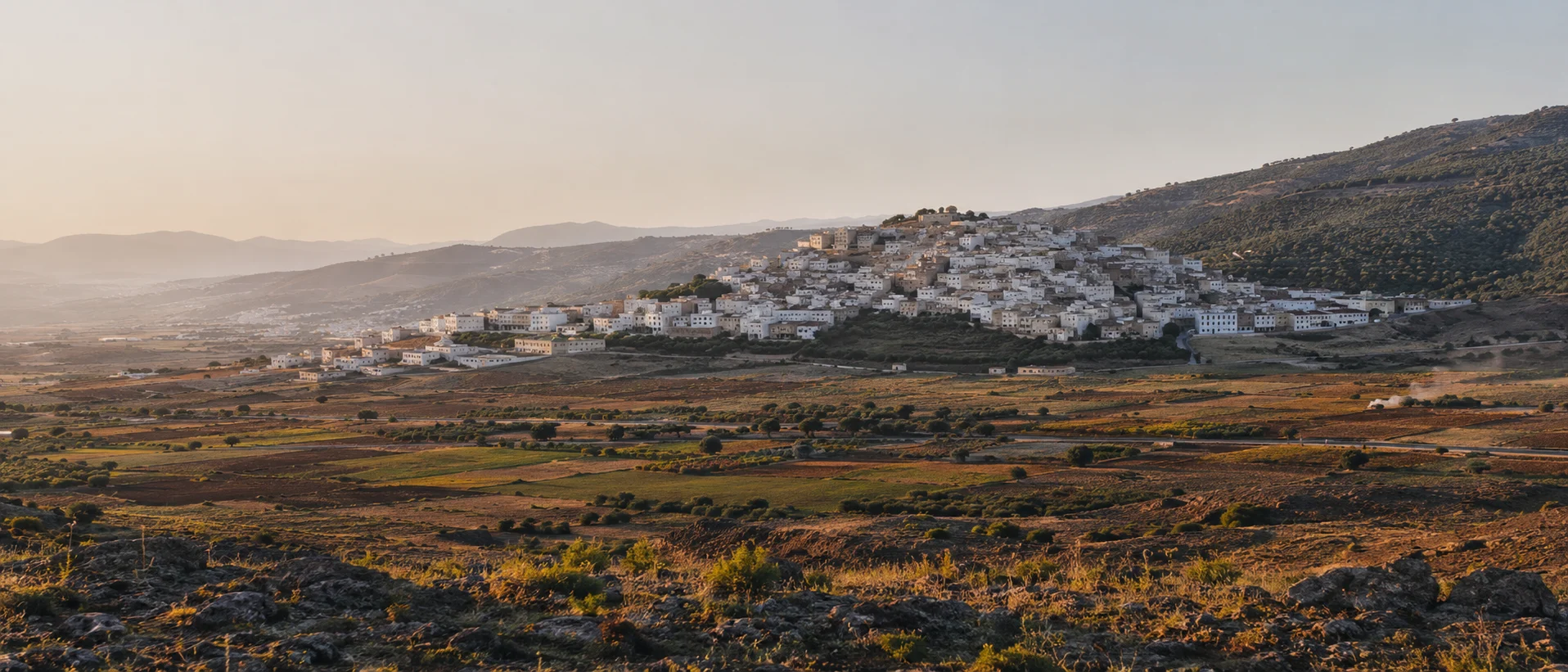
Begin in Moulay Idriss Zerhoun today and the first surprise is scale. This is not a capital trying to announce itself with avenues and towers. White houses gather over the hills, streets climb and turn, and beyond them lies a landscape that has watched people arrive and disappear for centuries.
Yet the name Idris is enormous in the Moroccan story. To understand why, we have to leave the present for a moment and go back more than twelve centuries, before Rabat was the capital, before Marrakech existed, and before the dynasties that later filled Moroccan history books with familiar names.
This is where I prefer to begin history: not with a list of rulers, but with a place you can still walk through.
Before Morocco was the Morocco we know
The land we call Morocco already possessed very old histories before the Idrisids. Amazigh communities, Phoenician and Punic contacts, Mauritanian kingdoms, Roman rule in parts of the north, Christianity, Judaism and the gradual arrival of Islam all belong to the layers that came before.
That matters because the Idrisid story did not begin on an empty map. No dynasty ever does.
Walili, known internationally as Volubilis, makes this visible better than almost anywhere. Its archaeological remains preserve evidence of ancient settlement and Roman urban life, while nearby Moulay Idriss Zerhoun belongs to a later Islamic chapter. Two historical worlds sit almost beside one another.
Idris ibn Abdallah arrives in the far west
Idris ibn Abdallah, remembered as Idris I, was a descendant of the Prophet Muhammad through Hasan ibn Ali. After the Abbasid repression that followed the battle of Fakh near Mecca in 786, he escaped east-to-west across a vast distance and eventually reached the far Maghrib.
By 788–789 he was established around Walili. The Awraba, an Amazigh tribal group, supported him. That alliance is essential. The Idrisid beginning was not simply an eastern prince arriving and creating Morocco by himself. Political authority required local relationships, tribal support and a landscape already inhabited by communities with their own power.
From this meeting emerged a new political project.
Why 789 matters without turning it into a magic number
Moroccan historical summaries commonly use 789 as the beginning of the Idrisid dynasty. It is a useful date, but history rarely wakes up on January first and announces that a new era has begun.
Authority had to be negotiated, extended and defended. Different regions of what is now Morocco did not suddenly become one uniform state. The Idrisid realm itself would later divide among branches of the family.
So I prefer to say that the late eighth century marks the beginning of one of the foundational political chapters of Islamic Morocco, rather than pretending that the modern country appeared complete in a single year.
Walili: ruins do not belong to only one civilisation
Walk through Volubilis and Roman stone dominates what the eye sees: columns, arches, mosaics, streets and the geometry of an ancient city. But a ruin is not a photograph frozen at one date.
After Roman political control withdrew, life in the region continued. Centuries later Idris I made the area around Walili his first centre of power.
I like this because it destroys the temptation to divide Moroccan history into sealed boxes. Roman, Amazigh, Islamic, Arab, Andalusian, African and Mediterranean stories repeatedly meet on the same ground.
The alliance with the Awraba
The Awraba should not appear in our story as extras waiting for the hero to arrive. Their support helped make Idris I’s authority possible.
This is one reason I dislike histories written only through dynastic names. A king gives us an easy chapter title. The society around him is much harder to fit into a paragraph.
Tribes, farmers, merchants, religious figures, soldiers, craftsmen and families create the world in which a dynasty can exist. Without them, the ruler is only a name.
A descendant of the Prophet, and the power of lineage
Idris I’s descent from the Prophet gave his leadership a religious and symbolic legitimacy that mattered deeply. The language of sharifian descent would continue to have importance in Moroccan history long after Idrisid political power disappeared.
But lineage alone did not build towns, feed populations or secure roads. The Idrisid story is interesting precisely because symbolic legitimacy met local alliances and practical politics.
Morocco would repeatedly combine these dimensions in different ways under later dynasties.
A short reign with a long shadow
Idris I did not rule for decades. He died in 791. Traditional accounts attribute his death to poisoning connected with Abbasid hostility.
His political life in Morocco was therefore remarkably short compared with the memory that followed.
Sometimes history works like this. A person occupies only a few pages chronologically and then remains present for twelve centuries through a town name, a sanctuary, family lineages, public memory and the state story.
Idris II inherits more than a throne
Idris II was born after his father’s death and later assumed leadership while still young. Under him the Idrisid project gained a more durable political and urban centre.
That centre was Fez.
Depending on how one describes the stages of foundation, both Idris I and Idris II belong to the city’s early story. What matters for our journey is that under Idris II, in the early ninth century, Fez became the seat from which a new political and cultural centre could grow.
Fez before it became Fez in our imagination
It is difficult to look at Fez today without carrying a thousand later images into the ninth century: madrasas, carved cedar, zellij, tanneries, scholars, merchants and the dense lanes of Fez el-Bali.
But the early Idrisid city did not yet contain all the centuries that would later be added to it.
UNESCO describes the medina as preserving the memory of a capital founded by the Idrisid dynasty between 789 and 808. The city developed as two fortified communities on opposite banks of the Fez wadi.
That division would become one of its strengths.
Andalusians on one bank
In the early ninth century, families arriving from al-Andalus settled on one side of Fez. Moroccan tourism documentation connects a major arrival to families expelled from Córdoba after the revolt of the suburb in 817–818.
They did not arrive carrying only bodies. Migrants never do.
They brought language, habits, skills, religious learning, food, memories and ways of building a life. Fez began becoming itself partly because people arrived from somewhere else.
Kairouan on the other
Another community came from Kairouan in Ifriqiya and settled on the opposite bank. The two sides would later be known through their Andalusian and Qarawiyyin identities.
This is one of my favourite facts about Fez because it makes the city a lesson in movement.
A city we now call deeply Moroccan was strengthened by people arriving from Córdoba and Kairouan. Identity did not become weaker because of movement. Movement helped build the identity.
Al-Qarawiyyin and the danger of stealing history from the people who made it
When speaking about Fez, Al-Qarawiyyin inevitably appears. Its later role in scholarship and religious life is immense.
But we should be precise about chronology. The famous mosque is traditionally associated with Fatima al-Fihri in the ninth century, after the earliest Idrisid foundation of Fez. It should not simply be described as a monument personally built by Idris I or Idris II.
History becomes richer when we allow different actors to keep their own achievements.
A capital becomes a crossroads
Fez had geography on its side. Water, fertile surroundings and a position connecting different regions helped it grow into a political, commercial and intellectual centre.
Over centuries, later dynasties would rebuild, expand and transform it. The Almoravids united the two early quarters within one wall. Almohads and Marinids added their own layers. Fez Jedid came later under the Marinids.
So when we call Fez an Idrisid city, we are naming its beginning, not claiming that everything we admire today was made in one period.
Meskaoui
“As a child, I did not ask which dynasty built what. An old wall was an old wall, a door was a door. Growing older taught me that sometimes history had been standing beside us quietly all along.”
— Meskaoui
The south was not waiting for Fez
Now I want to leave the north, because this is where a simplified story of Morocco can become misleading.
While Idrisid power developed around Walili and Fez, the south and southeast had their own political worlds. Sijilmasa, in the Tafilalt, had emerged in the eighth century and became a major Saharan commercial centre under rulers associated with the Sufri Kharijite tradition and later the Midrarids.
This matters to me personally because when we speak about the Ziz, Tafilalt and today’s Errachidia region, we are not speaking about a peripheral blank space waiting for northern dynasties to give it history.
The south already had history.
Sijilmasa: another Morocco was growing at the same time
Sijilmasa stood near the great trans-Saharan routes. Gold, salt, people, ideas and goods moved through networks linking the Maghrib with regions south of the Sahara and with the Mediterranean world.
The Encyclopédie berbère describes the Midrarids as a Miknasa Amazigh dynasty based at Sijilmasa and notes the city’s importance as a terminus of trans-Saharan caravan traffic.
So in the ninth century, while Fez was developing in the north, the Tafilalt belonged to another political and commercial story.
Morocco was already plural.
Did Idrisid descendants reach the Tafilalt?
Here we arrive at a question that is tempting for someone from the southeast: did Idrisid families or descendants eventually travel toward the Tafilalt, the Ziz valley or lands around today’s Errachidia?
It is possible. Families, scholars, merchants and sharifian lineages moved across Morocco over many centuries. Political fragmentation also dispersed branches and followers.
But possibility is not proof.
I have not found evidence strong enough to say that Idrisid families settled specifically in Ksar Meski or the immediate Errachidia area during the dynasty’s early period. The honest sentence is therefore the more interesting one: they may have passed or settled in parts of the wider region over the centuries, but we should not transform a possibility into a family legend simply because it would make a beautiful paragraph.
Meskaoui
“Sometimes history gives us a name and a date. Sometimes it gives us only a road. When it gives me only the road, I prefer to imagine the travellers without inventing their names.”
— Meskaoui
The Ziz is a road as much as a river
The Ziz valley naturally encourages these questions because valleys are corridors. Water makes settlement possible, and routes connect oases to larger commercial worlds.
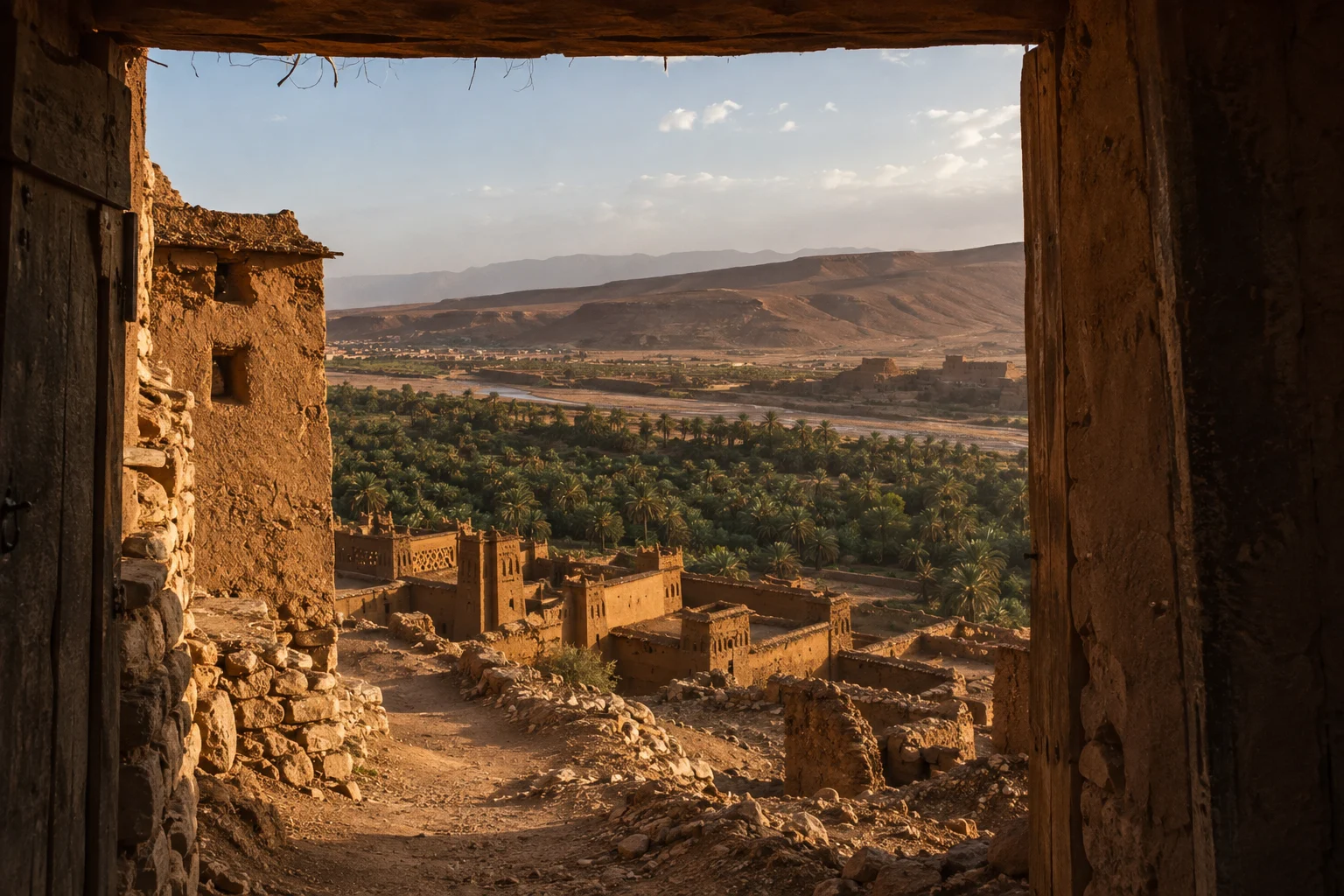
Growing up around an oasis can make history feel strangely close. A ksar, an old wall, a well, a palm grove: as a child these are simply the furniture of life. Later you begin asking who passed here before you.
That question is valuable even when the answer is incomplete.
Ksar Meski and the discipline of not claiming too much
I could easily write a romantic sentence claiming that Idrisid descendants once stood beside the spring at Ksar Meski. It would sound beautiful.
But beauty is not evidence.
What I can say is that the wider Tafilalt and Ziz region participated in long histories of settlement, oasis agriculture and caravan movement, and that Sijilmasa became one of medieval Morocco’s most important southern centres.
For me that real history is already rich enough.
When dynasties fragment
Idrisid political unity did not remain intact. After Idris II, territories were divided among descendants and competing powers pressed from different directions.
By the tenth century, the western Maghrib had become a field of rivalry involving Idrisid branches, Miknasa groups, Umayyad Córdoba and the Fatimids.
This is another reason not to imagine a clean coloured map with one dynasty controlling every valley in the same way.
Medieval power was often layered, negotiated and unstable.
The Idrisids disappear politically, but Idris does not disappear
Political dynasties can fall while their symbolic life continues.
The memory of Idris I at Moulay Idriss Zerhoun and Idris II at Fez became embedded in Moroccan religious and historical consciousness. Sharifian lineage remained politically meaningful in later centuries.
Even when another dynasty ruled, Idrisid memory could still help Moroccans tell the story of beginnings.
Then came other Moroccos
After the Idrisid age came political orders that changed the scale of Morocco. Almoravids built Marrakech and ruled an empire extending across the western Maghrib and al-Andalus. Almohads followed. Marinids made Fez flourish again. Saadians and then Alaouites wrote later chapters.
Each dynasty inherited a country that did not begin with it.
This is why Moroccan history feels less like replacing one house with another and more like adding rooms to a structure whose foundations keep reappearing.
The Tafilalt returns to the centre centuries later
Centuries after the Idrisids, the Tafilalt would again become central to the dynastic story of Morocco through the rise of the Alaouite dynasty, whose origins are associated with the region.
For someone from the Ziz area, this is an important correction to a north-centred history.
Fes, Meknes, Marrakech and Rabat are famous imperial cities. But the southeast has also sent political history outward.
A country made by roads between regions
Perhaps the most useful way to understand early Morocco is not as a collection of isolated capitals but as movement between regions.
Walili connected to wider northern networks. Fez drew people from al-Andalus and Ifriqiya. Sijilmasa connected the Mediterranean world to trans-Saharan commerce. Mountain routes, plains, valleys and oases moved people between them.
A dynasty may rule from a city. A civilisation needs roads.
What survives in Fez
Today Fez el-Bali is not a ninth-century city preserved under glass. It is the result of continuous change.
That is precisely why it matters.
Walk through it and you encounter Idrisid memory beside Almoravid, Almohad, Marinid and later contributions. Crafts continue in forms that changed over generations. Houses have been repaired. Streets adapted. Families arrived and left.
Heritage survives by living, and living always changes things.
What survives in Moulay Idriss Zerhoun
Moulay Idriss Zerhoun carries memory differently. The town’s identity remains inseparable from the figure of Idris I and his mausoleum.
For visitors, it can be tempting to photograph the white town, eat, leave and say it was beautiful.
But knowing why the name matters changes the landscape. The hill becomes connected to an eighth-century refugee, an Amazigh alliance, the beginnings of a dynasty and a memory that outlived political power.
What survives at Volubilis
At Volubilis the lesson is almost the opposite.
The visible ruins remind us that Morocco did not begin with the Idrisids. The country contains pre-Islamic and Roman chapters that deserve their own dignity.
Standing there and then looking toward Moulay Idriss Zerhoun allows two truths to coexist: Morocco’s Islamic dynastic story is deep, and Morocco’s history is much older than that story.
Neither truth needs to erase the other.
History is more beautiful when it refuses propaganda
I love Morocco. Precisely because I love it, I do not need to simplify it.
I do not need to claim that one man invented the country, that one dynasty controlled every corner, or that every old family descends from a famous ruler.
The real story contains Amazigh alliances, Arab lineages, Andalusian migration, Saharan trade, African connections, religious diversity, rivalry, fragmentation and reinvention.
That is not a weakness. That is richness.
What a dirham can tell us
Coins are among the quiet witnesses of early states. Idrisid dirhams survive in collections and catalogues, carrying names, formulas and minting evidence that historians can compare with written chronicles.
A coin does not tell us what a family ate for dinner or what a road smelled like after rain. But it can tell us that authority wanted to be named, recognised and circulated through exchange.
History becomes strongest when texts, archaeology and material evidence are allowed to question one another.
Religion was not a single colour either
The religious history of the early Maghrib was complex. Different Kharijite currents had influence in parts of North Africa, while Sunni traditions developed over time and competing political movements used religious legitimacy in different ways.
Even the Idrisids are sometimes described too quickly with modern sectarian labels. UNESCO’s General History of Africa cautions against simply classifying them as a Shiite dynasty, noting that they did not preach Shiite doctrine in the straightforward way such a label might suggest.
Again, the complicated answer is usually more useful.
Fez teaches us what migration can become
There is something almost modern in the early Fez story. People displaced from one city arrive in another and, generations later, their neighbourhood becomes part of the destination’s heritage.
Nobody visiting Fez today says the Andalusian quarter is less Moroccan because its name remembers migration.
Time can transform arrival into belonging without requiring people to erase where they came from.
The caravan and the court
Political histories naturally focus on courts. Trade histories follow different protagonists.
A merchant leaving Sijilmasa did not need to care which dynasty a modern textbook would use as the chapter heading. He cared about security, water, animals, prices, partners and the road ahead.
Putting the caravan beside the court changes our view of Morocco. The country becomes not only territory ruled from capitals, but a junction between Mediterranean, Saharan, African and Atlantic worlds.
Why the uncertainty around Errachidia is worth keeping
I could remove the question of Idrisid movement toward Errachidia entirely and make the article cleaner. I prefer to keep it because uncertainty is part of historical literacy.
People naturally want to connect their home region to famous names. Sometimes documents allow that. Sometimes family tradition suggests it. Sometimes nothing reliable survives.
Saying ‘perhaps, but we cannot demonstrate it here’ is not a failure. It teaches the reader where history ends and imagination begins.
A dynasty is not a people
Another trap is to use Idrisid, Moroccan, Arab or Amazigh as if each word describes the same kind of thing.
A dynasty is a ruling lineage. A population contains many communities. A political territory changes. Cultural identity develops over centuries.
Keeping those categories separate helps us appreciate how a sharifian Arab lineage could depend on Amazigh alliances and rule within a society that was never reducible to the dynasty’s family tree.
The Moroccan habit of carrying history in names
Morocco is full of names that act like small archives: Moulay Idriss, places associated with saints, dynasties remembered in gates and neighbourhoods, family names that point toward regions or occupations.
Not every story attached to a name can be verified literally. But names tell us what communities chose to remember.
That is a historical fact in itself.
Why this belongs in a honey journal
Someone may reasonably ask what Idris I has to do with a journal created by people who work with honey.
My answer is simple: very little, if the journal exists only to sell jars. A great deal, if the jar is part of a larger relationship with land, travel, family and culture.
I do not want every road to end at a product page. Some roads should end at a place, a question or a book.
Culture loses value when we allow ourselves to discuss it only when it can sell something.
The child of the oasis looks north
When I think from Ksar Meski toward Fez, the distance is not only kilometres.
The landscapes change. The climate changes. The architecture changes. The histories that dominated each region at particular moments change.
Yet both belong to the same Moroccan story.
This is perhaps what growing older has taught me about the country: loving your own oasis should make you more curious about the other valley, not less.
Why we should visit history rather than only read it
A date such as 789 is easy to forget.
A road climbing through Moulay Idriss Zerhoun is harder to forget. The stones of Volubilis are harder to forget. Getting lost in Fez is almost impossible to forget.
Travel gives dates somewhere to live.
If you can, visit these places slowly. Do not try to collect them as photographs. Read a little before arriving, walk, then read again afterward. You will notice that the second reading has acquired smells, distances and light.
From one beginning to many beginnings
Was the Idrisid dynasty the beginning of Morocco?
It depends on what we mean.
It was a foundational early Islamic dynasty in the far Maghrib and occupies a central place in Morocco’s dynastic memory. But the land had long histories before Idris I, and regions such as Sijilmasa followed political trajectories that were not simply extensions of Fez.
So perhaps Morocco has many beginnings.
That answer is less convenient than a slogan. It is also much closer to the country I recognise.
The road remains open
Our journey began in a small hill town and travelled backward to Idris I, across Walili, into Fez, then south toward Sijilmasa, Tafilalt and the Ziz.
We did not prove that an Idrisid ancestor stood in Ksar Meski. We did something better: we allowed the evidence to tell us where certainty ends.
And beyond certainty, we kept curiosity.
That is how I want to write history here. Respect the date when we know it. Respect the doubt when we do not. Then walk the road and listen to what the places still have to say.
Questions about the Idrisids and early Morocco
Idris I, a descendant of the Prophet Muhammad through Hasan ibn Ali, established himself around Walili in the late eighth century with crucial support from the Awraba Amazigh.
789 is commonly used for the establishment of Idrisid rule. It marks a foundational phase in the development of an independent Islamic political authority in the far western Maghrib.
Fez developed as the principal Idrisid political centre under Idris II. Its early communities included settlers associated with al-Andalus and Kairouan.
The southeast had its own political history. Sijilmasa was associated with Sufri Kharijite rulers and the Midrarids. Idrisid influence and later family movements should not be confused with direct, continuous Idrisid control of the Tafilalt.
Movement of families and sharifian lineages across Morocco makes later presence in the wider southeast possible, but this article does not claim a specific early Idrisid settlement at Ksar Meski or Errachidia without documentary evidence.
Continue the Journey
If this story brought you here, continue the journey through related stories from The House of Meski.