
How the desert forged the most influential horse breed in history — and why it still matters today.
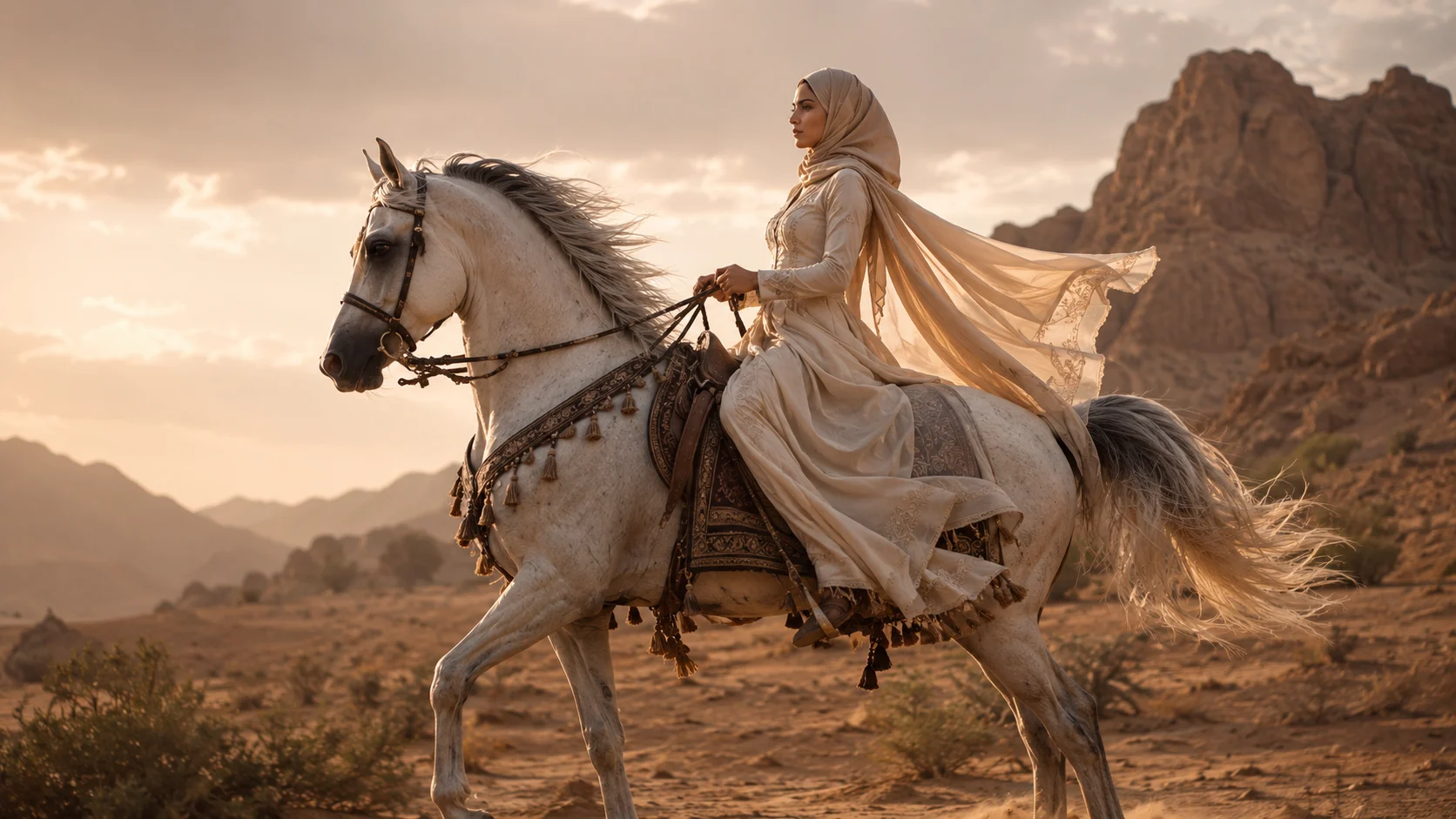
The Arabian horse is one of the oldest and most influential horse breeds in history — shaped by the desert, refined by Bedouin wisdom, and carried across continents to become the genetic foundation of modern racing and the living symbol of Gulf heritage.
A Silhouette on the Horizon
Before the sun clears the dunes, before the heat begins to press down on the sand, there is a moment of perfect stillness across the Arabian desert. The sky is not yet blue — it is that particular shade between amber and rose that belongs only to the hour before full light. The silence is complete.
And then, on the horizon, something moves.
A horse. Alone. Its neck arched, its tail lifting like a banner in the early wind, its steps so fluid that it appears to float just above the ground rather than touch it. It moves with the confidence of something that has always belonged here — not as a visitor to this landscape, but as one of its essential elements, as natural and inevitable as the dunes themselves.
This image — a single Arabian horse against the immensity of the desert — is not merely beautiful. It is one of the oldest images in human memory. People have been watching it, drawing it, singing about it and writing poetry in its honour for thousands of years. No other horse breed has inspired as much literature, as much art, as many legends. No other breed has been carried so far from its birthplace and left so deep an impression on the equine world.
This is the story of the Arabian horse. Not simply a breed profile, but the story of a living creature that helped shape civilisations, trade, exploration, warfare, diplomacy and the very genetics of modern horse racing. It is a story that begins in the desert and ends — so far — everywhere on earth.
The Birth of a Legendary Horse
The Question of Origins
Honesty demands a beginning with uncertainty. The precise origins of the Arabian horse are, as more than one scholar has put it, “lost in the sands of time.” This is not a poetic evasion — it is an accurate description of the state of the evidence.
Archaeological indications of horses in the Arabian Peninsula date back at least 4,000 to 5,000 years, with some estimates reaching further. Horses with refined heads and high tail carriage appear in Egyptian artwork dating to the 16th century BC. The Neolithic site of al-Maqar in what is now Saudi Arabia yielded carved equid statues that have prompted genuine scholarly debate about whether the domestication of horses in Arabia may predate earlier assumptions — though researchers are careful to note that faunal remains from the peninsula are difficult to interpret with certainty, as distinguishing between equid species from bone fragments alone remains a genuine challenge.
One influential theory places the earliest domestication in the Nejd plateau of central Arabia. Another argues that horses were relatively rare on the Arabian Peninsula before the rise of Islam in the seventh century AD, and that the distinctive breed as we know it emerged and was refined through Bedouin selective breeding over the centuries that followed. Academic journals continue to explore both possibilities.
What is not in dispute is this: whatever the precise date of its emergence, the Arabian horse was shaped most profoundly by the Bedouin people of the Arabian Peninsula, and the result was a breed unlike anything the world had produced before.
Shaped by the Desert Itself
To understand the Arabian horse, it helps to understand the environment that formed it.
The Arabian desert does not forgive weakness. Temperatures swing between extremes. Water sources are scarce, sometimes separated by days of travel. Forage is minimal. The air is dry and the ground is hard. Any animal that could not adapt to these conditions simply did not survive long enough to breed.
Over centuries, natural selection and the deliberate choices of Bedouin breeders produced a horse perfectly fitted to this world. Large, flaring nostrils that could take in more air during effort. A broad forehead with what the Bedouin called the jibbah — a slight convex bulge between the eyes — that increases sinus capacity and is believed to have assisted with breathing and temperature regulation in dry desert air. A large windpipe set cleanly on a refined, arched neck. A deep chest with well-sprung ribs offering exceptional lung capacity. Legs with dense, strong bone rather than mere size.
Many Arabians also display a slightly shorter back than other breeds — some carry one fewer lumbar vertebra — which contributes to their famously compact, powerful build. It is worth noting that scientists have found variation in this: some Arabians carry the standard vertebral count, others fewer. The breed shows a higher frequency of these anatomical variations, but it is not a universal rule applied to every horse. This is the kind of nuance that enthusiasts sometimes flatten into myth, and the breed deserves better than that.
The result of all this natural and human refinement is a horse of extraordinary stamina. Not necessarily the fastest over a short distance — the Thoroughbred, its descendant, surpasses it in pure sprint speed — but capable of covering distances across difficult terrain that would exhaust almost any other breed. In endurance competition today, the Arabian is the undisputed master of the long race.
Arabia: The Cradle of the Arabian Horse
The Bedouin and the Science of Memory
What the Bedouin built around the Arabian horse was not simply a breeding programme. It was, in the truest sense, a civilisation of knowledge.
For centuries, at a time when no written pedigree books existed, the Bedouin maintained the purity and identity of their horses through an oral tradition of genealogical memory so precise and so disciplined that it functioned as a living archive. Every mare’s lineage was known — not just for one or two generations, but often stretching back further than memory itself could confidently reach. Breeders knew the history of their best war mares in detail comparable to the way they knew their own family histories. The two were, in a sense, the same kind of knowledge: a record of descent, character and proven ability.
This matrilineal system — tracing lineage through the dam rather than the sire — was both culturally meaningful and practically sound. A foal’s strain identity was always determined by its mother. If a Kuhaylan mare was bred to a Saqlawi stallion, the foal was Kuhaylan. The strain — the asil — was passed through the female line, and it carried real meaning: not merely a name, but a set of characteristics that had been selected and reinforced across generations.
The concept of asil — meaning “pure of origin” or “of authentic descent” — was central to Bedouin horse culture. An asil horse was one whose lineage could be vouched for entirely through Bedouin breeding, without admixture from non-Arabian horses. The responsibility of attestation was serious: a Bedouin who swore to a horse’s purity did so before Allah, and the oath carried genuine weight. The first written pedigrees in the Middle East that specifically used the term “Arabian” date to 1330 AD — but the oral tradition they eventually recorded was already centuries older.
Where there was no pasture, Bedouin fed their horses on dates and camel’s milk. At night, in cold desert conditions, horses were sometimes brought inside the family tent for warmth. This was not merely sentiment. It was practical wisdom: a horse that lived alongside humans became familiar with human scent, human voice and human gesture. The result was the Arabian’s famous temperament — alert, intelligent, sensitive, capable of forming deep bonds with people, but also high-spirited in ways that could surprise those who underestimated it.
The Five Great Strains
Among the many strain families recognised by Bedouin breeders, five emerged as the most prominent and widely acknowledged: Kuhaylan (sometimes spelled Kuhailan), Saqlawi (Saklawi), Hamdani, Hadban and ‘Ubayyan (Aayan in some transliterations). Each was associated with particular physical and temperamental qualities — the Kuhaylan considered “masculine” and powerfully built, the Saqlawi more refined and elegant, the Hamdani larger-framed and harder, the Hadban notable for its calm disposition.
These distinctions were not rigid categories but living descriptions, shaped by the particular conditions of each tribe’s territory and the specific demands placed on their horses. Different tribes in different regions maintained their own sub-strains and regional variations, which is why modern researchers encounter such complexity when attempting to map the strain system onto contemporary genetics. The oral tradition was never designed to satisfy a European stud book — it was designed to serve the needs of desert life.
The Warrior Strain
Powerfully built, “masculine” in type, prized by Bedouin as the great war strain. Known for courage and endurance under the most demanding desert conditions.
The Elegant Strain
More refined and elegant in conformation. Traditionally associated with beauty, refinement and the qualities most prized in a mare of exceptional breeding.
The Hardy Strain
Larger-framed and harder than other strains, bred for sustained performance over long distances in the most unforgiving terrain.
The Bond That Went Beyond Utility
It would be a mistake to describe the Bedouin relationship with the Arabian horse purely in terms of usefulness. The horse was companion, confidant and cultural hero. Arabic poetry dedicated to horses is a genre unto itself, stretching across centuries. Horses appear in the Quran and in the hadith of the Prophet Muhammad ﷺ, who encouraged his followers to care for horses with kindness and spoke of the mare as the most precious of animals for the continuation of the breed. This was not incidental: the integration of the horse into spiritual and cultural life reflected how deeply the Arabian had woven itself into the fabric of Arabian identity.
When the Bedouin described a great horse, they used words that they also used for great people: honour, loyalty, courage, generosity. The horse was not a tool that happened to be beautiful. It was a being whose qualities mirrored the virtues they most admired in themselves.
A Companion of Trade and Exploration
Along the Caravan Roads
The Arabian horse did not remain within the boundaries of the peninsula for long.
The great caravan routes that connected Arabia to Persia, the Levant, Egypt, India and the Mediterranean were among the most important arteries of the ancient world. Along these routes moved spices, incense, silk, gold, ivory and slaves — but also horses. The Arabian horse became, over centuries, one of the most prized commodities of the ancient trade world, sought by rulers and military commanders who understood that the quality of their cavalry could determine the fate of entire campaigns.
Egyptian pharaohs prized horses from Arabia. Persian kings maintained studs of oriental breeds. The armies of the ancient world — Assyrian, Persian, Egyptian — competed for access to the finest desert-bred animals. Even before the Islamic expansion that would carry the Arabian horse to every corner of the known world, the breed was already moving along trade routes, arriving as tribute, as diplomatic gifts, as prizes of war and as objects of commerce.
The Horse That Crossed Continents
The single most significant expansion of the Arabian horse’s range came with the rise of Islam in the seventh century AD. The Hijra — the Prophet’s migration from Mecca to Medina in 622 AD — marked the beginning of a transformation that would reshape the world within a generation. By 630, Muslim influence had expanded across the Arabian Peninsula. By 711, Muslim warriors had reached the Iberian Peninsula. By 720, they controlled most of what we now call Spain and Portugal.
Their horses went with them.
The Islamic expansion was not simply a military event. It was a cultural, intellectual and agricultural revolution, and horses were part of it. As Muslim armies moved into North Africa, Persia, the Levant, Central Asia and Iberia, they brought with them horses of Arabian and oriental breeding that would begin, over subsequent centuries, to influence the native breeds of those regions. The Andalusian horse of Spain, celebrated across Europe, carries Arabian influence in its ancestry. The Barb of North Africa absorbed oriental bloodlines. The horse breeds of Persia, of India — where Mughal emperors famously prized Arabians arriving via diplomatic exchange — and of Turkey all reflect centuries of contact with the Arabian horse.
The Ottoman Empire played a particularly important role in this transmission. The Ottomans acquired Arabian horses through trade, through diplomacy and through the fortunes of war, and their campaigns carried these horses deep into central and eastern Europe. When the Ottoman cavalry was turned back at the gates of Vienna in 1683, the horses captured from the retreating army became, in some cases, foundation stock for new Central European breeds. History has a way of moving through horses.
A Gift Fit for Emperors
Throughout the medieval and early modern period, the gifting of an Arabian horse was among the most significant diplomatic gestures one ruler could offer another. This was not merely custom — it was a statement of trust, prestige and cultural connection. An Arabian horse was not a commodity. It was a message.
Chinese emperors sought Arabians via the Silk Road. Mughal courts in India received them as symbols of the highest regard from Middle Eastern rulers. European monarchies, beginning in the Renaissance period and accelerating through the 17th and 18th centuries, began importing Arabian stallions with deliberate purpose: not as ornaments, but as instruments of equine improvement.
They had understood something important. The native horse breeds of northern Europe — heavy, cold-blooded, excellent for ploughing and carrying armoured knights — were ill-suited to the new style of warfare and sport that modernity demanded. What was needed was speed, stamina and refinement. What was needed, it turned out, was the Arabian horse.
How the Arabian Horse Changed the World
Three Stallions That Rewrote Racing History
In the late 17th and early 18th centuries, three stallions arrived in England from the Middle East. Their names — the Byerley Turk, the Darley Arabian and the Godolphin Arabian — are today the founding names of every single modern Thoroughbred racehorse on earth. All of them, from the winners of the Kentucky Derby to the champions of Ascot and Dubai, trace their male line back to one of these three horses.
The Byerley Turk (c. 1689)
Reportedly captured at the Battle of Buda in 1686 by Captain Robert Byerley and brought to England, where he served as a war horse before beginning a career at stud. Whether he was purely Arabian or of another oriental type remains debated by historians, but his eastern desert origin is not in question.
The Darley Arabian (c. 1704)
Bought in Aleppo, Syria, around 1700 by Thomas Darley, an English merchant, and shipped to Aldby Park in Yorkshire as a gift for his brother. Bay in colour, he became what historians now consider the most influential of the three — his male-line descendants account for a vast majority of all modern Thoroughbreds. His great-great-grandson Eclipse, foaled in 1764, was never defeated in a race.
The Godolphin Arabian (c. 1724)
Foaled in Yemen around 1724, sent as a gift from the Bey of Tunis to King Louis XV of France — and then, apparently not valued at the French court, found by an Englishman drawing a cart in Paris. From obscurity to the foundations of the world’s greatest racing breed: few journeys in horse history are more improbable.
These three horses did not simply contribute to the Thoroughbred. They are the Thoroughbred’s entire male ancestry. Every Derby winner, every champion at Royal Ascot, every record-breaker at Meydan in Dubai carries in its blood the genes of horses that were born in the deserts and cities of the Arabian world.
Napoleon’s Grey Horse and the Limits of Legend
One of the most frequently cited examples of the Arabian horse’s influence in European history is Marengo — reportedly Napoleon Bonaparte’s favourite war horse, an Arabian grey carried from Egypt to France after the Battle of Abukir in 1799, and said to have carried the Emperor at Austerlitz, Jena, Wagram and Waterloo. His skeleton is held today at the National Army Museum in London.
It is a wonderful story. And, as with many wonderful stories, it deserves honesty. Historians have noted that contemporary French records do not mention a horse named Marengo, and some researchers suggest that Napoleon may have used the name for several different horses — the name commemorating the famous battle rather than identifying a single animal. The horse whose skeleton is displayed in London is categorised as an Arabian — but whether it is the specific horse of legend, or one of several greys associated with Napoleon, remains genuinely uncertain.
This does not diminish the Arabian horse’s real presence in European military history. What it illustrates is something The House of Meski believes profoundly: that legends, however beautiful, are best told with their seams visible. The Arabian horse’s actual contribution to European history needs no embellishment. It is remarkable enough on its own terms.
The Breed That Improved All Breeds
“For centuries,” wrote one of the leading authorities on horse breeding, “nearly all light horse breeds and some draft and warmblood breeds have used the Arabian horse to develop or improve their breed.”
This is not an exaggeration. The Andalusian of Spain carries Arabian influence from the Islamic centuries. The Lipizzaner of the Spanish Riding School in Vienna traces oriental lines. The Morgan of North America, the Quarter Horse, the Standardbred, the Saddlebred, the Trakehner of Germany, the Lusitano of Portugal — each carries Arabian blood, in some cases extensively. A 2020 genomic study published in scientific literature confirmed the Arabian’s foundational genetic role in the global horse population, revealing patterns of ancestry that radiate outward from the Arabian Peninsula across centuries of breeding history.
What does the Arabian horse possess that made it so valuable as an improver of other breeds? Breeders across cultures and centuries identified the same qualities: an unusual capacity for endurance without visible fatigue, a refined bone structure that reduced weight without sacrificing strength, a large respiratory system that fuelled sustained performance, a sensitivity and intelligence that made horses more responsive and easier to manage, and a remarkable ability to pass these traits to offspring regardless of the mare’s breed. This last quality — what breeders call “prepotency” — made the Arabian almost uniquely powerful as a breeding stallion.
The Legacy That Lives Today
Saudi Arabia, the UAE and the Living Tradition
The Arabian horse was never simply a historical artefact. In Saudi Arabia and the UAE, it remains a living symbol of identity, pride and continuity — not as nostalgia, but as a genuinely practised tradition.
In Saudi Arabia, the Arabian horse occupies a place in national culture that few other animals share anywhere in the world. The annual Ubayyah festival in Diriyah celebrates the breed’s heritage with events that draw participants from across the Arab world. The Princess Sultan bin Abdulaziz International Arabian Horse Festival is among the most important beauty contests of its kind. On Saudi Founding Day — observed every February 22nd — the Arabian horse is formally recognised as a centrepiece of Saudi identity and national heritage.
In the UAE, the Emirates Arabian Horse Society works alongside the Abu Dhabi Heritage Authority to promote the breed internationally, including partnerships with events in Morocco. Al Shaqab in Qatar — the equestrian facility of Qatar Foundation — has become one of the most celebrated centres of Arabian horse culture in the world, hosting international shows and preserving bloodlines of the highest documented purity.
Today, the Arabian horse exists in far greater numbers outside its land of origin than it ever did in the deserts of ancient Arabia. Registries operate across North America, Europe, Australia, Brazil and beyond. And yet, for serious breeders and cultural custodians, the connection to the Bedouin tradition — to the concept of asil, to the strain system, to the unbroken chain of matrilineal memory — remains the measure of authenticity that no number can replace.
Endurance: The Ancient Test Revived
Perhaps nowhere is the Arabian horse’s ancient character more visible today than in endurance riding — long-distance equestrian competitions that can cover 80 to 160 kilometres across demanding terrain in a single day. In these events, the Arabian is, without meaningful competition, the dominant breed worldwide. It wins not with a burst of speed but with the quality that the desert selected for across millennia: the ability to keep going when everything else stops.
The UAE hosts some of the world’s most prestigious endurance events, including races associated with the name of Sheikh Mohammed bin Rashid Al Maktoum of Dubai, whose passion for the breed has brought international attention to both endurance competition and Arabian breeding. When an Arabian horse crosses the finish line of a 160-kilometre desert race, it is completing a version of the same journey its ancestors made alongside Bedouin riders thousands of years ago. The test has changed in detail. The horse has not.
The Asil Tradition
The concept of asil — “pure of origin” — remains alive today. Organisations such as Al Khamsa in North America and the Asil Club in Europe maintain registries of horses whose pedigrees trace entirely to Bedouin-bred Arabians, without admixture from other breeds. For their members, this is not antiquarianism. It is stewardship of a living heritage.
Final Thoughts
There is a particular kind of knowledge that comes not from reading but from standing still beside a great horse and understanding, in your body rather than your mind, that you are in the presence of something that has survived much longer than any of our certainties.
The Arabian horse has outlasted empires. It accompanied the armies that built them and the caravans that connected them. It was sent as a gift between rulers who no longer exist, across borders that have been redrawn a dozen times. It arrived in England as three unknown stallions and became the ancestor of every champion racehorse that has run on earth since. It moved through history not as a symbol, but as a participant.
What the Bedouin understood — and what serious breeders, historians and horsemen continue to understand — is that the Arabian horse is not simply a beautiful animal. It is a record. In its conformation, its physiology, its temperament and its genetics, it carries the accumulated wisdom of thousands of years of deliberate, careful, loving human attention. The desert shaped it. The Bedouin refined it. And the world inherited it.
If you stand at sunrise on the edge of the Arabian desert and watch a horse move across the dunes, you are watching something that people have been watching for four or five thousand years. The sand is the same. The light is the same. The horse is the same.
Some legends are written in books. Others leave their footprints across the desert.
Discover the Flavours of Arabian Heritage
The Arabian horse is one symbol of the Peninsula’s extraordinary heritage. The honeys of Oman and the Emirates are another — gathered from the same landscapes that shaped this legendary breed, and offered with the same spirit of generosity that the Bedouin called karam.
Frequently Asked Questions about the Arabian Horse
The Arabian horse is one of the world’s oldest known horse breeds, originating on the Arabian Peninsula. It is distinguished by its refined head with a characteristic “dished” facial profile, arched neck, high tail carriage, exceptional endurance and strong capacity for bonding with human beings. It is widely considered the most influential horse breed in history in terms of its contribution to other breeds worldwide.
Archaeological and historical evidence suggests that horses have been present on the Arabian Peninsula for at least 4,000 to 5,000 years. The distinctive breed shaped by Bedouin selective breeding is generally dated to at least 3,000 years ago, though the precise timeline remains a subject of ongoing scholarly research. Written pedigrees in the Middle East using the term “Arabian” date from 1330 AD, though the oral traditions they recorded were far older.
The Arabian horse spread through several major pathways: through ancient caravan trade routes connecting Arabia to Egypt, Persia, the Levant and India; through the Islamic expansion from the 7th century AD that carried Arabian horses to North Africa, Spain and Central Asia; through diplomatic gifts exchanged between rulers across the Middle East, India and Europe; and through deliberate importation by European breeders from the 17th century onward for the purpose of improving native breeds.
All modern Thoroughbred racehorses trace their male line to one of three foundation stallions imported to England from the Middle East: the Byerley Turk (arrived c. 1689), the Darley Arabian (arrived 1704) and the Godolphin Arabian (arrived c. 1730). The Darley Arabian’s line is estimated to account for the majority of modern Thoroughbred pedigrees through his descendant Eclipse, foaled in 1764 and never defeated in a race.
“Asil” (also spelled asl or aseel) is an Arabic concept meaning “pure of origin” or “of authentic descent.” In the context of Arabian horses, an asil horse is one whose pedigree traces entirely to Bedouin-bred Arabian horses without admixture from other breeds. The Bedouin maintained this purity through a matrilineal strain system passed down through oral tradition, and formal attestation of a horse’s asil status was historically made under oath, invoking Allah.
The Arabian horse’s exceptional endurance stems from physiological traits developed over millennia in the desert: a large respiratory system with wide nostrils and a generous windpipe, a well-sprung chest providing significant lung capacity, dense and efficient bone structure that minimises weight without reducing strength, and a metabolism adapted for sustained effort over long distances. These traits, honed by both the desert environment and Bedouin selection, make the Arabian the dominant breed in long-distance endurance competitions worldwide today.
Yes, profoundly so. In Saudi Arabia, the UAE, Qatar and beyond, the Arabian horse is an active symbol of cultural identity and heritage — not a historical relic. Annual festivals, international breeding programmes, endurance competitions and state-level cultural initiatives all sustain the breed’s central role in Gulf life. The tradition of caring for, celebrating and gifting Arabian horses continues as a living practice, connecting contemporary Gulf societies to Bedouin traditions that are thousands of years old.