
Before Doha became a skyline, Qatar’s founder wrote Nabati poetry, built maritime trade, faced Ottoman power and helped shape a state around sea, tribe and memory.
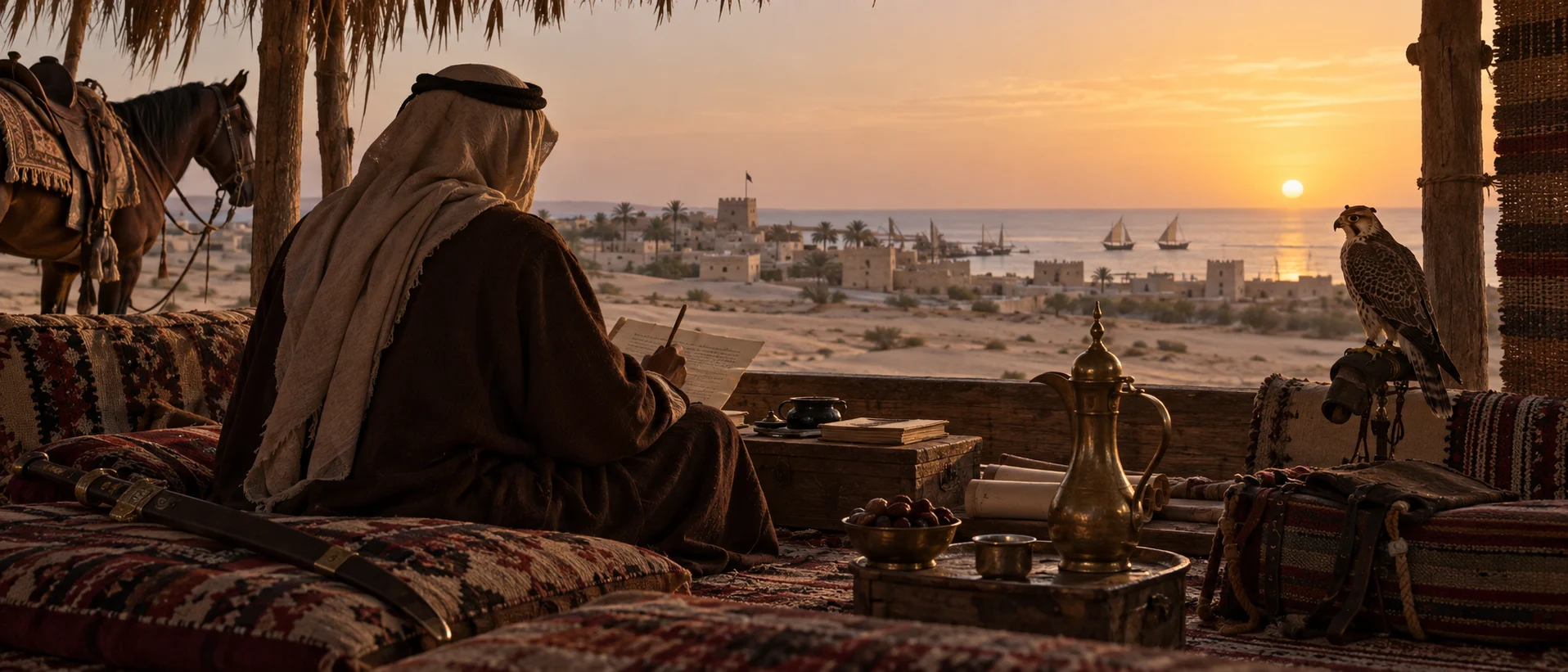
Before Doha became a skyline, its founder wrote poetry. That is the detail that changes Sheikh Jassim bin Mohammed Al Thani from a name in a national timeline into a human historical figure: a ruler whose world contained horses, falcons, pearling boats, Ottoman officials, legal disputes and, somewhere among all of it, verses written in the language of Arabia.
Before Doha Became a Skyline, Its Founder Wrote Poetry
Modern Doha makes scale easy to see: towers, museums, stadiums, highways and aircraft. Sheikh Jassim bin Mohammed Al Thani belongs to a Qatar where power was measured differently.
He was a political leader and military commander, but the Amiri Diwan also describes him as a judge, scholar, knight and poet.
That last word changes the article for me.
A founder who leaves poetry behind gives us something a conventional political biography cannot: language chosen by the man himself, not only dates chosen by historians.
A Childhood in Fuweirat, Not in a Capital
The Amiri Diwan places Sheikh Jassim’s birth around 1827 and his upbringing in Fuweirat in northeastern Qatar.
He studied the Quran, jurisprudence and Islamic law, while also learning horsemanship, hunting and falconry.
That combination belongs to a world in which religious learning, tribal leadership and practical desert skills were not separate identities.
There was no modern capital waiting for him. Qatar’s settlements were tied to coast, wells, pearling, tribes and maritime trade.
The Poet Was Not a Decorative Side of the Ruler
Sheikh Jassim wrote Nabati poetry, the vernacular poetic tradition of Arabia.
The Amiri Diwan says he authored a collection in which he recorded his exploits, and Qatar National Library preserves a manuscript collection containing poems attributed to him.
One of the best-known pieces is associated with the title Ka’bat Al Madhyoom, a phrase the Diwan renders through the idea of being a haven for the oppressed.
A short line from the official English rendering says: “We are a haven for the oppressed.”
That is not only literary language. It is a statement about the kind of leadership he wanted remembered.
Poetry in Arabia Was Also Memory
Before radio speeches, television archives and social media, poetry could carry reputation farther than a document stored in an office.
Nabati verse could remember conflict, loyalty, generosity, courage, grievance and belonging in a language people actually spoke.
That helps explain why Sheikh Jassim’s poetry matters historically. It was not a private hobby hidden from public life.
It participated in the construction of memory.
1878: A Date Qatar Still Celebrates
In 1876, Sheikh Jassim was already helping manage the country’s affairs alongside his ageing father, Sheikh Mohammed bin Thani.
After his father’s death, he succeeded him on 18 December 1878.
That date is now Qatar National Day.
The Amiri Diwan treats his succession as a decisive moment in the consolidation of national rule under Al Thani leadership and identifies him as the founder of the State of Qatar.
Building a State Meant More Than Winning Battles
Military history is easy to dramatise, but the quieter work of government matters just as much.
The Amiri Diwan credits Sheikh Jassim with supporting Quranic education, inviting jurists, building mosques, teaching and adjudicating disputes.
He was working in a society where authority had to be political, social, religious and personal at the same time.
The state did not arrive one morning as ministries and paperwork. It accumulated through relationships, arbitration, defence, commerce and institutions.
Pearls Paid for More Than Jewellery
Qatar’s nineteenth-century economy was deeply tied to pearls.
The Amiri Diwan states that Sheikh Jassim improved harbours and shipbuilding to support the pearl trade, helping expand commercial relations with India and East Africa.
That immediately connects his political history to the maritime world we have been building across the MESKI Journal.
In The City the Desert Kept, Al Zubarah shows an earlier Qatari pearl economy. Sheikh Jassim’s period belongs to a later chapter, but the sea is still central.
Before hydrocarbons transformed the Gulf, pearls could finance boats, merchants, households and political influence.
Harbours Are Political Infrastructure
Improving harbours and shipbuilding is easy to read as an economic footnote.
It is more than that.
A harbour connects the ruler to merchants, divers, boatbuilders, crews, foreign buyers and neighbouring ports. Better maritime capacity increases trade, but it also increases the state’s ability to communicate and supply.
Qatar’s links with India and East Africa were therefore not decorative international contacts. They belonged to everyday economic life.
The Ottoman Relationship Was Complicated
Sheikh Jassim’s relationship with the Ottoman Empire cannot be reduced to one battle.
The Amiri Diwan notes that he supported the Islamic Caliphate and received Ottoman administrative titles, including kaimakam.
Tension grew when Ottoman authorities pushed toward more direct intervention in Qatar’s internal affairs.
That distinction matters because history becomes less useful when every relationship is turned into permanent friendship or permanent resistance.
1893: Al Wajbah
In 1893, the tension became military confrontation.
The Battle of Al Wajbah ended in a decisive victory for Sheikh Jassim according to the Amiri Diwan, which treats the battle as a major landmark in Qatar’s political history and as a moment that strengthened his regional standing.
I would be careful with the word independence here. The political status of the Gulf in the nineteenth century was more complicated than a modern national slogan.
What can be said safely is that Al Wajbah became a foundational memory of Qatari political autonomy and leadership.
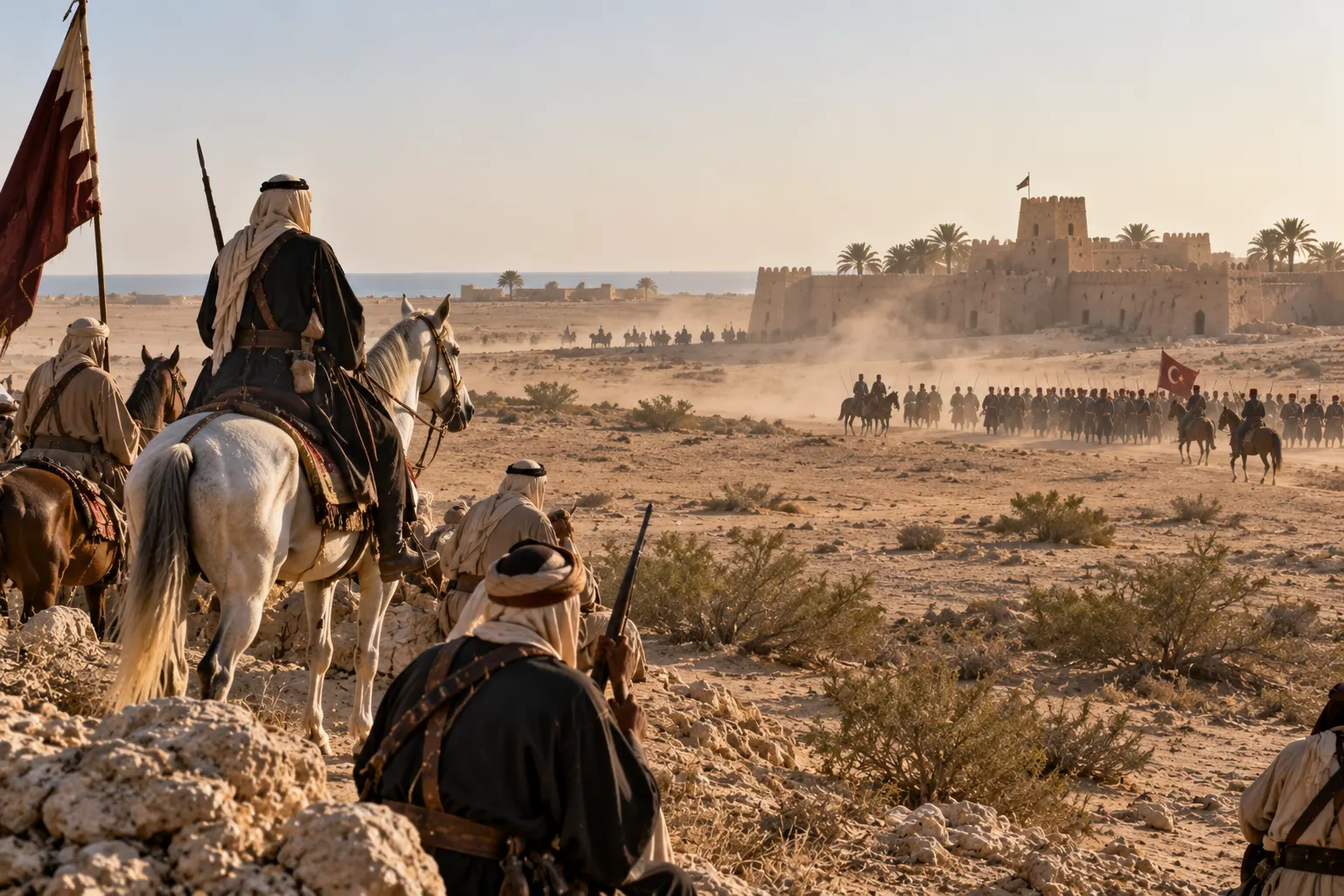
The Battlefield and the Poem Belong in the Same Biography
This is where Sheikh Jassim becomes more interesting than a simple founder portrait.
He could write poetry about protection, dignity and adversity, and he also had to make decisions when power became physical.
Poetry does not make the battle softer. The battle does not make the poetry less important.
Together they reveal how leadership in his period could be remembered through both words and action.
The Falcon, the Horse and the Sea
His official biography includes falconry, hunting and equestrian training.
These can easily become romantic Gulf imagery if we are careless.
But in Sheikh Jassim’s world, a horse was transport, status and military capacity; falconry belonged to elite and desert practice; the sea was the economic road; and poetry carried social memory.
The familiar symbols of Gulf heritage were once practical parts of life before they became museum displays.
Doha Was Growing, but Qatar Was Larger Than Doha
During Sheikh Jassim’s reign, urbanisation and population increased according to the Amiri Diwan.
Still, I would not tell his life only through Doha.
Fuweirat matters because it was where he grew up. Al Wajbah matters because it became a political landmark. Harbours matter because the economy was maritime. Pearling grounds matter because wealth came from the sea.
Our recent Qatar Through Art article looks at how modern Doha now preserves and reinterprets memory through museums and architecture. Sheikh Jassim belongs to the history those institutions are trying to make visible.
The Founder and the Souq
Markets are useful places to think about political history because states are built around ordinary exchange as much as around palaces.
Walk through Souq Waqif today and you encounter a living mixture of trade, food, scent, horses, falcons, visitors and memory.
The market is not a preserved nineteenth-century Qatar, and we should not pretend it is.
But it reminds us that commerce and social life are inseparable. Sheikh Jassim’s Qatar was also a place where authority had to coexist with merchants and maritime labour.
A Manuscript Survived the Transformation
One of the most moving things about this story is that a small poetry manuscript can survive while the physical country around it changes almost beyond recognition.
Qatar National Library’s digital repository preserves a manuscript collection containing two poems by Sheikh Jassim among other Nabati pieces.
The object is fragile, modest and easily overlooked beside a national museum.
But it carries a voice.
Sometimes a few pages preserve a ruler differently from a monument.
The Difference Between History and National Memory
Every country builds national memory around selected dates and figures. Qatar is no exception.
Sheikh Jassim is officially remembered as the founder, and 18 December is celebrated nationally.
Our job as an editorial journal is not to repeat a ceremonial biography word for word.
It is to keep the documented facts, show why they mattered in their own time, and leave enough complexity for readers to understand that state formation is never one man acting alone.
Sources & Further Reading
The central biographical source is the Amiri Diwan biography of Sheikh Jassim, which documents his education, poetry, succession, state-building, pearl trade, Ottoman relationship and the Battle of Al Wajbah.
For the surviving literary record, Qatar National Library preserves a Nabati poetry manuscript containing poems attributed to Sheikh Jassim.
For the older pearl world that preceded his reign, see our own Al Zubarah article.
Where this article imagines the silence before a poem or the practical meaning of a harbour, those are editorial interpretations built around documented history, not invented quotations.
The Sheikh Who Wrote Poetry
Sheikh Jassim died in 1913.
Qatar around him was already changing, but the skyline we know did not exist. The oil economy had not yet remade the peninsula. The state he helped consolidate still depended heavily on the sea, pearls, ships, tribal relationships and regional diplomacy.
Yet a line of poetry could already travel farther than a building.
Before Doha became a skyline, its founder wrote poetry.
And some of those words are still here.
Questions About Sheikh Jassim and Early Qatar
He is officially recognised by Qatar as the founder of the State of Qatar and ruled from 1878 until 1913.
Yes. The Amiri Diwan describes him as a Nabati poet, and Qatar National Library preserves manuscript material containing poems attributed to him.
The Amiri Diwan places his birth around 1827 and his upbringing in Fuweirat in northeastern Qatar.
He studied the Quran, jurisprudence and Islamic law, and also learned horsemanship, hunting and falconry.
Sheikh Jassim succeeded his father on 18 December 1878. The date is now celebrated as Qatar National Day.
A 1893 confrontation between Sheikh Jassim’s forces and Ottoman forces that the Amiri Diwan describes as a decisive victory and major landmark in Qatar’s history.
Pearling was central to the economy. His official biography credits him with improving harbours and shipbuilding and expanding trade with India and East Africa.
No. His relationship with the Ottoman state was complex: he received Ottoman titles, but later resisted direct interference in Qatar’s internal affairs.
He died in July 1913.
Continue Through Qatar’s Earlier Worlds
From the founder’s poetry to pearl ports, markets and modern museums, Qatar’s history becomes clearer when the stories are read together.