
Before hospitality became an industry, a guest needed water, a seat, something to drink and a sign that the house had opened for them.
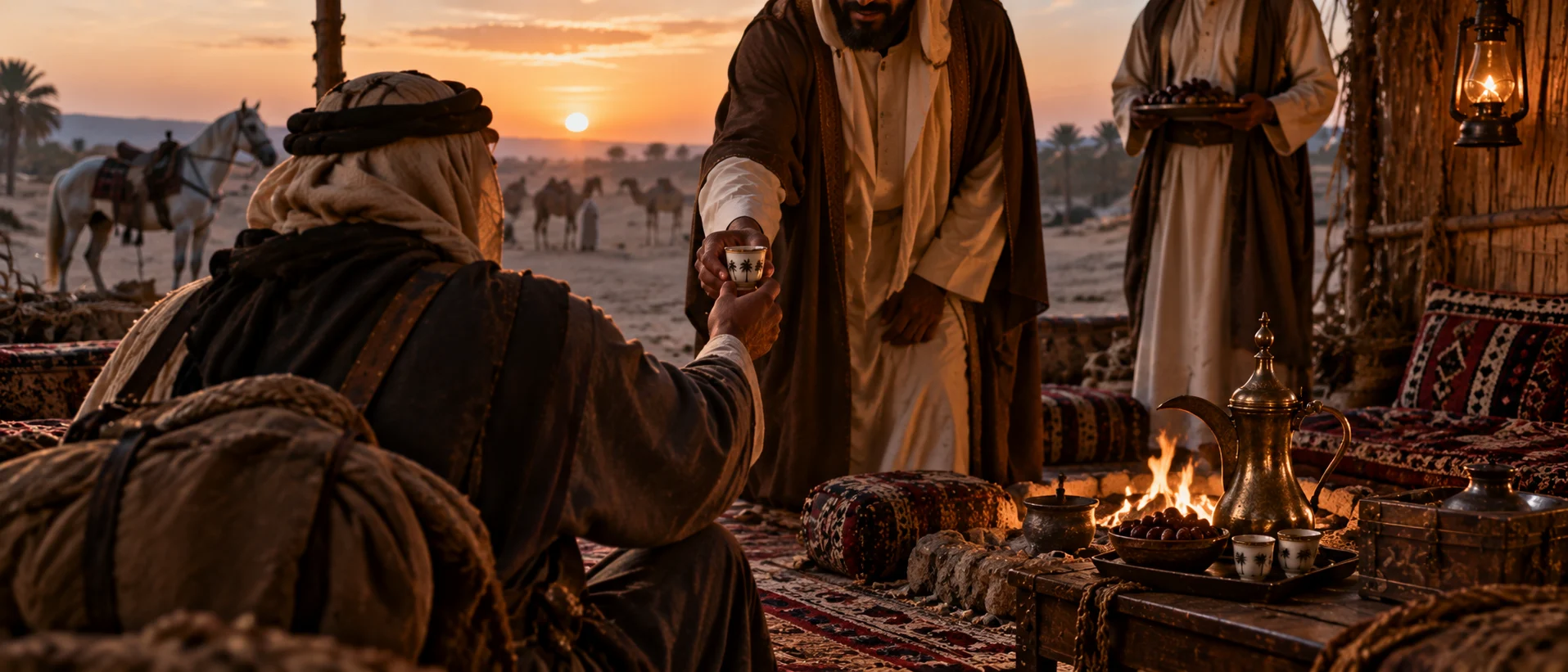
Before hotels taught us to measure hospitality through stars, another test was enough: what happened when somebody arrived at your door? Across Morocco and Arabia, the answer was never exactly the same. Tea in one house, coffee in another, dates, bread, halwa or a full meal depending on place and means. The common thread was simpler: the stranger did not remain a stranger while sitting in your house.
Before Hospitality Became a Hotel Service
Hospitality is one of those words that modern tourism has made very polished. We use it for hotels, restaurants, lounges, welcome desks and carefully designed guest experiences.
But long before there were five-star lobbies, hospitality meant something more basic.
A stranger arrived. Perhaps tired. Perhaps hungry. Perhaps carrying news. Perhaps needing water, shade or a safe place to sit.
The first question was not whether the room had a view. It was whether the guest would be received.
There Was Never One Arab Menu for the Guest
This article is not a historical menu card, because one did not exist.
What was served depended on country, region, season, wealth, household and occasion. A mountain village in Morocco, a coastal house in Oman and a desert majlis in central Arabia did not put exactly the same things in front of a visitor.
What they often shared was the gesture: bring something before asking too many questions.
Drink first. Sit. Eat something. Then speak.
The Majlis Was More Than a Room
UNESCO describes the majlis in the UAE, Saudi Arabia, Oman and Qatar as a social space where people receive guests, exchange news, discuss local matters, resolve problems and pass on oral traditions.
That description matters because it reminds us that hospitality was never only food.
The guest entered a social world.
Coffee could be prepared beside the seating. Elders might be present. News could travel with the visitor. A dispute might be discussed. A poem might be recited. Hospitality created the conditions for conversation.
Coffee Was a Language Before It Was a Beverage Trend
Arabic coffee has its own ritual because it carries more than taste.
UNESCO describes it as a symbol of generosity across the UAE, Saudi Arabia, Oman, Qatar and, in the extended inscription, Jordan. Guests and elders are served first; the coffee is poured with the right hand; the cup is only partly filled so it can be refilled.
Even the end of the drink has a gesture: a small shake of the cup says enough.
That is an extraordinary amount of meaning inside a very small finjan.
UAE: Gahwa, Dates and the Guest Who Comes First
In Emirati culture, gahwa and dates remain among the clearest symbols of welcome.
Experience Abu Dhabi describes Arabic coffee as a centuries-old sign of warmth and generosity and notes that the guest is served first. Dates remain paired with the coffee in homes, gatherings and cultural settings.
Our recent article about Abu Dhabi from Qasr Al Hosn to Emirates Palace follows the city from older forms of hospitality into the modern capital.
The important continuity is not the furniture around the cup. It is the order of the gesture: the guest matters first.
Saudi Arabia: Coffee and Dates Before the Conversation Is Finished
Saudi hospitality keeps the same pairing visible.
Visit Saudi describes dates as an iconic symbol of Arabian hospitality and notes that a visitor entering a Saudi home or office will often be welcomed with dates and qahwa.
The coffee may vary by region in strength, roasting and spice, but the social meaning remains recognisable.
You do not need a banquet for the welcome to feel complete.
A small cup and a few dates can already say: you are received here.
Oman: Coffee, Dates and Halwa
Oman adds another element that has become strongly associated with formal welcome: halwa.
Experience Oman describes the brass dallah, small cups and tray of dates as familiar parts of Omani hospitality, with halwa joining the table for more formal welcomes.
The local sweet is dense, perfumed and made to be eaten in small amounts beside coffee.
That makes a natural connection with our Muscat essay, where the city is understood through harbour, memory and small gestures rather than spectacle.
In Oman, hospitality can be quiet and still feel complete.
Qatar: The Majlis Still Explains the Ritual
Qatar belongs to the same UNESCO traditions of majlis and Arabic coffee.
The coffee server, the seating, the order of service and the social purpose of the room make the ritual larger than the drink itself.
Walk through Souq Waqif and you still see the vocabulary of that older social world around you: coffee pots, dates, perfumes, falcons, textiles and places where people sit rather than rush.
The souq is not a frozen nineteenth-century majlis, but it keeps many of the objects and habits in circulation.
Morocco: Tea First, Then the House Opens
Morocco speaks a different hospitality language.
The Moroccan National Tourist Office says it very simply: when you are invited, tea is served. Mint tea becomes the opening gesture around which people sit, talk and get to know one another.
That does not mean every Moroccan guest receives the same tray.
Bread, olive oil, pastries, dates, honey or a fuller meal may appear depending on place and occasion. The official tourism material itself connects Moroccan hospitality with tea, shared food, bread and traditional delicacies.
The key difference from the Gulf is not generosity. It is the vocabulary through which generosity is expressed.
In My Mind, Morocco and the Gulf Are Closer at the Table Than on the Map
This is one of the ideas behind MESKI.
Morocco and Arabia are far apart geographically, and their languages, foods and rituals are not identical. But I keep seeing familiar gestures crossing the distance.
Do not let the guest sit with nothing.
Pour something. Bring bread. Put dates nearby. Offer more than the person asked for. Insist once, sometimes twice. Make the guest understand that the house has opened for them.
Different countries, same instinct.

Bread Matters Because It Says This Is Food, Not Performance
Hospitality becomes most human when the food is ordinary.
Bread is a good example.
In Morocco, bread sits beside many meals and can be part of the first things placed on a table. In the Gulf, rice, dates, harees and other shared foods have their own social roles.
UNESCO notes that harees in the UAE, Oman and Saudi Arabia is especially associated with social occasions and honouring guests.
The point is not to rank foods by importance.
It is to notice that hospitality is strongest when it uses foods people actually live with.
Honey Belongs Here, but It Should Not Take Over the Story
MESKI sells honey, so it would be easy to force honey into every country.
I do not want to do that.
In Morocco, honey may appear with bread, msemen, pastries or Ramadan foods. Across Arabia, honey has its own culinary and medicinal traditions, but it is not the universal first thing every stranger was served.
When honey does appear, our Honey Atlas helps separate origin from storytelling.
The article is stronger if we let coffee be coffee and tea be tea.
The Stranger May Have Brought News
Before telephones and instant messages, a traveller carried information.
A guest might know what happened on another road, in another settlement or at another market.
That gives hospitality another function.
Receiving a traveller was not only kindness. It could also be contact with the wider world.
Sit down, drink, then tell us what you saw.
The Fire Could Be a Signal Before It Was a Fireplace
UNESCO documentation for the majlis includes a beautiful detail about the open-air Bedouin setting: the fire provided heat and light, prepared coffee and could also guide travellers and people lost in the desert.
I like that image because it makes hospitality visible from far away.
Before the stranger arrived, the possibility of arrival had already been imagined.
The fire said there are people here.
Hospitality Also Had Rules
Generosity does not mean the absence of etiquette.
Who is served first, which hand is used, when the cup is refilled, how the guest signals they have had enough, where the guest sits: these details form a language.
The language varies by place and family, but the principle is common.
Hospitality is not random abundance.
It is attention.
What Changed When Wealth Arrived?
Oil, modern cities, tourism and global trade changed the objects around hospitality.
A guest might now be received in a hotel suite instead of a tent, with designer porcelain instead of a simple finjan. Dates may arrive in a luxury box. Honey may be presented with gold. Coffee service may be choreographed by staff.
But the modern form only works culturally when the old idea remains visible underneath it.
The guest is still being told: we prepared something for you.
Luxury Can Carry Tradition, but It Can Also Hide It
This is where I think brands, hotels and gift companies need to be careful.
Traditional-looking packaging is easy.
Real hospitality is harder because it requires understanding what the object means.
A luxury honey box can be beautiful, and we make them ourselves. But as we wrote in our luxury honey gifting guide, the box should support the story of the food, not replace it.
If the gift becomes only gold and velvet, the gesture becomes thinner.
What Was Served When a Stranger Arrived?
There is no single answer.
In Morocco: very often tea, then whatever the house could comfortably share.
In the UAE: gahwa and dates remain among the clearest welcome rituals.
In Oman: coffee and dates, with halwa especially visible in formal hospitality.
In Saudi Arabia: coffee and dates are still a familiar opening gesture.
In Qatar: the majlis and Arabic coffee continue to hold the social grammar of welcome.
The foods differ. The sentence is similar: sit with us first.
Sources & Further Reading
For the Gulf, UNESCO documents both Arabic coffee as a symbol of generosity and the majlis as a cultural and social space across the UAE, Oman, Saudi Arabia and Qatar.
For Emirati practice, see Experience Abu Dhabi on coffee and dates. For Oman, see the Experience Oman guide. For Saudi Arabia, see Visit Saudi on dates and hospitality.
For Morocco, the Moroccan National Tourist Office hospitality guide identifies tea as the classic welcome ritual.
This article compares living traditions, not a fixed historical menu. Practices vary by region, family and period.
The Gesture Was the Real Dish
If I had to reduce all of this to one idea, it would not be coffee, tea, dates, bread or honey.
It would be the pause.
A stranger arrives, and ordinary life makes room.
Something is poured.
Something is shared.
Then the questions can begin.
Questions People Ask
Arabic coffee, or gahwa, and dates are among the most recognised Emirati hospitality rituals, though meals and other foods vary by occasion and household.
Coffee and dates are common, and Omani halwa is especially associated with formal welcomes and celebrations.
Coffee and dates are a classic opening gesture, with larger meals and regional dishes depending on the occasion.
Tea, especially mint tea, is one of the clearest hospitality rituals. Bread, pastries and shared food may follow depending on the home and occasion.
A majlis is a social sitting space used to receive guests, exchange news, discuss community matters and pass on oral traditions.
UNESCO recognises Arabic coffee as a symbol of generosity, with specific etiquette around preparation, serving guests and refilling cups.
No. Honey has important food traditions across the region, but it was not a universal first course. Hospitality customs vary by country, region and household.
The guest is received before business begins: a drink, food, a seat and attention create the social space for conversation.
Continue Through the Houses, Souqs and Majlis
Hospitality makes more sense when you follow it into the places where people still sit, trade, pour coffee and choose gifts with meaning.