
A hunting partner born from scarcity became a symbol of patience, prestige, conservation and living Gulf heritage.
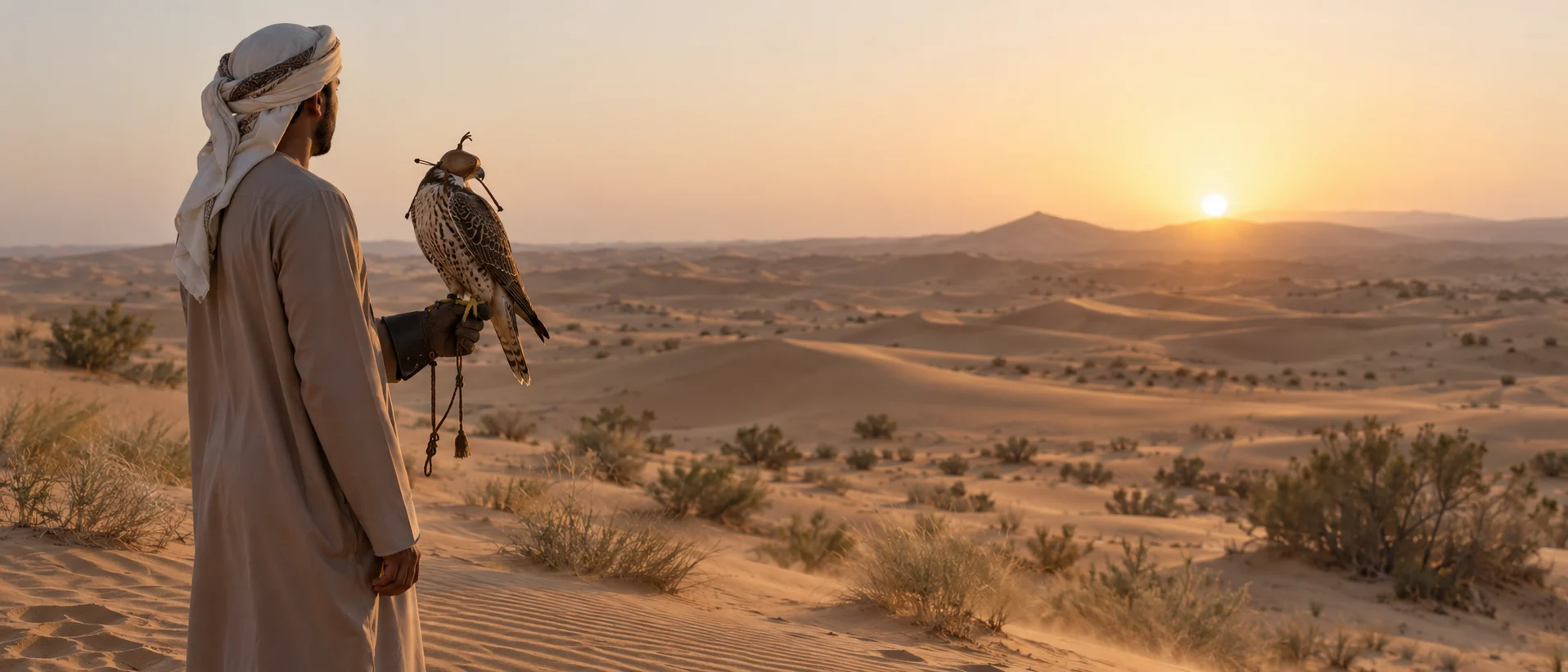
The falcon is one of those symbols people think they understand before they learn the story. It appears on emblems, in photographs and in luxury settings, but its place in Gulf culture began somewhere much harder: the desert, where usefulness came before prestige. From Abu Dhabi’s open landscapes and specialist falcon hospital to the Falcon Souq of Doha, the bird still connects survival, family, skill, animal care and identity.
The Falcon Was Never Just a Symbol
Today the falcon appears on emblems, in museums, at heritage festivals and in carefully designed cultural experiences.
But that is not where the relationship began.
In the desert, a falcon was useful before it was prestigious.
UNESCO describes falconry as an ancient practice that began as a way of obtaining food and gradually became a social, recreational and cultural tradition connected to nature.
That old practical purpose matters because it prevents us from turning falconry into decoration.
The bird earned its place before it became an icon.
The desert does not give symbols for free. Before the falcon became prestige, it had to prove itself beside people who understood exactly what survival meant.
Meskaoui
A Hunter That Required Trust, Not Ownership
Falconry is not simply the act of possessing a bird of prey.
The whole practice depends on training, patience, handling and a relationship built over time.
UNESCO emphasizes the bond between falconer and bird, and the way knowledge passes through families, mentors and clubs.
That is why the language of falconry is full of small skills.
How the bird is approached. How it is calmed. How it is trained to return. How its health is watched. How the falconer reads behaviour instead of forcing it.
In that sense, falconry is as much about discipline in the human as it is about power in the bird.
Abu Dhabi: Where Desert Memory Became Institution
Abu Dhabi is one of the places where falconry moved from survival memory into a protected modern heritage.
Experience Abu Dhabi describes the practice as one of the UAE’s treasured traditions, transmitted over generations and built on patience and care.
Abu Dhabi Culture places falconry inside a wider language of courage, honour, nobility, conservation and companionship.
That combination is important.
The tradition survived because it was not frozen.
It entered clubs, veterinary care, breeding, conservation and formal heritage work while keeping its connection to the desert.
The Abu Dhabi Falcon Hospital Says Almost Everything About the Modern Story
One of the most striking examples is the Abu Dhabi Falcon Hospital.
Official Abu Dhabi tourism describes it as the world’s largest and most advanced falcon hospital of its kind, with treatment facilities, a display museum and guided visits.
That detail tells us how far the relationship has travelled.
A bird once trained in the desert for hunting can now pass through specialist veterinary wards and conservation systems without losing its cultural meaning.
Modernity did not erase the falcon.
It built an entire infrastructure around caring for it.
The Desert Is Still the Classroom
Even with hospitals, clubs and heritage institutions, the desert remains central.
The bird needs space.
The falconer needs to read wind, distance and movement.
Young people still learn by watching others handle birds, and the desert keeps the practice connected to something larger than spectacle.
Abu Dhabi’s official cultural material repeatedly returns to patience, fortitude, companionship and the transmission of those values to younger generations.
That is why a falconry experience makes more sense in open landscape than in a glass display case.
Then Doha Changes the Scene
Cross the Gulf to Qatar and the story takes another shape.
In Doha, falconry is visible inside the city itself.
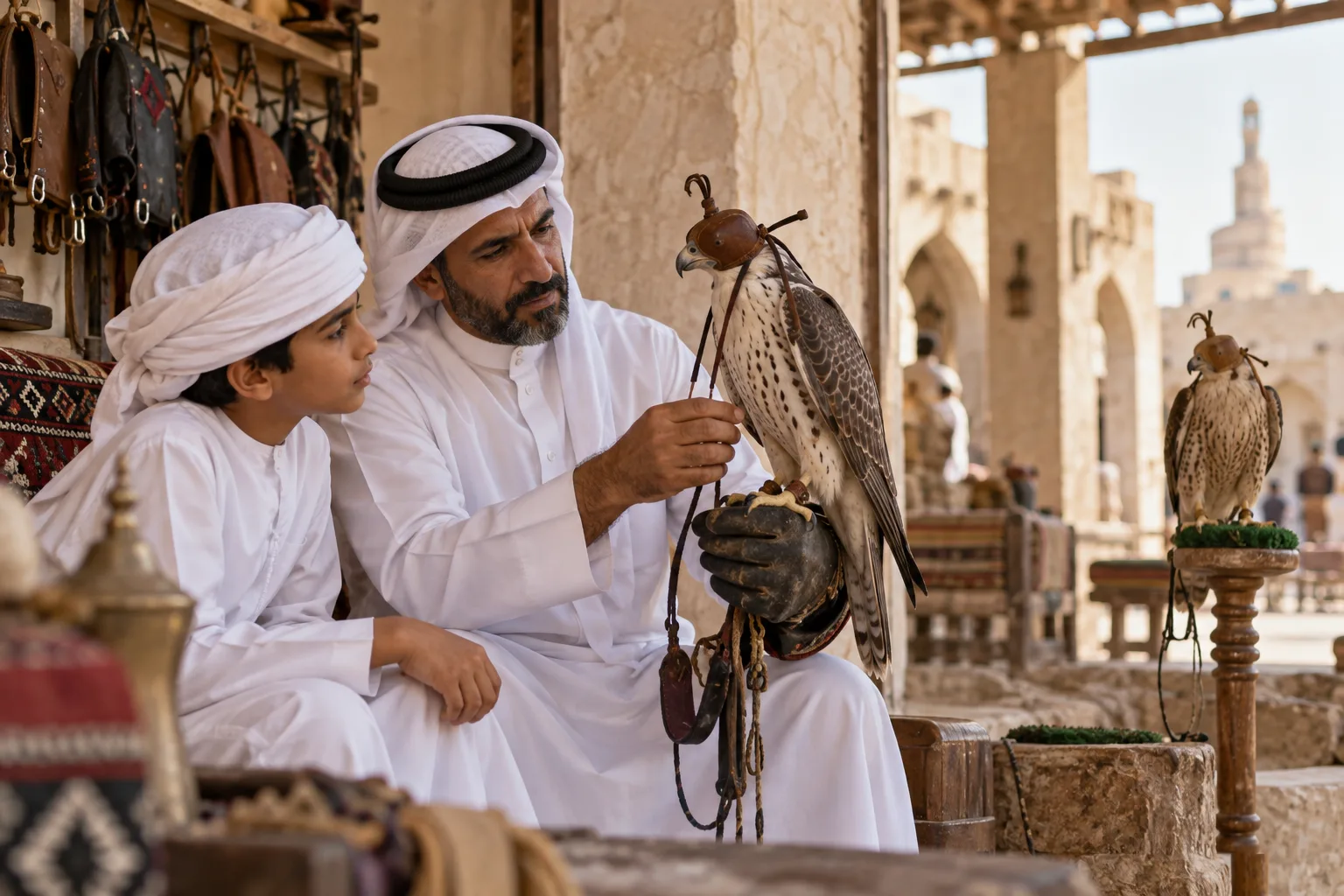
Visit Qatar places the Falcon Souq within Souq Waqif, where visitors can see birds, learn about the tradition, encounter equipment, and even find a specialist falcon hospital nearby.
That is a remarkable cultural contrast.
The falcon belongs to the desert, yet its world also survives in the narrow lanes of a capital city.
Souq Waqif Is Not a Stage Set for Falcons
If you already know our Souq Waqif visitor guide, you know that the souq works because many layers of Qatari life still overlap there.
The Falcon Souq is one of those layers.
Visit Qatar describes shops selling hoods, gloves, lures, perches, restraints, medicines and veterinary supplies.
That is not the inventory of a decorative souvenir shop.
It is the infrastructure of a living practice.
Even the presence of a falcon hospital inside the souq tells you that the bird is treated as an animal requiring real specialist care, not merely a national symbol.
From Hunting Tool to Prestige, but Not Only Prestige
Of course prestige became part of the story.
Falcons can be valuable. Lineage, ability, health and training matter. Auctions can attract attention.
But reducing the tradition to price would be another mistake.
UNESCO describes falconry today as a source of social connection, identity, mentoring and a relationship with nature.
Abu Dhabi Culture also emphasizes conservation and respect for animals.
Prestige exists, but it sits on top of a much older foundation of skill.
The Hood Is a Small Object With a Big Meaning
One of the most recognizable falconry objects is the hood.
To someone unfamiliar with falconry, it can look ceremonial.
In practice, it helps keep the bird calm and reduces visual stimulation while the falcon becomes accustomed to its surroundings and handler.
Visit Qatar explains this directly in its description of the Falcon Souq and hospital.
This is something I like about heritage objects.
The most beautiful ones often began as practical answers.
Majlis Culture Changes the Meaning Again
A falcon does not need to sit permanently inside a majlis for falconry to belong to majlis culture.
The connection is social.
Falconers talk about birds, seasons, training, breeding, desert trips and competitions in the same social spaces where other knowledge is exchanged.
That is why falconry connects naturally with our article What Was Served When a Stranger Arrived?.
The majlis is not only where coffee is poured.
It is where experience becomes conversation and conversation becomes transmission.
Why Young People Matter More Than Tourists
Tourism can introduce a visitor to a falcon.
It cannot preserve falconry by itself.
The tradition survives when younger people learn how to handle birds, understand their welfare, respect the desert and absorb the vocabulary and values around the practice.
UNESCO specifically describes transmission through mentoring, families and training clubs.
That is the real heritage mechanism.
A photograph with a falcon may last a minute.
Knowledge has to survive a generation.
Falconry Also Forces a Conversation About Conservation
The old purpose of hunting cannot simply be copied into the modern world without rules.
Wildlife populations, migratory species and habitats face different pressures today.
That is why modern falconry increasingly sits beside regulation, breeding, veterinary science and conservation.
UNESCO describes contemporary safeguarding as including falcons, quarry and habitats.
Abu Dhabi’s cultural institutions make the same link between falconry and conservation.
A living tradition survives by adapting its responsibilities as well as its techniques.
Abu Dhabi and Doha Are Not Competing Versions
I do not see Abu Dhabi and Doha as two cities trying to prove who owns falconry.
That would miss the point.
Falconry belongs to a wider Arabian and global heritage shared across many countries.
What interests me is how each place makes the tradition visible.
Abu Dhabi gives you the desert, institutions, specialist hospitals and a strong national heritage infrastructure.
Doha gives you the Falcon Souq inside Souq Waqif, where the tradition sits beside shops, coffee, spices, textiles and daily urban life.
Same bird. Different doorway.
A tradition stays alive when it can leave the desert, enter the city, and still remember why it was born.
Meskaoui
From Abu Dhabi Desert to Doha Majlis
This is why the route from Abu Dhabi to Doha makes such a good cultural line.
One side opens onto desert horizons and institutional preservation.
The other lets you turn a corner in an old souq and suddenly find yourself in the working world of falconry.
Neither makes sense without the wider Gulf landscape.
The falcon connects desert, family, prestige, animal care, trade, memory and social life.
What I Would Tell a First Time Visitor
If you are in Abu Dhabi, do not treat falconry as a five minute photo opportunity.
Learn why the bird mattered. Look at the relationship between falconer and falcon. If you visit the Falcon Hospital, pay attention to the medical seriousness around the bird.
If you are in Doha, walk the Falcon Souq slowly.
Look at the equipment. Look at the people who are there to buy, care for or discuss birds rather than simply take pictures.
Then go sit somewhere in Souq Waqif and let the connection settle.
The heritage is not hidden.
You just have to stop looking at it as a performance.
Sources and Cultural Notes
UNESCO lists Falconry, a living human heritage on the Representative List and describes its evolution from obtaining food to social practice, mentoring and conservation.
For the UAE context, Abu Dhabi Culture explains the tradition’s desert roots and its connection to courage, honour, companionship and conservation.
For current visitor context, Experience Abu Dhabi documents the Abu Dhabi Falcon Hospital and the continuing practice of falconry.
For Doha, Visit Qatar documents the Falcon Souq, its equipment shops and the specialist falcon hospital at Souq Waqif.
This article treats falconry as living heritage, not as a hunting guide.
Why the Falcon Still Matters
The falcon still matters because it carries more than one age at the same time.
It remembers scarcity and hunting.
It lives inside modern veterinary care.
It appears in the desert and in the city.
It can symbolize prestige without being reduced to luxury.
And it continues to teach patience, observation and responsibility.
That is enough to understand why the bird still commands attention from Abu Dhabi to Doha.
Not because the Gulf refuses to leave the past.
Because some parts of the past learned how to keep moving.
Questions People Ask
It was originally used as a practical hunting method in resource-scarce environments, helping people obtain food.
Yes. It remains a living cultural practice, supported through families, clubs, heritage institutions, veterinary care and regulated activities.
Official Abu Dhabi tourism highlights the Abu Dhabi Falcon Hospital and desert falconry experiences.
The Falcon Souq at Souq Waqif is one of the clearest places to encounter the tradition and its specialist equipment.
Yes. Visit Qatar describes a specialist falcon hospital serving the birds and falconers at the souq.
The hood helps keep a falcon calm by reducing visual stimulation while it adjusts to surroundings and handling.
No. Prestige is part of the modern image, but the tradition also involves animal care, training, social transmission, conservation and identity.
Yes. UNESCO lists Falconry, a living human heritage on the Representative List of the Intangible Cultural Heritage of Humanity.
Because the majlis is one of the social spaces where knowledge, stories, values and experiences are transmitted between generations.
Continue Through Gulf Heritage
Falconry becomes richer when placed beside Souq Waqif, the majlis, Arabian hospitality and the cultural landscapes of Abu Dhabi and Doha.