
Forget the flame test and the colour myths. Real honey buying begins with origin, producer, batch, handling and evidence that actually matches the claim.
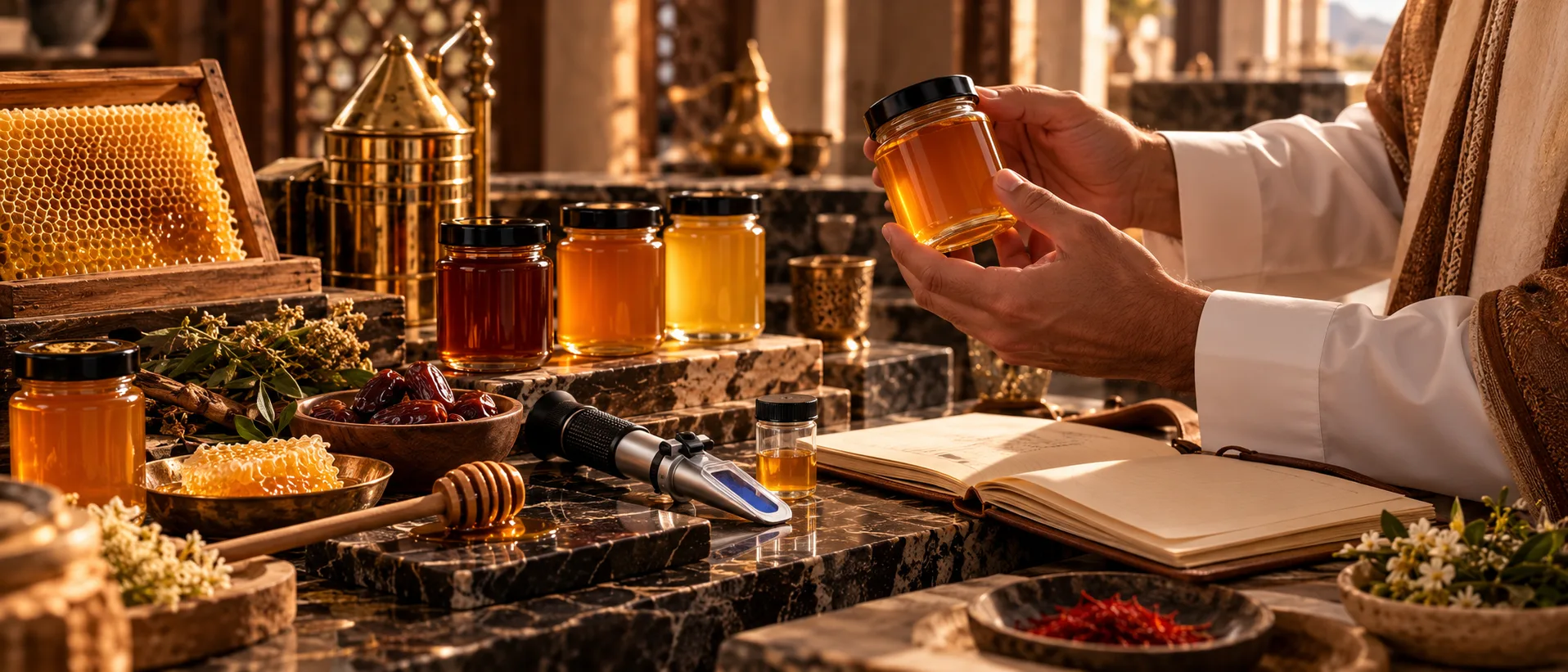
The Gulf is one of the most exciting places to buy honey because so many origins meet here. It is also a market where words such as Sidr, raw, mountain, royal and pure can become detached from evidence. You do not need to become a laboratory scientist before buying a jar. You do need a method. These twelve checks are the questions I would rather ask than any viral home test.
1. Separate the place of purchase from the place of harvest
The first mistake in Gulf honey shopping is geographical. Honey bought in Dubai is not automatically Emirati. Honey bought in Doha is not automatically Qatari. A Yemeni Sidr jar remains Yemeni when it crosses a border, and an Omani Samar jar remains Omani when it sits on a shelf in the UAE. Start by asking where the bees actually foraged.
This sounds obvious, yet market language constantly mixes origin and retail location. MESKI’s Gulf Honey Charade exists because this confusion affects almost every premium category. Country is only the beginning. Region can matter just as much.
2. Ask who produced the honey
A good jar should lead to a producer, beekeeper, cooperative or traceable supply chain. You do not always need the name of one individual beekeeper, especially when a cooperative pools production, but someone should be accountable for the harvest and handling. “Imported premium honey” is not a producer identity.
When a seller knows the supply chain, simple questions produce specific answers. When the supply chain is vague, the conversation often returns to colour, tradition and price. Those things can be interesting, but none of them replace knowing who handled the honey before it reached the shelf.
3. Treat floral names as claims that need context
Sidr, Samar, Ghaf, Talh and Manuka are not decorative adjectives. They point toward plants and, in some cases, formal authentication systems. Ask what the floral claim means. Was the honey produced during a dominant flowering? Is pollen analysis available? Is the name a traditional market category? For Manuka exported from New Zealand, regulatory testing uses a defined set of chemical and DNA markers.
Not every excellent honey needs to be monofloral. Multifloral honey can be outstanding. The problem is not botanical complexity. The problem is charging for a precise floral identity without being able to explain why that identity is credible.
4. Look for a real batch or harvest reference
Honey changes by season. Rainfall, heat, forage density, colony strength and harvest timing all matter. A premium seller should therefore be comfortable with batch differences. A report from three years ago should not float beside every jar as if it certified all future harvests automatically.
Look for batch numbers, harvest dates or another reference system that connects the jar to records. The exact format can vary. What matters is that traceability exists beyond the front label. If a laboratory analysis is shown, ask whether the sample can be connected to the batch you are buying.
5. Read the ingredient list before admiring the story
Pure honey should not quietly contain syrups, flavouring or other additions. When ingredients such as saffron, edible gold, nuts or botanicals are intentionally added, they should be declared and understood as additions. They do not redefine the floral origin of the honey.
This is especially useful in luxury gifting. “Gold honey” is not a botanical variety. “Saffron honey” may describe a preparation with saffron rather than nectar collected from saffron flowers. The more beautiful the presentation becomes, the more important it is to keep the ingredient story simple and exact.
6. Ask what “raw” actually means
Raw is one of the most attractive and least standardised words in honey marketing. Buyers often use it to mean minimally heated and minimally processed honey. Sellers may use it differently. Ask what happened after extraction: was the honey warmed for bottling, finely filtered, pasteurised, or simply strained and settled?
The Codex principle is clear that honey should not be heated to a point that impairs its essential composition and quality. That does not mean every warm bottling step ruins honey. It means the word “raw” should lead to a handling explanation instead of functioning as a magic quality badge.
7. Understand what a laboratory report can and cannot prove
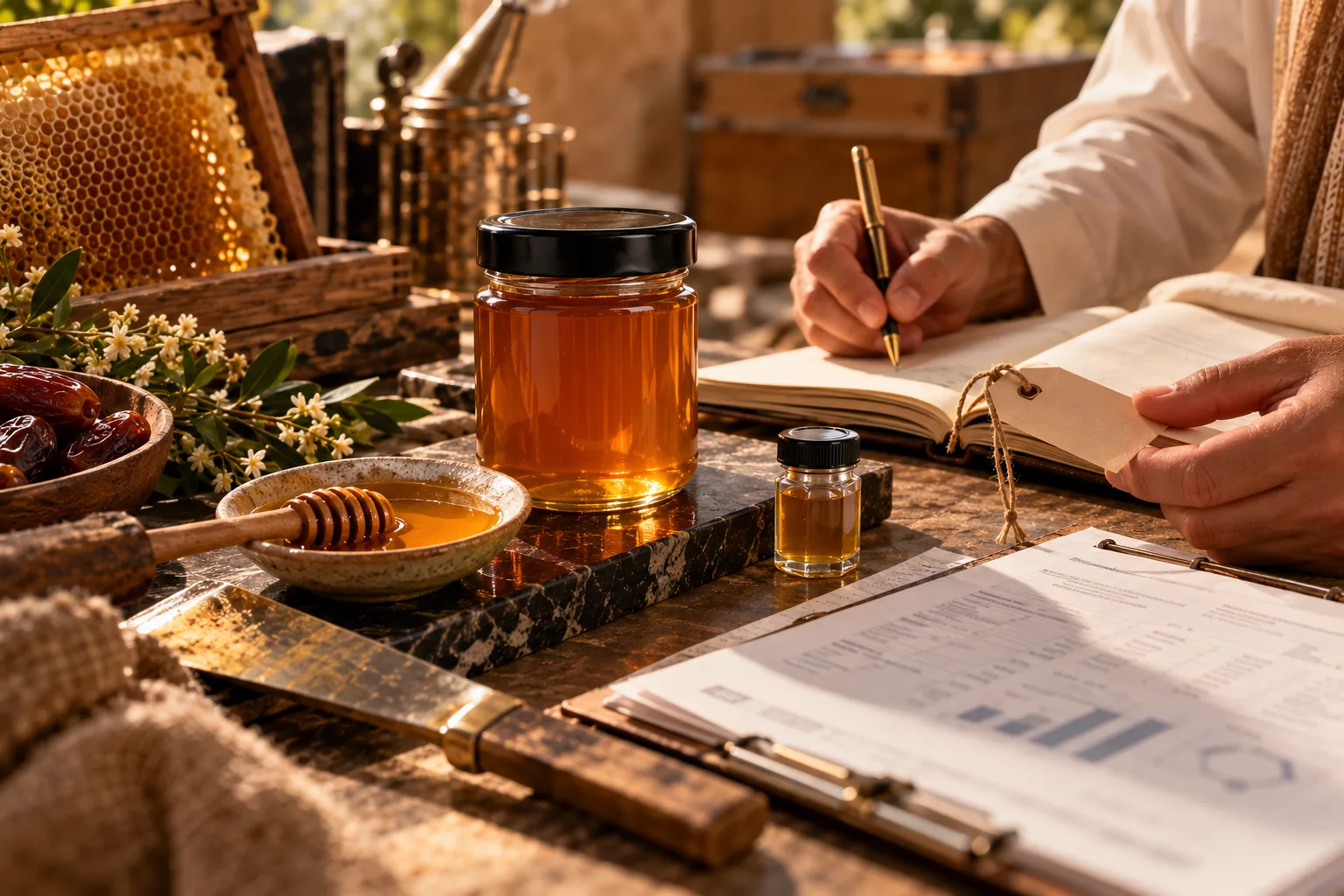
Laboratory analysis is valuable, but only if you know what was tested. Moisture, HMF, diastase activity, sugars, acidity, residues and other parameters answer different questions. A normal moisture result does not automatically prove geographic origin. A good HMF value does not prove the honey is Sidr. One test cannot answer every authenticity question.
The strongest report is linked to the batch and interpreted modestly. Saudi regulation and international Codex standards both treat honey as a food with measurable composition and quality requirements. Use the lab to test specific claims, not to create a halo around the jar.
8. Do not use colour, thickness or crystallisation as lie detectors
Dark honey can be genuine or adulterated. Light honey can be genuine or adulterated. Thick honey can result from natural composition and moisture, but thickness alone proves nothing. Crystallisation is a normal physical process in many honeys and can happen quickly or slowly depending on glucose-fructose balance, temperature and seed crystals.
The internet is full of water tests, flame tests, thumb tests and claims that “real honey never crystallises”. These shortcuts are unreliable. Authenticity is a supply-chain and analytical question, not a kitchen trick.
9. Look at storage as seriously as origin
Authentic honey can still be damaged by poor storage. Excessive heat over time can affect quality. A jar left in direct sunlight or a very hot display environment has a different history from one stored carefully. Premium origin does not make a product immune to handling.
Ask how stock is stored and rotate attention toward the actual condition of the jar. Leaking lids, fermentation signs, unusual foaming or obvious packaging damage deserve caution. Honey is stable, but it is still food.
10. Use price as context, not proof
Rare harvests, small batches, difficult access, low yield, laboratory testing, premium packaging and import costs can all raise price. But a high price can also be a marketing strategy. The inverse is true too: a small beekeeper can sell excellent honey at a modest price because the supply chain is short.
Do not ask “Is this expensive enough to be real?” Ask “Can the seller explain why it costs this?” A credible answer may involve origin, season and scarcity. A weak answer usually returns to prestige words.
11. Listen to how the seller handles uncertainty
Trustworthy sellers do not need certainty about every detail. “We do not have pollen analysis for this batch” can be a better answer than an invented botanical percentage. “This report confirms moisture and HMF, not geographic origin” shows more competence than presenting one certificate as proof of everything.
Honesty about limits is a quality signal. Honey is biologically variable, and monofloral boundaries are not always neat. The seller who can explain what is known and what remains uncertain gives you more useful information than the seller who claims perfection.
12. Compare like with like before you decide
A one-kilogram everyday multifloral honey and a 250-gram limited-origin Sidr gift jar are not designed for the same purpose. Neither is automatically better. Compare similar origins, weights, harvest claims and levels of documentation. If you are choosing a gift, presentation matters. If you are buying for daily breakfast, value and flavour may matter more.
This final step prevents the market from collapsing into one ranking. The goal is not to find “the best honey in the Gulf”. It is to find a jar whose claims, quality and price make sense together.
Authenticity is not one test, it is an agreement between several facts
A convincing honey story is coherent from several directions. The stated region should make sense for the floral source. The harvest period should make sense for the flowering. The batch should connect to the producer. The laboratory report, if offered, should measure something relevant and belong to the jar being sold. The storage history should not contradict the claim that the product was handled carefully.
Fraud becomes easier when buyers search for one decisive signal. That signal rarely exists. Even sophisticated analytical methods answer defined questions rather than every question at once. This is why traceability is so powerful: it does not replace science, but it gives each piece of evidence a place in a real chain.
Walk away when the seller repeatedly substitutes drama for detail. “Secret mountain”, “royal recipe” and “ancient purity” are not answers to where, when and who.
Read the back label as carefully as the front
The front of a premium jar is designed to persuade. The back is where practical information usually lives: country of origin, ingredients, net weight, storage, importer or producer details, batch references and dates. A beautiful story should agree with those small lines. If the front promises a precise valley while the formal origin says only another country or region, ask why.
For online purchases, the same rule applies. Look for product specifications rather than relying on photography. The more expensive the jar, the less acceptable it is for essential provenance information to be missing.
Frequently Asked Questions
There is no reliable single home test. Start with traceable origin, producer, batch information, ingredient declaration, storage and credible analysis where appropriate.
Yes. Many genuine honeys crystallise naturally. The speed and texture depend on sugar composition, temperature and other factors. Crystallisation is not proof of fraud.
No. Viscosity depends on moisture, temperature and natural composition. Thickness alone cannot prove authenticity, floral origin or superior quality.
It depends on the question. Common quality parameters include moisture, HMF, diastase, sugars and acidity. Botanical or geographic authentication may require different evidence.
HMF can increase with heat and storage time and is used as one quality indicator. A good HMF result does not by itself prove floral or geographic origin.
The term is used inconsistently. Ask the seller how the honey was heated, filtered and handled after extraction instead of relying on the word alone.
Yes. Price can reflect rarity and cost, but it is not proof. Premium claims should be supported by provenance, batch traceability and credible documentation.
No. Sidr or Ziziphus honeys are produced in Yemen, Oman, the UAE, Saudi Arabia and other regions. The country and region should be stated separately from the floral source.
Ask where the flowers were and who produced the batch. That usually reveals whether the rest of the story is specific and traceable or mainly marketing.
Buy with questions, not myths
Continue through MESKI’s Honey Academy to compare origins, understand laboratory language and read premium honey labels more critically.