
Sidr Honey by Country:
UAE, Oman, Yemen & Beyond
What the labels never tell you — and what every serious buyer in the Gulf should know before choosing a jar.
Walk through any premium grocery in Dubai or Abu Dhabi, and you will find shelf after shelf of jars labelled “Sidr.” Some cost 80 AED. Others ask for 800. They all carry similar stories about ancient trees, mountain valleys, and centuries of tradition. Most of those stories are true — in the sense that Sidr honey really is extraordinary. What the labels almost never tell you is how much the country of origin changes everything: the flavour, the texture, the traceability, and ultimately whether the jar in your hand is worth what you’re paying.
We have been sourcing and curating exceptional honeys in the Gulf since our founding in Sharjah. This guide is what we wish more brands would write honestly — a clear, country-by-country breakdown of Sidr honey, based on what we know from direct sourcing relationships, not on what looks good on a label.
What Makes Sidr Honey Different
One tree, many terroirs — and why that distinction matters enormously.
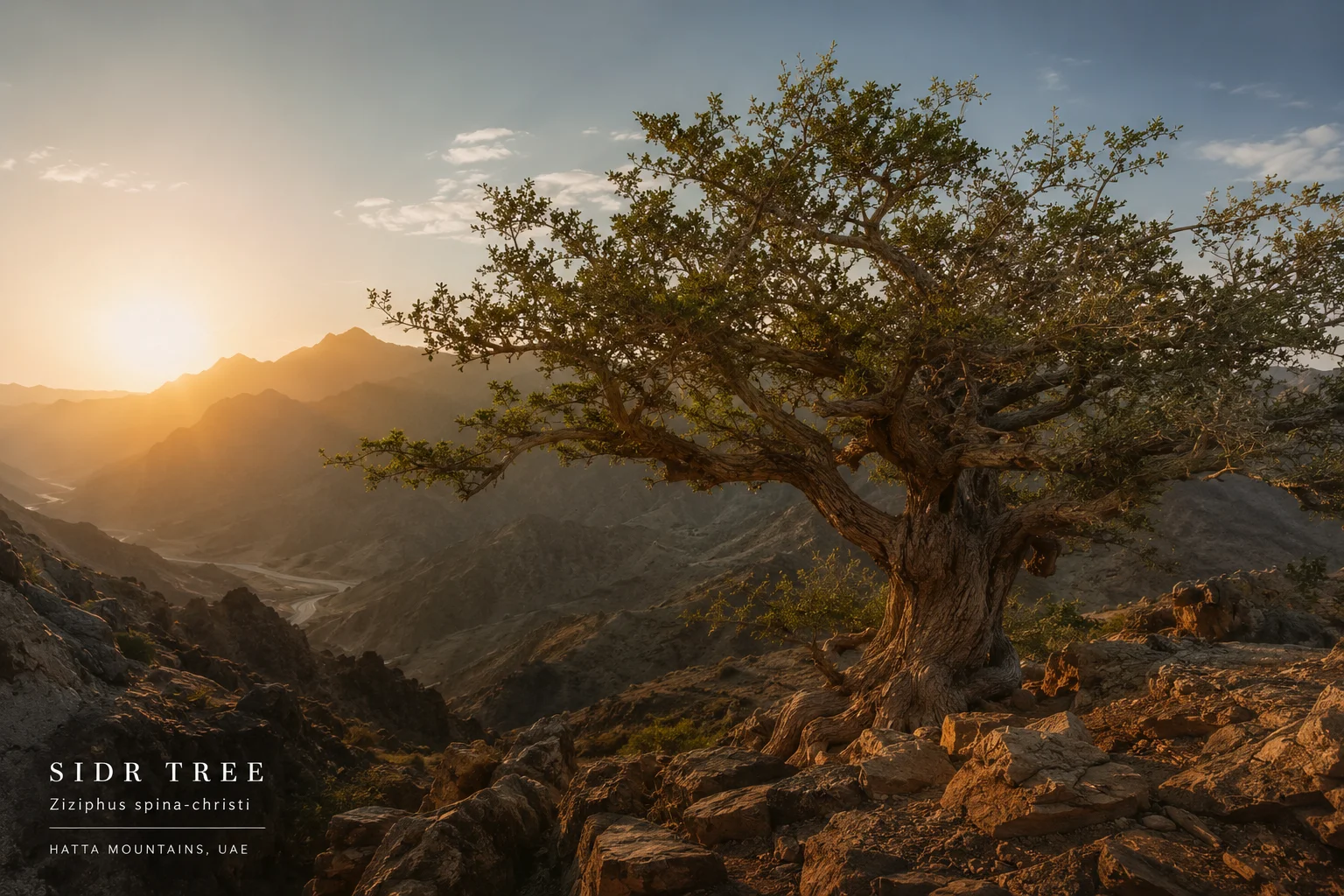
All Sidr honey begins with the same tree: Ziziphus spina-christi, known in Arabic as the Sidr tree and in English as the jujube or Christ’s Thorn. According to Wikipedia’s entry on Ziziphus spina-christi, the tree has been documented across the Middle East for millennia and is referenced in the Quran, in ancient Egyptian medical papyri, and in historical accounts spanning multiple civilisations — a pedigree that explains much of the reverence it receives. Our own guide to the Sidr tree explores that history in detail.
What sets Sidr honey apart from generic honey is its monofloral nature: bees feeding almost exclusively on Sidr blossoms produce a honey with a distinct biochemical fingerprint — higher concentrations of phenolic compounds, a characteristic thick amber texture, and an aroma that carries notes of caramel, warm wood, and wildflower. That profile is real and scientifically documented.
But here is what most sellers omit: the Sidr tree grows across a wide geographic arc — from Yemen and Oman through the UAE, Morocco, Algeria, Pakistan, and parts of East Africa. The honey produced by bees feeding on these trees varies significantly depending on altitude, soil, microclimate, and the surrounding ecosystem. Calling all of it “Sidr honey” without specifying origin is a bit like labelling any red wine from anywhere “Bordeaux.” Technically related. Not the same thing.
Hatta mountain / Sidr tree photography
Country by Country: What You’re Actually Getting
Five origins. Five different stories. One honest comparison.
UAE — The Rarest Sidr in the World
Emirati Sidr honey is produced in the Hatta mountains, a dramatic highland region at the border between Dubai and Oman where wild Sidr trees grow at altitude without agricultural interference. Annual production is minuscule — which is precisely why most people outside the UAE have never tasted it. The UAE Flora database confirms Ziziphus spina-christi as a documented native species used by local bees for nectar collection.
The texture is noticeably dense and slow to pour, the colour a deep amber verging on mahogany, and the flavour carries a floral delicacy that distinguishes it from the more intensely woody Yemeni profiles. Our Emirati Sidr honey, sourced from Hatta, won recognition at the London Honey Awards 2022 — one of the few Emirati honeys to earn international certification.
Oman — The Expert’s Choice for Traceability
Oman consistently earns the highest marks among buyers who understand the market — not because it claims to be Yemen, but because it offers something arguably more valuable in 2026: a fully traceable, government-backed supply chain. The Sultanate’s Ministry of Agriculture oversees honey standards and export certification with genuine rigour, meaning a jar of Omani Sidr carries a level of authenticity guarantee that few origins can match.
The honey itself comes primarily from the Al-Hajar mountain range — rugged, mineral-rich terrain that produces a Sidr with a slightly sweeter, more caramelised profile than Yemeni varieties, with less of the intense woody depth but more approachable complexity. Sophisticated buyers in Riyadh and Abu Dhabi have been choosing Omani Sidr for years for exactly this reason: honest quality at a price that reflects the product, not a label.
Yemen — The Legend, and the Reality
No honest account of Sidr honey can dismiss Yemen. The Hadhramaut region — particularly the Wadi Do’an valley — has produced what experts consistently describe as the world’s most complex and prized monofloral honey. The combination of altitude, ancient soil, traditional beekeeping methods, and near-total absence of agricultural chemicals creates a flavour profile that is genuinely unreproducible elsewhere: deeply aromatic, long-finishing, with a richness that stays on the palate for minutes rather than seconds.
The difficulty in 2026 is not the honey’s quality — it is access and verification. Production volumes from premium regions have declined significantly since 2015 due to the ongoing conflict. Authentic Hadhramaut Sidr is largely absorbed by Gulf markets before it reaches the broader world. When we carry Yemeni Sidr, we source exclusively through verified partners with direct beekeeper relationships and laboratory analysis — and we are transparent when stock is unavailable rather than substituting inferior product.
Morocco — A Genuine Sidr, Often Overlooked
Morocco’s Souss-Massa, Drâa-Tafilalet, and Zagora regions host wild Sidr trees in semi-arid terrain that produces a distinctly different honey — lighter in colour, softer in flavour, with herbaceous floral notes that reflect the Atlantic-influenced climate rather than the desert mineral character of Gulf Sidr. It is exported under EU-compatible food safety standards, making traceability robust.
This is the honey we recommend for those discovering Sidr for the first time — approachable, genuine, and fairly priced. It does not compete with Yemeni or Emirati profiles on depth, but it earns its place on the table as an authentic monofloral honey with a character entirely its own.
Algeria — Wild, Mineral, Underestimated
Algerian Sidr comes from pre-Saharan zones where the jujube tree grows entirely wild, without any agricultural intervention. The result is a honey with pronounced mineral character — denser, more intense, and markedly more sauvage than Moroccan Sidr. For buyers who appreciate complexity without necessarily chasing Yemeni prestige, this is a compelling option at a price point that reflects actual production cost rather than brand mythology.
Algeria’s apiculture sector has professionalised meaningfully in recent years, and selective importers now have access to traceable, quality-controlled product that would have been difficult to source a decade ago.
At a Glance: The Comparison
Same tree, different worlds.
| Criterion | 🇦🇪 UAE | 🇴🇲 Oman | 🇾🇪 Yemen | 🇲🇦 Morocco | 🇩🇿 Algeria |
|---|---|---|---|---|---|
| Flavour complexity | Floral, refined | Caramel, deep | Legendary | Soft, light | Mineral, wild |
| Traceability | Certified ✓✓ | State-backed ✓✓ | Verify carefully | EU standards ✓ | Improving ✓ |
| Fraud risk | Very low | Low | High on market | Moderate | Low |
| Availability in UAE | Very limited | Available | Selective | Good | Limited |
| Best suited for | Gifts, collectors | Daily luxury use | Connoisseurs | First discovery | Character seekers |
Five Signs the Jar Isn’t What It Claims
Buy Sidr the way you would buy saffron or aged olive oil — with questions, not assumptions.
The price is suspiciously low
Authentic Yemeni Sidr from Hadhramaut costs upwards of 150–300 USD per kilogram at source. A 250g jar at anything under 50–60 USD is almost certainly not what the label says it is. Emirati and Omani Sidr carry different price points, but any Sidr sold at generic honey prices should prompt a question.
The label says “Yemen” with no further detail
“Product of Yemen” is a beginning, not a guarantee. A serious seller names the specific region (Hadhramaut, Wadi Do’an, Shabwa), the harvest period, and ideally a batch reference. Vague geographic claims paired with premium pricing are a consistent indicator of product inflation.
The texture is thin or pours quickly
Genuine Sidr honey is thick. It clings to a spoon, moves slowly, and has a viscosity that reflects its dense sugar and pollen composition. Honey that pours freely at room temperature — particularly anything called “liquid Sidr” — should be approached with caution.
There is no aroma before you taste it
Open a jar of authentic Sidr and the aroma is immediate — warm, slightly woody, unmistakably different from supermarket honey. A product with weak or neutral scent before tasting is telling you something worth listening to.
The seller cannot explain the supply chain
Any credible Sidr seller in the UAE — particularly one asking premium prices — should be able to answer: who is the beekeeper or cooperative, what region did this batch come from, and is there laboratory analysis available? If the answer to any of those is vague, the jar probably deserves to stay on the shelf.
Why We Source Across Multiple Origins
A transparent answer to a question our customers often ask.
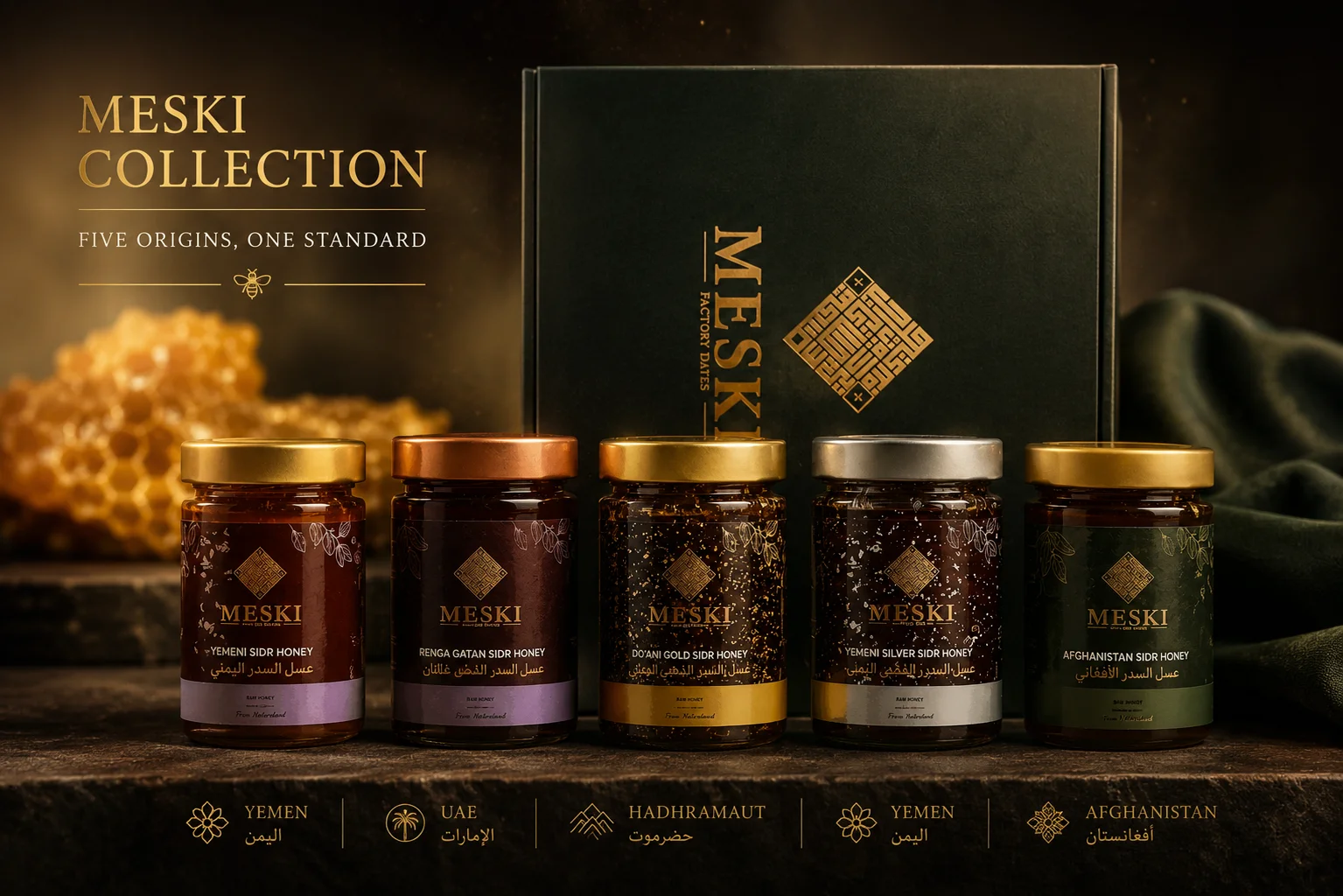
People sometimes ask why Meski — a UAE-based company — carries honeys from Oman, Yemen, and even Corsica alongside our Emirati production. The answer is straightforward: because our philosophy has always been to source the most honest, exceptional expression of each honey, wherever it comes from, rather than to artificially limit ourselves to national origin.
Our Emirati Sidr from Hatta is a source of genuine pride — it is rare, it is local, it is award-winning. But we also believe that a customer looking for the deep complexity of Hadhramaut deserves access to the genuine article from a verified source, and a customer exploring Sidr for the first time deserves an approachable, high-quality starting point at an honest price.
Every honey in our raw honey range is sourced from identified producers, not wholesale brokers. Where laboratory analysis is available, we make it accessible. Where a honey’s origin cannot be verified to our standard, we do not carry it — regardless of how attractive the label looks. This is not a marketing claim. It is simply the only way to operate credibly in a market where the gap between genuine and counterfeit product is often invisible to the eye.
Meski sidr photography
Frequently Asked Questions
Everything the label doesn’t tell you.
Yemeni Sidr — particularly from Hadhramaut’s Wadi Do’an valley — is widely regarded as the most complex and flavourful Sidr honey in the world, with a depth and finish that authentic Omani or Emirati varieties approach but rarely equal. However, “better” depends entirely on what you are buying. A genuine Hadhramaut Sidr sourced with full traceability is exceptional. A mislabelled jar of diluted or mixed honey sold as “Yemen” is considerably worse than a well-sourced Omani Sidr.
For UAE buyers in 2026, the honest advice is: prioritise traceability over origin label, and be prepared to pay what authentic product actually costs.
The Hatta mountain region — the primary source of authentic Emirati Sidr honey — is a relatively small highland area with a limited number of active beekeepers and wild Sidr trees. Annual production is extremely small compared to Yemeni or Omani output. Most of what is produced is either consumed locally or reaches only a very small number of specialist retailers. Our Emirati Sidr from Hatta is available in limited batches precisely for this reason.
Ask the seller for specific region of origin (not just country), harvest period, and whether laboratory analysis exists. Check the texture — genuine Sidr is thick and slow-pouring. Note the aroma on opening — authentic Sidr has an immediate, distinctive warm-woody fragrance. Be cautious of unusually low prices for claimed Yemeni Sidr. Products meeting ESMA food standards in the UAE (ESMA guidance here) will have accurate labelling requirements, but that does not automatically verify monofloral claims.
Ziziphus spina-christi grows across South Asia as well as the Arabian Peninsula, and honey labelled “Sidr” from Pakistan, India, or Kashmir is produced from closely related but botanically distinct species (often Ziziphus mauritiana or Ziziphus nummularia rather than spina-christi). The flavour profiles differ noticeably — lighter, often more aqueous, with less of the characteristic depth associated with Arabian Peninsula Sidr. It is not inferior honey, but it is not the same product, and should not be priced or marketed as such.
For a gift that carries regional meaning and verifiable quality, our Emirati Sidr from Hatta is the natural choice — it is locally produced, award-winning, and rare enough to feel genuinely considered. For a gift that showcases the breadth of Sidr across the Gulf region, our Royal Collection pairs multiple origins in a single presentation. Both are available in our limited-edition range.
Natural raw honey crystallises over time — it is a sign of quality, not deterioration. Sidr honey typically crystallises more slowly than many other raw varieties due to its high fructose-to-glucose ratio, often remaining liquid for six to twelve months. If your Sidr honey crystallises, placing the jar in warm (not hot) water will return it to a liquid state without damaging its natural compounds.
This article is provided for informational and editorial purposes. No health or medical claims are made or implied regarding any honey product. All sourcing descriptions reflect Meski’s current supplier relationships and are subject to seasonal availability.