
Dates belong clearly to Qatari hospitality. Honey can complement them beautifully when we present it as a thoughtful regional food, not as an invented cultural obligation.
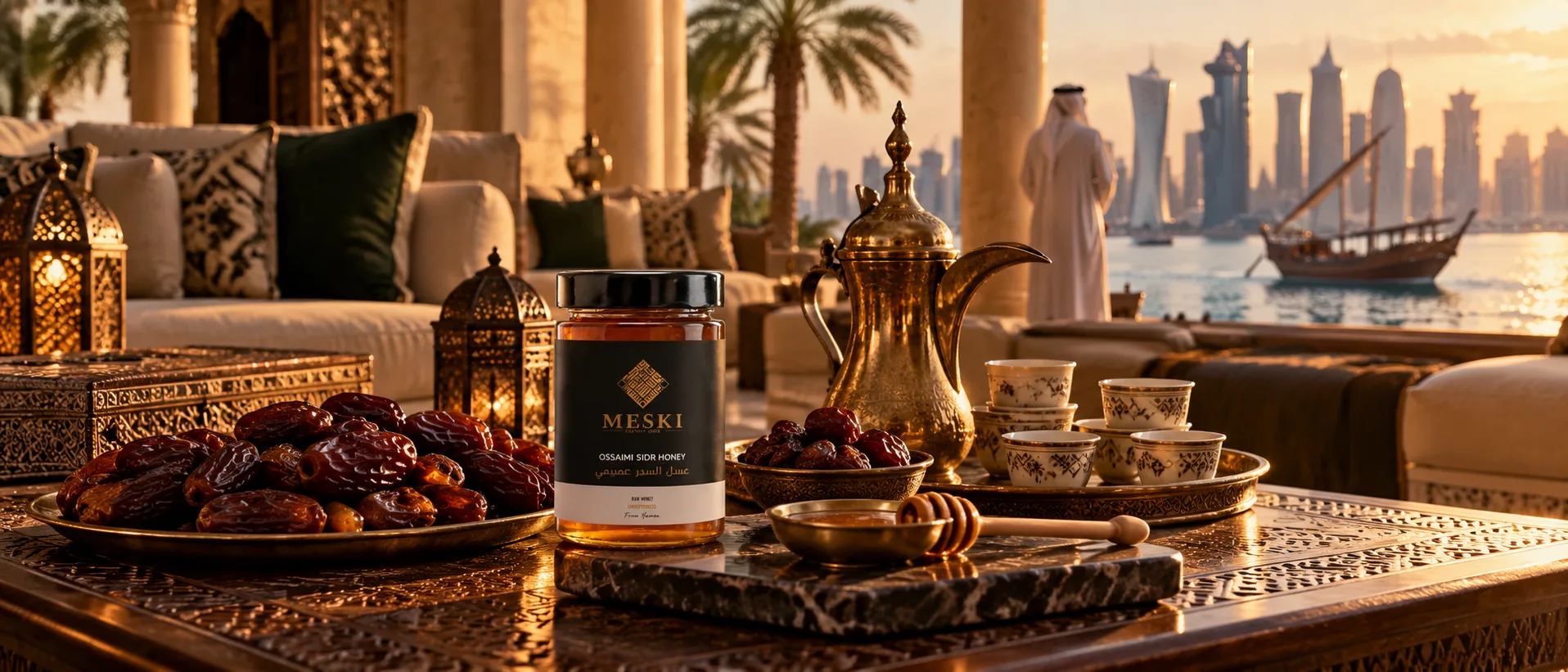
A gift becomes more meaningful when the reason for choosing it is true. In Doha, dates and Arabic coffee already carry a documented language of hospitality. Honey can join that table naturally, especially when the jar has a clear origin and is meant to be opened and shared. The important thing is to understand the difference between a living tradition and a modern gift that respectfully fits beside it.
Begin with what is documented in Qatari hospitality
In Qatar, dates and Arabic coffee have a clear place in hospitality. Visit Qatar describes dates as a national fruit and notes that they are commonly served with coffee as a sign of welcome. The majlis is also documented as a social space where guests receive dates and qahwa. That gives us a strong cultural foundation. Honey should be added to this picture carefully. It is a valued regional food and an elegant contemporary gift, but I would not pretend that every Qatari household has an old rule requiring honey to be offered with dates.
That distinction matters because meaningful gifting depends on truth. Dates already carry a local agricultural and social story. Honey adds another layer: harvest, origin, sharing and generosity. Together they can make sense on a Doha table without needing a fictional tradition invented for marketing.
Why edible gifts work so well in a majlis culture
A food gift can be opened. It can be tasted immediately or placed on the table for later. It does not require the recipient to display it, wear it or find storage for an object chosen by someone else. In a majlis culture, where hospitality is expressed through repeated serving, conversation and shared time, this practical quality matters.
Honey and dates also divide naturally into small portions. A date can be offered beside coffee. A spoon of honey can be tasted with bread, yoghurt or another food. The gift becomes part of a social moment rather than remaining sealed in a box. For me, this is one reason food can feel more generous than an object that is expensive but disconnected from how people actually gather.
Dates carry the clearest Qatari meaning
Qatar cultivates many date varieties, and dates appear in daily life, Ramadan, local festivals and hospitality. Khalas is especially familiar, but Shishi, Barhi, Khunaizi and other varieties also belong to the local market. If the goal is a gift that feels connected to Doha, dates already provide that bridge.
The best box does not need to pretend that every date was grown inside the city. Doha is a trading capital as well as a place of local agriculture. What matters is clear provenance. A Qatari-grown date should be described as such. An imported premium date should keep its own origin. The same rule applies to honey.
Honey adds regional depth rather than replacing the date
Honey works differently. Doha gives buyers access to Qatari, Yemeni, Omani, Emirati, Saudi and international honeys. That makes honey a useful gift precisely because it can open a conversation about origin. A Yemeni Sidr jar gifted in Doha remains Yemeni. An Omani Sidr remains Omani. A local Qatari harvest should be presented as Qatari only when that is genuinely where the bees foraged.
Our guide to buying Sidr honey in Doha starts with that distinction. The city is the place of purchase. The flowers define the honey. When a gift box keeps both facts visible, it feels more intelligent and less generic.
Ramadan and Eid change the rhythm of gifting
Ramadan intensifies visiting, family meals, charitable giving and evening gatherings. Eid brings its own rounds of visits and celebration. Food gifts fit these periods because they can join the table rather than compete with it. Dates are already strongly associated with Ramadan. Honey can complement that experience, especially when it is chosen for origin and taste rather than vague wellness promises.
The point is not that honey and dates form one mandatory traditional pair. The point is that both belong comfortably to a culture of food offered, shared and discussed. A restrained box can therefore feel more appropriate than a large decorative hamper filled with unrelated products simply to create volume.
A business gift and a family gift are not identical
For family or close friends, taste can lead. You may know that someone prefers dark Sidr, soft Khalas dates or a particular regional harvest. For a professional gift, the priorities often shift toward presentation, ease of sharing, clear provenance and a level of luxury that feels considered without becoming theatrical.
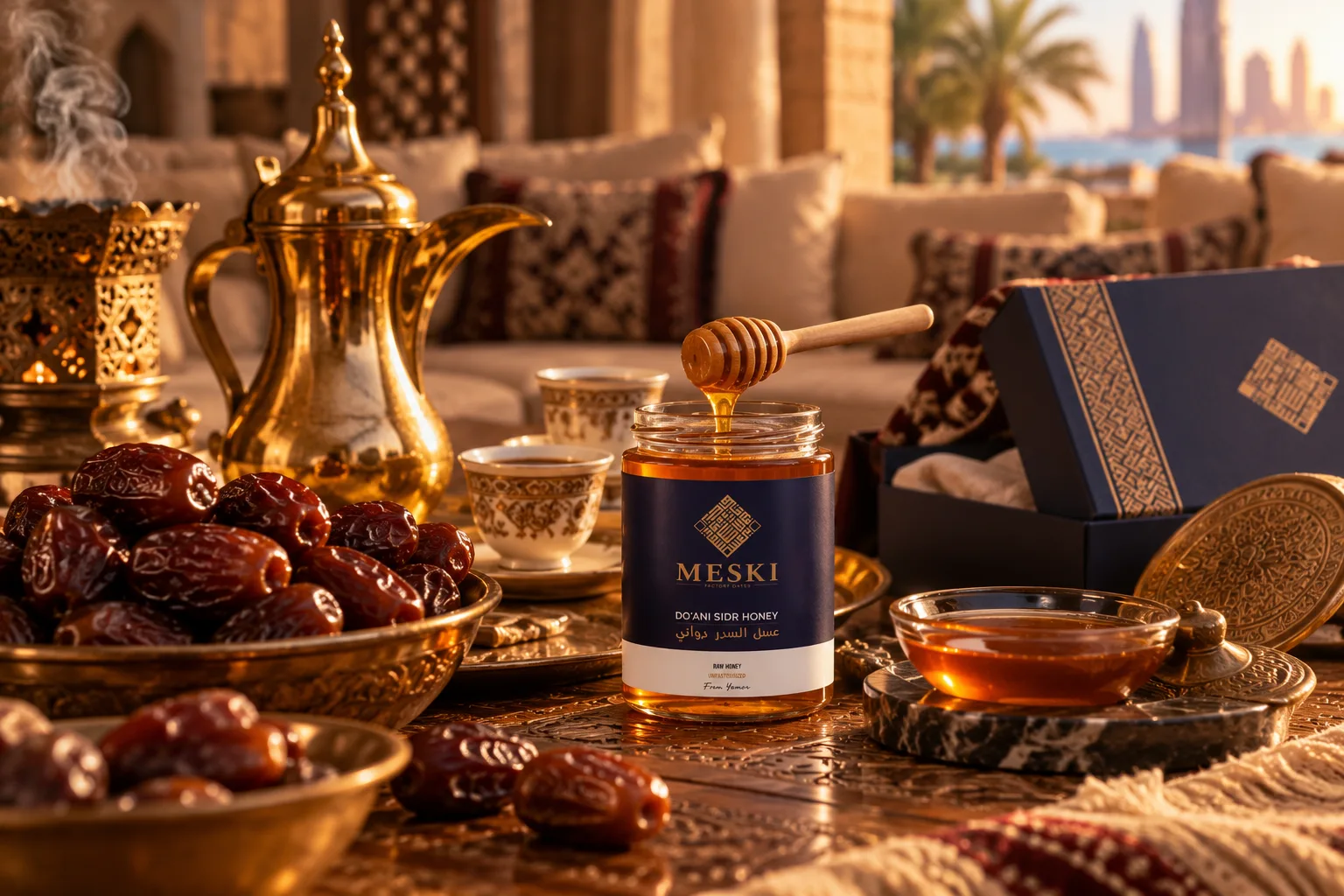
This is where premium honey earns its place. A documented harvest can offer a story without requiring the giver to explain too much. The recipient sees the country, region and floral source, then can taste it later. MESKI’s Royal Sidr Honey Collection is one example of using origin first and precious presentation second.
Presentation should support the food, not bury it
Luxury gifting in Doha can become visually ambitious very quickly. Heavy boxes, metallic finishes and elaborate ribbons have their place, but the food should still be the main event. If the dates are ordinary and the honey origin is vague, expensive packaging cannot repair the gift.
I prefer a box that makes the contents legible. Which dates? Which honey? Where were they produced? Why were these two items chosen together? The more the recipient can understand without a sales speech, the stronger the gift becomes. This is especially important for corporate and VIP gifting, where beautiful presentation is expected and therefore no longer enough by itself.
The best honey depends on the recipient
Sidr is the obvious choice when the recipient already values Arabian honey or when you want a jar with strong regional recognition. Samar can be more unusual and intense. Ghaf can bring an Emirati story. Manuka belongs to a different New Zealand system of grading and authenticity. Gold or saffron editions are not new floral sources; they are additions to a honey whose origin should already be worth giving.
If you do not know the recipient’s taste, a comparative collection can be safer than one extreme jar. If you know they love one origin, choose depth rather than variety. A good gift decision begins with the person, not with the most expensive item on the shelf.
Doha makes a strong setting for provenance-led gifts
Doha is a city where Gulf, Arabian, South Asian and international products meet. Souq Waqif itself reminds us that trade is part of authenticity, not its opposite. A gift bought in Qatar does not have to be grown in Qatar to be meaningful. It simply has to be represented honestly.
That is why our Qatar gift guide and Souq Waqif buying guide both return to the same question: where did this object or food actually come from? Honey and dates become more interesting when the answer remains visible.
A meaningful gift is one the recipient can use
The most convincing reason to give honey and dates in Doha is ultimately simple. They are foods with a natural place on a hospitality table. They can be shared, tasted and remembered. Dates connect directly to Qatari agricultural and social life. Honey can connect the table to another landscape across Arabia or, when genuinely local, to Qatar itself.
That is enough. We do not need to invent an ancient rule saying the two must always be offered together. Respect for culture sometimes means resisting the perfect marketing sentence and keeping the real one: dates welcome the guest, coffee sustains the ritual, and a carefully chosen honey can make the gift feel personal.
Honey and dates do not need to perform the same role
Dates connect a gift directly to Qatari hospitality because their place beside Arabic coffee is already culturally legible. Honey contributes differently. It may bring another Arabian landscape into the box, invite comparative tasting or offer a product whose season and beekeeper can be discussed. If both items are asked to symbolise exactly the same thing, the gift becomes repetitive. Their strength lies in complementing one another.
This also helps when choosing quantities. A larger date selection may make sense for immediate sharing, while a smaller premium honey jar can be opened slowly over several visits. The two foods have different rhythms. A thoughtful box respects that instead of forcing symmetry for visual effect.
For corporate buyers, this distinction can improve the message. Dates can say welcome to Qatar. Honey can say we chose a particular origin because it was worth discovering. The result feels curated rather than filled.
How to build the box without overloading it
A coherent Doha gift does not need ten categories. Start with one excellent date variety or a small selection, then one honey whose origin is worth explaining. Add coffee only if the presentation and recipient make sense. The aim is not to recreate an entire majlis in cardboard, but to give a few elements enough space to retain their identity.
This restraint also helps the recipient. They can open the box and understand what to taste first, what to share immediately and what to keep. Good luxury design is often an editing exercise: remove what does not add meaning.
Frequently Asked Questions
Yes. Visit Qatar describes dates and Arabic coffee as established elements of Qatari hospitality, including in majlis settings.
No fixed rule should be invented. Honey is a valued food and gift in the Gulf, but dates and qahwa have the clearer documented role in Qatari hospitality.
Both are shareable foods with strong regional associations. Dates bring a direct Qatari hospitality connection, while honey can add origin, harvest and tasting interest.
It can be. Honey can sit naturally beside dates, coffee and sweets during Ramadan, especially when the origin is clear and the presentation is designed for sharing.
Sidr is widely recognised, while Samar, Ghaf, Omani, Yemeni, Emirati or local Qatari harvests can suit different recipients. Choose by provenance and taste, not prestige alone.
Not necessarily. Doha has always been connected to trade. Imported products can be meaningful if their real origin is stated clearly rather than presented as local.
Traceable origin, good sensory quality, appropriate jar size, careful storage and thoughtful presentation matter more than a large box or decorative claims.
Yes. They are easy to share and culturally compatible with hospitality. For professional gifting, clear origin, presentation and reliable delivery become especially important.
Avoid vague origin claims, exaggerated health promises, oversized packaging that hides ordinary contents, and language that presents modern gifting choices as mandatory ancient customs.
Explore gifting through culture, not decoration
Continue with MESKI’s Qatar guides, honey buying articles and regional stories of hospitality before choosing what belongs in the box.