
A journey through the most widespread faces of the jujube tree — beginning with Morocco’s ancient thorny shrubs, then travelling east through Pakistan, Nepal, India and China.
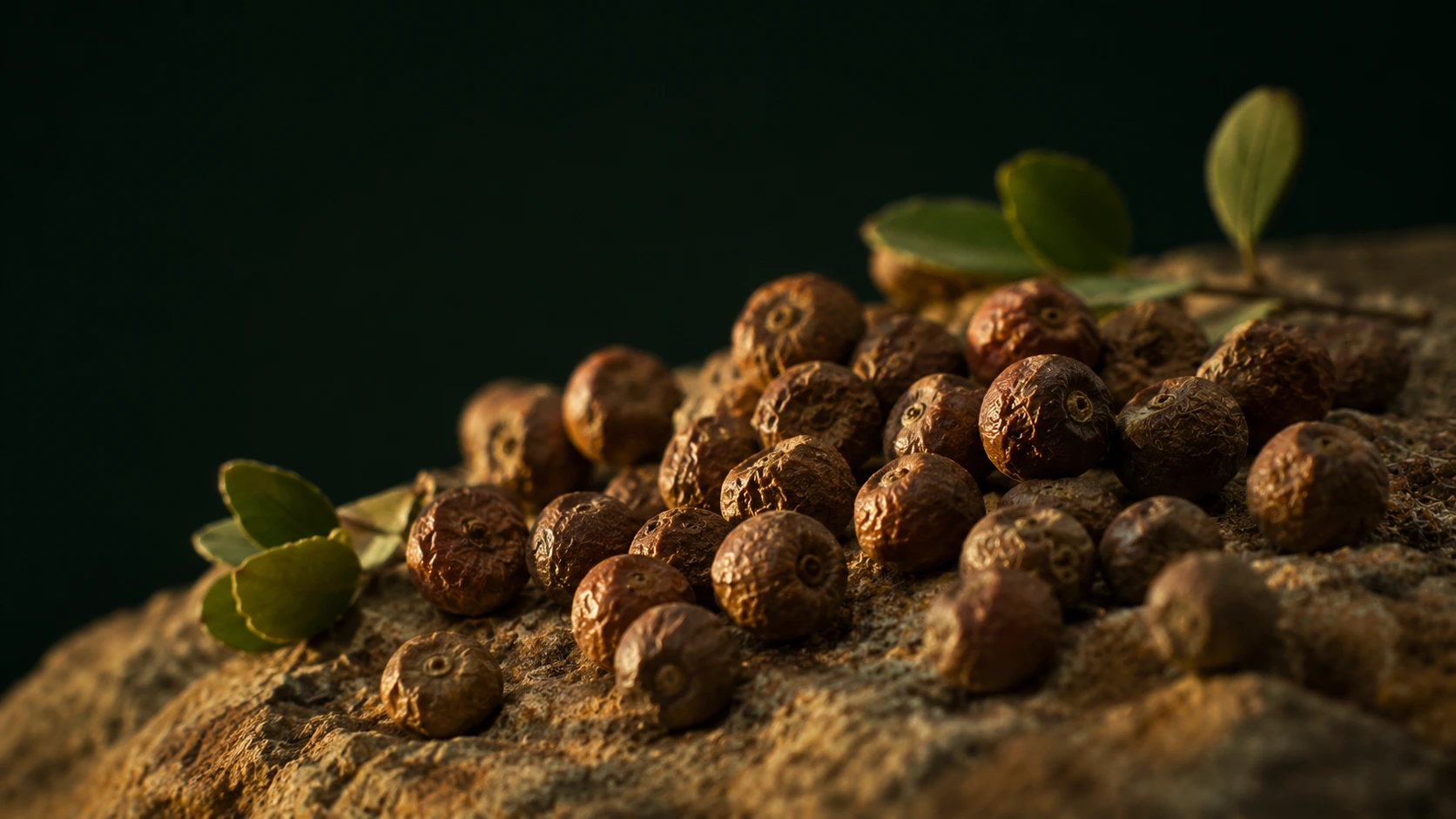
The jujube tree is not one single tree with one single appearance. Across Morocco, the Arabian Peninsula and Asia, the name is used for a broad family of thorny shrubs and trees belonging to the genus Ziziphus. Some grow as dense, almost impenetrable wild bushes. Others become generous orchard trees bearing large, cultivated fruit. To understand the jujube, we must first look beyond modern borders and follow the landscapes in which it has survived, adapted and been cultivated for generations.
What Is a Jujube Tree?
A jujube tree is a shrub or tree belonging to the buckthorn family, known botanically as the Rhamnaceae. Members of the genus Ziziphus are found across warm temperate, subtropical and tropical regions. They are usually recognised by their small greenish flowers, distinctive leaf veins, thorny branches and stone fruits known as jujubes.
The word “jujube” can therefore describe several related plants rather than one universal species. Local names add another layer of richness — and sometimes confusion. Depending on the country, people may speak of sedra, sidr, nabq, ber, wild jujube, Indian jujube or Chinese red date.
These names carry cultural meaning, but they do not always provide a complete botanical identification. A plant’s exact identity depends on its physical characteristics, regional flora and, when necessary, specialist examination. This matters today because wild plants, old cultivated trees and recently introduced varieties can grow within the same country.
Why Jujube Trees Can Look So Different
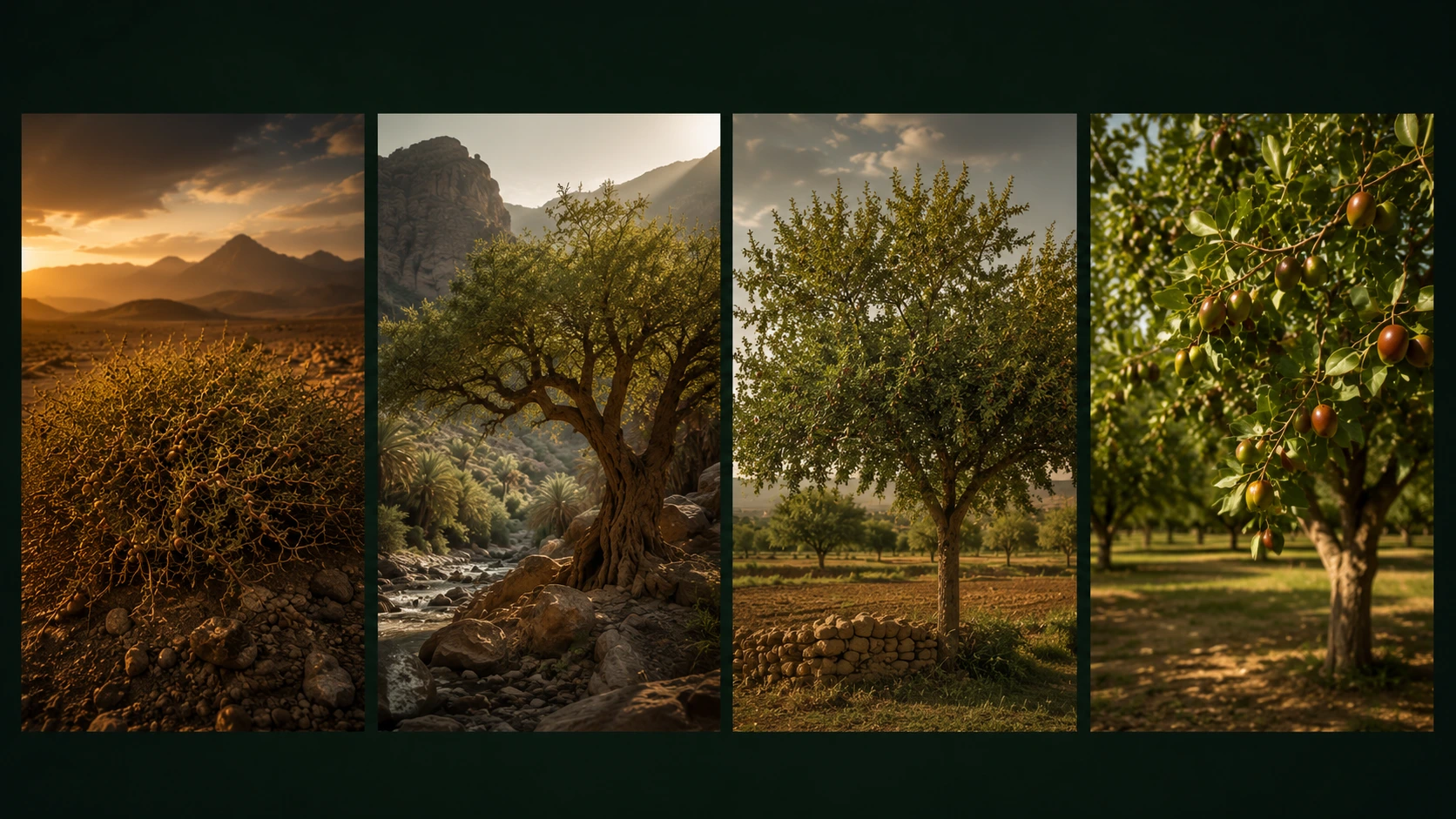
A traveller seeing an old jujube thicket near Errachidia may struggle to recognise the same plant family in a Chinese orchard. The Moroccan specimen may be low, broad, deeply thorny and covered in small fruits. The orchard tree may stand upright, carry selected fruit varieties and receive regular pruning or irrigation.
Several forces shape this contrast:
Species and natural variation
Different members of the Ziziphus genus naturally vary in height, leaf size, fruit size, thorns and preferred climate.
Wild growth or cultivation
A wild shrub shaped by drought, grazing and wind develops differently from a selected orchard variety given water, pruning and care.
Water, altitude and soil
Rainfall, seasonal water flow, mountain elevation and soil depth can influence whether a plant remains compact or develops into a larger tree.
Age and human intervention
Repeated cutting can produce a dense multi-stemmed bush, while protection and long-term care may allow a visible trunk and wider crown to form.
Four Important Types of Jujube Tree
The genus contains many species, and no short article can represent every regional form. The following four, however, offer a useful introduction to the jujube trees most often discussed across North Africa, the Middle East and Asia.
Ziziphus lotus — The Wild Shrub
Strongly associated with Morocco and other dry Mediterranean landscapes, it commonly grows as a dense, thorny shrub with relatively small fruit. It is particularly adapted to arid and semi-arid environments.
Ziziphus spina-christi — The Arabian Sidr
A shrub or tree native across a very broad dryland range extending from western Africa to Pakistan. It is central to the Sidr heritage of Yemen, Oman, Saudi Arabia and the Gulf.
Ziziphus mauritiana — The Indian Jujube or Ber
Widespread through seasonally dry tropical regions, this species includes wild and cultivated forms. Selected varieties can produce fruit far larger than that of Morocco’s wild shrubs.
Ziziphus jujuba — The Chinese Jujube
A temperate shrub or tree native mainly to northern and eastern China through South Korea. Centuries of cultivation have produced numerous fruit varieties for fresh eating and drying.
Morocco’s Wild Jujube: An Ancient Presence in Arid Land
In Morocco, the jujube is not always encountered as a carefully shaped fruit tree. Across dry plateaus, rocky valleys and desert mountain landscapes, it can appear as an enormous thorny bush whose branches form a dense natural fortress.
This is the jujube known through direct observation in areas such as the wider Errachidia region: old shrubs embedded in the landscape, carrying small fruit and surviving where rainfall is scarce. Some appear so established that they feel less like individual plants and more like permanent features of the land.
The botanical name most commonly associated with the wild Moroccan sedra is Ziziphus lotus. Kew Science records this species as a shrub of dry subtropical environments with a natural range across the southern and eastern Mediterranean and North Africa. Nevertheless, a precise identification of every wild population should remain the work of field botany. Morocco can contain local variation, related plants and cultivated introductions.

More Than a Thorny Bush: A Living Island in Dry Landscapes
To an observer focused only on cultivation, a large wild jujube bush may look untidy or obstructive. Ecologically, however, its presence can be far more meaningful.
Research on Ziziphus lotus in arid and semi-arid Mediterranean systems describes the shrub as a potential “nurse plant” and ecosystem engineer. Its deep-rooted structure and broad canopy can create a comparatively sheltered zone beneath and around the plant. Leaves, organic matter and trapped material may contribute to small islands of improved soil conditions, while shade and physical protection can support other organisms.
Recent Moroccan research has also examined how soil microbial communities change around Ziziphus lotus patches. The findings reinforce the idea that the old shrub is not isolated from its surroundings: it can influence the living soil beneath its canopy and the ecological pattern of the land around it.
This does not mean that every jujube bush transforms the desert in exactly the same way. It means that removing an established shrub may erase more than visible branches. Roots, shelter, soil structure and biological relationships developed over many years can disappear with it.
A natural heritage increasingly cleared
Moroccan research describes Ziziphus lotus as a neglected species that may be removed to make way for agricultural land. An ancient wild shrub cannot be recreated simply by planting a young tree elsewhere. Its ecological relationships, age and adaptation belong to the precise place where it developed.
Why Morocco’s Old Jujube Shrubs Deserve Protection
The disappearance of these old shrubs is particularly painful because they are often destroyed quietly. There may be no official monument, marked boundary or visible sign explaining their importance. A bulldozer sees thorns. A field remembers generations.
Protecting the wild jujube does not require freezing rural development or opposing agriculture. It calls for greater discrimination between necessary land use and automatic clearing. Where possible, old shrubs can be retained along field edges, around wadis, on slopes or within uncultivated pockets. Natural regeneration can be protected rather than removed before it becomes established.
Their value may include:
| Natural Value | Why It Matters | What Is Lost When Cleared |
|---|---|---|
| Deep-rooted vegetation | Long adaptation to dry terrain | An established root network that cannot be rapidly replaced |
| Dense canopy | Shade and physical shelter in exposed land | A local refuge for insects, small animals and seedlings |
| Soil influence | Organic matter and distinct microbial communities beneath the shrub | A living soil island developed over time |
| Seasonal flowering | A resource for pollinating insects in dry landscapes | Part of the local flowering calendar |
| Cultural memory | Connection to local names, fruit gathering and landscape knowledge | A piece of rural heritage that may never be documented |
Pakistan, India and Nepal: Where Wild and Cultivated Jujubes Meet
South Asia is one of the most complex regions in the jujube story because several species, wild forms and cultivated varieties overlap. The common word ber may refer to fruit from Ziziphus mauritiana, but the landscape also contains other members of the genus.
Kew records Ziziphus mauritiana across a vast seasonally dry tropical range extending through southern Iran, Pakistan, India and farther east. A recognised wild variety occurs from Pakistan to India and the western Himalaya. Ziziphus nummularia, another often-bushy dryland species, is also native across parts of Pakistan, Nepal, India and the Arabian Peninsula.
This explains why “the Pakistani jujube” cannot be reduced to one image. In one place, it may be a low thorny shrub used by local communities. Elsewhere, it may be a managed fruit tree producing larger ber. In commercial orchards, selection, grafting, irrigation and pruning can dramatically change fruit size and appearance.
Nepal adds altitude to this diversity. Warm lowland zones, dry valleys and Himalayan environments do not offer identical growing conditions. A jujube cultivated in the Terai cannot automatically be compared with a wild shrub growing at a different elevation.
China and the Long History of the Cultivated Jujube
Ziziphus jujuba represents another chapter entirely. Native mainly to northern and eastern China through South Korea, it belongs primarily to a temperate biome. Human selection has transformed it into one of the world’s best-known jujube fruit trees.
Its fruit is often called a Chinese red date, especially when dried and wrinkled. Botanically, however, it is not a date and has no close relationship to the date palm. The comparison is culinary and visual.
Chinese cultivation has produced varieties that differ in shape, size, texture, sweetness and intended use. Some are crisp when fresh. Others are valued after drying. This cultivated diversity shows how far a plant can move from its wild relatives without leaving the same botanical genus.
For this reason, fruit size alone should never be used to judge the age, authenticity or value of a jujube tree. A tiny fruit on an ancient Moroccan shrub and a large fruit in a Chinese orchard tell two different stories of adaptation and human selection.
Survival Shapes the Plant
Limited water, exposed soil, browsing animals and repeated environmental stress often favour compact, thorny and highly resilient forms.
Selection Shapes the Fruit
Pruning, grafting, irrigation and generations of selection can favour larger fruit, predictable harvests and easier orchard management.
Wild Does Not Mean Inferior — Cultivated Does Not Mean Artificial
It is tempting to turn the jujube story into a contest between wild and cultivated plants. That would miss the point.
Wild shrubs preserve ecological adaptation, genetic diversity and relationships with their original landscapes. Cultivated trees preserve agricultural knowledge, fruit traditions and varieties selected by generations of growers. Both deserve respect, but for different reasons.
The real danger begins when a commercial label erases these differences. A cultivated fruit variety should not be marketed as an untouched ancient wild plant. Equally, a small wild fruit should not be dismissed simply because it lacks the size or appearance of an orchard product.
Observe Before Naming
Local names are culturally valuable, but precise botanical claims should be made only when the plant has been reliably identified.
Protect Before Replacing
An ancient wild shrub is more than a young plant of the same name. Its roots, soil relationships and history are site-specific.
Value Every Terroir Honestly
Morocco, Pakistan, Nepal, India and China each hold a distinct part of the jujube story. None needs to imitate another.
What Comes Next: The Jujube Tree in the Arabian Peninsula
This first part has followed the jujube from Morocco’s wild thorny shrubs to the cultivated fruit traditions of Asia. The second part turns toward the Arabian Peninsula, where the tree is deeply connected to the landscapes and honey heritage of Yemen, Oman, Saudi Arabia and the United Arab Emirates.
There, one central question deserves a careful answer: if the same jujube species grows across neighbouring countries, why can the honeys still taste and flow differently?
Continue the Jujube Heritage Series
Discover how one great natural cradle extends across Yemen, Oman, Saudi Arabia and the UAE — and how valleys, water, altitude and harvest conditions give each Sidr honey its own character.
Research Notes and Botanical Sources
This article draws on botanical distribution records from Kew Science — Plants of the World Online, including its accepted records for Ziziphus lotus, Ziziphus spina-christi, Ziziphus mauritiana and Ziziphus jujuba. Ecological context is supported by research on Ziziphus lotus as a potential ecosystem engineer and Moroccan studies of the soil communities surrounding wild jujube patches.
Frequently Asked Questions About Jujube Trees Around the World
A jujube tree is a shrub or tree belonging to the genus Ziziphus in the Rhamnaceae family. Different species grow across Africa, the Middle East and Asia. They commonly have thorny branches, small greenish flowers and stone fruits called jujubes.
No. “Jujube tree” is a broad common name. Important species include Ziziphus lotus, Ziziphus spina-christi, Ziziphus mauritiana and Ziziphus jujuba, alongside many others. Local names do not always identify the exact species.
Ziziphus lotus is the species most widely associated with Morocco’s wild sedra and with the large thorny shrubs of North African arid and semi-arid landscapes. Exact identification of an individual plant or population should still be confirmed botanically.
Its natural growth form, limited water, wind, grazing, repeated cutting and the conditions of arid land can all favour a dense multi-stemmed shrub. A bush form is not a sign that the plant is young or inferior; it may reflect long adaptation to a difficult environment.
Wild jujube occurs across several Moroccan arid and semi-arid zones. Long-established thorny shrubs can be observed in dry plateaus, valleys and desert mountain landscapes, including areas around Errachidia. Local distribution should be documented carefully because many populations remain poorly recorded.
The Moroccan wild jujube is commonly associated with Ziziphus lotus, a dense dryland shrub with small fruit. The Chinese jujube, Ziziphus jujuba, is primarily a temperate fruit tree with many selected varieties. They belong to the same genus but are not the same species.
Ziziphus mauritiana, commonly linked with ber fruit, is widespread in South Asia. Ziziphus nummularia and other regional species are also present. Pakistan and Nepal therefore contain more than one jujube form, ranging from wild shrubs to cultivated fruit trees.
Old shrubs can provide shelter, influence soil conditions, support pollinators and preserve genetic and cultural heritage. Their roots and ecological relationships may have developed over decades. Clearing them removes a living system that cannot be instantly replaced by a young planted tree.