
Our Story — Meski · Sharjah · UAE
Meski
Where a Name Comes From
A ksar in the Moroccan desert. Arab roots from Yemen. A word the Quran uses for paradise. And a honey that has followed the same roads for a thousand years.
I — The Ksar
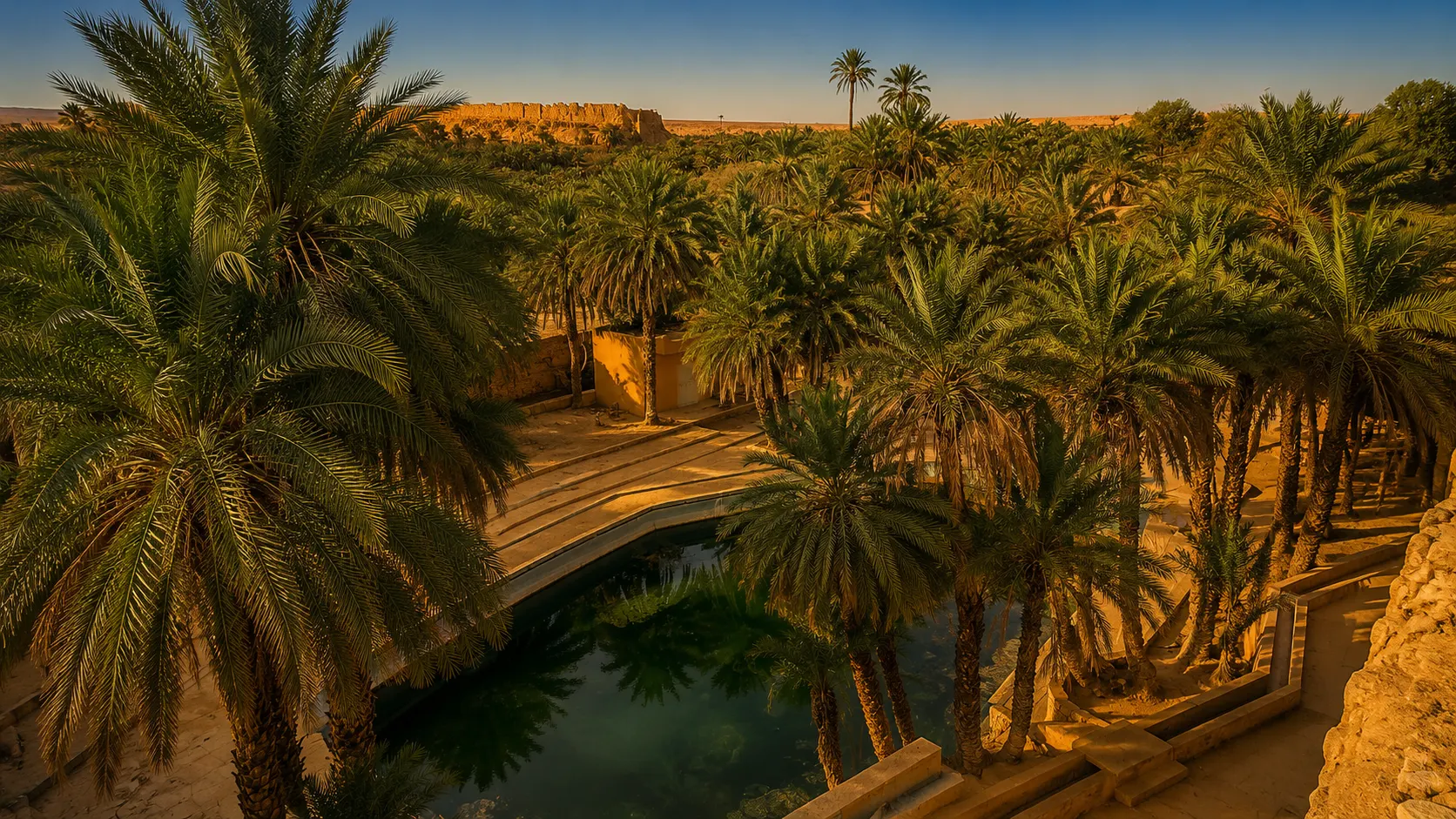
In the Ziz Valley, where the river cuts through pre-Saharan rock before disappearing into the desert, there is a village built on a hill. Not a new village. Not a town that grew. A ksar — a fortified settlement of stone and earth, built to last, built to remember. Its name is Meski. مسكي.
The Tafilalet has always been a crossroads. Berber tribes who knew these mountains before any written record. Caravans from sub-Saharan Africa carrying gold and salt. Jewish communities who built some of the region’s earliest trading houses. And Arab families who arrived from the east — from Yemen, crossing the Sahara’s edge, following routes that commerce had already drawn across the sand for centuries.
They came in waves. The largest, documented by Ibn Khaldun himself, were the Banu Maqil — Arab nomads whose grandfather, the great historian wrote, “is of the Arabs of Yemen.” They arrived in the eleventh century. They settled in the ksour along the Ziz. They stayed.
Among the families that put down roots in this valley, some carried titles that became names. Amini. Amerini. Amirini. Descendants of an Amir — أمير — a commander, a prince, a man whose word held weight in the tribe. In Arabic naming tradition, the suffix tells you everything: you are not just a person, you are a lineage. You carry your origin in your name.
The Tafilalet was never pure anything. It was a place where Berber, Arab, Jewish, and Saharan cultures lived in friction and in harmony for a thousand years. What survived that long is not fragile.
II — The Word
المسك. Musk. The most prized perfume of the ancient Arab world — extracted from the musk deer, carried on trade routes across continents, worth more per gram than gold in the markets of medieval Sijilmassa, the great caravan city whose ruins still lie a few kilometres south of Ksar Meski.
The word appears in the Quran. In Surah Al-Mutaffifin, verse 26, describing the drink of paradise, God says its seal — its final note, its last impression on the lips — is musk. خِتَامُهُ مِسْكٌ. Of all the words available, this was the one chosen to describe what awaits at the end. Not gold. Not silk. Musk. A perfume. A scent. Something that reaches you before you can name it.
A ksar in the Tafilalet carries this name. And the families who lived within its walls carried it with them when they left — the way you carry a smell from a place you love: involuntarily, permanently, in a part of you that has no language.
III — The Honey
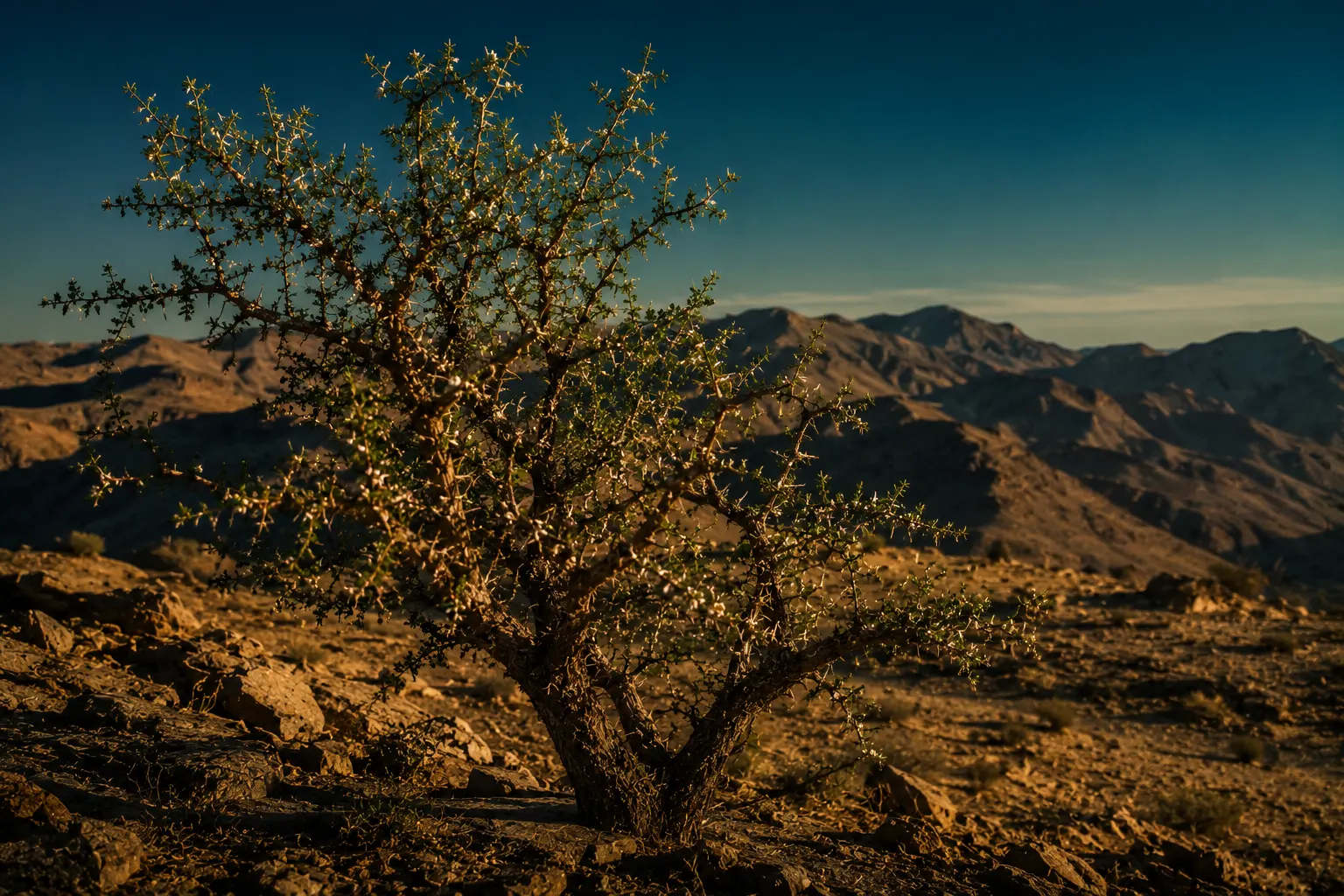
Here is what grows in the valleys around Ksar Meski, in the ravines where the Ziz river brings just enough water to sustain what would otherwise not survive: the Sidr tree. شجرة السدر. Ziziphus spina-christi. Thorned, ancient, drought-resistant. It flowers for a few weeks each year — briefly, almost reluctantly — and the bees that find it produce something that Moroccan families have called precious for as long as anyone can remember.
Moroccan Sidr is not Yemeni Sidr. Anyone who tells you otherwise is selling you something other than truth. The tree is the same species, yes. The honey carries the same name. But the terrain is different — the Atlas foothills instead of Hadhramaut’s high valleys. The Moroccan Sidr is lighter, more floral, softer on the palate. It does not have the deep woody intensity of Yemen’s finest. It is not trying to. What it has is its own truth. Wild. Unmanaged. Gathered by hand. The same liquid gold. A different poem in the same language.
1,000
Years since Arab families from Yemen settled in the Tafilalet ksour — in the same valleys where wild Sidr still grows along the Ziz river today
IV — The Distance
Between the Ziz Valley and the Hatta mountains on the border between the UAE and Oman, there are four thousand kilometres of desert, sea, and history. They share something that distance cannot dissolve: the same tree. The Sidr that grows above Ksar Meski and the Sidr that grows above Hatta are the same species — separated by a continent, connected by a root system older than any border drawn by any empire.
The Yemeni families who crossed the Sahara a thousand years ago and built their lives in the Tafilalet did not know they were carrying something that would one day complete a circle. They were simply moving, the way people always move — following routes that commerce and necessity draw across the earth. They brought their language. Their titles. Their names. And in the valleys they passed through, they found trees they recognised. The same tree. Producing the same honey. Tasting of the same memory.
The world is both smaller and larger than it appears. Smaller because the same plant, the same honey, the same word for “perfume” persists across thousands of kilometres and dozens of generations. Larger because each place it takes root produces something entirely its own — Moroccan Sidr that is not Yemeni, Emirati Sidr that is neither, and yet all three liquid gold, all three unmistakably Sidr, all three pointing back to the same source the way rivers point back to the same rain.
The Sidr that grows above Ksar Meski and the Sidr that grows above Hatta are the same species — separated by a continent, connected by something older than any border.
V — The Name
Meski. مسكي. A ksar in Morocco. A word in the Quran. A perfume that Arab traders carried across the ancient world alongside frankincense, myrrh, and honey. A name that arrived in Sharjah the way names always arrive — not by decision, but by inheritance. By the weight of what came before.
The honey we source — from Hatta, from Oman, from the mountains of Yemen and Morocco — follows the same roads that the Arab families of the Tafilalet once walked in the other direction. Eastward then. Westward now. The direction changed. The cargo did not. It was always this: something rare, something from a tree that flowers briefly and gives generously, something that the ancient world already knew was worth carrying very far.
The circle has taken ten centuries to close. We did not plan it that way. We simply followed the name.
The Same Story. Different Origins.
The honeys we carry at Meski come from the same arc of mountains and valleys that this story describes — from Hatta in the Emirates, from Oman, from Yemen when the sourcing allows it, from Morocco when it does not. Each origin tells a different part of the same story. Each jar is a version of the same sentence that started a very long time ago in the mountains of the Arabian Peninsula.
Explore the range