
Ramadan — From Meski · Sharjah to the World
The Month That Brings
Us Back to Each Other
From Dubai to Doha, from Riyadh to Casablanca — every year, رمضان does something that nothing else manages to do. It brings people home. Not just to a place. To each other.
I — The Table
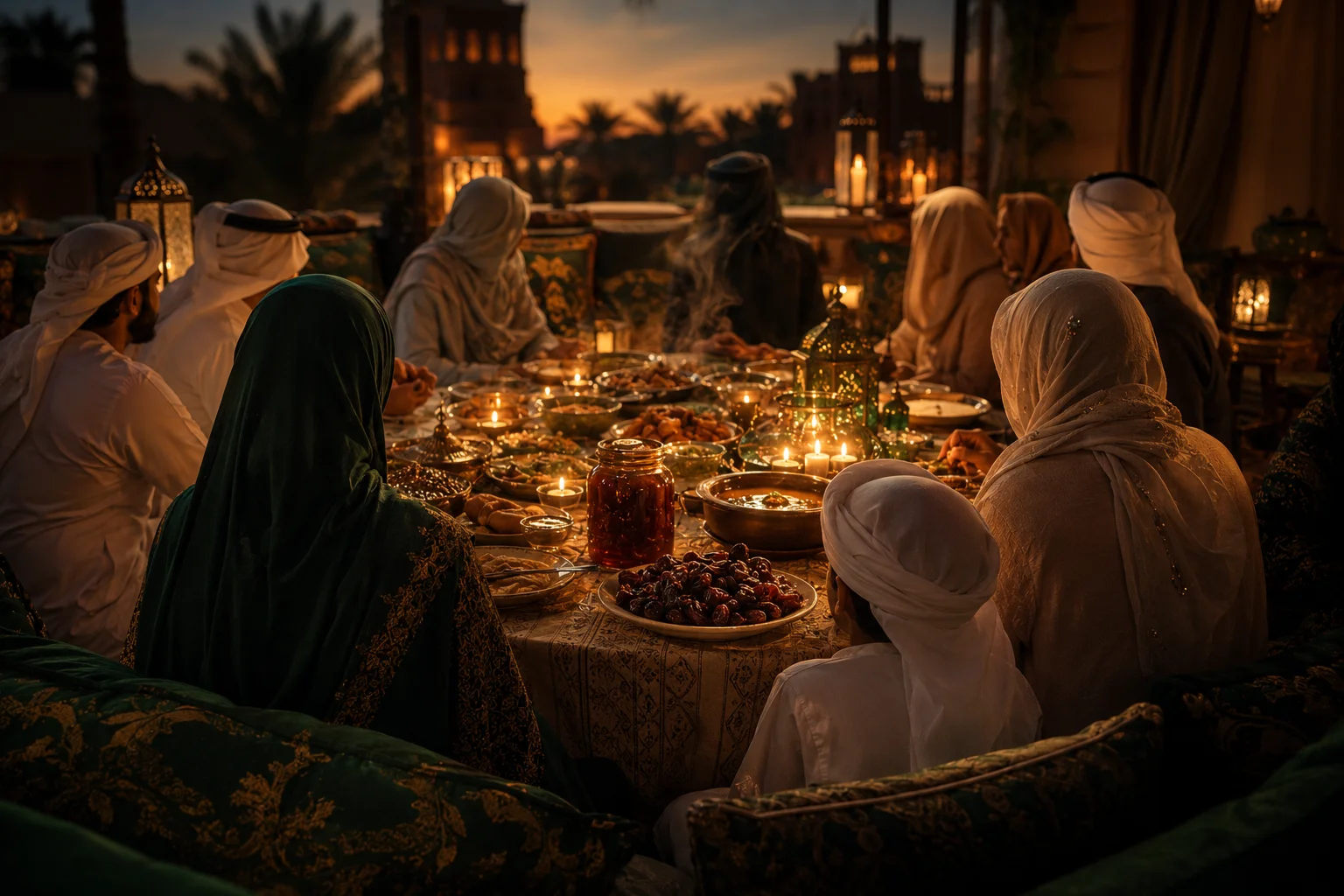
There is a table being set right now in Dubai — someone’s mother has been in the kitchen since afternoon, and the smell coming from that apartment will pull three generations through the door before the call to prayer has finished. The same table is being set in Abu Dhabi, in a villa where children who live abroad have come back for the month. In Doha, where a family gathers in a majlis that holds forty people when the cousins arrive. In Riyadh, where the iftar starts quietly with dates and water and expands slowly into something that lasts until midnight. In Casablanca, where harira steam rises and chebakia waits on a plate that comes out only during this month. In Mecca, where every table feels like it is the centre of the world.
Different cities. Different dishes. The same hunger for something that is not on any of the plates.
Ramadan does not ask you to be ready. It arrives and rearranges everything — the schedule, the appetite, the priorities — until what matters rises naturally to the top.
II — What the Month Asks of Us
The fast is the part everyone knows. But the fast is not the point — or rather, it is not the whole point. It is the instrument that creates the space. When the ordinary rhythm of eating and distraction is suspended, something else becomes possible. Patience. Presence. The willingness to sit across a table from someone you love without looking at your phone.
Ramadan asks us to slow down. And in slowing down, it asks something harder: to notice what we have been neglecting. The relative we have not visited in months. The friend we argued with and never resolved. The parent who is older this year than last year, and will be older still next Ramadan, and one day will not be there to sit beside.
The iftar table is not just a meal. It is an appointment that Ramadan keeps for us — so that we do not miss each other completely in the speed of the rest of the year.
III — Visit. Show Up. Bring Something.
There is a tradition — not written in any book, but practised in every home from Tangier to Dubai — of visiting during Ramadan. Not a formal visit. Not an occasion. Just arriving. Sitting. Staying for iftar even when you were not invited because you did not need to be.
These visits are where Ramadan does its real work. Around a table in Sharjah, a disagreement that had been festering for months dissolves in the warmth of a shared meal. In a living room in Doha, two brothers who had not spoken find themselves next to each other at iftar and discover that the distance was smaller than the stubbornness that created it. In a house in Riyadh, an elderly grandmother receives visitors all evening, and each one who leaves carries something of her with them — a blessing, a prayer, a piece of advice that will come back to them years after she is gone.
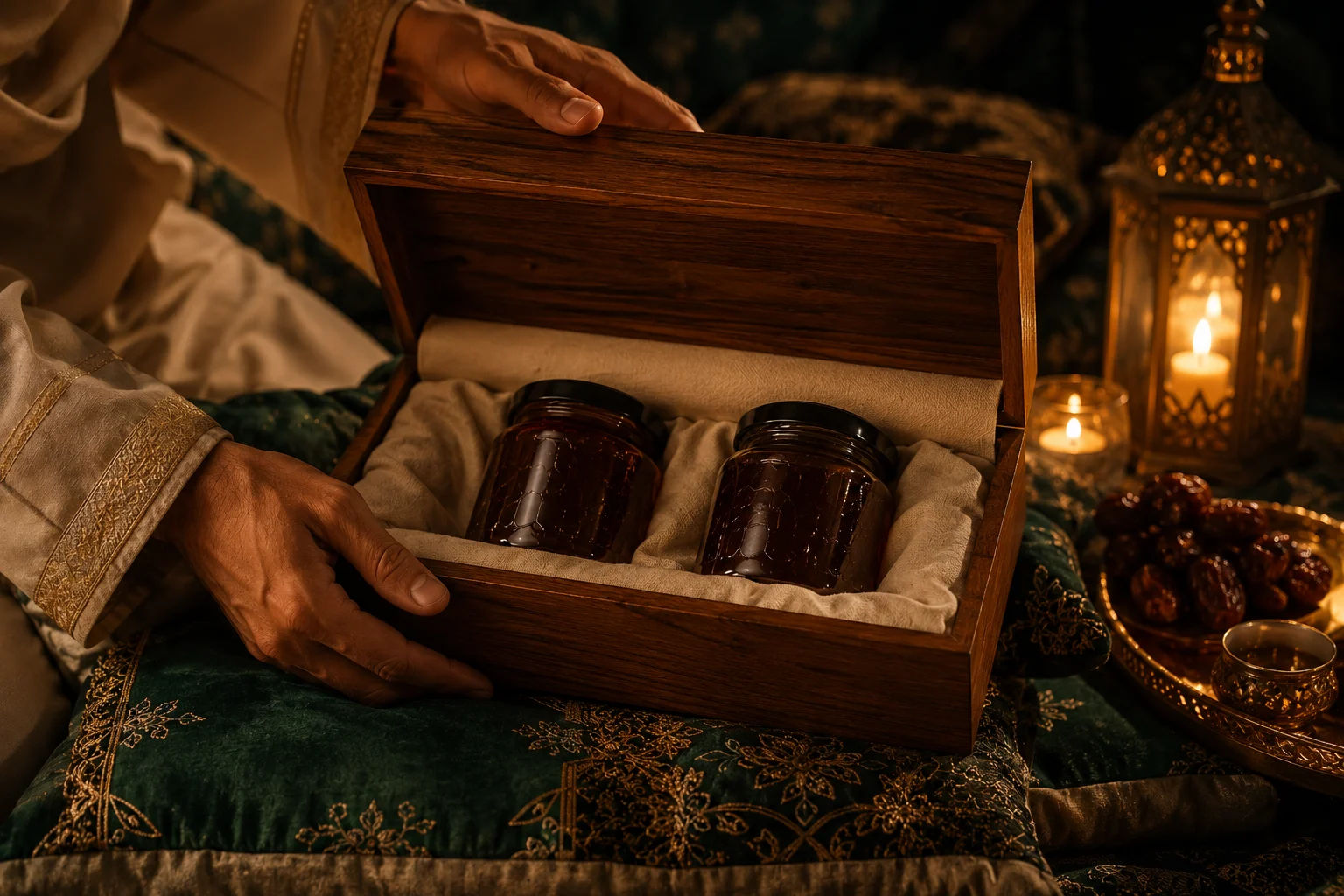
When you arrive, bring something. Not because it is required. Because it says: I thought of you before I came through this door. A jar of good honey on a Ramadan table is not a product. It is a gesture. Something that, like this month, does not last forever — which is exactly why it should not be wasted.
IV — After Iftar: The Mosque
After the meal, when the table has been cleared and the tea has been poured, there is a moment that belongs specifically to Ramadan nights. The men rise. The children follow — half-asleep already but unwilling to be left behind, because somehow they know, even without words, that what happens next is something they will remember.
Tarawih. The night prayer that belongs only to Ramadan. In mosques across Dubai, across Abu Dhabi and Sharjah, across Doha and Riyadh and Mecca — the same verses fill the same night air. Men and boys standing in rows, the oldest beside the youngest, the familiar beside the stranger, all turned in the same direction.
Back at the house, the women may stay — talking quietly around what remains of the table, the evening extending into something unhurried. Or they go to their own rows at the mosque, and the night holds both gatherings at the same time, in the same sanctity. Both are right. Both are Ramadan.
The children who were brought to Tarawih half-asleep in their fathers’ arms — they will be fathers themselves one day. And they will bring their own children. And the night prayer will mean something to them that they cannot yet explain, because some things are understood before they are articulated.
The moments you make for your family during Ramadan are not lost when the month ends. They are deposited somewhere in them — and one day, without warning, they will pass them on.
V — Do Not Let It Pass
Ramadan comes once a year. It feels like it will always come again. And it will — until it does not. Until someone is missing from the table. Until the house is quieter than it used to be. Until you would give anything to sit in that crowded, noisy, imperfect iftar one more time.
Do not wait for that moment to understand the value of this one.
Call the person you have not called. Visit the house you have not visited. Sit at the table without your phone. Let the children stay up late because they will sleep deeply and wake up having been part of something. Bring something when you go — because when you give with love, you do not count the cost. And speak sweetly. كلام عسل — words like honey — cost nothing and leave everything.
Life passes. These moments do not have to. They can be carried forward, from table to table, from generation to generation, if we choose to make them matter while we still can.
From Meski — To Every Table
From the Ksar Meski in Morocco’s Tafilalet to the mountains of Hatta on the UAE-Oman border — from Sharjah to every Muslim home in Dubai, Abu Dhabi, Doha, Riyadh, Mecca, and every city where Ramadan gathers families around a table — we at Meski wish you a blessed month. May your table be full. May the people around it be the ones who matter. And may the sweetness of this month stay with you long after it ends.
Explore gifting