
How the art of welcoming — learned through gestures, teapots and open doors — travels quietly from one generation to the next.
There are lessons in life that are never spoken aloud. They are absorbed through proximity — through watching hands move with quiet purpose, through standing at the edge of a room and understanding, without a single word of explanation, that something important is happening. In Morocco, one of the most enduring of these silent lessons is Moroccan hospitality — a living tradition passed from generation to generation through gestures, tea rituals, and the careful setting of a table.
The Lesson No One Teaches — And Everyone Learns
Ask any Moroccan where they learned to welcome a guest, and they will pause. Not because they don’t know the answer, but because the answer is everywhere and nowhere at once. It was in the way their mother straightened a tablecloth at the age of seven. It was in their father’s voice dropping half a register when he said “Marhaba bik” — “You are most welcome” — to someone crossing the threshold. It was in the steam rising from their grandmother’s teapot on a winter afternoon, and in the careful, unhurried height from which she poured.
No school teaches this. No manual explains it. And yet, generation after generation, the knowledge is transmitted with extraordinary precision — carried not in books, but in gestures.
The Mother and the Table: Where Hospitality Begins
Long before a single guest arrives, the preparation has already begun. In a traditional Moroccan home, the mother moves through the house with an instinct that looks effortless — and is, in fact, the product of decades of practice. The tablecloth is selected with care: not just for its color, but for what it communicates. The plates are arranged not merely for function, but for beauty. A small bowl of olives here. A plate of sellou or almond pastries there. A dish of honey — rich, amber, deeply fragrant — placed at the center of the table like a quiet declaration of generosity.
And somewhere in the house, a child is watching.
She — or he — may appear to be playing, or reading, or doing nothing in particular. But children notice everything. They notice that their mother does not rush. That she hums softly as she works. That she steps back from the table and looks at it with the quiet scrutiny of a craftsperson assessing a finished piece. Something is moved slightly to the left. A glass is polished one more time. Then, satisfied, she nods imperceptibly to herself.
The child files this away. Not as a rule. As a feeling. A table prepared with love looks a certain way.
Every Detail Tells a Guest: You Matter
There is a saying, passed between Moroccan women for generations, that goes something like this: “The table is the first word of welcome.” Before anyone speaks, before tea is poured, before a single dish is shared, the table has already told the guest: you were expected, you were thought of, and we are glad you are here.
This is not mere aesthetics. It is a moral stance. In the Moroccan tradition — as in much of the broader Arab and Islamic world — the guest holds an almost sacred position. The Prophet Muhammad, peace be upon him, urged the faithful to honor their guests, and Moroccan culture has taken this teaching and woven it into the very fabric of domestic life. The mother preparing the table is not simply setting dishes. She is making a theological and cultural statement, one tile at a time, in the mosaic of her household’s identity.
And the child, watching from the doorway, is learning that generosity is not an impulse. It is a practice. It is prepared in advance.
On Honey at the Moroccan Table
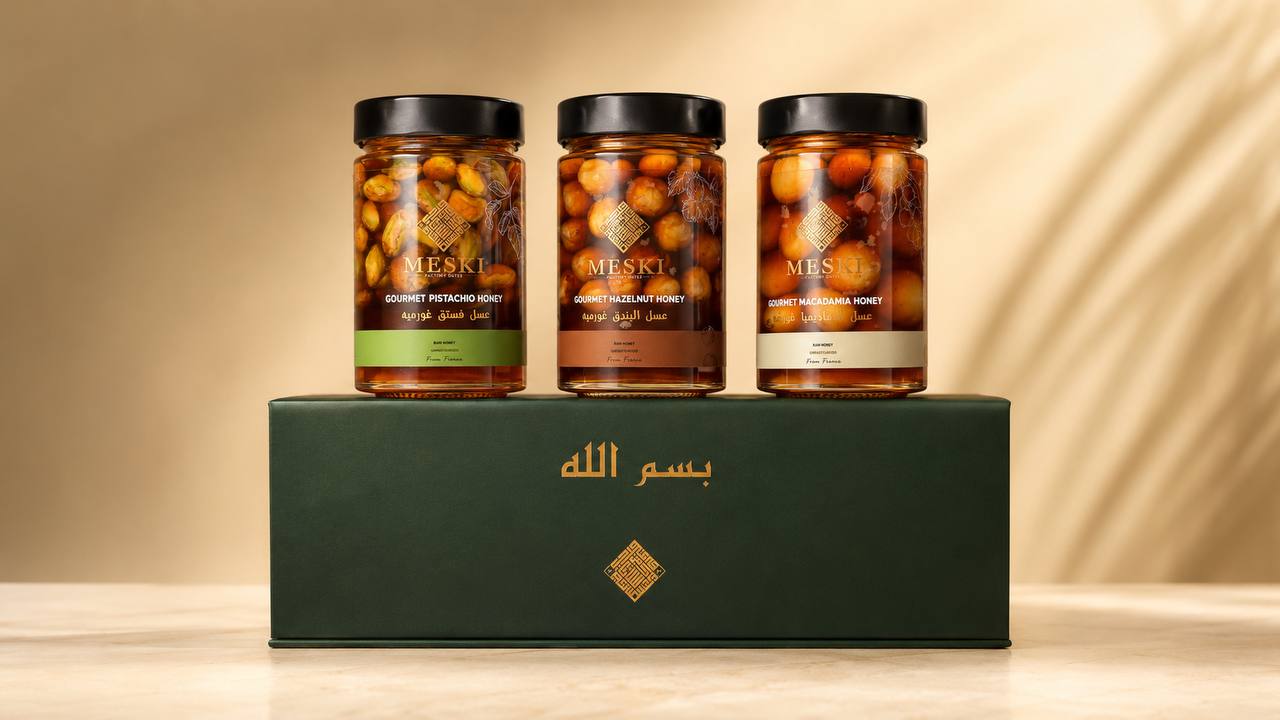
Honey has graced Moroccan tables for centuries, placed at the center not merely as a sweetener but as a symbol of generosity and abundance. At Meski Dates Factory, our Moroccan Royal Sidr Honey carries this heritage — sourced with the same reverence that Moroccan families have always given to the finest things they offer their guests.
The Father at the Door: The Art of the Welcome
If the mother’s domain is the table, the father’s is the threshold. In Morocco, the moment of arrival is treated as a ceremony in itself. The father — or the senior male of the household — does not merely open a door. He opens a world. He steps forward to greet the guest before they have fully crossed the entrance, as if to say: we have been waiting, and we are genuinely glad you are here. The handshake is warm and extended. The eyes meet properly. The phrase “Ahlan wa sahlan” — roughly, “you have come among family, and the path to us is wide” — is not a formula. It is meant.
A well-known anecdote from the Moroccan diaspora in Europe captures this beautifully: a family from Fès, settled in France for two decades, received an unexpected visit from a neighbor one rainy Tuesday evening. There was no occasion, no prior arrangement. The neighbor had simply been passing by. Within minutes, the father had placed his newspaper aside, changed into a proper djellaba, and was already calling toward the kitchen. The neighbor, a Frenchman unaccustomed to such reception, later told friends: “I stopped to say hello. I stayed for three hours. And I was made to feel that staying was the greatest favor I could do them.”
This is the Moroccan father’s gift. He makes the guest feel that their arrival is a blessing — not an imposition. Somewhere nearby, his son is watching, rehearsing a role he will one day play himself.
A Handshake, a Word, a Posture — The Architecture of Marhaba
The word marhaba — welcome — comes from the Arabic root r-h-b, which carries the sense of wideness, openness, spaciousness. To say marhaba is literally to offer the guest room: room in your home, room in your time, room in your heart. Moroccan fathers, often without knowing the etymology, embody this root perfectly. The welcome is never hurried. The conversation is never half-attended. The guest is always made to feel that there is no other place in the world the host would rather be.
This quality — full presence, generous attention — is perhaps the rarest and most valuable thing one can offer in the modern world. And it is taught, silently, at the front door of Moroccan homes, to children who will one day stand there themselves.
The Grandmother and the Teapot: Where the Real Magic Happens
Every Moroccan family has, or has had, a grandmother whose tea is spoken of with the kind of reverence usually reserved for matters of deep importance. Her name may change; her teapot is always silver. Her hands may be aged; her movements are always precise.
The preparation of Moroccan mint tea — called atay in Darija — is one of the most carefully codified rituals in North African culture. Gunpowder green tea leaves are rinsed first with a brief infusion of boiling water, which is then discarded — a gesture of purification. Fresh nana mint, cut just hours before, is pressed gently into the pot. Sugar — always too much, by any outside standard — is added with the generous hand of someone who understands that sweetness offered to a guest is not an indulgence, but a kindness.
Three Pours, Three Meanings
The grandmother lifts the teapot high — sometimes a full meter above the glass — and pours in a long, thin, confident arc. The liquid falls into the small, decorated glass and produces a delicate layer of foam called rghwa, which is considered not just beautiful, but essential. No foam means the tea was not poured with proper attention.
Moroccan tradition prescribes three rounds of tea from the same pot, each brew deepening in intensity. There is an old Moroccan saying, often shared across the Maghreb: “The first glass is as gentle as life, the second as strong as love, the third as bitter as death.” The experience of sharing tea is designed to evolve, to deepen, to reward those who stay.
The grandchild sitting nearby — invariably small, invariably quiet, invariably watching — sees all of this. They see that their grandmother never rushes the pour. That she offers the first glass to the eldest guest present, or to the guest who has travelled farthest. They see the guest’s face change when they taste it — the small, involuntary softening that happens when something is genuinely, unexpectedly good. Years later, perhaps decades later, they will find themselves lifting a teapot in that same high, confident arc — and they will understand, in that moment, that they have been carrying this gesture inside them for their entire life.
The Purification Pour
The first brief infusion is discarded — a ritual gesture of cleansing that signals care and intentionality before the tea is ever tasted.
The High Arc
Pouring from height creates the essential foam — rghwa — that signals the tea was prepared with full attention. No foam, no honour.
The Three Rounds
Each successive brew deepens in strength. The tradition rewards the guest who lingers — a quiet encouragement to stay, to talk, to belong.
The Child Watching from the Corner
The deepest hospitality traditions are never imposed on children in Morocco. They are not sat down and told: “This is how you welcome a guest. This is how you set a table. This is how you pour tea.” The knowledge is far too subtle for instruction. Instead, children are simply present. They are allowed to sit at the edge of adult gatherings. They bring glasses, or carry a plate of dates, or are asked to fetch a fresh sprig of mint from the kitchen — small responsibilities that draw them into the ritual without overwhelming them.
In this way, hospitality becomes, for the Moroccan child, not a lesson learned but a memory inhabited. The smell of mint tea brewing. The sound of laughter when a guest feels truly at home. The sight of their father’s face, proud and relaxed, as the evening unfolds over an abundant table. These sensory memories are the most durable kind. They survive everything — distance, time, change of country. They travel with the child wherever they go.
It is perhaps no coincidence that Moroccan hospitality has a reputation that extends far beyond Morocco’s borders. In the Gulf, in Europe, in the Americas, wherever Moroccan families have settled, the same phenomenon repeats: guests walk in as strangers and leave as friends, marvelling at something they cannot quite name. What they are experiencing is the output of this invisible education — hospitality practiced with such consistency across generations that it has become, quite simply, who these people are.
Transmitted Through Proximity
Moroccan hospitality is never formally taught. It is absorbed — through watching, through being present in the right room at the right moment, through the quiet repetition of beautiful gestures.
Rooted in Sacred Values
The tradition draws directly from Islamic teachings on the sanctity of the guest. Generosity is not optional — it is a spiritual practice, expressed through every plate set and every tea poured.
Carried Across Borders
Wherever Moroccan families settle — Gulf, Europe, the Americas — the same tradition reappears, intact and unmistakable. It is perhaps the most portable inheritance a culture can possess.
A Tradition That Travels
At Meski Dates Factory, we have spent years in the company of producers, families, and communities for whom this kind of heritage is not nostalgic sentiment but active, daily reality. From the honey valleys of Yemen to the olive groves of the Mediterranean, from the date palms of the Arabian Gulf to the homes of Moroccan families who set their tables with the same care their great-grandmothers once did — we see, again and again, that the most precious things are those passed not through institutions, but through proximity. Through watching. Through being present in the right room at the right moment.
When we curate a gift — a jar of raw Moroccan Sidr honey, a bottle of first cold-pressed Moroccan olive oil, a handcrafted box that carries the weight of a tradition — we are participating, in our own small way, in this same logic. A gift prepared with genuine attention says, before a single word is spoken: you were thought of. You matter. Welcome.
Which is, when you reduce it to its essence, exactly what a Moroccan grandmother says every time she lifts her teapot high and pours.
Bring the Spirit of Moroccan Generosity to the Table
From our Moroccan Royal Sidr Honey to our curated luxury gift collections, every Meski product is chosen with the same intention that sets a Moroccan table: to tell the guest, before a single word is spoken, that they were thought of.
Moroccan Hospitality: Your Questions Answered
Moroccan hospitality is distinctive for its intergenerational transmission: it is never formally taught, but absorbed through presence and observation from childhood. It is also deeply rooted in Islamic values that regard the guest as sacred, combining spiritual obligation with aesthetic care — the prepared table, the high pour of mint tea, the unhurried welcome — into a seamless cultural practice.
The Moroccan mint tea ceremony, known as atay in Darija, is one of North Africa’s most codified hospitality rituals. It involves a precise sequence: purifying the tea leaves, pressing fresh mint, adding generous sugar, and pouring from height to create the characteristic foam (rghwa). Three successive rounds are traditionally served, each deepening in strength — symbolising the evolution from gentleness to love to depth. It is as much a social and spiritual act as a culinary one.
Children in Morocco are not taught hospitality through formal instruction. They are made present: allowed to sit at the edge of adult gatherings, given small tasks such as carrying a plate of dates or fetching mint. Through this participation, they absorb the values, gestures, and sensory memories of hospitality — the smell of brewing tea, the sound of a guest laughing freely — which remain with them for life, often reproduced with remarkable fidelity decades later.
In Moroccan tradition, honey occupies a place of honor at the table because it represents generosity and abundance. Placing the finest jar at the center communicates to the guest that nothing has been held back. This gesture echoes broader Arab and Islamic traditions in which offering one’s best — including the most prized honeys — is a form of respect and affection. At Meski Dates Factory, our Moroccan Royal Sidr Honey is crafted to carry exactly this quality: something worthy of being placed at the center of a well-prepared table.