
Heritage Series — The Meski Journal
King Solomon
and the Honey of the Queen’s Kingdom
She came to test him. She brought gold, spices, and the rarest honey her mountains produced. He returned her gifts. And in that exchange, something more significant than tribute changed hands.
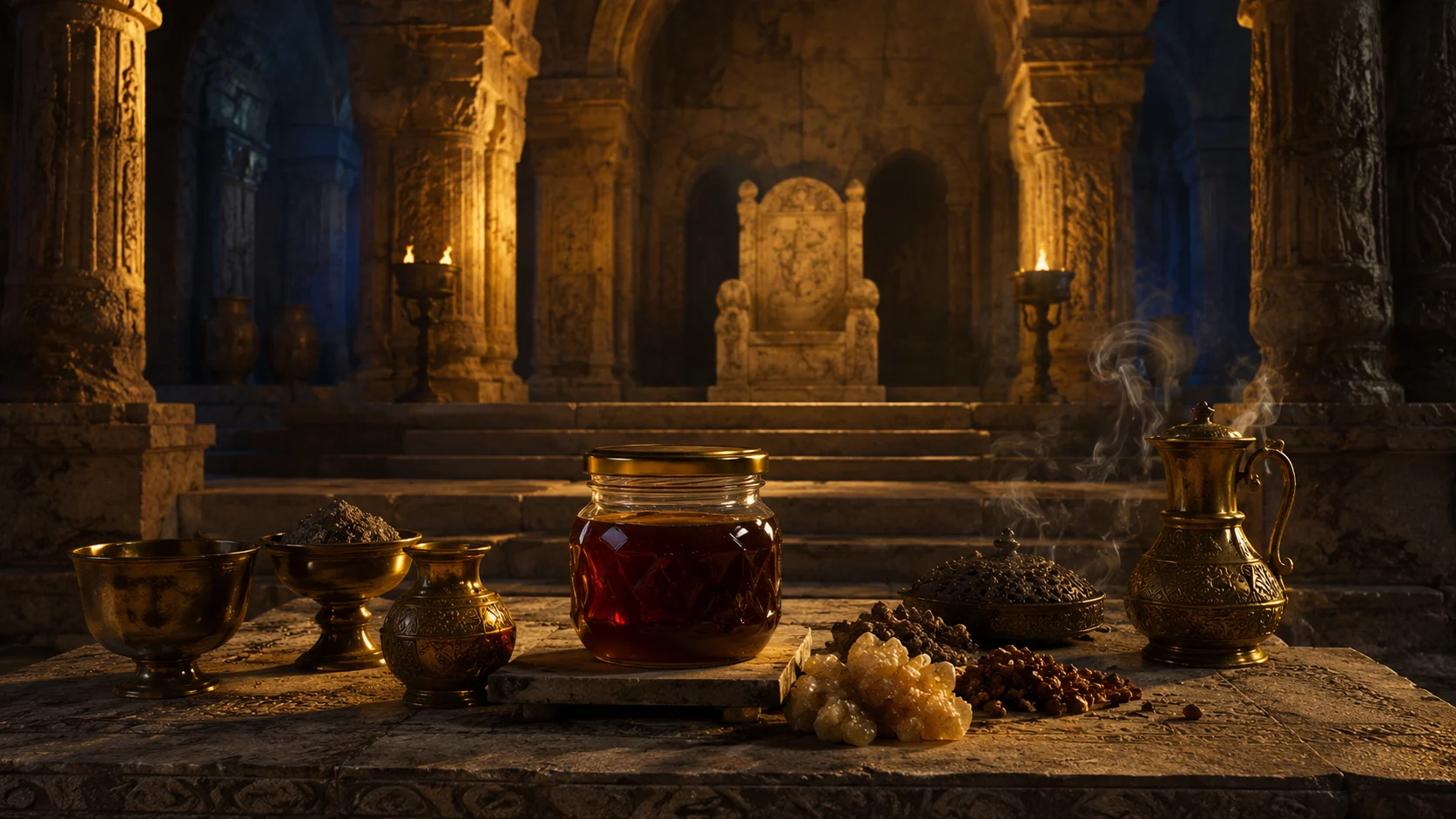
Three thousand years ago, two of the most powerful rulers on earth met in Jerusalem. One came from the north — a king known for wisdom so extraordinary that people travelled from the edges of the known world to hear him speak. One came from the south — a queen whose kingdom controlled the most valuable trade routes on earth, whose caravans carried gold, frankincense, myrrh, and honey across continents. Their meeting is recorded in three sacred texts — the Hebrew Bible, the Quran, and the Ethiopian Kebra Nagast — and debated by scholars across three thousand years of history. What is not debated is the honey. It was there. It has always been there.
I — The King Who Asked Impossible Questions
Suleiman — سليمان, Solomon in Hebrew — is one of the few figures whose story appears, in slightly different form, in every Abrahamic tradition. In the Hebrew Bible, he is the son of David, builder of the First Temple in Jerusalem, a king whose wisdom was described as greater than all wisdom in the east and Egypt. In Islamic tradition, he is a prophet — نبي — to whom God granted dominion not only over humans but over wind, animals, and the jinn. In the Quran, Surah An-Naml — the Chapter of the Ant — dedicates more verses to his encounter with the Queen of Sheba than to almost any other single narrative.
In all three traditions, Solomon is identified with a particular quality beyond his political power: he could not be deceived. He saw through appearances to what lay beneath them. He posed riddles that required genuine understanding to answer, not merely intelligence. He was, in the deepest sense of the word, someone whose judgment could not be purchased.
This quality — the incorruptibility of true wisdom — is exactly what the Queen of Sheba came to test. And it is exactly what made the gifts she brought something more interesting than tribute.
II — What She Brought and What He Did with It
The biblical account in 1 Kings 10 describes her arrival with precision: “a very great train, with camels that bore spices, and very much gold, and precious stones.” The Islamic account in Surah An-Naml is more nuanced about the purpose — in the Quranic narrative, the Queen (whose name is never given in the sacred text itself — Bilqis, بلقيس, comes from the commentary tradition) sends gifts not as tribute but as a test. She wants to know whether Solomon is a prophet or simply a powerful king.
Among the gifts that her caravans carried northward from Yemen to Jerusalem were the products her kingdom was famous for: frankincense, myrrh, the spices that Egypt and Greece and Persia could not produce themselves. And honey — the dark, dense, extraordinarily concentrated honey of the Sidr trees that grew in the same mountain valleys where her kingdom’s power was rooted. عسل السدر. Not generic honey. The honey of those specific mountains, produced by bees that had been kept by the same families for generations, from flowers that bloomed for a few weeks each year and gave what they gave without reservation.
Solomon returned the gifts. In the Quranic account, he told her emissaries: “Do you think to provide me with wealth? What God has given me is better than what He has given you.” He was not interested in her gold or her honey. He was interested in her.
He returned her gold and her honey. He kept her attention. That was the exchange — and it was the more significant one.
III — The Kingdom That Made the Honey
To understand what the honey meant, you have to understand where it came from. The Kingdom of Saba — سبأ, Sheba — was centred around the ancient city of Marib in what is now Yemen. Its power rested on control of the frankincense and myrrh trade routes — the routes along which every gram of incense that reached the temples of Egypt, Greece, Persia, and Israel passed through Sabaean hands.
In the mountain valleys of this kingdom — in the Hadhramaut region, in the highlands above Aden — the Sidr tree grew in the same calcareous limestone soil where it grows today. At altitudes between 1,500 and 2,800 metres. In terrain so dry that the honey the bees produced had a moisture content below 17%. Concentrated, dense, with a flavour that lingered for minutes after tasting — warm, woody, with a caramel depth that the flat lowlands could not replicate.
This was the honey that went north with the Queen’s caravans. Not because it was plentiful — it was not. Not because it was cheap — it was not. Because it was the finest thing those mountains produced, and when you are presenting yourself to the wisest person on earth, you bring what is finest, not what is easiest.
3
Sacred texts — Hebrew Bible, Quran, Kebra Nagast — that record the meeting of Solomon and the Queen of Sheba
3,000
Years since the Kingdom of Saba produced Sidr honey in the same mountains where it is still harvested today
105
Kilometres from Dubai to the Hatta mountains — where the same Sidr tree still produces the same honey
IV — Solomon, Honey, and Wisdom in Tradition
The connection between Solomon and honey runs deeper than the Queen’s tribute. In Jewish tradition, the Book of Proverbs — attributed to Solomon — contains one of the oldest recorded comparisons of wisdom to honey: “My son, eat thou honey, because it is good, and the honeycomb, which is sweet to thy taste: So shall the knowledge of wisdom be unto thy soul.” The comparison is deliberate: wisdom is like honey because both are sweet, both are produced through sustained collective effort, and both are found by those who know where to look and have the patience to wait for them.
In Islamic tradition, the Quran’s Surah An-Nahl — the Chapter of the Bee — describes honey as a healing for humanity and as a sign of divine provision: “There comes forth from their bellies a drink of varying colours, wherein is healing for mankind.” This verse does not specifically connect to Solomon, but the cultural resonance between the Prophet-King who received honey from the Queen of the greatest honey-producing region on earth, and the Quranic designation of honey as something sacred and healing, runs through Islamic scholarship on both figures.
V — From Jerusalem to Sharjah
The honey that the Queen of Sheba carried northward to Solomon was produced in mountain valleys that still produce the world’s most celebrated Sidr honey today. Wadi Do’an in Yemen’s Hadhramaut Governorate — the source of what honey connoisseurs consider the finest Sidr on earth — sits within the ancient heartland of Saba. The Sidr trees that flower there today are the same species that flowered in those valleys three thousand years ago. The bees that make the honey — the native Apis mellifera jemenitica — are the descendants of the same native bee that worked those flowers when the Queen’s beekeepers were gathering honey for the royal tribute.
The same tree grows in the Hatta mountains on the border of Dubai and Oman — 105 kilometres from the city that has named a shopping mall after the explorer who crossed these same roads in the fourteenth century. The honey from Hatta was recognised at the London Honey Awards in 2022. It comes from trees that predate every building in the city around them.
Solomon received honey from the Queen of Sheba’s kingdom and returned it as unnecessary — he already had wisdom, which was worth more. What he could not return was the memory of it. Three thousand years later, the honey is still being produced. The wisdom of not wasting it is the same.
Questions About Solomon, Bilqis, and the Honey
Solomon (سليمان, Suleiman) was a king and, in Islamic tradition, a prophet — the son of the Prophet David (داود). He is described in the Hebrew Bible as the builder of the First Temple in Jerusalem and a ruler whose wisdom exceeded all wisdom in the east. In the Quran, he was given dominion over the wind, animals, and the jinn, and could understand the language of birds and other creatures. He appears in Surah An-Naml (the Chapter of the Ant) in the context of his encounter with the Queen of Sheba, and in Surah Saba (the Chapter of Sheba) in relation to his kingdom’s connection to her land.
Yes — their encounter is one of the most detailed narrative sequences in Surah An-Naml (the Quran, Chapter 27), as well as appearing in 1 Kings 10 and 2 Chronicles 9 in the Hebrew Bible, and in the Ethiopian Kebra Nagast. In the Quranic account, a hoopoe bird informs Solomon of a queen who rules a great kingdom and worships the sun rather than God. Solomon sends her a letter. She sends gifts — which Solomon returns, uninterested in material tribute. She eventually comes herself, and the narrative describes a court and a throne that she recognises as her own, and her conversion to monotheism. The name Bilqis does not appear in the Quran itself — it comes from later Islamic commentary tradition.
The biblical account describes “a very great train, with camels that bore spices, and very much gold, and precious stones” — the luxury products of the Sabaean kingdom’s trade network. In the Quranic account, the emphasis is different: the Queen sends gifts specifically as a diplomatic test to determine whether Solomon is a political ruler or a true prophet. He returns the gifts, demonstrating that his interest is not in material wealth but in submission to truth. The honey that the Sabaean kingdom produced — from the same mountains that produce the world’s most celebrated Sidr honey today — would have been among the luxury provisions any Sabaean diplomatic mission carried.
Honey is mentioned in the context of wisdom in the Book of Proverbs — attributed to Solomon — where the sweetness of honey is used as a comparison for the value of wisdom: “eat thou honey, because it is good… so shall the knowledge of wisdom be unto thy soul.” In the Quran, the Chapter of the Bee (Surah An-Nahl, 16:69) describes honey as containing “healing for mankind” — a verse not specifically connected to Solomon but in the same text that contains his story. The geographic connection is direct: the honey of the Sabaean kingdom (present-day Yemen) was the most valued honey of the ancient world, and the Queen carried it as part of her tribute to the wisest king known to history.
The Kingdom of Saba occupied the same mountain valleys of Yemen where the world’s most celebrated Sidr honey is still produced today. The tree — Ziziphus spina-christi — is the same species. The beekeeping tradition in Hadhramaut traces back further than any written record can document. When Solomon received honey as part of the Queen of Sheba’s tribute, it came from the same calcareous limestone mountains where Wadi Do’an beekeepers work today — the same altitude, the same soil, the same brief flowering season. The connection is not mythological. It is botanical and geographic.
The Honey of That Kingdom
The Sidr honey from Hadhramaut — the same mountain region where the Kingdom of Saba produced its tribute honey for the ancient world — is available through Meski with full traceability documentation. And the Emirati Sidr from Hatta, 105 kilometres from Dubai, comes from the same geological range and the same tree. Some stories take three thousand years to reach their next chapter.
Explore the range