
Ramadan Kitchen — Meski · Dubai · Sharjah
Honey Bite:
Six Ways to End an Iftar Right
No lengthy recipes. No specialist equipment. Six ways to use raw Sidr honey in the minutes around iftar — each one under five minutes, each one worth repeating.
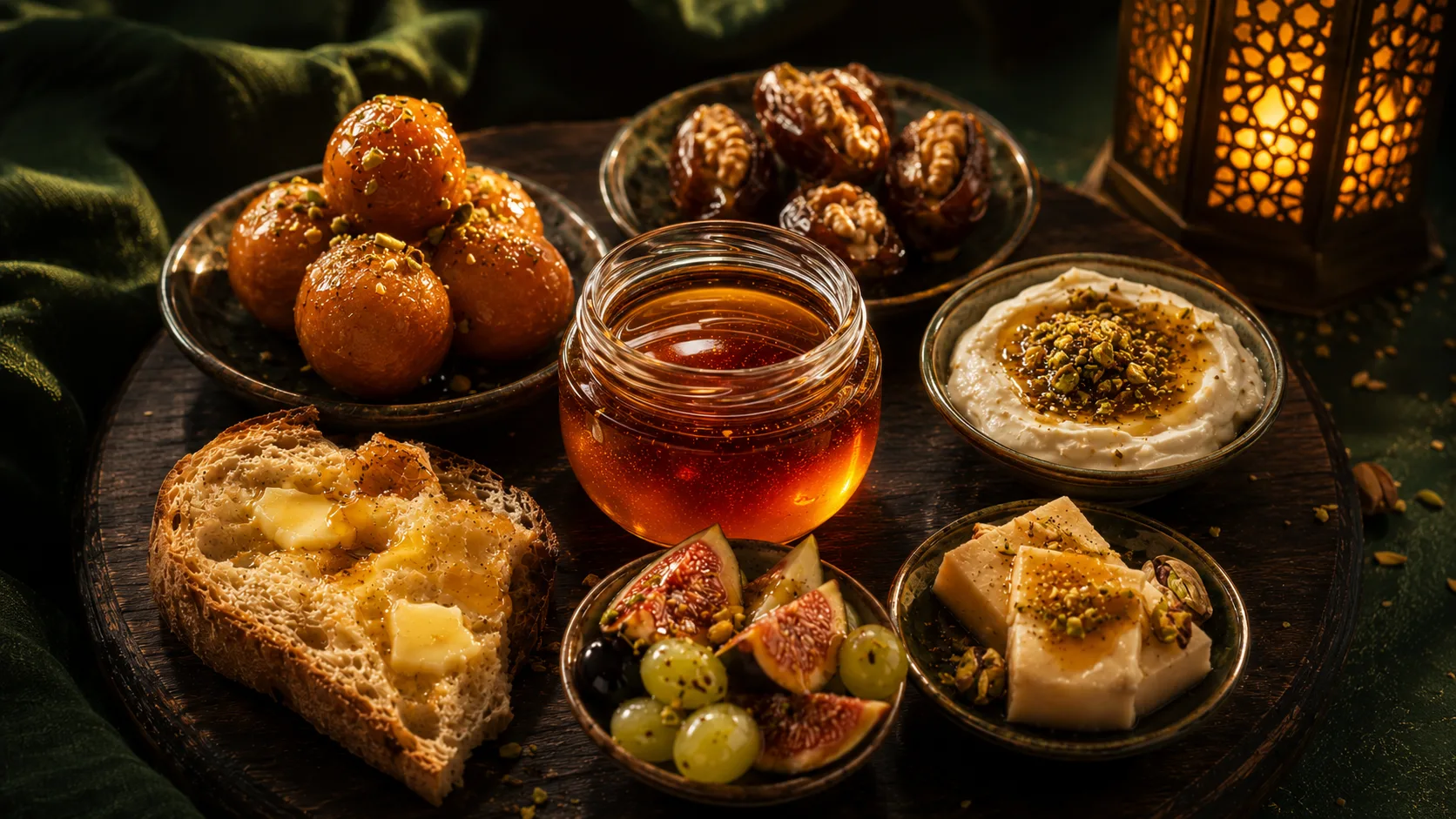
Ramadan iftar is not the time for elaborate cooking. The fast has been long, the family is gathered, and the first things on the table should arrive quickly. These six honey bites are exactly that — fast to prepare, simple to present, and good enough that people will ask you about them without knowing there was nothing to explain. All of them use raw Sidr honey. All of them can be prepared in the time it takes the dates and water to reach the table. All of them have been tested at an actual iftar table, not in a studio.
The Six Bites
Sidr Honey over Fresh Luqaimat
This is not a recipe. It is a ritual. Hot luqaimat — the small Emirati fried
dough balls, crisp outside and soft inside — arrive at the table from wherever
you are getting them from. You drizzle raw Sidr honey over them the moment
they land, while they are still warm enough that the honey thins slightly
and seeps into the crevices rather than sitting on the surface.
The ratio: generous. The honey should reach every piece.
Serve immediately. They will not wait and neither will anyone at the table.
Honey recommendation: Emirati Sidr from Hatta
— the local provenance adds a layer to the moment that imported honey cannot.
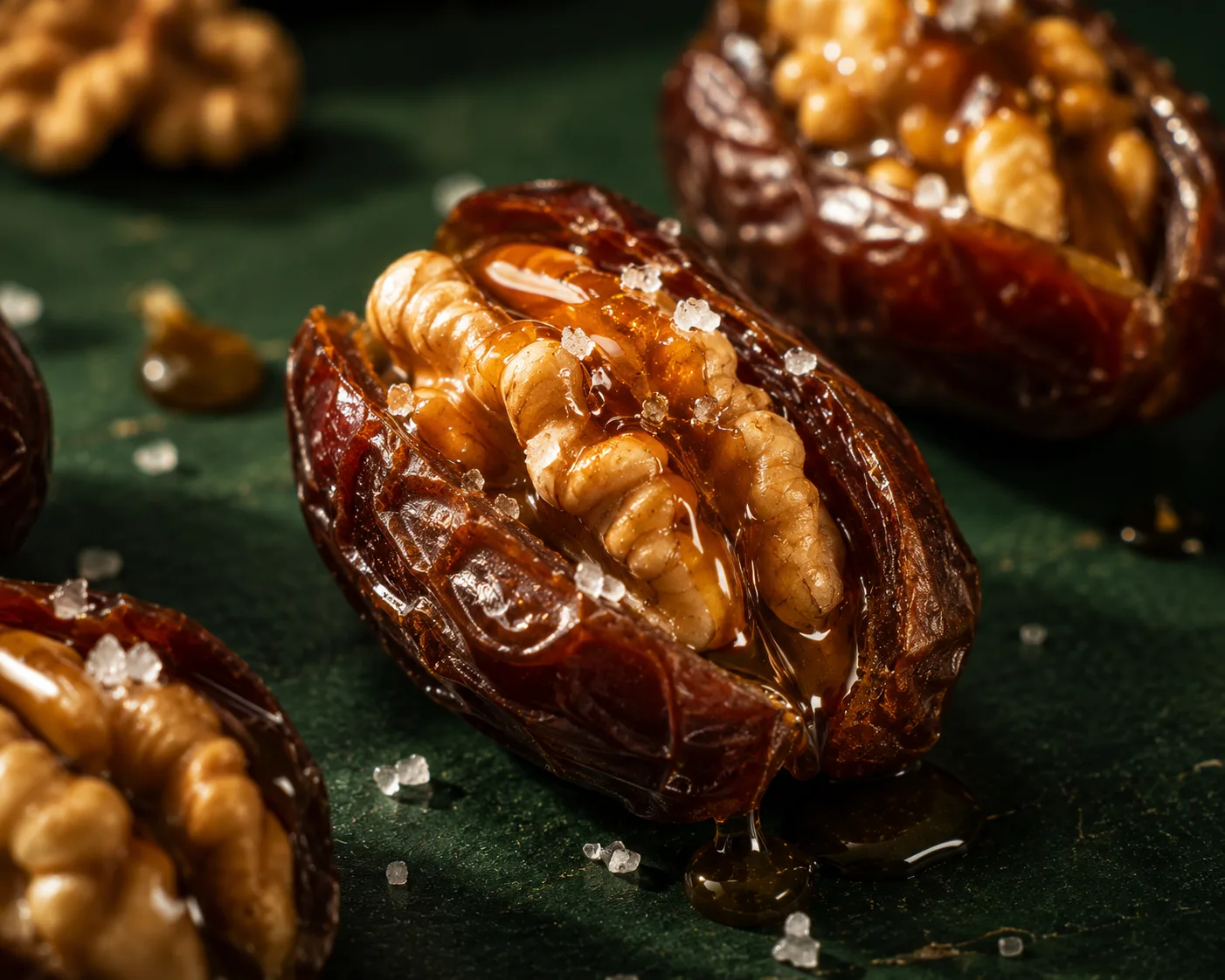
Date and Honey Bites
Split a Medjool date lengthwise. Remove the pit. Press half a walnut into
the centre. Place on a small plate. Drizzle raw Sidr honey across the top —
enough to coat the walnut and pool slightly in the date.
Optionally: a tiny pinch of coarse sea salt on each one.
The salt is not decorative. It is the fourth element that makes
the sweetness of the honey and the date sharper and more present.
These take four minutes to assemble for a table of eight.
They disappear considerably faster than that.
Honey recommendation: Yemeni or Emirati Sidr —
the depth of character stands up to the richness of the Medjool.
Labneh, Olive Oil, and Honey
Spread labneh on a flat plate. Make a well in the centre.
Fill the well with a generous pour of good olive oil. Drizzle raw honey
over the entire surface. Add dried thyme (zaatar) if you have it —
the bitterness of the herb against the sweetness of the honey
is one of those combinations that sounds wrong and tastes exactly right.
Serve with warm Arabic bread. This is breakfast, iftar, and a late-night snack
simultaneously — it works at every hour and it is better than it looks
in any description.
Honey recommendation: A lighter honey — Moroccan Sidr
or Ghaf — that does not overpower the labneh’s delicate tang.
Warm Honey Milk — Before Sleep
This is not technically an iftar bite — it is the last thing of the evening,
and it belongs there. Warm whole milk — not boiling, warm — with a teaspoon
of raw Sidr honey dissolved in it and a pinch of ground cinnamon.
No recipe needed. No measurements required. You know when it is right
by smell and by temperature. The honey dissolves easily in warm milk
and the result is something that slows the evening down
and makes sleeping after a long Ramadan day considerably easier.
Important: below 40°C. The honey goes in after
you’ve removed the milk from the heat and let it cool to drinking temperature.
Honey and Fresh Fruit Plate
Slice whatever fruit is in season — in the UAE winter months,
this means oranges, strawberries, kiwi. Arrange on a flat plate.
Drizzle raw honey across the entire plate just before serving —
not mixed in, just across the surface, so some pieces have more
and some have less and people can choose their ratio.
Add a small handful of crushed pistachios over the top.
The green of the pistachios against the honey is incidentally beautiful —
but the reason to use them is textural, not visual.
The crunch of the pistachio against the soft fruit and the honey is the point.
Honey recommendation: A light, floral honey —
Ghaf honey from the UAE is exceptional here.
Its butterscotch lightness does not compete with the fruit.
Chebakia Dipped in Honey — The Moroccan Ramadan Classic
If you have access to chebakia — the Moroccan sesame and anise pastry
that appears only during Ramadan — this is its correct preparation.
The pastry is deep-fried and then dipped in warmed honey
while it is still hot. The honey should be slightly warmed — not hot,
not cold — so that it coats the chebakia completely and penetrates
the sesame surface rather than sitting on it.
If you cannot find chebakia in Dubai or Sharjah, any crisp,
slightly sweet pastry works with the same dipping treatment.
The logic is the same: something that has been fried needs honey
while it is still warm, when the surface is open to absorbing it.
Honey recommendation: Moroccan Sidr or wildflower —
for a Moroccan pastry, a Moroccan honey is not sentimentality.
It is the right flavour combination.
A Note on the Honey
These recipes are not difficult. What makes the difference between a good version and a version that people talk about is the honey. A generic processed honey from a supermarket shelf — filtered, pasteurised, blended from multiple sources — will produce the same result visually. It will not produce the same result on the palate.
Raw Sidr honey — unheated, from an identified source — has aromatic compounds that processed honey has lost. When it meets warm luqaimat or dissolves into milk, those compounds are released. That is the difference. It is not subtle.
For Ramadan tables in Dubai and Abu Dhabi, we recommend our Emirati Sidr from Hatta as the everyday honey for all six of these preparations. For the chebakia, a Moroccan honey adds a layer of cultural specificity that matters if you are making it for someone who will recognise the difference.
Questions About Honey Recipes for Ramadan
A honey bite is any small, fast preparation where honey is the central ingredient — not a garnish or an afterthought, but the element that makes the preparation what it is. The term has gained significant search interest in the UAE and Gulf in 2026, partly driven by social media content around creative honey uses. In the context of Ramadan iftar, a honey bite is something you can prepare and place on the table in under five minutes that deserves to be there.
Some, yes. The date and walnut bites can be assembled an hour ahead and kept covered at room temperature — add the honey just before serving. The labneh plate can be prepared in advance without the honey and oil, which go on at the last moment. The fruit plate can be sliced ahead; the honey and pistachios go on at serving. The luqaimat honey drizzle and the warm honey milk must be done immediately — neither tolerates waiting. The chebakia preparation also requires immediate serving while both the pastry and the honey are at the right temperature.
For the preparations in this article — all of which involve adding honey at a final stage rather than cooking it — raw Sidr honey from an identified origin is the best choice. Our Emirati Sidr from Hatta is the natural recommendation for tables in Dubai and Abu Dhabi: locally produced, award-recognised, and with a flavour profile that suits the sweet-savoury range of these preparations. For the chebakia specifically, a Moroccan honey adds cultural specificity that Moroccan guests will notice and appreciate.
Luqaimat is a traditional Emirati dessert or sweet snack associated specifically with Ramadan, where it appears as one of the most emblematic iftar foods across the UAE and Gulf. Traditionally served with date syrup (dibs), the combination with honey — particularly a raw local honey — is a natural variation that respects the same sweet-fried logic. In Dubai and Sharjah, luqaimat carts appear across the city as soon as Ramadan begins. The smell of warm dough and honey is, for many people in the Emirates, the specific smell of the holy month.
The Honey Behind These Recipes
Raw Emirati Sidr from the Hatta mountains — the natural choice for iftar tables across Dubai and Abu Dhabi. Locally produced, London Honey Awards 2022 recognised, from trees that have been in those mountains longer than the city around them.
Get Emirati Sidr