
A sweeping heritage journey tracing thirteen centuries of Arab migration — from the Hijaz and Yemen to the caravan crossroads of Tafilalet — and the living legacy it left in Morocco’s language, culture, and identity.
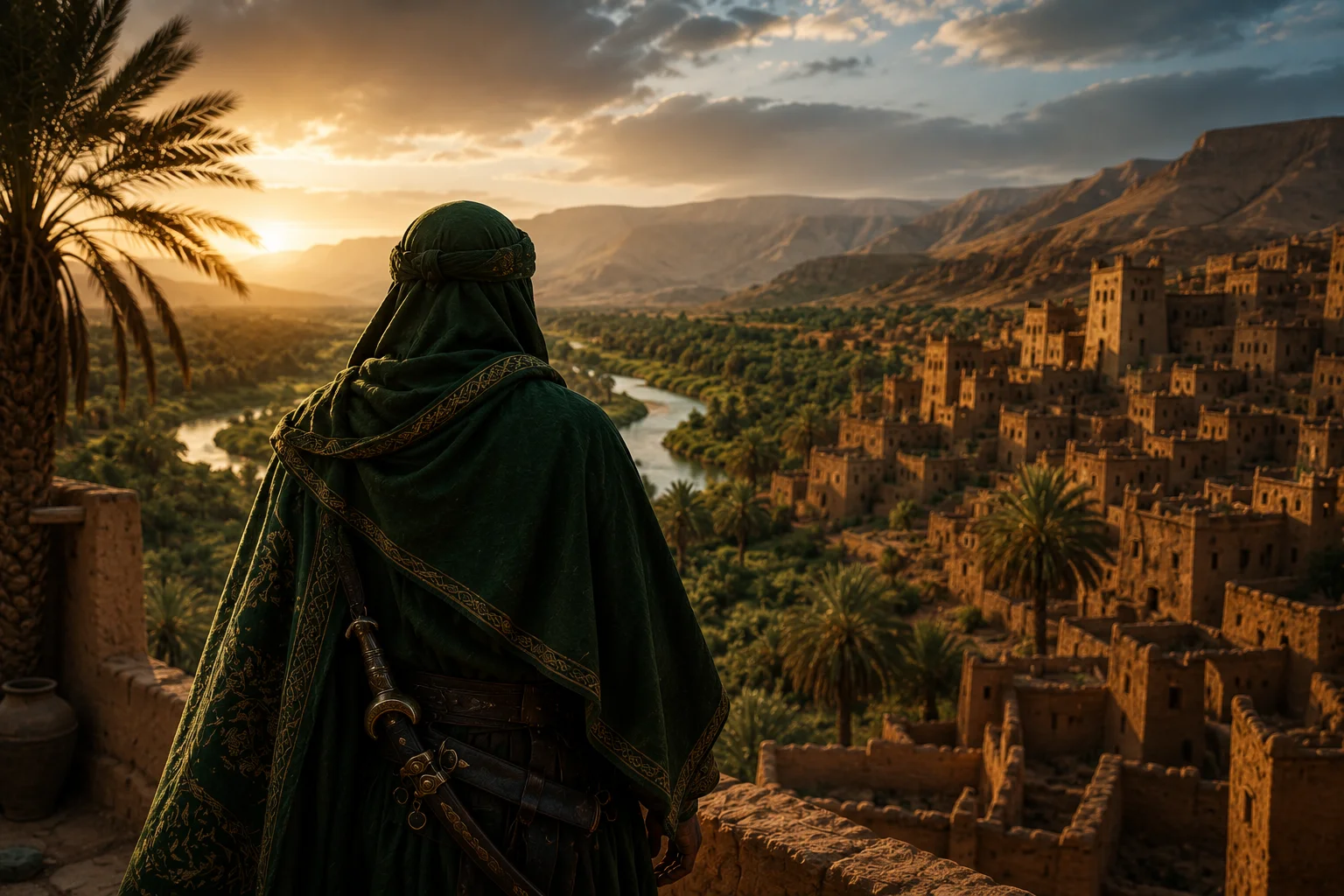
Every story of Arab presence in Morocco leads back to a single point of origin: the storied expanse of the Arabian Peninsula. Over thirteen centuries, successive waves of migrants — scholars, merchants, tribal confederations, and Sharifian families — traced routes westward from the Hijaz, Yemen, and Najd to the oases and plains of the Maghreb, shaping a civilisation that endures to this day.
The Arabian Peninsula: Where Every Journey Began
Long before the name Maghreb — the land of the setting sun — entered the Arabic tongue, the valleys of the Hijaz, the highlands of Yemen, the plateaus of Najd, and the southern coastlines of Arabia were already bound together by roads, languages, and kinships that would one day stretch all the way to the Atlantic.
These were living landscapes: the Hijaz, home of Mecca and Medina, anchor of Islamic civilisation; Yemen, legendary land of frankincense, honey, and agricultural abundance; Najd and Asir, territories of proud tribal confederations whose oral traditions carried centuries of genealogy. Together, they formed the human reservoir from which wave after wave of travellers, scholars, merchants, and families would depart — heading ever westward toward the horizons of the Maghreb.
The Hijaz, Yemen, and the Roads Already Drawn
It would be a historical misconception to imagine that Arab contact with North Africa began with the rise of Islam. Long before the 7th century, caravan routes linked the Arabian Peninsula to Egypt, Libya, and the Ifriqiya. Merchants from the Hijaz traded leather, horses, dates, spices, and textiles across the Sinai and along the Nile. These roads were already well-worn by the time the call to prayer first rang out over Mecca in the early 600s CE.
What the emergence of Islam did, with extraordinary speed and intensity, was transform these commercial arteries into corridors of civilisation. The same routes that had carried frankincense northward and gold southward now carried scholars, judges, teachers, and entire extended families — all moving toward the western edges of the known world.
The Westward Routes: From Medina to the Maghreb
The principal itinerary followed by the earliest Arab migrants to Morocco was a vast overland arc — one of the most consequential human journeys in Mediterranean history. From the Arabian Peninsula, travellers moved through the Hijaz and on into Egypt, then westward across Libya, through the plains of Ifriqiya, into what is now Algeria, and finally into the lands that would become Morocco. Each stage of this journey was not merely a geographical crossing but a cultural encounter — a layering of languages, beliefs, and traditions that left an indelible mark on every region it touched.
A Path Shaped Long Before Islam
These roads were already the arteries of pre-Islamic trade. Along them flowed some of the most precious commodities of the ancient world: aromatic resins from the southern Arabian coasts; salt and gold from sub-Saharan Africa; finely worked leather and woven textiles from the workshops of the Hijaz; manuscripts and scientific knowledge from the scholarly centres of the East. When Arab families began to move along these routes not merely as traders but as settlers, they brought with them something even more durable than goods: a language, a faith, a sense of lineage, and a culture of hospitality and learning that would take root wherever they stopped.
The Cradle
Home of Mecca and Medina, the Hijaz was the point of departure for the first waves of Arab scholars, jurists, and chorfa who made their way to Morocco in the 8th and 9th centuries.
Land of Honey and Frankincense
Yemen’s highlands were home to agricultural abundance and ancient trading traditions. Yemeni tribal groups — including branches of the Banu Ma’qil — became among the most influential Arab settlers in the Moroccan south.
The Bedouin Interior
The great tribal confederations of Banu Hilal and Banu Sulaym originated in the Najdi interior. Their westward migration in the 11th century reshaped the demographic landscape of rural Morocco.
The First Settlements: Cities as Anchors of Memory
The earliest Arab settlements in Morocco were not scattered or random. They clustered around the places where political authority, religious prestige, and commercial life converged. Cities were the anchors — and nowhere was this more true than in Fes.
Fes — The City That Became a Civilisation
Founded in 808 CE by Idris II, son of the dynasty’s founder Idris I — himself a descendant of the Prophet Muhammad ﷺ through his grandson Hasan — Fes rapidly became the most significant urban centre in the Muslim West. The Idrisid dynasty, which ruled most of present-day Morocco from 788 to 974 CE, played a decisive role not only in the Islamisation of the region but in the acceleration of Arab settlement in its cities. Under their patronage, Arab families — scholars, jurists, craftsmen, and chorfa — arrived and established themselves in numbers sufficient to make Fes, within a generation, a byword for Islamic learning and refinement.
The founding of the Qarawiyyin mosque and university, one of the oldest continuously operating universities in the world, was part of this broader current of intellectual and cultural migration. Fes became, and has remained, a city where the memory of Arab origins is inscribed in every medina alleyway, every family name, every recitation passed from grandparent to grandchild.
Moulay Idriss Zerhoun and the Sharifian Lineage
Not far from Fes, the hilltop town of Moulay Idriss Zerhoun holds a singular place in this story. It was here that Idris I first established himself after fleeing the Abbasid court — a prince who had survived a massacre of his family and who carried with him, across thousands of kilometres of desert and mountain, both the blood of the Prophet ﷺ and the knowledge and gravitas that this lineage conferred. His tomb in Moulay Idriss Zerhoun remains, to this day, one of the most visited pilgrimage sites in Morocco — a living monument to the moment when the Arab world and the Moroccan world first became, irrevocably, intertwined.
Heritage Note
The Idrisid dynasty’s legacy is not merely historical: it established the template of Sharifian legitimacy that continues to define Moroccan political and spiritual identity. The current Alaouite dynasty traces its own origins to the same Sharifian lineage — through the Tafilalet branch that arrived centuries later.
The Great Tribal Migrations of the 11th Century
If the first wave of Arab settlement was essentially urban and elite — scholars, chorfa, merchants of standing — the second great wave, beginning in the 11th century, was of an altogether different character. It was tribal, vast, and transformative in its geographical reach.
Banu Hilal, Banu Sulaym, Banu Ma’qil — Reshaping the Plains
From the Arabian Peninsula, large confederations of Bedouin tribes began moving westward across North Africa. The most historically significant were the Banu Hilal, the Banu Sulaym, and the Banu Ma’qil. Originating in the Hijaz and the Arabian interior, these tribal groups had moved first into Egypt and then across Libya and Tunisia before pushing ever further west — a migration of such scale that medieval historians recorded it with a mixture of awe and apprehension.
In Morocco, these tribes settled across an extraordinary range of territories: the Atlantic plains, the Gharb, the Haouz of Marrakech, the pre-Saharan regions, and the fringes of the deep south. The Banu Ma’qil, in particular, gave their names to entire territories and tribal sub-groups that persist in Moroccan geography and genealogy to this day — from the Rehamna and the Abda to the tribes of the Guich of Marrakech. Their arrival was not a conquest in the military sense but a slow, profound reshaping of the demographic and cultural landscape of rural Morocco.
Pre-Islamic trade routes established
Arabian merchants reach Egypt, Libya, and Ifriqiya long before the 7th century, laying the physical and commercial foundations for later migration.
First Islamic wave (7th–8th century)
Arab military commanders and their families move westward with the expansion of Islam, establishing the first permanent Arab communities in the Maghreb.
Idrisid foundation (788 CE)
Idris I founds the first Arab dynasty in Morocco. Fes is established as the intellectual and spiritual capital of the Muslim West.
Great tribal migrations (11th century)
Banu Hilal, Banu Sulaym, and Banu Ma’qil arrive from the Arabian Peninsula, permanently reshaping the demographic map of rural Morocco.
Sharifian families in Tafilalet (13th–17th century)
Descendants of the Prophet ﷺ settle in the Tafilalet oases. From this lineage, the Alaouite dynasty emerges to rule Morocco from the 17th century to the present day.
Tafilalet — The Gateway Between Two Worlds
Of all the regions touched by this long history of Arab migration, none carries the weight of memory quite like the Tafilalet. Situated at the precise intersection of the Sahara, the sub-Saharan trade networks, and the Maghrebi highlands, this oasis region in southeastern Morocco was, for many centuries, the most important gateway between two worlds — and one of the most vital nodes in the entire trans-Saharan trading system.
Sijilmassa: The Northern Port of the Sahara
At the heart of the Tafilalet stood Sijilmassa — founded in the 8th century near what is today the town of Rissani — a city of such strategic and commercial importance that historians nicknamed it “the northern port of the Sahara.” Here, the caravan routes from sub-Saharan Africa met those descending from Fes and the Maghrebi coast. Gold from West Africa, salt from the Saharan mines, dates from the Tafilalet palm groves, manuscripts and spices from the East — all converged in Sijilmassa before being redistributed across a vast network stretching from Timbuktu to the Mediterranean.
The city attracted not only merchants but scholars, judges, and entire Arab families who saw in this crossroads an opportunity to put down roots. For centuries, the oral traditions of the communities of Tafilalet traced their lineages to Sijilmassa — a city that became, even after its eventual decline, a founding myth of the region’s collective identity.
The Ksour and Ksar Meski: Fortified Memory
Around Sijilmassa and throughout the valleys of the Ziz and the Gheris, dozens of ksour — those iconic fortified villages of compacted earth and palm timber — rose from the oasis landscape. Each was a world unto itself: its own families, its own agricultural plots, its own network of commercial relationships and oral histories. Among them, Ksar Meski stands as one of the most evocative — a name that connects the history of the caravan world to the living heritage of the region, carrying within it the memory of the families who made this far corner of the Maghreb their permanent home.
In the Tafilalet’s ksour, family memory was considered a form of wealth. Genealogical trees were kept — sometimes on paper, sometimes in the minds of the elders — tracing lineages back to Arabia with a precision and devotion that speaks to just how deeply this sense of origin was valued. The desert landscape of Tafilalet did not erase identity; it preserved it, in the amber of oral tradition and the architecture of sun-dried earth.
The Sharifian Families and Their Lasting Influence
Woven through every phase of this long history of migration is a thread of particular distinction: the arrival and settlement of families claiming descent from the Prophet Muhammad ﷺ — the chorfa, or Sharifian families. At various periods, these families made their way to Morocco — some following the Idrisid example, others arriving later as religious scholars and spiritual leaders sought out communities willing to receive them.
They settled preferentially in Fes, in the Tafilalet, in the Draa valley, and in the oases of the south. Their influence extended far beyond the purely religious: they served as mediators in tribal disputes, as educators in communities that had no other access to formal learning, and as custodians of the written and oral heritage that connected Moroccan communities to the broader world of Islamic civilisation. It is from the Sharifian families of the Tafilalet that the current Alaouite dynasty of Morocco — reigning since the 17th century — traces its origins, a fact that lends this history of migration a resonance that is very much alive in the present day.
An Inheritance Written in Stone, Language, and Name
More than thirteen centuries after the first Arab families made the crossing from the Arabian Peninsula to the Maghreb, their inheritance is not a museum piece. It is alive in the fabric of Moroccan daily life. The Arabic language — with its remarkable richness of poetic form, its capacity to carry both the sacred and the earthly — is the language in which millions of Moroccans think, dream, and pray. The patronyms borne by countless families point, sometimes directly, to specific tribes, cities, or regions of Arabia. The architecture of the medinas and ksour speaks of a tradition of building that fused Arabian, Andalusian, and Amazigh genius into something uniquely Moroccan.
The traditions of hospitality — the date offered to a guest, the glass of mint tea poured without being asked, the gift presented not as a transaction but as an expression of relationship — all carry within them the memory of a culture that began its journey in the valleys of the Hijaz and the highlands of Yemen, and found its second home in the oases and plains of Morocco. Even the routes of the caravans, now silent, remain legible in the landscape: in the alignment of the ksour, in the old markets of Rissani, in the date palm groves of the Tafilalet that fed both local families and distant travellers for centuries.
Rooted in Ksar Meski
Meski Dates Factory takes its name from Ksar Meski — one of the historic fortified villages of the Tafilalet. The brand’s identity is inseparable from this landscape of memory, caravan heritage, and oasis culture.
Arabian and Maghrebi Worlds United
Based in Sharjah and the Emirates, Meski draws its products from the same Arabian and Moroccan worlds that shaped this history — an expression of the enduring bond first traced by the caravans thirteen centuries ago.
Heritage as Living Practice
From Moroccan Royal Sidr Honey to Emirati Sidr and Omani varieties, each product in the Meski range embodies the shared heritage of the Arabian Peninsula and the Maghreb — provenance, craft, and tradition in every jar.
A Living Legacy
The story of Arab migration to Morocco is not a single chapter with a fixed beginning and end. It is, rather, a long conversation — between the Arabian Peninsula and the Maghreb, between the desert and the oasis, between the ancient world of the caravan and the modern world of the city — that continues to unfold. Every family that traces its name to a Yemeni valley, every city built around a mosque founded by a scholar from Medina, every oasis that still bears the imprint of a Bedouin tribe that arrived there a thousand years ago, is part of this conversation.
At Meski Dates Factory, this heritage is not a backdrop — it is the very ground on which the brand stands. Named after Ksar Meski, rooted in Sharjah and the Emirates but drawing its products from the same Arabian and Maghrebi worlds that shaped this history, Meski is an expression of the enduring bond between the Arabian Peninsula and the wider Arab world — a bond that the caravans first traced, and that every generation since has chosen, deliberately, to honour.
Taste the Heritage of Two Worlds
From the Moroccan oases of the Tafilalet to the Emirati and Omani valleys of the Arabian Peninsula — explore honeys sourced from the very landscapes that shaped this thirteen-century story.
Arab Migration to Morocco: Frequently Asked Questions
The first significant wave of Arab settlement in Morocco began in the late 7th and early 8th centuries CE, following the Islamic expansion across North Africa. The founding of the Idrisid dynasty in 788 CE by Idris I — a descendant of the Prophet Muhammad ﷺ — marked the establishment of the first Arab ruling house in Morocco and accelerated the settlement of Arab scholars, merchants, and chorfa families, particularly in Fes and the surrounding regions.
Sijilmassa, founded in the 8th century near the modern town of Rissani in the Tafilalet, was one of the most important cities in the medieval Islamic world. Known as “the northern port of the Sahara,” it served as the primary commercial hub where trans-Saharan caravan routes converged. Gold, salt, dates, manuscripts, and spices all passed through Sijilmassa, attracting Arab merchants, scholars, and Sharifian families who settled permanently in the region and whose descendants continue to inhabit the Tafilalet to this day.
The Banu Hilal were a large Bedouin tribal confederation originating in the Hijaz and the Arabian interior. Beginning in the 11th century, they migrated westward across North Africa — through Egypt, Libya, and Tunisia — before settling across Morocco’s Atlantic plains, the Gharb, the Haouz of Marrakech, and the pre-Saharan south. Together with the Banu Sulaym and the Banu Ma’qil, they permanently reshaped the demographic and cultural landscape of rural Morocco, leaving their names in regions and tribal sub-groups that remain identifiable in Moroccan geography and genealogy today.
Ksar Meski is a historic fortified village in the Tafilalet — the oasis region of southeastern Morocco that served for centuries as the gateway between the Sahara and the Maghreb. The ksour of the Tafilalet, including Ksar Meski, were built and inhabited by Arab families — many of Sharifian descent — who settled in the region following the caravan routes from the Arabian Peninsula. Meski Dates Factory takes its name directly from this heritage site, grounding the brand’s identity in the centuries-old bond between Arabian and Moroccan civilisation.