
A thoughtful editorial comparison showing that the most nourishing path lies in understanding, combining and honouring both culinary heritages.
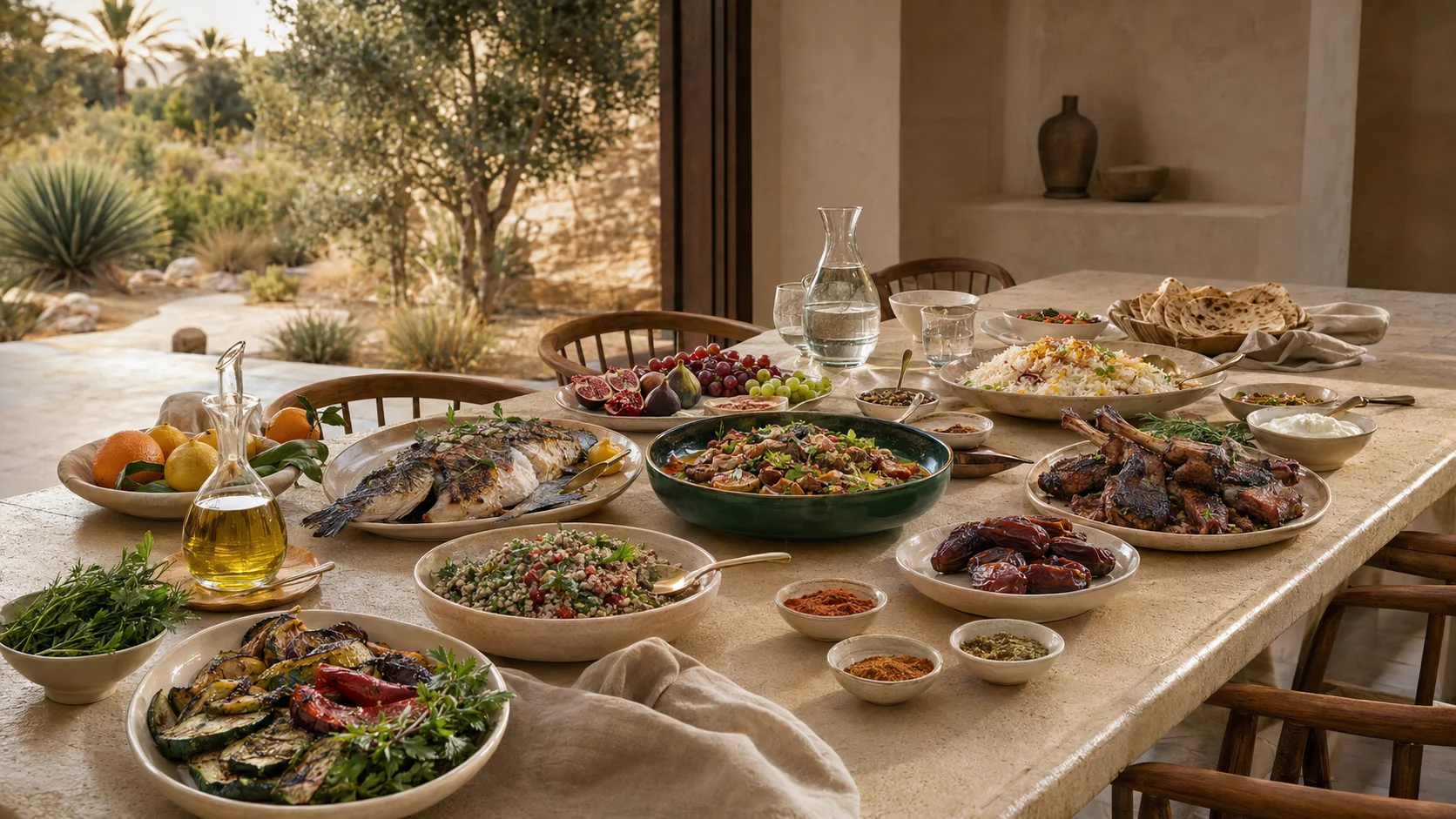
The debate around Mediterranean diet vs Gulf diet is often framed as a competition. It should not be. Both traditions carry genuine nutritional and cultural richness — and the most honest, useful answer is that each illuminates the other. Whole foods, olive oil, raw honey, dates, seasonal rhythms: the shared logic runs deeper than any ingredient list.
Two Great Culinary Traditions
The Mediterranean diet, documented by researchers and recognised by the World Health Organization as a healthy dietary pattern, draws from the eating habits of populations bordering the Mediterranean Sea — Greece, Italy, Spain, Lebanon, Tunisia and Turkey among them. It is not a single rigid protocol. It is, rather, a set of shared principles: abundant plant foods, olive oil as the primary fat, moderate fish and poultry, limited red meat, and fresh fruit where refined sugar would otherwise appear.
The traditional Gulf diet is less frequently discussed in nutritional science, yet equally coherent. Rooted in the demands of desert geography and the rhythms of nomadic and maritime life, it developed around a small number of extraordinarily useful ingredients: dates, which provided fast, sustained energy; dried fish along the coastal towns; whole grain breads and porridges like harees (a slow-cooked wheat and meat dish); slow-braised meats with aromatic spice; and raw honey, which served both as sweetener and as a preserved, concentrated food source. Olive oil appears in Gulf cooking too — referenced in Islamic tradition and present in dishes like tharid and saleeq — often alongside ghee, sesame and local plant oils.
Neither tradition was designed around restriction. Both were shaped by what was available, what could be stored, and what sustained people through long days of labour, fasting or travel.
What Defines the Mediterranean Diet?
At its core, the Mediterranean approach to food emphasises variety within a plant-forward framework. Whole grains — bulgur, farro, barley, brown rice — form a steady base. Legumes such as lentils, chickpeas and white beans provide protein without relying heavily on meat. Vegetables, eaten raw and cooked, appear at every meal. Olive oil is used generously as both cooking fat and condiment. Fish, particularly oily varieties rich in omega-3 fatty acids, is preferred over red meat. Nuts and seeds add texture and density. Dairy, in the form of yoghurt and aged cheese, appears in moderate amounts.
What research institutions including Harvard’s Nutrition Source and the Mayo Clinic consistently note is that the Mediterranean diet is not simply a food list — it is a rhythm of eating. Meals are slow. Ingredients are seasonal. Processing is minimal. The act of preparing and sharing food is itself part of the pattern.
Fresh Ingredients Above All
The principle that carries the most weight in Mediterranean cooking — and that is most often abandoned when the diet is commercialised — is freshness. Not freshness as a marketing claim, but as a practical discipline: buying what is in season, cooking it the same day, not adding what is not needed. A tomato dressed with extra-virgin olive oil and salt is not a simplified recipe. It is a complete philosophy.
This matters enormously for anyone adapting Mediterranean habits to a UAE or Gulf context. The question to ask is not whether a food is labelled Mediterranean, but whether it is whole, recent and unprocessed.
What Is the Traditional Gulf Diet?
The traditional diet of the Arabian Peninsula evolved in response to extreme conditions: scorching heat, limited fresh water, long distances between settlements. The foods that survived in this context were dense, durable and nutritionally concentrated. Dates are the most obvious example. A small handful of khalas or fard dates — the varieties you will still find displayed in clay bowls at the entrance of a majlis in Abu Dhabi or Sharjah — provides natural sugars, potassium, magnesium and dietary fibre. They were the original fast food, carried by Bedouin travellers across the desert before the word nutrition had been coined.
Raw honey held a similar position. In the Gulf, Yemen and Oman, honey from Sidr trees — Ziziphus species that flower in arid conditions — was gathered and used in food preparation and in traditional wellness practices that passed from generation to generation. Dishes like masoub — bread, banana, honey and cream — or marasee, made with flour, honey and butter, reflect how honey was treated not as a garnish but as a primary ingredient. Meski’s Emirati Sidr Honey and Omani Sidr Honey are sourced precisely from the wild jujube groves that shaped this tradition.
Slow-cooked grain dishes like harees and tharid — the latter reportedly described in Islamic tradition as superior among foods — provided protein and complex carbohydrates together. Research on the nutritional composition of traditional Gulf meals has found that many of these dishes are naturally moderate in sodium, balanced in macronutrients, and built around high-moisture, whole-grain preparations suited to the climate.
Olive Oil, Dates and Seasonal Foods
One of the most persistent misconceptions about Gulf food is that it is heavy and meat-centred. The traditional diet was not. Meat — lamb, camel, dried fish — appeared at communal feasts, during Ramadan, at celebrations. Daily eating was far simpler. Dates at dawn, a grain porridge midday, dried fish or legumes in the evening. Olive oil was present in coastal and trading communities, arriving via the same Silk Road routes that brought saffron from Persia and dried limes from Oman’s coast.
Seasonal eating was not a choice. It was geography. Dates ripen in late summer and early autumn — and that rhythm still shapes the Liwa Date Festival in Abu Dhabi, where dozens of varieties are displayed and traded annually. Fish availability followed the tides and the monsoon. The diet was, in the most literal sense, an expression of what the land and sea could offer at a given moment.
Core ingredients
Olive oil, legumes, whole grains, oily fish, seasonal vegetables, yoghurt, nuts, fresh herbs, moderate wine in some regions.
Core ingredients
Dates, raw Sidr honey, dried fish, slow-cooked grains (harees, tharid), aromatic spices (cardamom, loomi, saffron, turmeric), ghee, olive oil in coastal communities.
Where the Two Traditions Meet
When you place these two traditions side by side, the similarities are striking. Both rely on olive oil. Both favour legumes and whole grains over processed carbohydrates. Both use honey as a natural sweetener rather than refined sugar. Both are structured around shared meals, slow preparation, and a cultural understanding that food is not merely fuel.
The differences are real, but they are differences of ingredient and spice palette rather than philosophy. The Mediterranean kitchen reaches for basil, oregano and lemon. The Gulf kitchen reaches for cardamom, dried lime (loomi), saffron and turmeric. The underlying logic — use what is local, cook it gently, eat it with others — is the same.
This convergence suggests something the diet industry rarely acknowledges: before globalisation homogenised what people ate, many distinct food cultures had arrived independently at similar conclusions about what sustained human health. Not through scientific study, but through centuries of observation and transmission.
| Dimension | Mediterranean | Traditional Gulf |
|---|---|---|
| Primary fat | Olive oil | Olive oil + ghee |
| Natural sweetener | Honey, fresh fruit | Raw Sidr honey, dates |
| Protein staples | Legumes, fish | Dried fish, slow-cooked grains |
| Grain base | Whole grains (bulgur, barley) | Whole grains (wheat, harees) |
| Meal rhythm | Slow, shared, seasonal | Communal, ritual, seasonal |
| Processing level | Minimal | Minimal in traditional form |
The Importance of Moderation
Both traditions understood moderation not as deprivation but as proportion. In the Mediterranean diet, a handful of nuts is a snack — not a bag. In the Gulf, dates were eaten in odd numbers, as tradition prescribed; honey was a spoonful in tea, not a stream poured over everything. Ghee was used with precision.
What both cultures recognised — and what nutritional science now supports — is that even genuinely healthy fats and natural sugars carry consequences when eaten without awareness. Olive oil is calorically dense. Dates are high in natural sugars. Raw honey, however pure its origin, remains a concentrated source of fructose and glucose. None of these facts diminish the value of these ingredients. They simply affirm what both traditions already knew: quality and quantity are not the same question, and both matter.
The modern Gulf resident navigating a city of supermarkets, delivery apps and international restaurants faces a different challenge from their ancestors: abundance rather than scarcity. The wisdom of both traditions, transposed to this context, points toward the same practical guidance — choose whole over processed, prefer home-prepared over packaged, eat slowly, eat with others, and trust the ingredients that have survived across centuries of use.
A note on honey in both traditions
Raw honey appears in Mediterranean and Gulf culinary heritage as a primary ingredient — not a finishing touch. In its best forms, it is minimally processed and retains trace natural compounds absent from refined sugar. It remains a source of natural sugars and is best used with the moderation both traditions applied: a spoonful in tea, a drizzle over cheese or grain porridge.
Learning from Both Cultures
There is a particular quality to the way food is presented in a Qatari or Emirati home during a gathering. The dallah — the tall, curved Arabic coffee pot — arrives first, poured into small finjan cups barely larger than an espresso. The qahwa, spiced with cardamom and sometimes saffron, is bitter and aromatic. Alongside it: a plate of dates. This is not a snack. It is a ritual of welcome, calibrated over generations to offer exactly the right combination of warmth, bitterness and natural sweetness to a guest arriving from the heat.
A Mediterranean table operates on different aesthetics but a related generosity. Bread arrives before anyone asks for it. Olive oil is poured without ceremony. A bowl of olives is set down not as a course but as a presence. The shared impulse — to make a guest feel sustained, at ease, and welcomed through food — is identical.
What both cultures teach, by example rather than prescription, is that eating well is not primarily a personal discipline. It is a social practice. The health benefits that researchers have documented in these dietary patterns may be inseparable from that social context. You cannot extract the olive oil and the whole grains and leave behind the slowness, the company and the conversation, and expect the same result.
Provenance matters
At Meski, every product traces its origin: Omani Sidr honey from wild jujube groves, cold-pressed Moroccan olive oil from a family grove in Tazaouia. The source is not a marketing detail — it is the product.
Minimal processing
Both culinary traditions thrived on ingredients that required no label to understand. Meski applies the same discipline: raw honey, unfiltered and unheated, harvested at the right moment and delivered without alteration.
Heritage as expertise
Meski, based in Sharjah, sits at the crossroads of these two traditions — sourcing ingredients that belong to both the Gulf pantry and the broader Mediterranean arc, from Yemen to Oman to Morocco.
Building Your Own Healthy Plate
For anyone living in the UAE — Emirati, Arab expat or international resident — the practical invitation is not to follow a named diet but to reconnect with the logic that underlies both traditions.
Start with ingredients that require no label to understand: seasonal vegetables, whole grains, legumes, fresh fish, good olive oil, a handful of dates, a spoonful of raw honey in place of refined sugar. Let the Mediterranean and Gulf palettes inform your spice choices — there is no contradiction between finishing a salad with za’atar and dressing a grain bowl with cumin and dried lime. These flavour worlds belong to the same geographic arc, connected by trade routes, shared climates and overlapping histories.
Start with whole grains
Bulgur, barley, farro or whole wheat — the base of both traditions. Swap processed carbohydrates for grains that still carry their fibre and mineral content.
Build around legumes and vegetables
Lentils, chickpeas, broad beans, seasonal greens. These are the daily workhorses of both the Mediterranean and Gulf pantries.
Choose quality fats
Extra-virgin olive oil as primary cooking fat. A touch of ghee where tradition calls for it. Both in measured quantities.
Sweeten with intention
Replace refined sugar with raw honey or dates. Use them as both traditions did: sparingly, purposefully, as part of a meal rather than an afterthought.
Eat with others, eat slowly
The most consistently documented factor in the longevity of both dietary patterns is not any single ingredient — it is the social and temporal context of the meal.
Ingredients that honour both traditions
Meski sources raw honeys and premium ingredients that sit at the intersection of Gulf and Mediterranean heritage — from wild Sidr hives to cold-pressed olive groves. Know the origin of what you bring to the table.
Final Thoughts
The healthiest diet is often the one you can enjoy and sustain for a lifetime. No dietary tradition in history was designed to be followed reluctantly, under sufferance, by people who did not enjoy the food. The Mediterranean diet and the traditional Gulf diet both produced populations that ate with pleasure and, when practiced in their whole, unprocessed form, with evident long-term benefit.
The conversation between these two traditions — olive oil meeting honey, lentils meeting dried lime, fresh fish meeting slow-braised lamb — is not a tension to be resolved. It is an invitation. The table is large enough for both.
Frequently Asked Questions
The Mediterranean diet is characterised by abundant plant foods, olive oil as the primary fat, legumes, whole grains and moderate fish consumption, drawing from Southern European and Eastern Mediterranean culinary traditions. The traditional Gulf diet shares several of these principles — olive oil, whole grains, honey, dates — but is built around ingredients suited to arid desert and coastal environments: dates, dried fish, slow-cooked grain dishes, aromatic spices and raw honey. The philosophies overlap more than the ingredient lists differ.
When practiced in its original, minimally processed form, the traditional Gulf diet is nutritionally well-structured. Research on traditional Gulf dishes has found that many — including harees, tharid and masoub — are moderate in sodium, balanced in macronutrients, and built around high-moisture, whole-grain preparations. The challenge lies in distinguishing the traditional diet from modern commercial food habits that have replaced it in urban settings.
Yes — and the combination is more coherent than it might initially appear. Both traditions prioritise whole foods, olive oil and minimal processing. Practically, this means combining Mediterranean staples (leafy greens, legumes, whole grains, fresh fish, extra-virgin olive oil) with Gulf ingredients and spice profiles (dates, cardamom, saffron, dried lime, raw honey). The result is a varied, culturally grounded approach to eating that draws from two of the region’s most established food traditions.
Dates are one of the most nutritionally dense foods native to the Gulf region, providing natural sugars, dietary fibre, potassium and magnesium. Traditionally eaten in small quantities — often at the start of a meal or alongside qahwa — they function as a controlled source of fast energy. The key, consistent with the moderation that defined their traditional use, is to treat them as a whole food rather than a processed sweetener.
Neither is superior to the other, and the choice of one over the other is not the most useful frame. For a UAE resident, the most practical approach is to return to the underlying logic of both traditions: favour whole over processed foods, choose olive oil and quality fats, include legumes and seasonal vegetables, use honey and dates as natural sources of sweetness in moderate amounts, and eat slowly in the company of others. This approach draws naturally from both traditions and is well-suited to the ingredients available across the Gulf.