
From the limestone canyons of Hadhramaut to the Hajar Mountains of Oman and the pre-Saharan plains of Morocco — every major Sidr terroir on earth, explored with the depth it deserves.
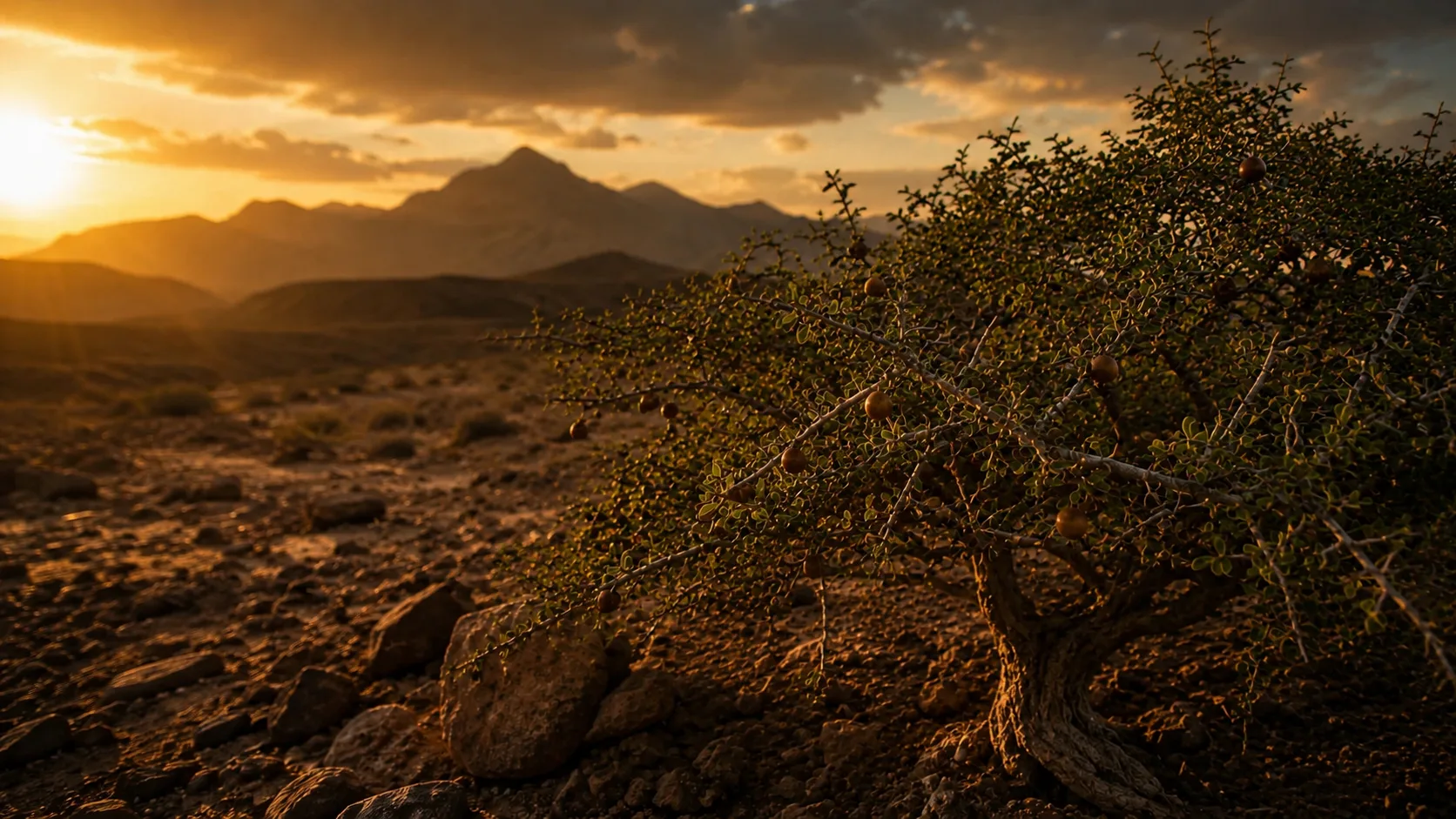
Sidr honey is one of the most celebrated and sought-after honeys on earth — produced from the nectar of the Ziziphus spina-christi, the ancient Lote tree revered across the Arab world. Yet not all Sidr honeys are the same. Geography, altitude, mineral-rich soils and local bee populations all conspire to make each terroir a world unto itself. This guide is your journey through them.
Introduction: One Tree, Many Worlds
There are honeys that are merely sweet, and then there are honeys that carry within them the memory of a landscape, the patience of a beekeeper, and the quiet authority of a tree that has been standing since before recorded history. Sidr honey belongs firmly to the second category.
Produced from the nectar of the Ziziphus spina-christi — the Sidr tree, also called the Lote tree — this is one of the most celebrated and sought-after honeys on earth. Its name travels from the valleys of Yemen to the palaces of the Gulf, from the mountain ranges of Oman and the Emirates to the pre-Saharan plains of Morocco. Wherever the Sidr tree grows, it leaves behind a honey that is unmistakably richer, thicker, and more complex than almost anything else a bee can produce.
Yet not all Sidr honeys are the same. Geography, altitude, mineral-rich soils, rainfall patterns and the quiet differences in local bee populations all conspire to make each terroir a world unto itself. This guide is your journey through them — from the most legendary origins to the most surprising, with the practical knowledge to choose wisely at every stop along the way.
What Makes Sidr Honey Unique?
The Ziziphus Tree: Ancient, Resilient, Sacred
The Sidr tree is not simply a botanical host for bees. In the Arab world, it carries a weight that is simultaneously cultural, spiritual and historical. The tree is mentioned in the Holy Quran, it is referenced in ancient Arabic poetry, and it has been used across the Arabian Peninsula for millennia as a source of food, shade, wood and sustenance. Its very name is synonymous with endurance: the Sidr survives where almost nothing else does, in arid wadis, on rocky hillsides, in soils that other trees would abandon.
When its small, cream-white blossoms open — typically once a year, for a brief and exacting season — honeybees forage on a nectar of exceptional density. The result is a monofloral honey with a signature profile: dark amber to golden, viscous almost to the point of flowing reluctantly from the jar, and possessed of a flavour that combines caramel depth, floral warmth and a finish that lingers long after the spoon is set down.
Why Terroir Changes Everything
Much as the same grape variety produces a Burgundy that tastes nothing like a Napa Valley wine, the same Ziziphus species — or its close botanical relatives — produces honeys across different countries that differ markedly in colour, density, aroma and flavour. The altitude at which the trees grow, the mineral composition of the surrounding soil, the level of humidity during the blooming season, the presence or absence of other flowering species nearby — all of these variables inscribe themselves into the honey’s final character.
Yemen: The Undisputed Benchmark
Wadi Do’an and the Hadhramaut Highlands
If Sidr honey has a spiritual home, it is the Hadhramaut region of eastern Yemen — and within it, the narrow, breathtaking canyon of Wadi Do’an. Here, ancient Sidr trees grow along limestone cliffs at altitudes ranging from 800 to 1,500 metres above sea level. The valley stretches some fifty kilometres between steep rock faces, creating a microclimate of sharp temperature swings, mineral-rich sedimentary soils, and an almost complete absence of industrial activity.
The scarcity is structural: the trees are wild, the terrain is remote, and the beekeeping methods remain largely unchanged across generations. Beekeepers carry their hives by hand into valleys with no paved access, harvest once a year, and return with a product that commands some of the highest prices in the premium honey market worldwide.
Sourcing Note
The ongoing conflict in Yemen since 2014 has introduced significant disruption to production and supply chains. This makes authentically traceable Yemeni Sidr rarer still — and the responsibility of sourcing it ethically all the more important. At Meski, our Do’ani Sidr Honey is sourced with full traceability and direct beekeeper relationships.
Flavour Profile & Harvest Season
Yemeni Sidr honey from Hadhramaut is characteristically dense and caramel-forward, with layers of warm spice and a finish that some describe as buttery, others as faintly resinous. The colour ranges from deep golden to rich amber depending on the specific wadi, the time of harvest and the age of the hive. The primary harvest season falls between September and November, with the Hadhramaut region reaching its peak slightly later than northern governorates such as Amran and Sa’ada.
This is the honey against which all other Sidr honeys are measured — not because of provenance alone, but because the convergence of altitude, soil, isolation and tradition in Wadi Do’an produces something genuinely irreproducible.
United Arab Emirates: The Mountain Treasure at Home
Hajar Range, Hatta and Ras Al Khaimah
It surprises many visitors to learn that the United Arab Emirates produces its own Sidr honey — and that it is regarded, within informed circles, as a genuine treasure. Wild Sidr trees grow throughout the rugged ridgelines of the Hajar Mountains, particularly in the emirate of Ras Al Khaimah and in the Hatta enclave of Dubai. These are landscapes of extraordinary drama: granite and limestone peaks, ancient falaj irrigation channels, and a silence broken only by the sound of bees moving between blossoms.
Emirati beekeepers harvest their Sidr honey once a year, in a season tied closely to the brief blooming window of the local Ziziphus trees. The honey produced here is considered a rare seasonal treasure, reflective of its desert mountain terroir. For the discerning buyer at Meski Dates Factory, sourced in Sharjah, the proximity to these mountain regions makes it possible to offer UAE Sidr with a level of traceability that long import chains simply cannot match.
What Makes Emirati Sidr Distinctive
Compared to its Yemeni counterpart, UAE Sidr honey tends to have a slightly lighter profile — less resinous, with a cleaner floral sweetness and a texture that, while still thick, flows with a touch more ease. The altitude of the Hajar Mountains is lower on average than Wadi Do’an, and the surrounding botanical landscape is somewhat different, contributing to these subtle distinctions.
What gives Emirati Sidr its particular appeal is its local identity: in a country that imports much of its premium food, this is a honey that is genuinely, proudly of the land.
Oman: Quiet Mastery from the Interior
Al Dhahira, Dhofar and the Western Hajar
Oman approaches beekeeping as it approaches most things: with a quiet, unshowy mastery that reveals itself only to those who are paying close attention. Sidr honey is produced in several regions of the country — in the Al Dhahira governorate of the interior, in parts of Dhofar in the south, and along the Western Hajar range that it shares with the UAE. Omani beekeepers have long used traditional palm-wood hive barrels, a method that speaks to the centuries-deep roots of the craft here.
The Sidr blooming season in Oman typically falls between October and November. The Sidr variety is among the most prized of Omani honeys, commanding significant premiums in local markets. Meski’s Omani Sidr Honey reflects this heritage of artisanal mastery.
A Honey That Speaks in Whispers
Omani Sidr honey is often described as slightly softer in character than its Yemeni equivalent — the caramel notes are present but more restrained, and there is a delicacy to the floral finish that rewards slow, attentive tasting. The mountain villages of the Western Hajar, some of which are among the oldest continuously inhabited settlements in the Arabian Peninsula, provide a backdrop of extraordinary heritage to this production. In places like Misfat Al Abriyeen, honey is still sold directly from the beekeeper, in small quantities, at the threshold of stone houses built into the cliff face.
For a connoisseur, Omani Sidr represents one of the most authentic, least-commercialised expressions of what this honey can be.
Saudi Arabia: The Asir Legacy
High-Altitude Hives and Artisanal Traditions
The Asir region of southwestern Saudi Arabia sits at elevations that surprise those who think of the Kingdom primarily as desert flatlands. Its terraced mountain slopes, cooled by highland mists, support a beekeeping tradition of great antiquity. Sidr trees grow across these highlands, and the annual Sidr honey season in Asir draws significant attention — from collectors, from culinary connoisseurs, and from the broader Gulf market where Saudi provenance carries its own cultural authority.
Saudi Sidr honey is also produced in other regions, including parts of the Hejaz and along the eastern foothills of the Hijaz mountains, though Asir remains the most celebrated origin. The soil is said to be richer here than in flatter, more arid zones, which contributes to the nectar density and the honey’s depth of flavour.
How Saudi Sidr Compares
Saudi Sidr honey shares many of the warm, caramel-forward qualities found in Yemeni honey — which is geographically and botanically its near neighbour. The distinctions are subtle rather than dramatic: Saudi Sidr often presents with a slightly warmer, spicier note, and its texture can vary considerably between highland and lowland sources. Purists place Yemeni Hadhramaut above it, but many connoisseurs in the Gulf argue passionately for the virtues of their own terroir — and they are not without cause.
Morocco: The North African Counterpart
Ziziphus lotus and the Pre-Saharan Zones
Morocco introduces a botanical nuance that is worth understanding clearly. The Sidr honey of North Africa is produced not from Ziziphus spina-christi — the species of the Arabian Peninsula — but from its close relative, Ziziphus lotus, endemic to the pre-Saharan zones of Morocco, Algeria and Tunisia. This is not a lesser honey; it is simply a different expression of the same botanical family, shaped by a completely different landscape.
Moroccan jujube honey — as it is sometimes labelled to distinguish it — comes primarily from the areas south and east of the Atlas Mountains, where the Ziziphus lotus thrives in the arid, mineral-rich soils at the edge of the Sahara. Beekeeping here follows the seasonal rhythms of the local flora, and the honey produced is traceable, artisanal, and notably transparent in its origin.
An Accessible Rarity with Its Own Identity
Moroccan Sidr honey shares the rich, thick, caramel-buttery character of its Arabian cousins, but carries its own terroir signature: a slightly earthier base note, a warm amber colour that can shade toward deep gold, and a finish that recalls the dry warmth of the Atlas piedmont. Our Moroccan Royal Sidr Honey embodies this distinct identity.
For a buyer who values genuine traceability and artisanal production, Moroccan Sidr offers something that the most famous Yemeni varieties — constrained by conflict, rarity and distance — sometimes cannot: a clear chain of custody, reasonable availability, and a price point that reflects quality rather than scarcity-driven speculation. In the world of premium honey, Morocco is not the understudy. It is a distinct and fully legitimate voice.
Comparing the Terroirs: A Connoisseur’s Table
To bring these five origins into focus, consider them across five key dimensions.
| Origin | Species | Colour | Primary Tasting Note | Harvest Season |
|---|---|---|---|---|
| Yemen (Hadhramaut) | Z. spina-christi | Deep amber | Caramel, warm spice, resinous finish | Sep–Nov |
| UAE (Hajar / Hatta / RAK) | Z. spina-christi | Golden to amber | Floral, clean sweetness, lighter body | Autumn (once yearly) |
| Oman (Interior / Hajar) | Z. spina-christi | Warm gold | Soft caramel, delicate floral | Oct–Nov |
| Saudi Arabia (Asir) | Z. spina-christi | Amber | Warm, spiced, full-bodied | Autumn (variable) |
| Morocco (Pre-Saharan) | Z. lotus | Deep gold to amber | Earthy caramel, warm, dry finish | Spring–summer |
How to Choose Authentic Sidr Honey
The Five Questions to Ask Before You Buy
The premium Sidr honey market is, unfortunately, one of the most adulterated in the world. Demand consistently outstrips genuine supply, and the price premium makes counterfeiting commercially attractive. Before committing to a purchase, ask these five questions:
Is the origin clearly stated and verifiable?
A credible producer will tell you not just the country of origin but the specific region, wadi or mountain range — and will be able to back it up with documentation or direct beekeeper relationships.
Is the price within a credible range?
Authentic Yemeni Sidr from Wadi Do’an commands some of the highest prices in the honey world. A price that seems too good to be true almost certainly is. Suspiciously cheap Sidr is a warning sign, not a bargain.
Is the honey truly raw and unfiltered?
Genuine Sidr honey is minimally processed. Look for slight opacity, natural pollen particulates, and the slow, reluctant pour that speaks of natural density. Over-processed honey loses both its character and much of its value.
Does the seller have laboratory analysis available?
Reputable premium honey producers — particularly those supplying the UAE and Gulf markets — increasingly provide pollen analysis and physico-chemical certificates that confirm floral origin and rule out adulteration.
What is the crystallisation behaviour?
Authentic Sidr honey crystallises slowly and evenly over time — a sign of its high fructose-to-glucose ratio and low water content. Honey that never crystallises, or that does so in a grainy, irregular way, may have been processed or blended.
Red Flags and Signs of Adulteration
Beyond the five questions, certain sensory cues should give pause. An unusually light colour in a honey labelled as Yemeni Hadhramaut Sidr is worth questioning — the authentic product is characteristically rich in tone. An excessively watery texture, or a taste that is flat and purely sweet without the caramel complexity that defines the category, suggests dilution or blending. Anonymous online sellers offering large quantities at low prices, with no traceable source and no documentation, should be approached with considerable caution.
The Meski Commitment to Provenance
Direct Beekeeper Relationships
Every Sidr honey we carry is sourced through direct relationships with beekeeping families — not intermediary brokers. This is the only way to guarantee the traceability that the category demands.
Raw and Unfiltered
We never heat or over-filter our honeys. What arrives in your jar is as close as possible to what the beekeeper harvested — opacity, pollen and all.
Regional Expertise from Sharjah
Based in Sharjah, UAE, Meski benefits from proximity to the Hajar Mountain terroir and deep-rooted connections to the broader Gulf and Arabian honey trade.
Final Thoughts
Sidr honey is one of those rare things that exist at the intersection of nature, heritage and human craftsmanship. It is a product shaped by geography over centuries, carried across mountains by beekeepers whose knowledge is a form of inheritance, and ultimately delivered to the table as something that no industrial process could replicate.
From the limestone canyons of Wadi Do’an to the mountain silence of Ras Al Khaimah, from the interior of Oman to the pre-Saharan golden plains of Morocco, each terroir offers its own answer to the same question: what does the Sidr tree give us when we give it the space and respect to simply be itself?
The answer, in every case, is extraordinary. Whether you are building a personal collection of the world’s finest honeys, selecting a gift of rare distinction, or simply seeking to understand what you are tasting the next time you open a jar of Sidr — we hope this guide serves you well.
Explore the Meski Sidr Collection
From raw single-origin honeys to curated gift boxes, every jar is traceable, unfiltered and rooted in genuine provenance.
Sidr Honey: Your Questions Answered
Sidr honey is a premium monofloral honey produced from the nectar of the Ziziphus (Sidr or Lote) tree. Its high price reflects the tree’s single annual bloom, the remote and inaccessible terrain where it grows, and the entirely artisanal harvesting methods passed down through generations. Supply is structurally limited, while global demand — particularly in the Gulf — is very high.
Both come from the same botanical species (Ziziphus spina-christi) but grow in different terroirs. Yemeni Sidr — especially from Wadi Do’an in Hadhramaut — is characterised by a deeper amber colour, a rich caramel flavour with resinous notes, and higher altitude origins (up to 1,500m). Emirati Sidr from the Hajar Mountains tends to have a lighter, cleaner floral profile, owing to the different altitude and surrounding flora. Both are genuine and highly prized.
Authentic raw Sidr honey is viscous and pours slowly, has a slightly opaque appearance with natural pollen particulates, and crystallises slowly and evenly over time. Key red flags include: an unusually watery texture, a flat and one-dimensional sweetness without caramel complexity, an unrealistically low price, and the absence of any traceable origin, documentation or laboratory analysis. Always buy from producers who can name the specific wadi or mountain range of origin.
Not exactly — they are closely related but botanically distinct. Arabian Sidr honey is produced from Ziziphus spina-christi, while Moroccan Sidr (sometimes called jujube honey) comes from Ziziphus lotus, endemic to North Africa’s pre-Saharan zones. Both share a rich, caramel-forward character, but Moroccan Sidr has its own terroir signature: a slightly earthier base note and a dry, warm finish. It is a fully legitimate and prized honey in its own right.