
Most honey buyers assume ‘organic’ means better. It often doesn’t. Here is what each label actually means — and why the world’s finest honeys need no paperwork.
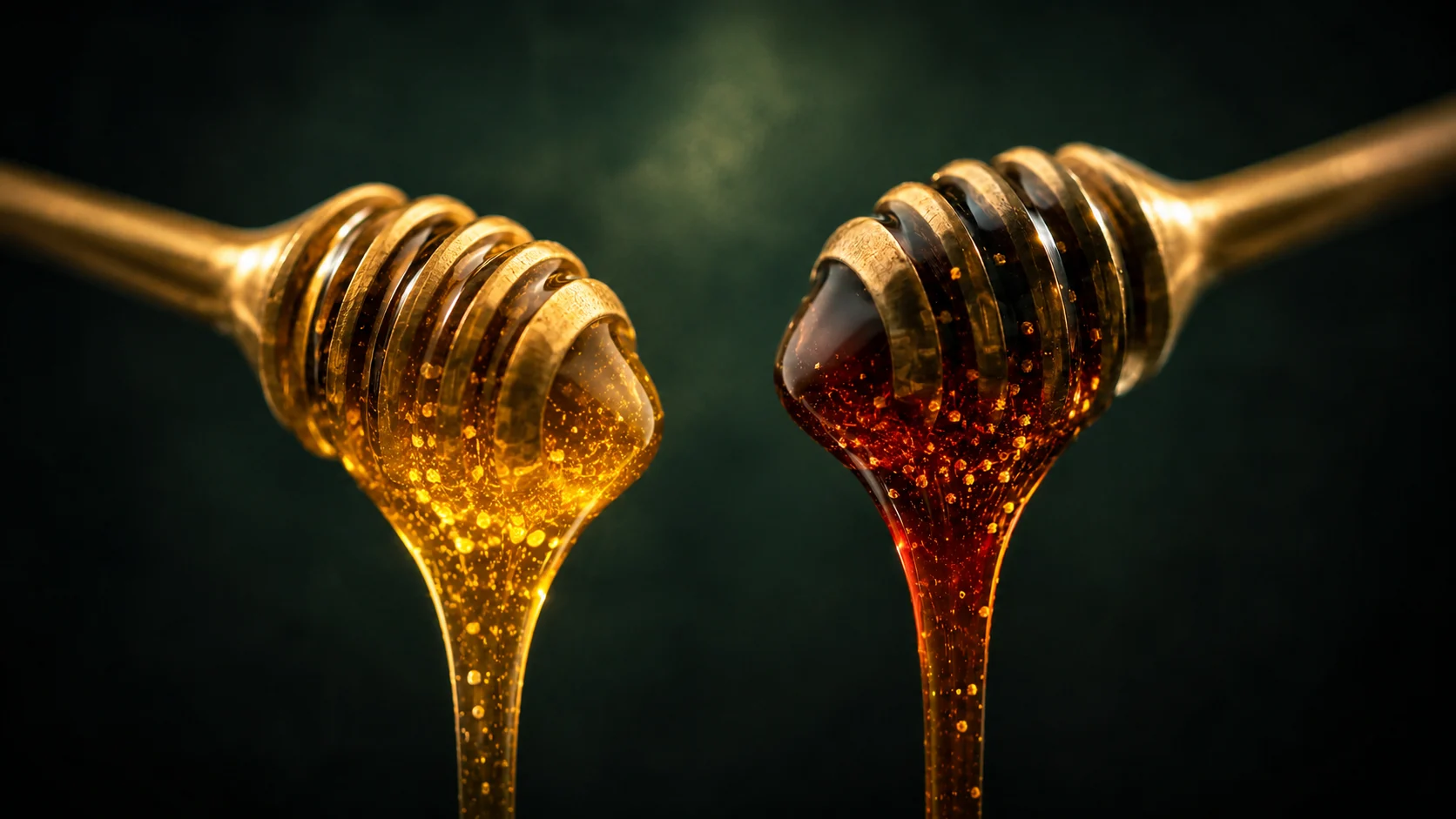
Stand in front of a honey shelf in any specialty food store in Dubai or Doha — or scroll through an online marketplace in Sharjah — and you will encounter both labels within seconds. Raw. Organic. Sometimes both, side by side on the same jar, as though they were synonyms. They are not. They describe two completely different qualities, measured by entirely different criteria. Confusing them costs buyers money, and occasionally costs them the very thing they were looking for.
The short answer
Raw honey describes how the honey was handled after leaving the hive — not heated, not aggressively filtered. Organic honey describes how the bees were managed and what they foraged on — in a documented pesticide-free environment. A honey can be one without the other. And some of the finest honeys in the world are neither certified nor labelled, yet exceed any standard a certification programme has ever attempted to capture.
What Is Raw Honey?
Raw honey is honey as it exits the hive, subjected to nothing more than gravity-straining to remove wax and debris. No pasteurisation, no pressure filtration, no blending for cosmetic consistency. What remains is structurally intact: natural enzymes present, pollen suspended in the liquid, propolis traces preserved, and a crystallisation behaviour that reflects the genuine botanical origin of the nectar.
The word “raw” has no universal legal definition in most countries — and that ambiguity is worth knowing. In practice, what separates genuine raw honey from honey merely labelled as such is temperature: raw honey is never heated above approximately 40–45°C, the natural temperature inside a healthy beehive. Beyond that threshold, enzymes such as diastase and invertase begin to degrade, aromatic compounds volatilise, and the complex character that distinguishes a Do’ani Sidr from a clover honey becomes flatter, simpler, less itself.
Why Heat and Filtration Matter
Commercial honey producers heat and pressure-filter their product for one primary reason: shelf appearance. A clear, uniformly amber liquid looks clean and sells reliably. Crystallisation — a natural process caused by glucose molecules forming lattice structures — is perceived by uninformed buyers as spoilage, so processors remove the pollen particles that act as nucleation points for those crystals.
What leaves with the pollen and the heat is a significant portion of what makes honey interesting. Pollen is not a nutritional afterthought: it is one of the primary botanical fingerprints of a honey, allowing laboratory analysis to confirm geographic and floral origin. Its removal makes adulteration far easier to conceal. A honey stripped of its pollen cannot be traced. That fact alone should give any serious buyer reason to pause.
What Is Organic Honey?
Organic honey, strictly defined, is honey produced by bees that forage within a pesticide-free environment — typically a radius of several kilometres around the hive — and are managed without synthetic chemicals or antibiotics. The beekeeper must document their practices, submit to third-party inspection, and receive annual certification from an accredited body such as the USDA Organic programme, the EU Organic label, or equivalent national schemes.
The certification says nothing about how the honey was processed after extraction. An organic-certified honey can be pasteurised, pressure-filtered, blended across batches, and stripped of its pollen. It can arrive in your jar as a perfectly transparent, enzyme-depleted liquid that happens to carry a green logo on its label. Organic and raw are orthogonal categories. Neither implies the other.
The Certification Reality
Honeybees do not read maps and they do not respect certification boundaries. A colony can forage up to five kilometres from the hive — sometimes further. For that foraging zone to genuinely qualify as pesticide-free, the beekeeper would need to verify that roughly 80 square kilometres surrounding their apiary contains no agricultural chemicals, no treated crops, no urban contamination sources. In most agricultural landscapes, that is simply not possible to guarantee.
In the United States, the situation is particularly revealing: as of the time of writing, the USDA has no enforceable federal standard specifically for organic honey. Most certified organic honey sold there is imported — primarily from Brazil, Argentina, and a handful of other countries — and certified under foreign standards that vary considerably in rigour. Some of that honey is then pasteurised and filtered by distributors before reaching a retail shelf, arriving as a jar simultaneously labelled “organic” and structurally stripped of most of what made it interesting.
Research note
Cornell University research suggests the actual median foraging distance of honeybees is closer to 750 metres — far less than the buffer zones certification guidelines demand. This raises a significant question: many small-scale traditional apiaries in genuinely remote landscapes may already meet organic standards in practice, whether or not they hold a certificate.
Can Honey Be Both Raw and Organic?
Yes — but it is genuinely uncommon, and it commands a significant premium. To be both raw and certified organic, a honey must satisfy two independent sets of requirements that pull in different directions economically. Organic certification reduces yield and increases management cost. Raw handling — refusing to heat the honey for clarity or to extend shelf life — reduces visual appeal and accelerates crystallisation, which many buyers still misread as a flaw.
| Criterion | Raw Honey | Organic Honey | Both |
|---|---|---|---|
| Heat treatment | None (below 40°C) | Not regulated | None |
| Pollen present | Yes | May be filtered | Yes |
| Pesticide-free env. | Not guaranteed | Certified | Certified |
| Third-party cert. | Not required | Required | Required |
| Traceability | Via pollen | Via paperwork | Both |
When you find a honey that is legitimately both — produced in a documented pesticide-free environment, extracted without heating, strained without pressure filtration, and certified by a credible body — that is a serious product. The price should reflect it. If it doesn’t, ask why.
Common Misconceptions About the Organic Label
The green logo has become a powerful psychological cue. It suggests purity, conscientiousness, environmental responsibility. For many food products, that association is largely justified. For honey, it is considerably more complicated.
Misconception 1: Organic automatically means better quality
Organic certification governs the production environment and beekeeper management practices. It does not govern flavour, floral complexity, enzyme activity, or the presence of pollen. A mass-produced certified organic honey blended across thousands of hives on three continents may carry the label with full legal legitimacy while tasting of very little.
Misconception 2: No organic label means contamination
Many exceptional small-scale producers — beekeepers working in remote mountain valleys, nomadic apiarists following ancient migration routes — operate in environments genuinely free of synthetic inputs. Their bees forage on wild flora untouched by agriculture. But the cost and administrative complexity of third-party certification is entirely out of reach for a traditional beekeeper in the Hadhramaut valley or the Dhofar mountains. They have no label. They have something more reliable: a landscape.
The Beekeeper Who Never Needed a Certificate
The beekeepers of Yemen’s Wadi Dawan, of Oman’s Dhofar region, and of the mountain terraces above Hadibo in Socotra have been practising what we would now call organic apiculture for centuries — not as a marketing decision, but as the only available option. There are no synthetic pesticide inputs in these landscapes. There is no industrial agriculture within the foraging radius of their hives. The Sidr tree — Ziziphus spina-christi — flowers once a year, in a brief window between autumn and early winter, and the bees that work those flowers have never encountered a herbicide.
That honey is raw by default. It is produced in conditions that would satisfy any organic certifier. But it carries no logo, because no certifier has ever climbed those cliffs. What it carries instead is provenance — a word that, in the world of serious honey, means considerably more than a label.
Do’ani Sidr Honey
Harvested from Ziziphus spina-christi trees in the cliffs of Hadhramaut. Raw by default, organically pure by landscape. No certification body has ever been required — the altitude and isolation are the guarantee. Available as Do’ani Sidr Honey at Meski.
Omani Sidr & Samar Honeys
Wild-flora harvests from the mountain highlands and acacia plains of Oman. Traditional apiculture with no synthetic inputs. Explore Omani Sidr Honey and Omani Samar Honey from Meski’s sourcing network.
Which One Should You Choose?
If you are buying honey for genuine quality — for flavour, for complexity, for the integrity of what you are putting in a cup of warm water with lemon at six in the morning or spreading on warm bread after Friday prayer — the answer is raw, with verified provenance, above all else.
Organic certification is worth something when it is issued by a credible body, when the honey is produced in a documented environment, and when the producer is transparent about their methods. It is worth considerably less when it appears on an imported, pasteurised, heavily filtered product that has travelled across three processing facilities before reaching its jar.
Ask: Where were the hives?
Floral and geographic origin tells you more than any label claim. A named valley in Yemen or a specific Omani massif is more informative than a certification stamp.
Ask: Was the honey heated?
A producer who can confirm non-pasteurisation — with specificity, without hesitation — is demonstrating genuine transparency.
Ask: Can the floral origin be verified?
Pollen presence is the botanical fingerprint of authentic raw honey. Its absence in a “raw” product should prompt further questions.
For buyers in the UAE, Qatar, and the wider Gulf region, this matters particularly. The great honey traditions of the Arabian Peninsula predate certification by centuries. Their quality is carried in the landscape itself: in the altitude, the soil, the specificity of the bloom, and the generations of beekeepers who learned which valleys produce the finest nectar and when to harvest it.
At Meski, the honeys we source — from Wadi Dawan, from the highlands of Oman, from the wild flora of the Emirates — are selected on this basis: raw extraction, verified floral origin, and a direct relationship with the producer that no third-party certificate can substitute. The Sidr honey in our collection has never been heated. It crystallises when it chooses to. It carries pollen. It is, in every meaningful sense, what honey should be.
Final Thoughts
The organic label was built for a world of industrial agriculture — a corrective measure designed to protect buyers from the worst excesses of chemical-intensive farming. For honey, it translates imperfectly. The biology of the bee does not respect certification boundaries. The economics of traditional apiculture make formal certification inaccessible for many of the world’s finest producers. And the label itself says nothing about whether the honey was heated, filtered, or blended into anonymity before reaching your table.
Raw speaks to integrity of process. Organic speaks to integrity of environment. Both matter. Neither, alone, is sufficient. And behind both, the question that never appears on any label remains the most important one: who kept these bees, and in what kind of place?
As The House of Meski has always held: a certificate tells you what a honey was permitted to be. The beekeeper’s landscape tells you what it actually is.
Explore Meski’s Raw Honey Collection
Every honey we carry is selected for raw extraction, verified provenance, and direct producer relationships. No blending. No pasteurisation. No compromises.
Frequently Asked Questions
Raw honey refers to honey that has not been pasteurised or heavily filtered after extraction — it retains its natural enzymes, pollen, and botanical complexity. Organic honey refers to honey produced in a documented pesticide-free environment, certified by a recognised body. The two labels describe entirely different qualities. A honey can be raw but not organic, organic but not raw, both, or neither.
Not necessarily. Organic certification governs the production environment, not the quality of the honey itself. Many certified organic honeys are pasteurised and heavily filtered, removing the very compounds — enzymes, pollen, propolis traces — that make raw honey aromatically and nutritionally distinct. For most buyers prioritising quality and complexity, raw honey from a verified source offers more than an organic label without corresponding raw processing.
It provides reasonable assurance, but not an absolute guarantee. Honeybees can forage several kilometres from the hive, and certifying bodies require documented pesticide-free buffer zones that are extremely difficult to verify in most agricultural landscapes. In practice, some non-certified honeys produced in genuinely remote, wild environments — such as Yemeni Sidr or Omani mountain honey — may be as pesticide-free as any certified product, without holding any official label.
Crystallisation is a natural process in genuine raw honey, caused by glucose molecules forming crystal structures over time. Pollen particles in unfiltered honey accelerate the process. It is not spoilage — it is evidence of minimal processing and authenticity. A raw honey that never crystallises, or that remains perfectly clear for years, may have been more processed than its label suggests. Crystallised honey can be gently returned to liquid by placing the jar in warm water, below 40°C.
Formal organic certification requires administrative infrastructure, recurring inspection fees, and access to certifying bodies — all of which are inaccessible to many traditional and nomadic beekeepers in remote regions of Yemen, Oman, or Socotra. These producers often work in landscapes entirely free of synthetic agricultural inputs, making their honey organically pure in practice. The absence of a label reflects geography and economics, not quality.
Look first for the floral origin and geographic provenance — these tell you more than any label claim. Then look for the word “raw” alongside a statement about non-pasteurisation. “Organic” alone, on an imported honey without further specification, carries limited informational value. Price transparency, named producer origins, and visual cues such as natural cloudiness or pollen content are more reliable indicators of quality than certification logos alone.
Raw honey — like all honey regardless of processing level — should never be given to infants under 12 months of age. Honey can contain Clostridium botulinum spores that, in infants, may cause infant botulism. This risk applies equally to raw, organic, and pasteurised honey. For children over one year and for adults, raw honey is considered safe for consumption under normal conditions. If in doubt, consult a healthcare professional.