
From a sincere smile to a shared table at sunset — exploring what generosity truly means during the holiest month of the year.
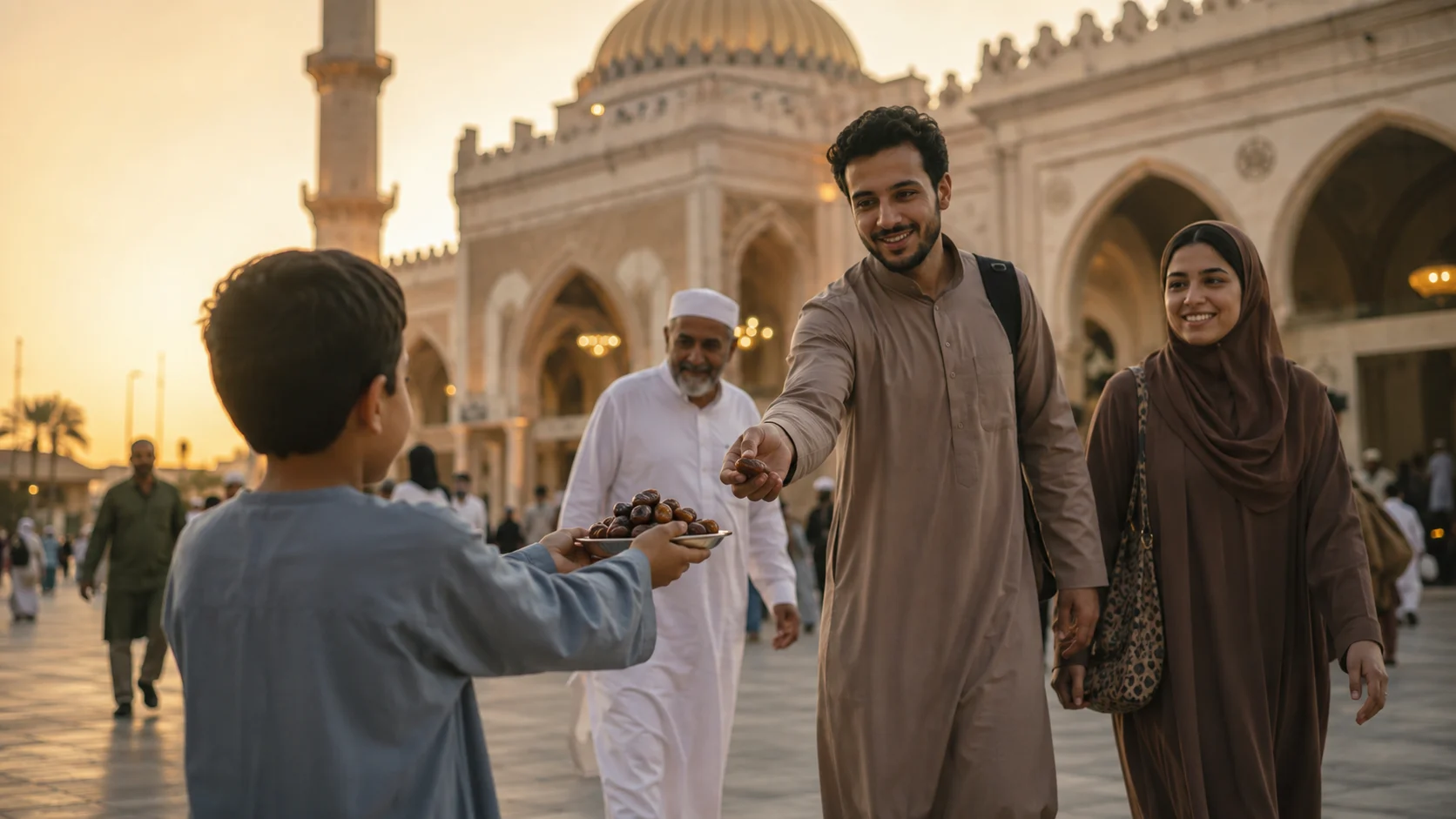
Sadaqah — the Arabic word for voluntary charity — is one of the most quietly profound concepts in Islamic tradition. During Ramadan, it comes alive in every open door, every shared meal, every smile offered freely to a stranger. This is not a guide to giving money. It is an exploration of what generosity truly means, and why Ramadan remains one of the most remarkable seasons of human kindness that any tradition has ever produced.
What Is Sadaqah?
The word sadaqah (صدقة) comes from an Arabic root that means sincerity — sidq (صدق). This is worth pausing on. Charity, in its Islamic understanding, is not primarily an act of wealth transfer. It is, at its core, an act of truthfulness. A declaration, through action, that one believes what one claims to believe.
In Islamic terminology, sadaqah refers to voluntary giving — an offering made freely, without obligation, without expectation of return, and with the sole intention of drawing closer to God. This distinguishes it from zakat, which is a calculated and obligatory contribution forming one of the five pillars of Islam. Sadaqah belongs to a different register entirely: the register of the heart.
What makes sadaqah remarkable in its classical definition is how expansive it is. A hadith attributed to the Prophet Muhammad ﷺ, recorded in Jami’ at-Tirmidhi (no. 1956), describes it with extraordinary generosity of scope:
“Your smiling in the face of your brother is charity. Commanding good and forbidding evil is charity. Your giving directions to a man lost in the land is charity. Your seeing for a man with bad sight is charity. Your removal of a rock, a thorn or a bone from the road is charity. Your pouring what remains from your bucket into the bucket of your brother is charity.”
— Jami’ at-Tirmidhi, 1956
A smile. A gesture. A moment of attention. All of these are named, explicitly, as acts of sadaqah. The tradition asks nothing more than sincerity — and nothing less.
What Is the Difference Between Sadaqah and Zakat?
This distinction matters, and it is frequently misunderstood. Zakat is the obligatory annual almsgiving incumbent on Muslims whose wealth exceeds a minimum threshold (the nisab). Its calculation, its recipients and its timing are carefully defined. It is a pillar — structured, communal and obligatory.
Sadaqah, by contrast, has no fixed amount, no required schedule and no defined recipient. It can be as small as a gentle word or as significant as a substantial donation. Its only condition is sincerity. This is why Islamic scholars have long described sadaqah as the space where the soul expresses itself most freely — unconstrained by calculation, driven only by inner intention.
During Ramadan, both forms of giving intensify. But it is sadaqah — in all its quiet, varied and personal expressions — that perhaps shapes the spirit of the month most intimately.
Why Does Ramadan Inspire Such Generosity?
Ramadan arrives each year through the appearance of the crescent moon, carrying with it a shift in consciousness that those who observe it describe in remarkably consistent terms across cultures, continents and centuries.
Fasting, at its most honest, produces empathy. When a person goes without food from dawn until sunset, the reality of hunger — usually an abstraction for many — becomes immediate. The stomach that is quiet by midday understands, viscerally, what it means to not know when the next meal will arrive. This is not a metaphor. It is a physical education in solidarity.
Islamic tradition has always understood this connection. The Yaqeen Institute for Islamic Research notes that the spirit of giving during Ramadan comes, in part, from the sympathy that fasting generates — the capacity to feel the weight of deprivation and respond with generosity rather than simply gratitude for one’s own comfort.
The Prophet Muhammad ﷺ was described in hadith literature as especially generous during Ramadan — “more generous than the blowing wind,” in the classical phrasing. This image has shaped how Muslims across generations have approached the month: not merely as a time of restriction, but as a season of expansion — of the self, the home, and the table.
How Does Sharing Meals Express Sadaqah During Ramadan?
In nearly every Muslim household, the moment of iftar — the breaking of the fast at sunset — is rarely private. Even when it is intimate, it is deliberate. A family gathers. A prayer is said. The first date is tasted. Tea is poured. And whatever the size of the table, there is almost always a wish that it were wider.
The tradition of hosting others for iftar is among the most vivid expressions of Ramadan generosity. Mosques across the world open their doors to anyone who approaches at sunset. Community kitchens are set up in streets. Neighbours leave parcels of food at doors. Strangers are invited without ceremony and without expectation of return.
UNESCO recognised iftar in 2023 as an element of the intangible cultural heritage of humanity — an acknowledgement of the extraordinary communal significance of this shared meal. The recognition was granted jointly to several countries, a fitting symbol of something that has never belonged to any one nation.
Dates hold a particular place in this tradition. The Prophet Muhammad ﷺ is reported to have broken his fast with fresh dates, dried dates, or water when neither was available — a practice deeply embedded in Muslim life around the world. To offer someone a date at sunset during Ramadan is to offer something that carries centuries of meaning: simplicity, nourishment, blessing and welcome, all at once.
What Role Do Gifts Play During Ramadan?
Gift-giving during Ramadan varies considerably across cultures and families — and this variety is itself part of its richness. There is no single correct form. What matters is the intention behind it.
In many Gulf households, the month of Ramadan becomes a time of quietly reinforcing the bonds that hold people together. Relatives visit. Small offerings are brought: boxes of dates, jars of honey, sweets wrapped with care, fragrant incense, or a modest bouquet. None of these are grand gestures. All of them speak a language the recipient understands immediately.
The Islamic tradition has always encouraged gift-giving between people, independent of Ramadan. A well-known hadith, recorded in multiple collections, attributes to the Prophet Muhammad ﷺ the advice to exchange gifts, for doing so increases love and affection between people. Ramadan amplifies what is already encouraged throughout the year.
Some gifts carry cultural depth that transcends their simplicity. A jar of honey brought to a household during Ramadan is, in many traditions, not merely a sweet offering — it is an acknowledgement of something precious, something that required effort and care in its production, something rooted in the earth and in the work of living creatures. Dates, similarly, carry the memory of deserts, of ancient trades, of the Prophet’s table, of family kitchens at sunset. When chosen thoughtfully, these gifts arrive already full of meaning.
Thoughtful Gifts Rooted in Tradition
Honey and dates have been offered as tokens of sincerity and welcome for centuries. Discover gift collections that carry this spirit into every box.
What Forms of Kindness Count as Sadaqah?
Perhaps the most underappreciated aspect of sadaqah is precisely the aspect that costs nothing — and yet demands the most of us.
A smile, the hadith says, is charity. Not a polite grimace. A genuine, warm, human smile directed at another person — enough to lighten their day or dissolve their isolation for a moment. Considered against everything that the word “charity” typically evokes — fundraising campaigns, donation buttons, bank transfers — a smile seems almost too small to count. But this is exactly the point the tradition makes. Nothing sincere is too small.
Giving someone your full attention is charity. Helping a person who is confused find their way is charity. Removing an obstacle from a path so that others are not harmed is charity. Staying patient with someone who is frustrated. Choosing the kinder word when a harsher one would have come more easily. Checking on an elderly neighbour who has not been seen in several days. Listening, truly listening, to someone who needs to be heard.
These are forms of sadaqah that no amount of wealth can purchase and no calculation can replace. They require something rarer than money: presence, intention, and care.
During Ramadan, when schedules change and the ordinary rhythms of life are altered, there is more space for this kind of generosity. Evening prayers bring communities together. Families gather at tables. Conversations deepen. Old friendships are renewed. Estrangements, sometimes, are quietly mended.
How Does Sadaqah Build a Culture of Compassion?
Individual acts of sadaqah, when they become habits, do not remain individual for long. They accumulate into something larger: a community shaped by the expectation of generosity rather than its absence.
There is a meaningful difference between a society in which people give when they feel particularly moved, and one in which giving — in its many forms — is woven into the ordinary texture of life. Ramadan, practised sincerely across millions of households, has historically served as an annual recalibration of this expectation. It reminds communities what they are capable of. It makes generosity visible. It shows people, year after year, that the impulse to share is not naive — it is real, it is wide, and it produces tangible goodness.
Research conducted by the Muslim Philanthropy Initiative has noted that charitable giving during Ramadan extends well beyond financial donations, encompassing volunteering, community service, the sharing of food, and the quiet acts of neighbourly care that rarely appear in any statistics but shape the daily experience of communities profoundly.
This culture of compassion is not exclusive to those with means. It is, by design, available to everyone. The widow who shares her small meal. The child who helps an elderly person carry their shopping. The person going through difficulty who still finds a way to smile at someone who needs it. The tradition makes no hierarchy among these acts. Sincerity is the measure, not scale.
What Ramadan teaches, gently and repeatedly, is that the world is changed not only by extraordinary actions performed by exceptional people, but by ordinary kindness practised by everyone, consistently, with intention.
Final Thoughts
Sadaqah does not begin with money. It begins with awareness — the moment a person notices someone else’s need, or senses an opportunity to bring comfort, connection or ease to another human being.
Ramadan sharpens that awareness. Fasting thins the wall between one person’s experience and another’s. Prayer creates space for reflection. And generosity — in all its forms, from the grand to the imperceptibly small — becomes the natural expression of what that reflection produces.
The beauty of giving during Ramadan is not that it is required. Zakat is required. Sadaqah, by definition, is not. Its beauty lies precisely in its freedom — in the fact that each act of kindness offered during this month is chosen, voluntary and sincere. A smile given freely. A meal shared without calculation. A gift brought to a door with nothing expected in return.
These gestures, multiplied across millions of homes, across dozens of languages and dozens of landscapes, create something that no single act could achieve alone: a season that reminds humanity of its better possibilities.
May it be accepted — from all of us, in whatever form we are able to offer it.
تقبل الله منا ومنكم
May God accept from us and from you.
Frequently Asked Questions About Sadaqah and Ramadan
Zakat is an obligatory annual almsgiving calculated on the wealth of Muslims who meet a minimum threshold, and it is one of the five pillars of Islam. Sadaqah is voluntary — an offering made freely, in any amount, at any time, and in any form. Both are acts of giving, but sadaqah is governed entirely by personal intention rather than religious obligation.
Yes. Islamic tradition explicitly includes non-material acts within the definition of sadaqah. A genuine smile, offering directions to someone who is lost, helping a person with poor sight, removing a hazard from a shared path — all of these are named in hadith literature (Jami’ at-Tirmidhi, 1956) as acts of charity.
Muslim scholars have long emphasised that Ramadan is a month of intensified spiritual practice, and many Muslims choose to give more generously during this period. However, Islamic teaching also holds that all sincere good deeds carry weight throughout the year. The significance of Ramadan lies in the awareness and intention it cultivates, not in a mechanical multiplication of rewards that overrides the rest of the year.
Gift-giving traditions vary across cultures. Common offerings include dates, honey, sweets, dried fruits, incense and other items associated with the table and the home. What distinguishes a Ramadan gift from a commercial transaction is the care with which it is chosen and the sincerity with which it is given.
Sadaqah, in its technical Islamic definition, refers to an act of giving performed with the intention of pleasing God within an Islamic framework. However, acts of kindness, generosity and charitable giving are valued and practised across all human traditions. Non-Muslims who wish to express generosity during Ramadan — whether by donating to a charitable cause, sharing a meal, or simply extending kindness to a neighbour — do so in a spirit that the season warmly welcomes.
The Islamic tradition is explicit on this point: sadaqah is not measured by amount. A smile, a kind word, a moment of genuine attention, help offered freely — these are among the forms of charity named directly in hadith literature. The tradition was designed to be accessible to everyone, regardless of material circumstances.