
A patient editorial guide for visitors who want to bring home more than a souvenir — and the knowledge to choose it well.
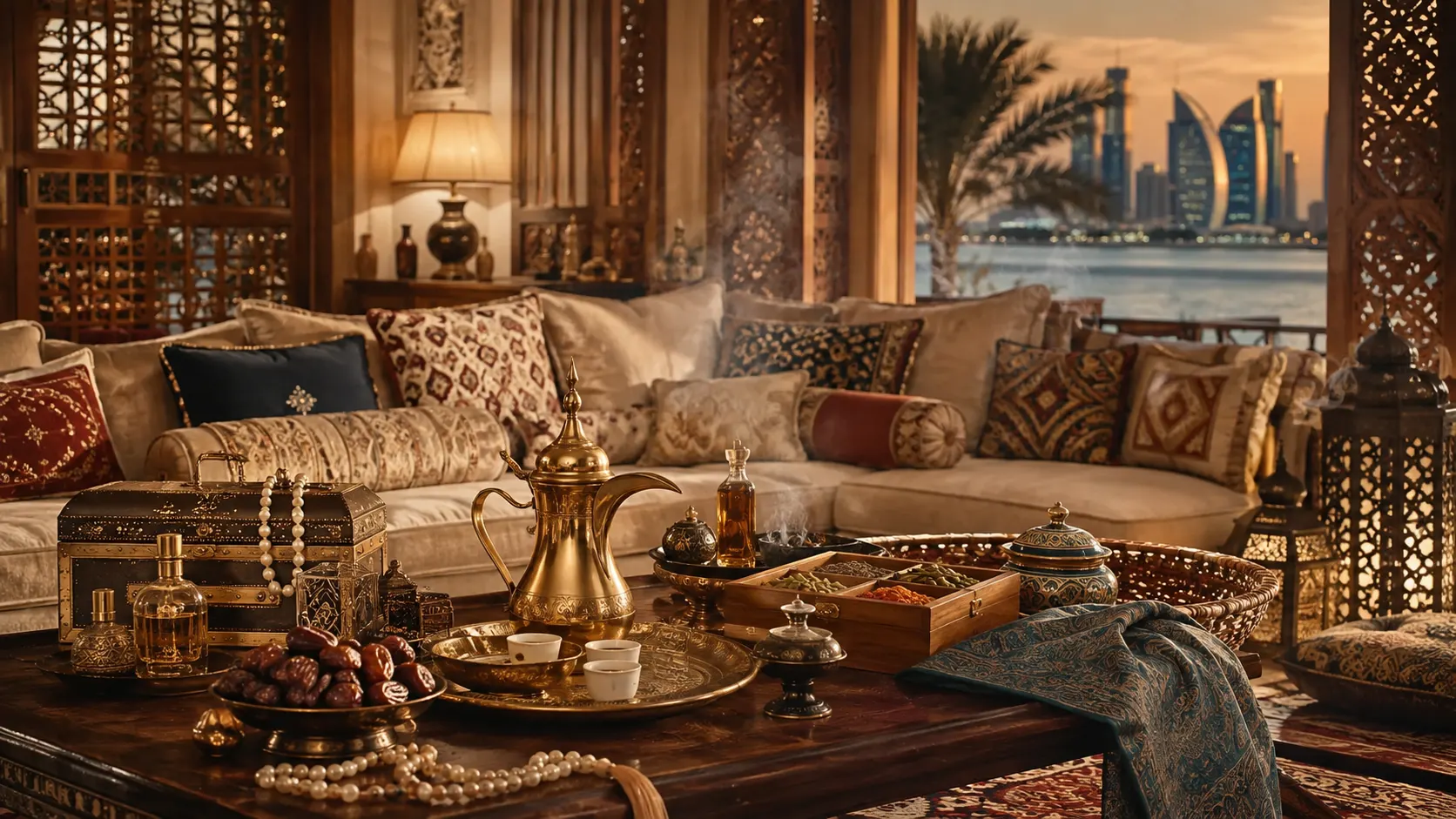
The difficulty of choosing a gift in Doha or Dubai is not a shortage of objects. It is knowing which one carries a memory worth keeping — and understanding enough about dates, honey, oud, pearls and Arabic coffee to choose with confidence rather than guessing.
In brief
The strongest gift categories in both cities are carefully selected dates, Arabic coffee (qahwa), honey, oud or bakhoor, artisanal perfume oils, spices and — depending on the recipient — pearls in Qatar or gold and contemporary Emirati design in Dubai. In every category, origin, floral source, production method and cultural context deserve a moment of honest enquiry before you buy. Price alone tells you very little.
Chapter One: Understanding a Meaningful Gulf Gift
1. What are the best gifts to bring home from Doha or Dubai?
The most consistently meaningful gifts fall into five categories: dates, fragrance (oud, bakhoor or attar), Arabic coffee with spices, honey and handcrafted objects connected to Gulf hospitality culture. Within each category, quality and provenance vary enormously. A date box from a specialist date house carries entirely different weight than a supermarket selection wrapped in tourist packaging. Similarly, a small bottle of genuine oud oil tells a different story from a synthetic spray sold under an Arabic name. The decision begins not with which category to choose, but with how carefully you are prepared to select within it.
2. What makes a gift genuinely connected to the Gulf?
Cultural connection comes from origin, use and meaning — not from the design of the packaging. A gift is genuinely connected to the Gulf when it belongs to a tradition practiced there: the daily offering of dates and qahwa to a guest; the burning of bakhoor before receiving visitors; the gifting of pearl jewellery at moments of celebration. Some of these objects are produced locally; others are sourced from elsewhere in the Arab world or beyond, but are woven into local ritual in ways that give them genuine cultural weight. The honest question is not only whether the object was made in Qatar or the UAE, but whether it carries a story — one you can explain and the recipient will remember.
3. Is an edible gift better than a decorative souvenir?
Neither is inherently superior. An edible gift — dates, honey, Arabic coffee, spices — disappears, but it creates an experience: a moment at a table, a conversation, a memory of flavour connected to a place. A decorative object — a dallah, a piece of pearl jewellery, a woven textile — remains and may carry meaning for years. The best choice depends on the recipient. For someone who values food and hospitality, an edible gift is direct and generous. For someone who collects or decorates, a crafted object may hold longer resonance. Food gifts also tend to travel more easily, which matters when you are carrying gifts across multiple time zones.
4. Should I buy the same gifts in Doha and Dubai?
Not necessarily, and the difference matters. Doha and Dubai share many Gulf traditions — dates, Arabic coffee, oud, bakhoor — but they carry distinct identities. Qatar’s cultural emphasis on its pearl-diving heritage, its Bedouin weaving traditions and its comparatively restrained approach to commerce gives gift-buying in Doha a different character. Dubai’s position as a global trading city means its souqs and boutiques offer greater variety, a wider range of contemporary design and more internationally polished packaging — but this also means that the line between locally relevant and globally imported is harder to see. Each city deserves its own purchasing decisions. Bringing a box of dates from Doha and a bottle of oud from Dubai is not duplication; it is attention to difference.
5. What is a refined gift that does not feel ostentatious?
The most restrained and effective Gulf gift is usually a beautifully presented box of premium dates accompanied by a small quantity of Arabic coffee blend. It references hospitality directly, it is appropriate across almost every relationship — professional, familial or social — and it requires no explanation, even to recipients unfamiliar with Gulf culture. A small jar of Sidr or wildflower honey, carefully sourced from a transparent producer, offers similar restraint. Refinement in gift-giving is less about spending more and more about selecting with precision: one excellent thing, well chosen, rather than a basket of miscellaneous objects.
6. What is a good first gift for someone who has never visited the Gulf?
Begin with something edible and explainable. A box of Medjool or Khalas dates with a short handwritten note describing the variety and its tradition in Gulf hospitality is more generous than almost any decorative object. A small pouch of Arabic coffee blend — lightly roasted beans, cardamom, sometimes saffron — with a brief explanation of how it is prepared and served introduces the recipient to a living ritual rather than an inert keepsake. These are gifts that open a conversation. They are also compact, practical and appreciated by people who might otherwise have no idea what to do with a camel figurine.
7. What is a good gift for a host?
In Gulf hospitality culture, the appropriate gift for a host is something that mirrors or complements the gesture of welcome. Dates and honey are both deeply embedded in the Qatari and Emirati traditions of generosity. A premium date selection, a jar of Sidr honey from a named source, or a quality bakhoor blend — something the host can burn during the next gathering — acknowledges the hospitality culture rather than simply reciprocating it commercially. Avoid large decorative objects unless you know the host’s home and taste. A beautiful, well-sourced edible or fragrant gift that can be shared with the household is almost always the right choice.
8. How can I avoid generic tourist souvenirs?
Ask one question before buying: is this object made here, used here, or merely sold here? Many objects sold in Gulf souqs — refrigerator magnets, mass-produced camel figurines, generic scarves, keyrings shaped like the Burj Khalifa — carry no genuine cultural content. They are manufactured at scale, often elsewhere, and assembled into tourist identity by their packaging alone. The way to avoid them is not to dismiss souqs entirely, but to look for objects that belong to a living tradition: dates from a serious producer, a coffee blend made with real cardamom and green beans, a piece of jewellery with verifiable pearl content, a textile whose weaving pattern has a name and a lineage. When in doubt, spend a little more time asking questions and a little less time browsing.
Chapter Two: What to Buy in Doha
Doha is a city that has grown extraordinarily fast, but its cultural character — restrained, rooted in Qatari and Bedouin traditions, deeply tied to the sea — remains legible in its markets, its museum gift shops and its hospitality rituals. Shopping here rewards patience and curiosity more than volume.
9. What gift best represents Doha?
A carefully selected date box accompanied by a pouch of qahwa — Arabic coffee blend — is the gift most authentically grounded in Qatari hospitality culture. The combination mirrors what every Qatari host offers a guest upon arrival: dates and coffee before any other conversation begins. It carries no ambiguity about meaning. Pearl jewellery, if authentic and within budget, adds a second layer of specifically Qatari heritage, since pearl diving shaped Qatar’s economy and identity for centuries before oil was discovered. For those seeking something singular, the gift shops at the National Museum of Qatar stock objects that connect directly to verified cultural and historical narratives — a reliable alternative to the souq for buyers who prefer curated provenance.
10. What should I buy in Souq Waqif?
Souq Waqif — Qatar’s most prominent traditional market — is best approached as a place of discovery rather than a destination for guaranteed authenticity. You will find dates, spices, oud, bakhoor, perfume oils, textiles, dallah coffee pots, pearl jewellery, fabrics and an extensive range of decorative objects. The quality and origin of these products varies widely from stall to stall. The most reliable categories for genuine cultural relevance are spices (particularly loose cardamom, saffron and dried rose petals, which are genuinely used in Qatari cooking and coffee preparation), oud and bakhoor from established fragrance traders, and well-packaged dates from dedicated date vendors. Ask where products come from. Reputable traders are generally comfortable answering. Those who deflect the question deserve more scrutiny.
11. Are dates a good gift from Qatar?
Yes — with one important caveat: not all dates sold in Qatar are grown in Qatar. Many are imported from Saudi Arabia, the UAE, Tunisia or Iran and repacked locally. This does not necessarily diminish their quality, but it changes what you are giving. A box of dates from Qatar is a culturally appropriate gift whether the fruit was grown locally or regionally; the gesture belongs to Qatari hospitality regardless of precise origin. However, if the recipient asks where the dates are from and the honest answer is unknown, the gift loses a small amount of its story. Look for producers and vendors who clearly label origin. Some specialty date houses in Doha source from verified farms and package with full traceability.
12. What date varieties should I look for in Doha?
Khalas, Medjool, Ajwa and Mabroom are among the most commonly found premium varieties in Doha, each with a distinct character worth understanding before you choose. Khalas — the name means “pure” or “finished” in Arabic — is considered the golden standard of Gulf dates: amber to rust in colour, with a caramel and toffee flavour and a silky texture that pairs precisely with the bitterness of Arabic coffee. Medjool dates are dramatically larger, softer and intensely sweet — impressive as a gift by appearance alone. Ajwa dates, smaller and darker, have deep cultural significance associated with Medina and are often sought specifically for that connection. Mabroom are long, slightly chewy and less sweet, appreciated by those who find Medjool overwhelming. Mixed-variety boxes make sound gifts when you are uncertain of the recipient’s preference.
13. Can I buy Qatari honey in Doha?
Honey is sold widely in Doha’s souqs and specialist food shops, but Qatar does not produce honey at significant commercial scale. Most honey sold in Qatar — including varieties labelled Sidr, wildflower and mountain honey — comes from Yemen, Oman, Saudi Arabia, Morocco or further afield. This does not make it a poor gift; Sidr honey from verified Yemeni or Omani sources is among the finest honey in the Arab world. The problem arises when origin is unverifiable and the price is used as a proxy for authenticity. In Doha’s markets, always ask for the country of origin, the floral source and, where possible, the producer’s name. Honey sold with detailed, accurate labelling is almost always safer than honey sold loose from a jar with a hand-written tag and an implausibly high price. A well-sourced jar of Omani Sidr honey or Emirati Sidr honey from a transparent supplier is one of the most meaningful edible gifts available in the Gulf. At The House of Meski, we select honeys only when origin and harvest conditions can be clearly explained — because a jar of honey without a story is simply sugar.
14. Is Arabic coffee a suitable Qatar souvenir?
Arabic coffee — qahwa — is one of the most culturally grounded souvenirs available in Doha, and it travels well. The tradition of preparing and serving qahwa was inscribed on UNESCO’s Representative List of Intangible Cultural Heritage of Humanity in 2015, in a joint submission by Saudi Arabia, the UAE, Oman and Qatar. The inscription recognised not just the drink but the entire social ritual around it: the dallah pot, the finjan cups, the order of serving, the silence that accompanies the first cup. A good qahwa blend — lightly roasted beans (often green or pale yellow), ground with cardamom and sometimes saffron, cloves or rose water — can be found in Souq Waqif’s spice lanes in bulk, or pre-packaged from reputable suppliers. Look for blends that list their ingredients clearly and avoid pre-sweetened versions.
15. Should I buy a dallah or finjan set?
A dallah — the tall, narrow-spouted coffee pot used throughout the Gulf — is one of the most recognisable objects in Arabian hospitality culture. As a decorative gift, it carries immediate cultural legibility; as a functional object, it requires the recipient to understand how to use it. Dallah sets vary from mass-produced tourist pieces in plated metal to genuinely crafted versions in brass or silver. A simple test: check the lid’s seal, the spout alignment and the weight. Cheap tourist versions are often lightweight, with poorly fitted lids and simplified geometry. If budget allows, a set of three to six small finjan cups (the handleless ceramic or glass cups used for Arabic coffee) paired with a good quality dallah is more useful and more considered than the dallah alone. Ensure the pieces actually fit together proportionally before buying.
16. What spices are associated with Qatari cooking?
Cardamom is the most emblematic spice in Qatari culinary culture, appearing in coffee, rice dishes and sweets. Saffron is used in qahwa and in celebration rice dishes. The spice blend known as bizar — a Qatari compound spice used in machbous (the national rice dish) and grilled meats — includes combinations of black pepper, turmeric, cumin, coriander, cinnamon, cloves and dried lemon (loomi). Dried black limes, or loomi, are particularly interesting as a souvenir: they are an ingredient with strong Gulf identity, used in rice dishes and stews, rarely found outside specialist shops in other countries. A small bag of quality whole cardamom pods, a pinch of genuine saffron threads and a packet of loomi make a quiet, intelligent food gift for a cook.
17. Is oud or bakhoor a good gift from Doha?
Both are culturally appropriate and meaningful gifts from Qatar — but they require a conversation with the seller before you commit. Oud — the resinous heartwood of Aquilaria trees, used as incense chips or distilled into oil — is associated with hospitality, prayer and celebration across the Gulf. Bakhoor is a prepared blend of oud chips, wood powders, rose water, oils and other aromatic ingredients, compressed or loosened, and burned on a coal or electric burner. In Doha’s souqs, both are available in wide quality and price ranges. The origin of the oud wood — whether from Southeast Asia, India, Bangladesh or the Arabian Peninsula — affects the scent profile significantly. Ask the trader to explain the origin and let you smell before deciding. A small quantity of good bakhoor makes an accessible, fragrant and genuinely Gulf-connected gift even for recipients who have never encountered it before.
18. Are pearls still a meaningful Qatari gift?
Pearls carry deep and specific Qatari heritage significance, but buyers must understand what they are purchasing before treating any pearl as a historically rooted gift. Pearl diving shaped Qatar’s economy and social structure for centuries — the trade was the country’s primary income source until oil was discovered in the mid-twentieth century. Today, the pearl diving heritage is celebrated at the National Museum of Qatar, through the Qatar Pearl Monument on the Corniche and in the pearl-diving-themed interior of Doha Metro stations. However, most pearls sold in Doha’s souqs today — including at Souq Waqif and the Gold Souq — are cultured pearls from Japan, China or elsewhere, not natural Gulf-harvested pearls. Cultured pearls are not fraudulent; they are simply different. Natural Gulf pearls exist and are sold by specialist dealers, but they command substantially higher prices and require documentation. If the heritage connection is important to the gift, ask specifically and verify before spending.
19. What textiles or crafts can I buy in Qatar?
Qatar has weaving traditions — including sadu-style geometric weaving associated with Bedouin women’s craft across the Arabian Peninsula — as well as pottery, basket weaving and embroidery. The challenge for buyers is that genuinely Qatari-made textiles are less easy to find in the souq than imported equivalents. Fabrics, rugs and embroidered pieces in Souq Waqif frequently originate from India, Iran, Pakistan or Turkey and are sold in a Gulf aesthetic context. This does not make them worthless, but it changes the nature of the gift. For objects with verified Qatari craft lineage, the gift shops at Qatar Museums institutions — including the National Museum of Qatar and Mathaf — are worth visiting. They stock pieces connected to documented craft traditions, produced in collaboration with Qatari artisans or institutions, and labelled with appropriate transparency.
20. What is a refined corporate gift from Doha?
The strongest corporate gifts from Doha combine cultural legibility with practical elegance. A premium date selection in a well-designed box, a curated spice set with a card explaining Qatari culinary use, or a small oud gift set with a brief note on its role in Gulf hospitality culture all communicate thoughtfulness without ostentation. Avoid generic luxury goods — branded pens, mass-produced leather items, technology accessories — unless your client specifically collects them. A gift rooted in the culture of the city you are visiting signals that you paid attention. In Qatari business culture, generosity and hospitality are central values; a gift that mirrors those values is always more appropriate than one that simply signals expenditure. Timing matters too: gifts given at the beginning of a relationship are more culturally weighted than those given at contract signing.
Chapter Three: What to Buy in Dubai
Dubai is many things simultaneously: a global trading city, a place of Emirati tradition, a destination for design and gastronomy, and a market where exceptional products sit alongside imitations. The key to shopping well here is knowing which identity you are navigating at any given moment.
21. What gift best represents Dubai?
No single object captures Dubai entirely — which is itself an accurate reflection of the city. For something rooted in Emirati culture: premium dates from a specialist producer, a quality oud or bakhoor from the Perfume Souk in Deira, or a piece of contemporary Emirati design that references Al Sadu weaving geometry without claiming to be handwoven by a Bedouin artisan. For something that reflects Dubai’s role as a world crossroads of luxury: gold jewellery from the Deira Gold Souk, priced transparently by the gram and crafted to order. The most honest answer is that Dubai’s gift identity is plural. It is not a contradiction to bring back both a jar of dates from an Emirati farm and a piece of gold designed in a contemporary Emirati workshop — both belong here.
22. Are premium dates one of the best Dubai gifts?
Premium dates are among the most culturally grounded and practically excellent gifts available in Dubai. The UAE is a significant date producer — the Khalas variety is particularly associated with Gulf agricultural traditions — and Dubai’s specialist date boutiques offer a range of quality that goes well beyond what most visitors expect. Packaged date selections from established Emirati producers are beautifully presented, well labelled with variety and origin, and suitable for both personal and professional gifting. Some boutiques also offer dates stuffed with pistachios, almonds or orange peel — a contemporary interpretation of an ancient fruit that has found wide appreciation globally. At The House of Meski, we source dates with full traceability because we believe the story of where a date was grown is inseparable from the pleasure of eating it.
23. Is Dubai chocolate a meaningful gift or mainly a trend?
Dubai chocolate — broadly defined as the pistachio-and-kataifi-filled chocolate style that went viral globally around 2023–2024 — is a genuine culinary trend that emerged from Dubai’s creative food scene. As a gift, it is cheerful and well-received, but it is better understood as a current cultural moment than as a rooted tradition. The original creation was made by a small independent chocolatier drawing on Middle Eastern flavour combinations (pistachio, tahini, kataifi pastry). Since then, dozens of imitators have produced versions of varying quality worldwide. If giving Dubai chocolate as a souvenir, seek out versions actually made in the UAE from quality producers rather than supermarket imitations. Camel milk chocolate — produced in the UAE since the early 2000s by brands such as Al Nassma — has a stronger regional identity: camel milk is genuinely a part of Gulf food culture, and the chocolate itself predates the viral trend by two decades.
24. Is Arabic perfume a good gift from Dubai?
Arabic perfume is one of Dubai’s most compelling gift categories — but it requires more care than a bottle from a duty-free shelf. The Perfume Souk in Deira is the traditional starting point: here, traders offer concentrated perfume oils (attar), oud-based blends, custom compositions and mass-market Arabic-style fragrances side by side. Prices range from very modest to collector-level. The difference between them is not always obvious from the bottle. A genuinely good Arabic perfume oil — particularly one that contains a meaningful proportion of real oud or natural musks — will have warmth, complexity and longevity that synthetic blends cannot replicate. Ask the trader to apply a small amount to your inner wrist and wait five minutes. A quality fragrance evolves; a synthetic one simply fades or turns sharp.
25. Should I buy oud oil, spray perfume or bakhoor?
Each format has a different use and a different kind of cultural meaning. Oud oil (applied directly to the skin from a small applicator or daubed with a stopper) is the most intimate and personal fragrance format in Gulf culture. It is worn on pulse points, warming with body heat, and its scent is unmistakably personal. Spray perfume in the Arabic style typically uses an alcohol base carrying oud, amber, musk and floral notes — more immediately accessible to recipients unfamiliar with concentrated oils, and easier to apply. Bakhoor is burned rather than worn: wood chips or pressed blends placed on a coal or electric burner fill a room or scent clothing before an occasion. For a first-time recipient, a small bakhoor set — a burner and a quantity of prepared bakhoor — is more accessible than raw oud and more experiential than a spray bottle. For a fragrance enthusiast, a small vial of genuine oud oil from a named origin is a collector’s gift.
26. Are spices from the Dubai Spice Souk a good souvenir?
Spices from Deira’s Spice Souk can be an excellent practical gift, but they require label literacy. The souk stocks a wide range: saffron (sold in threads or powder — always choose threads; powder is far more easily adulterated), cardamom, turmeric, dried rose petals, sumac, loomi (dried black lime), cinnamon sticks and blended ras el hanout and baharat mixes. Not all of these spices originate in the Gulf or the UAE; many are sourced from India, Iran, Morocco or elsewhere and are part of Dubai’s centuries-old trading tradition. This is historically accurate — the Spice Souk exists because of the dhow trade routes that connected the Gulf to the Indian subcontinent and East Africa. The spices are genuine goods in a genuine trading space. Just buy what smells right, what is clearly labelled and what the recipient will actually use.
27. Is gold jewellery a sensible Dubai gift?
Dubai’s Gold Souk in Deira is one of the world’s most significant gold markets — hundreds of shops, transparent daily pricing displayed on screens, and craftsmanship ranging from traditional Gulf design to contemporary international styles. Gold jewellery is a very sensible Dubai gift when the recipient wears jewellery and you know their taste. Gold pricing in Dubai is based on daily rates plus a making charge, with VAT applicable at the standard rate and a refund process available at departure. The gold content (18k, 21k, 22k or 24k) is stamped and verifiable. The risk is not quality — regulatory oversight of gold content is reliable — but aesthetic misalignment: gold jewellery is personal, and buying it without knowing the recipient’s preference can result in a significant expenditure producing a polite but unused gift.
28. Can I buy Al Sadu-inspired gifts in Dubai?
Yes — and this is a gift category with genuine heritage depth. Al Sadu weaving is a traditional Bedouin craft practiced by women across the Arabian Peninsula, using wool or cotton on horizontal ground looms to produce tightly woven geometric textiles. The UAE has led efforts to preserve it: Al Sadu was inscribed on the UNESCO List of Intangible Cultural Heritage in Need of Urgent Safeguarding in 2011, with subsequent safeguarding efforts recognised by UNESCO. Contemporary Emirati designers have incorporated Al Sadu motifs into bags, cushion covers, accessories and stationery — pieces that carry genuine design heritage without claiming to be handwoven by traditional artisans. When buying, look for objects that name the design source, distinguish between machine-produced interpretations and hand-woven originals, and ideally support artisan communities.
29. Is an Arabic coffee set a good Dubai souvenir?
An Arabic coffee set — a dallah pot, finjan cups and, ideally, a small tray — is a meaningful and visually distinctive gift, provided the buyer understands the difference between a decorative piece and a functional one. In Dubai’s souqs and design boutiques, dallah sets range from tourist-grade mass-produced pieces to beautifully crafted brass or steel versions suitable for regular use. A practical set, combined with a pouch of quality qahwa blend and a short note on preparation, transforms a decorative object into an invitation to experience something. For a purely decorative gift, a miniature dallah in silver or gold-plated brass serves as a well-recognised cultural symbol. The choice between function and decoration is one worth making consciously rather than by default.
30. What is a good corporate gift from Dubai?
The most effective corporate gifts from Dubai respect the culture of the recipient while drawing from the culture of the city. A premium date selection in elegant packaging is appropriate for almost any business relationship across cultures. A curated Arabic perfume oil in a quality bottle, accompanied by a brief description of its composition and tradition, is more distinctive than any branded pen or leather notebook. For international clients unfamiliar with Gulf traditions, a combined gift — dates, a small card explaining their role in Emirati hospitality, and a single vial of oud oil — introduces cultural context rather than assuming it. In Emirati business culture, gifts signal respect and relationship rather than transaction. They are given and received quietly. Loud packaging and excessive branding are unnecessary.
31. Should I shop in a traditional souq or a modern boutique in Dubai?
Both have distinct advantages, and the choice depends on what you value. Traditional souqs — particularly Deira’s Gold Souk, Spice Souk and Perfume Souk — offer the experience of navigating a living trading culture, the possibility of negotiation and a sensory environment that no mall can replicate. Prices are not always lower, and quality requires scrutiny. Modern boutiques and department stores offer consistent quality control, clear labelling, fixed prices and packaging designed for gift-giving. For buyers who are confident in their ability to evaluate spices, oud and dates by smell and appearance, the souqs reward the effort. For buyers making their first visit to the Gulf, or those with limited time, a reputable boutique may produce a more reliable result with less anxiety. Some of the finest contemporary Emirati date and fragrance brands operate from both channels.
32. Is it better to buy gifts in Dubai or at the airport?
Dubai International Airport stocks a wide range of gift products — dates, chocolates, oud sets, gold — but generally at prices reflecting the convenience of their location. For fragrance, some duty-free purchases can be sealed in tamper-evident bags that satisfy airline liquid regulations for connecting flights, which is a practical advantage. For dates and food, airport boutiques often carry established brands in attractive packaging. However, the selection at the airport is narrower than the city, and the ability to taste, smell and compare before buying — which the souqs and city boutiques allow — is reduced. The airport is a reasonable option for last-minute purchases or for liquids you cannot carry through security from city shops. It should not be the only plan. Shop in the city first; supplement at the airport if needed.
Chapter Four: Food, Fragrance and Authenticity
33. How can I choose a good box of dates?
The first test is appearance: premium dates have consistent colour, unbroken skin and a surface that is neither excessively sticky nor dry and shrivelled. The second test is labelling: a reputable date producer names the variety (Khalas, Medjool, Ajwa, Mabroom, Sukkari), identifies the origin region and provides a harvest or packaging date. The third test, where possible, is taste: a good date vendor will offer a sample. The texture should be appropriate to the variety — Medjool should be soft and yielding, Khalas should be smooth and slightly chewy with a clean caramel finish, Ajwa should be firm with a concentrated sweetness. Avoid boxes where the dates have been coated in excessive syrup or glaze, which often masks poor quality fruit. Stuffed dates (filled with nuts or dried fruit) are a legitimate contemporary presentation, but the quality of the base date still matters. A beautifully presented box of inferior dates is a worse gift than a simpler box of excellent ones.
34. How can I choose honey without believing exaggerated claims?
Treat extraordinary health claims on honey labels with the same scepticism you would apply to any food product. Sidr honey — made by bees that feed on the flowers of the Ziziphus tree — is genuinely prized across the Arab world for its distinctive flavour and density. However, the global annual production of genuine Sidr honey is limited, and the gap between what is produced and what is sold under that name is significant. A very low price for a jar labelled Sidr honey is a reliable indicator that something is not right. Conversely, a very high price alone does not confirm authenticity. Look for: a named country of origin and specific region; a producer name and contact information; a harvest date or batch number; and an absence of claims that cannot be verified. Honey that is transparent about what it is inspires more confidence than honey that promises everything. In the Gulf markets, buy honey from vendors who can explain where it came from and why they trust their supplier.
35. Which Arabic coffee should I buy as a gift?
The best qahwa gift is a blend that lists its ingredients clearly and has been prepared by someone who understands the tradition. The base is lightly roasted coffee — often green or pale yellow beans, quite different from the dark roasts of European or Ethiopian traditions. Cardamom is essential. Saffron is added in many Gulf recipes for colour and warmth. Some blends include dried rose petals, cloves or a touch of ginger. Ready-to-brew pouches and ground blends are both appropriate; the former is more convenient, the latter offers more flexibility. Avoid pre-sweetened versions: qahwa is traditionally unsweetened, and the sweetness comes from the dates served alongside it. If buying loose spices to assemble your own gift — whole cardamom pods, a small packet of saffron threads, and a bag of lightly roasted beans — label each component clearly with suggested proportions. It is a more considered gift than a sealed tin.
36. What is the difference between oud, bakhoor, attar and perfume?
These four terms describe related but distinct elements of Arabic fragrance culture, and confusing them leads to both purchasing mistakes and missed conversations.
- Oud refers to the resinous heartwood of Aquilaria trees infected with a specific mould, which produces the aromatic resin. It can be used as chips burned on coals, or distilled into a concentrated oil applied to the skin. The oil is among the most expensive natural fragrance materials in the world. Not all oud oil sold in Gulf souqs contains significant quantities of genuine oud; many are oud-style blends incorporating synthetic materials.
- Bakhoor is a prepared incense product: oud chips, wood powders, resins, rose water, musk and other aromatic ingredients are combined into a paste or compressed form, then burned on a coal or electric burner to scent a room or fabric. It is part of the ritual of welcoming guests in Gulf homes.
- Attar (or ittar) is a concentrated natural perfume oil, traditionally distilled without alcohol. In classical Arabic and South Asian fragrance culture, attar is applied directly to the skin and may contain rose, sandalwood, oud, musk or other botanical distillates. The term is sometimes used loosely in markets to mean any concentrated oil.
- Arabic perfume as a general category typically refers to alcohol-based spray fragrances built around oud, amber, musk and florals in concentrations and sillage profiles that differ from European norms — heavier, longer-lasting, designed for warm climates. Many contemporary Gulf fragrance houses produce genuinely outstanding perfumes in this tradition.
Understanding these distinctions allows you to ask better questions and choose more deliberately.
37. How should I test perfume in a busy souq?
Apply to skin rather than paper, and allow at least five minutes before forming an opinion. Paper scent strips can give a useful first impression of a fragrance’s top notes, but they tell you nothing about how it behaves on skin or what remains after the initial burst fades. The inner wrist or inner elbow are the standard application points. Avoid testing more than three or four fragrances in a session; olfactory fatigue sets in quickly and you will lose discrimination. If the trader offers rose water to rinse between samples, use it. In a busy souq, step away from the stall and its ambient incense before evaluating — the background smoke of burning bakhoor can influence how you perceive a fragrance on your skin. A good oud oil reveals its full character over twenty to thirty minutes; the initial impression of raw warmth settles into something more complex. If it simply fades or turns unpleasant, move on.
38. How can I tell whether a gift is locally made or imported?
In most Gulf souqs, the honest answer is: you often cannot tell from appearance alone. Many spices, textiles, ceramic pieces, wooden objects and even some date varieties sold in both Doha and Dubai are sourced from South Asia, Southeast Asia, Iran or North Africa and presented in a Gulf aesthetic context. This is not inherently dishonest — the Gulf has been a trading crossroads for centuries, and its markets have always reflected the breadth of that trade. The distinction matters when the origin is part of the gift’s meaning. The most reliable ways to verify: ask the trader directly and observe whether the answer is confident and specific; check labels for country of manufacture; look for certification seals from Qatari or UAE institutions; and, for food products, check whether the producer’s information matches verifiable sources. For crafts and textiles, institutions such as Qatar Museums and the UAE’s House of Artisans provide better provenance guarantees than souq stalls.
Chapter Five: Budget, Luggage and the Recipient
39. Which gifts are easiest to carry on a flight?
Practicality matters. Dry and solid goods — dates, spices, loose qahwa blend, dried loomi, dallah sets — travel well in both carry-on and checked baggage without triggering liquid restrictions. Honey, perfume oils, oud oil and any liquid or semi-liquid product larger than 100ml cannot be carried in hand luggage in most jurisdictions; they must go into checked baggage, securely wrapped to prevent leakage. This applies to bakhoor in oil form as well. Bakhoor chips and pressed dry bakhoor, however, are solid and travel as any dry good. Gold and pearl jewellery should always travel in hand luggage, kept close and listed on any required customs declarations. For food products entering certain countries — particularly the United States, Australia, the UK and the EU — customs regulations on plant products, seeds and animal-derived ingredients can affect dates, spices and honey. Always check the regulations of your destination country before departure; regulations change and no article can substitute for current official guidance.
40. What should I buy for someone who already owns everything?
For the recipient who has everything, the answer is rarely a more expensive object — it is a more considered one. A single, exceptional date variety they have never tasted, sourced from a named farm and accompanied by a card explaining its heritage, costs almost nothing to source but requires genuine attention to choose. A custom perfume blend from a respected Deira attar trader — made to order from a palette of materials the recipient would not encounter elsewhere — is unrepeatable. A small jar of verified single-origin Sidr honey from a named beekeeper, with documentation of its floral source, is a gift that a person with discerning taste will open carefully, eat slowly and remember. The logic of Gulf hospitality has always understood this: the finest gesture is not the largest one, but the one that shows you were paying attention.
Doha vs Dubai: Gift Comparison by Category
The table below is a practical guide, not a verdict. Both cities offer meaningful gifts in every category listed. The stronger association column reflects cultural heritage depth and practical availability rather than superiority.
| Gift Category | Stronger Doha Association | Stronger Dubai Association | What to Verify | Travel Ease |
|---|---|---|---|---|
| Premium dates | Cultural ritual, hospitality gifting | Specialist boutiques, variety, packaging | Variety name, origin region, harvest date | Excellent (dry, solid) |
| Arabic coffee (qahwa) | Deep hospitality ritual; dallah tradition | Wide availability; specialist blends | Ingredient list; roast level; freshness | Excellent (dry goods) |
| Honey | Sold widely; strong gifting tradition | Wider premium brand range | Country of origin; floral source; producer name | Checked baggage only (liquid) |
| Oud & bakhoor | Traditional souq trade; cultural ritual | Wider contemporary brands; Perfume Souk | Oud origin; synthetic vs natural; format | Oils: checked baggage. Dry bakhoor: carry-on |
| Perfume (spray) | Souq Waqif perfume traders | Perfume Souk Deira; contemporary houses | Natural vs synthetic; test on skin | Checked baggage or sealed duty-free bag |
| Spices | Bizar blend; loomi; saffron in cooking context | Spice Souk Deira; wider variety, trade heritage | Origin labelling; saffron thread vs powder | Excellent (dry; check destination customs) |
| Pearls | Pearl diving heritage; National Museum context | Limited | Natural vs cultured vs freshwater; documentation | Hand luggage; declare if required |
| Gold jewellery | Available; less depth of tradition | Gold Souk Deira; transparent pricing; karat variety | Karat stamp; making charge; recipient’s taste | Hand luggage; declare if required |
| Textiles & crafts | Qatar Museums gift shops (curated provenance) | Al Sadu-inspired design; contemporary Emirati brands | Made in Qatar/UAE vs imported; handmade vs machine | Good (soft goods pack flat) |
| Dallah & coffee set | Hospitality symbol; Souq Waqif | Wide range; contemporary designs available | Functional vs decorative; quality of lid and spout | Checked baggage (fragile) |
Gift Ideas by Recipient
| Recipient | Doha Option | Dubai Option | Budget Level | Travel Practicality |
|---|---|---|---|---|
| Family | Mixed date box + qahwa blend | Dates boutique selection + camel milk chocolate | Modest to mid-range | Excellent |
| Host | Premium date selection + Sidr honey jar | Oud or bakhoor set + dates | Mid-range to premium | Good (honey: checked baggage) |
| Business client | Curated spice set + branded date box | Premium date selection + small oud vial | Mid-range to premium | Good (oil: checked baggage) |
| Child | Stuffed dates (nut-filled) + spice cookies if available | Camel milk chocolate; small craft object | Modest | Excellent |
| Food lover | Khalas or Ajwa dates + bizar spice blend + loomi | Single-variety date box + saffron threads + qahwa | Mid-range | Excellent (dry goods) |
| Fragrance lover | Bakhoor set + small attar oil from Souq Waqif trader | Custom attar blend from Deira Perfume Souk | Mid-range to collector-level | Oils: checked baggage |
| Person who owns everything | Single exceptional date variety (named farm) + verified Sidr honey | Custom oud blend (to order) or Al Sadu-inspired design piece | Premium to collector-level | Varies by item |
A Note from The House of Meski
“The finest gift does not carry a city’s skyline. It carries a moment of attention — the trace of someone who paused long enough to understand what they were giving and why.”
There is a habit in gift-buying — particularly in the compressed time of travel — of reaching for whatever is most immediately legible as a souvenir. The glossy box. The branded tin. The object shaped like a landmark. These things serve their purpose, but they rarely survive in a recipient’s memory beyond the first week.
What does survive is the gift accompanied by a story: a date variety whose name you can explain, a jar of honey whose bees fed on a flower you can name, a perfume blend whose trader spent twenty minutes explaining what you were smelling and why. In Doha and Dubai, those stories are available. They require only a little patience to find.
At The House of Meski, we select dates and honeys only when we can explain their origin with honesty. We share them as an editorial house shares a story: with the belief that the reader — or the recipient — deserves the full account, not a summary dressed in elegant packaging.
The most appropriate closing thought for a guide about gift-giving in Gulf cities is perhaps the simplest one: give something whose origin you can explain, whose purpose you understand and whose meaning you could describe to a curious child. That is the threshold a gift must clear before it is worth carrying home.
بارك الله فيكم
Frequently Asked Questions: Gifts from Doha and Dubai
The most culturally grounded gifts from Doha are premium dates paired with Arabic coffee (qahwa), quality oud or bakhoor from Souq Waqif fragrance traders, verified Sidr honey from a named Omani or Yemeni source, and — for those with heritage interest — pearl jewellery (with verification of whether pearls are natural Gulf-harvested or cultured). The gift shops at the National Museum of Qatar also offer curated objects with verified cultural provenance.
Premium dates from a specialist Emirati boutique, Arabic perfume or oud oil from the Deira Perfume Souk, gold jewellery from the Deira Gold Souk, spices from the Spice Souk and Al Sadu-inspired contemporary Emirati design pieces are among the strongest choices. For a culturally rich single gift, a well-labelled box of Emirati Khalas dates accompanied by a small vial of oud oil covers both hospitality tradition and fragrance culture in one gesture.
Sidr honey is one of the most respected honey varieties in the Arab world and makes an excellent gift — provided you verify its origin. Qatar and the UAE do not produce Sidr honey at commercial scale; most sold in Gulf markets comes from Yemen, Oman or Saudi Arabia. Look for a jar that names the country, region, floral source and producer. Avoid honey sold with vague labelling and implausibly high prices, which are common indicators of authenticity issues.
Oud is the aromatic resinous heartwood of Aquilaria trees, used either as chips burned on coals or distilled into a concentrated skin oil. Bakhoor is a prepared incense blend — oud chips, resins, rose water and other aromatics — burned in a burner to scent a room or fabric. Attar (or ittar) is a concentrated natural perfume oil applied directly to skin, traditionally produced without alcohol. Arabic perfume in spray format uses an alcohol base with oud, amber, musk and floral accords. Each format serves a different purpose and suits a different recipient.
Most pearls sold in Doha’s souqs today — including Souq Waqif — are cultured pearls from Japan, China or other producing regions, not natural Gulf-harvested pearls. Cultured pearls are genuine pearls; they are simply grown with human assistance rather than formed entirely by chance in the wild. Natural Gulf pearls do exist in the Doha market but are sold by specialist dealers at substantially higher prices, and should come with documentation. If the Gulf heritage connection matters to the gift, ask specifically and verify before purchasing.
No — honey, perfume oils, oud oil and other liquids larger than 100ml cannot be carried in hand luggage under standard international aviation security regulations. They must be packed in checked baggage, securely sealed to prevent leakage. Dry goods — dates, spices, loose coffee blend, dry bakhoor chips — travel freely in carry-on baggage. Always check the import regulations of your destination country for food products, as restrictions on plant materials and animal-derived ingredients vary significantly.
Bring Gulf Honey Home — With Full Traceability
At The House of Meski, we source Sidr and Samar honeys from Oman and the UAE with honest documentation of origin, floral source and harvest conditions. The story of your gift begins before the jar is opened.