
Arabian Lifestyle · Dubai & Souks
What to Buy in Dubai
Beyond Malls and Luxury Brands
Dubai can sell you almost anything. The more interesting question is what you can take home that still carries the smell, gesture or memory of the place.
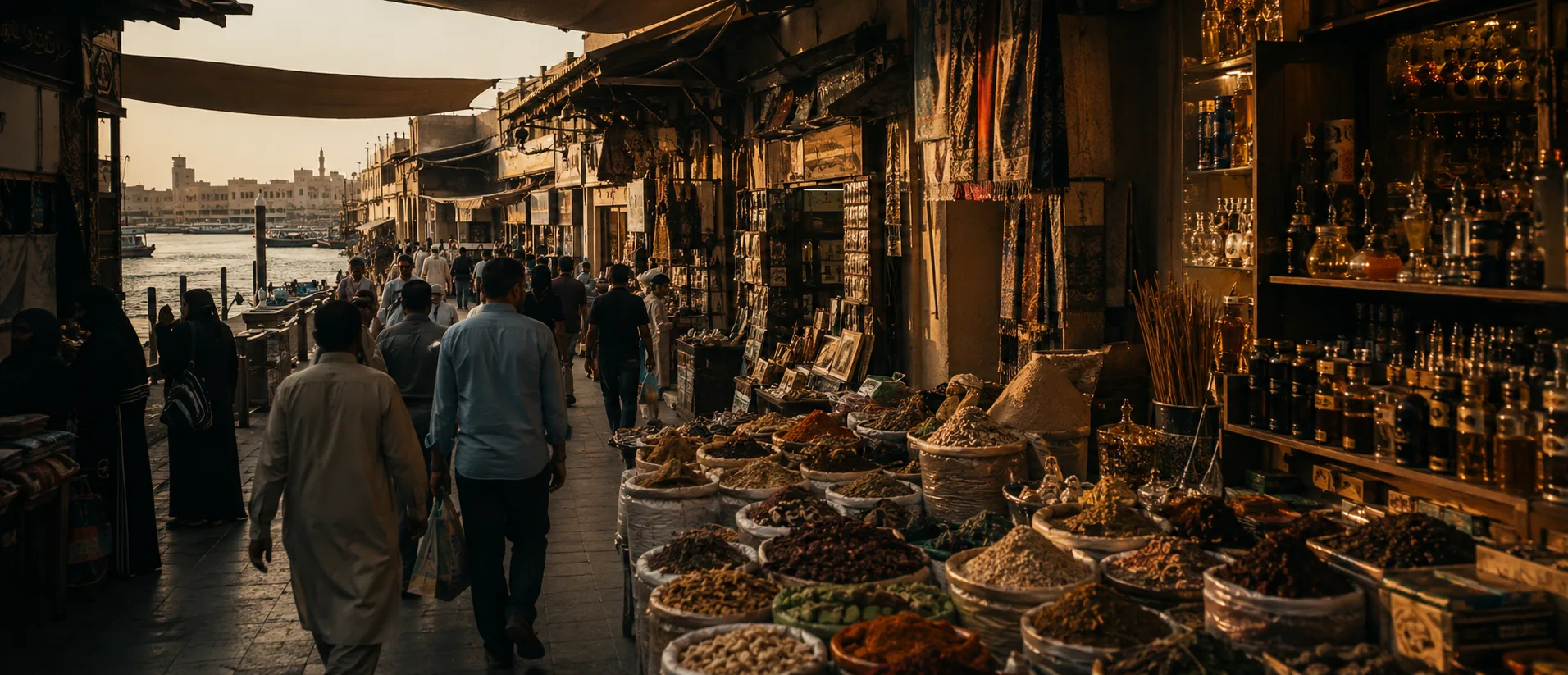
Ask what to buy in Dubai and the answers often arrive quickly: gold, perfume, chocolate, designer fashion, electronics.
None of those answers is wrong.
But when I want to bring something home from a place, I usually look for the object that will make me remember where I was. A smell. A spice. A small coffee cup. A perfume mixed while I wait. Something that carries more than a shopping bag.
Dubai is very good at showing you what is new. To understand what else it can offer, sometimes you have to leave the polished corridors and walk toward the Creek.
Start With Fragrance, Because Dubai Can Be Remembered With the Nose
Oud, bakhoor, musk, rose, amber and concentrated perfume oils are among the most satisfying things to explore in Dubai because fragrance here is not treated only as a cosmetic product. It belongs to homes, clothes, gatherings and hospitality.
In Deira’s Perfume Souk, the pleasure is not only choosing a bottle from a shelf. Many shops work with oils and accords, and the conversation can become part of the purchase. You can ask for something warmer, less sweet, woodier, cleaner or more floral and watch a scent take shape.
This is one of the things I enjoy most. A perfume becomes more personal when you have taken part in deciding what it should smell like. Even when the result is imperfect, it belongs to that afternoon, that shop and that conversation.
One useful question is simple: what exactly am I buying? Oud oil, an oud accord, bakhoor, perfume oil and eau de parfum are different products. Ask what is inside, where it was made and how the seller recommends using it.
Spices Are Small Enough for a Suitcase and Big Enough to Bring Back a Memory
The Spice Souk in Deira is one of those places where shopping begins before you touch anything. The air changes. Saffron, dried limes, herbs, teas, nuts and spice mixtures sit close together, and the scent reaches you before the labels do.
Visit Dubai describes the Spice Souk as a place for aromatic herbs, spices, teas, nuts, oils and saffron. For me, this is exactly the kind of shopping that makes sense while travelling. A small packet may later change the smell of an entire kitchen.
But I would not buy spices only because they are displayed in a Dubai souk. Ask the origin. Dubai has always been a trading city, so what you see may have travelled from Iran, India, Oman, Yemen, Morocco or much farther away. That does not make it less interesting. It simply makes the story more accurate.
Dried black lime, saffron, cardamom, spice blends and good tea are especially easy to carry. Buy quantities you will actually use. A beautiful ingredient forgotten in a cupboard is not much of a souvenir.
Textiles, Leather and Everyday Objects Can Be Better Than a Logo
Naif Souk and the older commercial streets of Deira are useful when you want clothing, fabrics, leather goods and practical items rather than a luxury-brand experience. Visit Dubai describes Naif as one of the city’s oldest bazaars, with more than a hundred shops and stalls.
I like objects that remain useful after the trip. A scarf, a simple tray, a small dallah-inspired object, incense equipment or a textile can stay in a home for years without needing the word Dubai printed across it.
There is one rule I would keep in mind: traditional-looking does not automatically mean locally made. If provenance matters to you, ask. The Gulf has been connected by trade for centuries, and today’s markets are international too.
Dates, Sweets and Food Gifts Are Often the Easiest to Share
Food is the souvenir that disappears, but sometimes that is exactly why I like it. Dates, local sweets, coffee, spice mixtures or a carefully chosen jar of honey can be opened with family instead of placed on a shelf.
If you buy dates, ask about the variety and origin rather than choosing only by packaging. If you buy honey, ask about floral source, country, harvest and traceability. A premium box tells you how something was presented. It does not necessarily tell you where it came from.
And if you discover something unusual while walking, taste it. One of the pleasures of old Dubai for me has been finding small things I would never have planned in an itinerary, including camel-milk ice cream. Not every memory needs to be important enough for a museum. Some are allowed to be simply delicious.
Cross the Creek Before You Decide What Old Dubai Means
There is a very simple way to change the scale of a day in Dubai: take an abra across the Creek.
Dubai’s Roads and Transport Authority currently lists the traditional crossings between Bur Dubai, Deira Old Souq, Dubai Old Souq and Al Sabkha at AED 1 per passenger on the classic routes. In a city famous for experiences that can cost almost anything, that small fare still carries you across one of its most historic spaces.
The journey is short. That is part of its charm. You sit close to the water, cross between two old commercial districts, step off, and continue walking.
If you want the more personal version of that walk, continue with Naif, Deira and the Dubai I Never Get Tired of Walking Through.
The Best Thing to Buy Is the Thing You Will Still Understand Later
A souvenir does not become meaningful because it is expensive. Sometimes the most memorable object is the cheapest thing in the bag.
Before buying, I like three questions: Where is it from? Who made or mixed it? Will I use it when I go home? Those questions quickly separate a meaningful purchase from an object bought because a guide told me I needed one.
Dubai can give you almost every kind of shopping experience, from a luxury boutique to a stall where the seller scoops spice from a sack. You do not have to choose one version of the city and reject the other.
The interesting part is moving between them.
“The best souvenir is not always the object that says where you went. Sometimes it is the object that makes you remember without saying anything.”
Meskaoui
Questions People Ask
Oud and perfume oils, bakhoor, spices, saffron, dried lime, textiles, dates, coffee-related objects and locally meaningful food gifts are good places to start. Ask about origin because not everything sold in Dubai is made in the UAE.
Deira is useful for the Perfume Souk, Spice Souk, Gold Souk and Naif area. Bur Dubai also has the Textile Souk. The Creek connects the historic commercial districts by abra.
Dubai RTA currently lists AED 1 per passenger for the motorised traditional abra on the Bur Dubai to Deira Old Souq and Dubai Old Souq to Al Sabkha routes. Fares can change, so check RTA before travelling.
Bargaining is common in many traditional souks, although not every shop or product works the same way. Be respectful, compare prices and ask questions before agreeing.