
Honey Academy · Oman & Discovery
Frankincense Honey:
The Omani Honey I Discovered Through a Local Beekeeper
I knew frankincense as incense. I did not know it could lead me to a honey that would stay in my memory, or to a beekeeper who would later become a trusted partner.
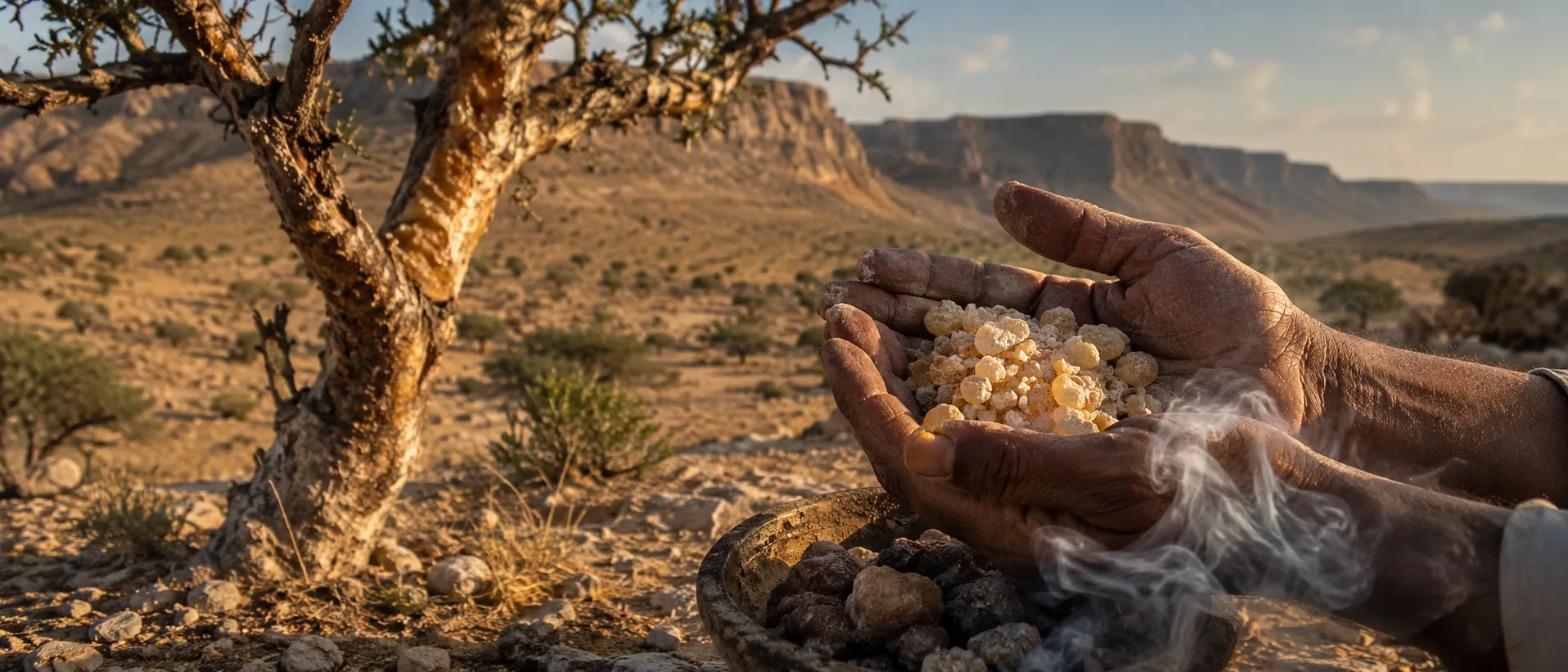
Some discoveries begin because you are searching for them.
This one did not.
I was speaking with a local Omani beekeeper whose beekeeping work is connected to the area around Nizwa. We were talking about honey, harvests and flavours.
Then he gave me something I had never tasted before.
Frankincense honey.
“The best discoveries often begin with someone saying: taste this.”
Meskaoui
I Knew Luban. I Did Not Know Luban Honey.
Frankincense is known in Arabic as luban.
In Oman, especially in Dhofar, frankincense has a history much larger than fragrance. But knowing the resin is one thing. Tasting honey associated with its flowering is another.
Experience Oman notes that in the Mugsayl area of Dhofar, frankincense trees flower and honeybees produce frankincense honey.
The First Spoon
I remember the flavour because it was different from what I expected.
It was not simply “sweet honey with incense flavour”. Honey does not work like that.
What interested me was its own character: something distinctive enough that I immediately wanted to understand where it came from.
I appreciated it from the first tasting.
Then He Gave Me Frankincense & Samar
The beekeeper made me taste another honey he described as Frankincense & Samar.
He explained it to me as a harvest connected to a period between floral phases, when the bees could work the available bloom across that transition.
I want to be precise: that is how this beekeeper described the harvest to me. Floral composition should ultimately be supported by traceability and, where needed, laboratory analysis.
In February 2026, Oman News Agency independently reported an Omani award for both frankincense honey and frankincense with Samar honey.
Rare Does Not Mean Magical
The beekeeper described Luban honey to me as rare and available in limited quantities.
A strongly characteristic harvest depends on flowering, bee movement, weather, colony strength and what else is blooming.
I prefer not to turn scarcity into mythology. A honey becomes interesting when rarity is accompanied by origin, harvest information, sensory identity and trustworthy people behind it.
Dhofar Gives the Honey Its Botanical Story
Frankincense is particularly associated with Dhofar in southern Oman.
Oman News Agency lists frankincense honey among notable honeys produced in Dhofar, alongside gum arabic, Sidr, flower and Samar honeys.
This matters because “frankincense honey” should refer to a real relationship between bees and frankincense bloom, not simply honey infused with resin after harvest.
A Conversation Became a Relationship
The most valuable part of this story did not end with the tasting.
I stayed in contact with the beekeeper. Over time, questions about harvests became discussions about origin, seasons and what was actually available.
Today, he has become a trusted partner.
That relationship matters to me because MESKI was never meant to be built by choosing anonymous jars from a catalogue. I want to understand the people behind what I offer and what I write about.
What Oman Keeps Teaching Me
One discovery leads to another.
Sidr leads to Samar. Frankincense resin leads to frankincense honey. A tasting leads to a beekeeper. A beekeeper becomes someone you trust.
The more I discover, the more I realise there is still something else I do not know.
How I Would Buy Frankincense Honey
I would ask simple questions. Where was it harvested? When? What was flowering? Is the honey naturally derived from bee forage, or has frankincense been added afterward? Can the producer explain the apiary and harvest?
The questions are not there to destroy the romance. They protect it.
Frankincense Honey in Oman
Frankincense honey is honey produced when bees forage on frankincense flowers. It should not be confused with ordinary honey to which frankincense resin or flavouring has been added.
Yes. Oman News Agency reported a 2026 international award for an Omani product described as frankincense with Samar honey. The precise floral profile of any individual jar still needs its own traceability.