
The House of Meski · Arabia Beyond the Postcard
The Arabia
We Rarely See
If the only images we keep are towers, dunes and luxury, we do not see less of Arabia. We see a different Arabia reduced to three photographs.
Arabia is easy to simplify.
A skyline.
A desert.
A camel.
A luxury hotel.
None of those images are false.
The problem begins when they become enough.
“A place becomes smaller when we allow its most famous image to replace everything else.”
Meskaoui
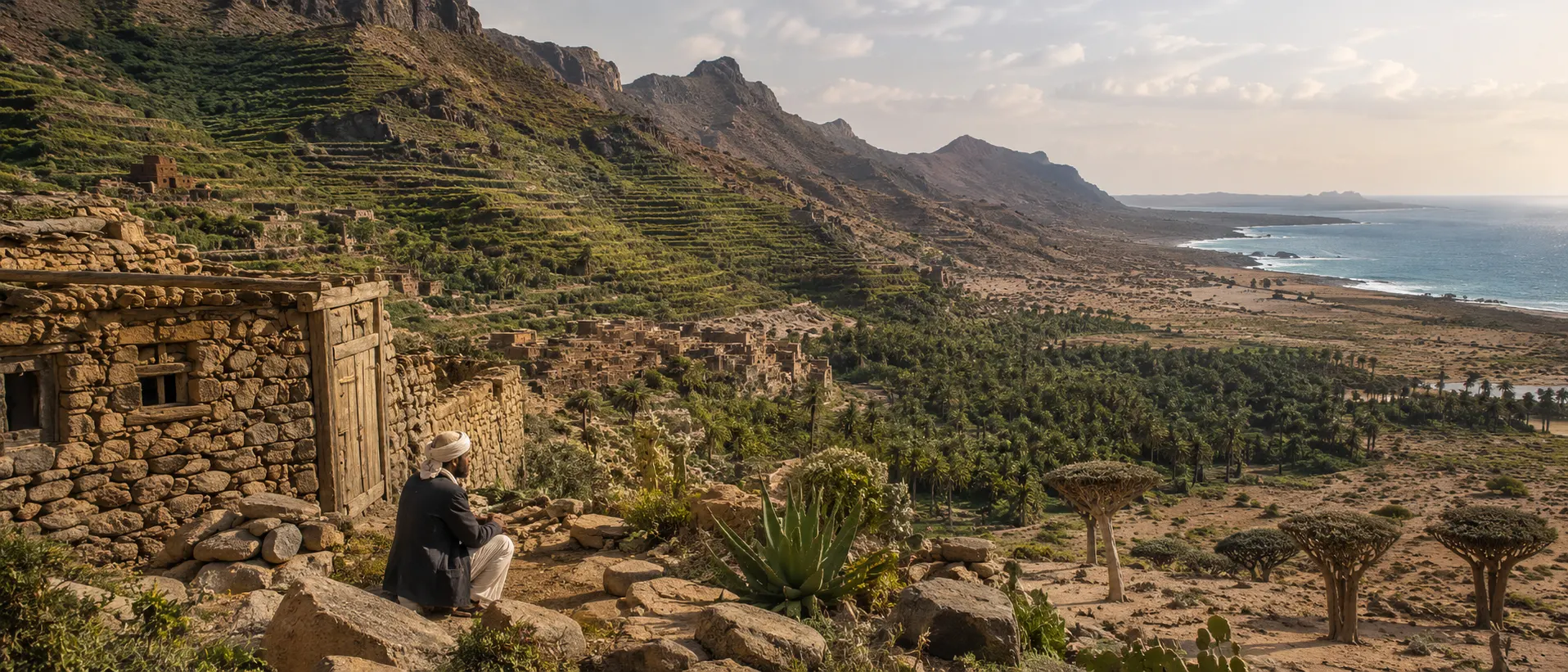
Start With Socotra
There is an island belonging to Yemen where more than a third of recorded plant species are endemic.
Dragon’s blood trees form canopies that look almost invented. A distinct Socotri language carries vocabulary shaped by pastoral life and the island’s environment.
That is Arabia too.
Not the Arabia of a desert advertising campaign.
An Indian Ocean Arabia.
Then Look at Yemen’s Mountains
Yemen can be hot and arid, but it can also be high, cultivated and green.
Terraces climb mountain slopes. Rainfall and altitude create agricultural zones where coffee, grains, fruit and vegetables have been grown for generations.
Old Sana’a rises at around 2,200 metres, its tower houses and gardens sitting inside a mountain landscape far removed from the flat desert stereotype.
When I discovered Yemeni mangoes in a UAE market, that small surprise was part of this bigger correction.
Oman Can Turn Green
Dhofar changes the picture again.
During khareef, seasonal moisture transforms parts of southern Oman. Mist hangs over hills and vegetation becomes intensely green.
Elsewhere, frankincense trees grow in landscapes tied to one of Arabia’s oldest trade stories.
Then Muscat gives you mountains dropping toward the sea instead of a wall of towers.
One peninsula, many geometries.
An Oasis Is Not Empty Desert With a Few Palms
This matters to me personally.
I come from Meski, where the presence of water changes everything.
An oasis is agriculture, shade, work, inheritance, routes, wells, irrigation and memory.
People unfamiliar with oasis life sometimes look at palms and see scenery.
Those who depend on them see systems.
The Old Ports Tell Another Story
Aden, Mocha, Julfar, Muscat and other ports remind us that Arabia was not sealed behind sand.
Boats moved toward India and East Africa. Merchants crossed the Red Sea. Coffee left Yemen. Frankincense travelled. Pearls moved out of Gulf waters and into global luxury markets.
Before modern airports made the region a hub, the sea had already done something similar on a different scale.
The Market Is Part of the Landscape
When I say landscape, I do not only mean mountains and coast.
I mean the human landscape too.
A spice shop in Deira.
A perfume seller blending something you did not plan to buy.
A carton of Yemeni mangoes.
A Qatari souq after iftar.
An Omani market before Eid.
These places teach through repetition rather than explanation.
Modern Arabia Is Real Too
I do not want to create the opposite stereotype where everything old is noble and everything modern is shallow.
I enjoy Gulf malls. I enjoy modern architecture. I enjoy the comfort, restaurants, roads, airports and extraordinary ambition of cities like Dubai and Doha.
The point is not to choose.
The point is to refuse amnesia.
A mall can be part of life without making the souq irrelevant.
A skyscraper can be admired without pretending the creek began yesterday.
The Arabia I Want to Keep Discovering
The more I learn, the less interested I become in saying “I know the Gulf” or “I know Arabia”.
Every answer creates another place I had not considered.
A fruit leads to a valley.
A honey leads to an island.
A perfume leads to a trade route.
A dish leads to a migration.
That is why I keep looking.
Perhaps That Is the Point of The House of Meski
Not to become the final authority on everything Arab.
That would be impossible and arrogant.
But to keep opening doors carefully.
To document what we learn.
To distinguish memory from fact.
To distinguish admiration from proof.
And to remind ourselves that what is famous is not always what is most worth seeing.
Seeing Arabia Beyond Stereotypes
Large arid zones are central to its geography, but the Peninsula also contains high mountains, monsoon-influenced landscapes, oases, long coastlines, islands, agricultural valleys and dense cities.
Socotra demonstrates how biologically and culturally distinctive one part of Yemen can be. Its high endemism and unique Socotri language resist simple images of Arabia.
No. It argues for seeing modernity and older cultural landscapes together rather than treating one as proof that the other no longer matters.