
Ramadan & Gulf Traditions · Children & Memory
Hag Al Leila, Garangao & Qaranqasho:
Similar Joy, Different Nights
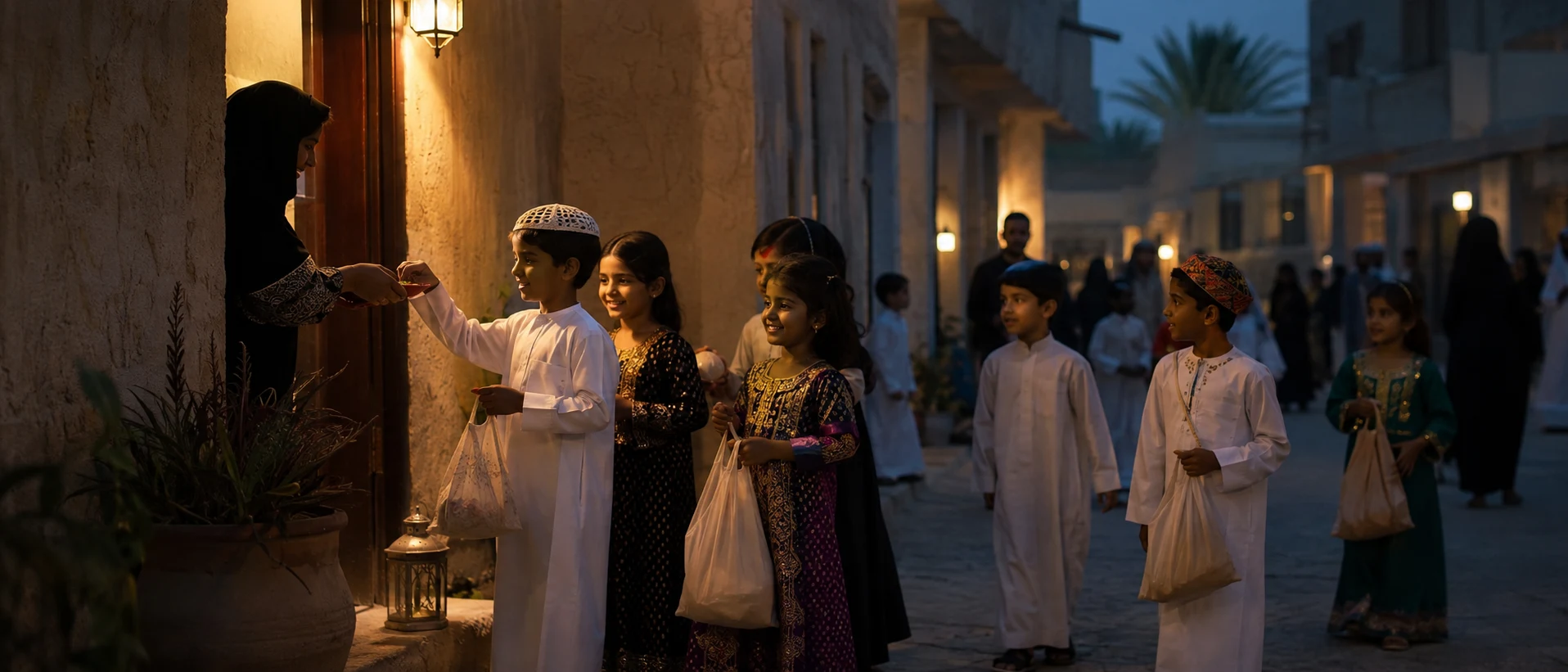
Children dress carefully, move from house to house, sing, knock, collect sweets and return home with bags that sound fuller than when they left. Across the Gulf, the scene feels related. The details are not identical.
At first glance, the traditions look like versions of the same memory.
Children. Traditional clothes. Neighbours. Songs. Sweets and nuts. Bags growing heavier from house to house.
But one of the most important things in cultural writing is knowing when similarity becomes oversimplification.
Hag Al Leila in the UAE, Garangao in Qatar and Qaranqasho in Oman belong to a recognisable Gulf family of children’s celebrations.
They are not one ceremony with three spellings.
“Traditions can resemble cousins: you recognise the family, but each one still carries its own name, timing and memory.”
Meskaoui
The Most Important Difference Comes First: The Date
In the UAE, Hag Al Leila is associated with the middle of Shaaban, the month before Ramadan.
The UAE Government describes Emirati children dressing in traditional clothes, visiting neighbouring homes, reciting songs and poems and receiving sweets and nuts in cloth bags.
In Qatar, Garangao is celebrated midway through Ramadan, on the 14th night according to Visit Qatar.
In Oman, Qaranqasho is also associated with the middle of Ramadan, and Oman News Agency describes children moving through neighbourhoods in groups, singing and receiving sweets, nuts, gifts or money.
So the visual resemblance is real.
The calendar is not the same.
Hag Al Leila in the UAE: Joy Before Ramadan Arrives
Hag Al Leila belongs to the approach of Ramadan.
That gives it a different emotional position.
It does not celebrate reaching the middle of the fasting month. It sits before Ramadan and forms part of the cultural preparation for the season.
Dubai’s Season of Wulfa now explicitly links Hag Al Leila, Ramadan and Eid as a continuous season of family and community traditions.
But government programming is only the modern public layer.
The older heart is much simpler: children, neighbourhood and giving.
Garangao in Qatar: The Sound of the Bag and the Door
Visit Qatar explains Garangao as a mid-Ramadan celebration especially prominent in Qatar.
Children wear traditional clothes, carry decorated bags and visit neighbourhood homes after sunset, singing as they collect nuts and sweets.
The name is often associated with the sound of things knocking together: sweets and nuts in a bag, or the knocking at a door.
I like that explanation because the tradition is almost audible before it is visible.
Qaranqasho in Oman: The Same Gulf Echo, an Omani Voice
Oman News Agency describes Qaranqasho as one of the popular customs children wait for in the middle of Ramadan.
They gather, move through neighbourhood lanes, wear Omani traditional clothing and sing inherited verses while households welcome them with sweets, nuts and sometimes money.
ONA also explicitly notes the related names used across the Gulf: Garangao in Qatar, Hag Al Leila in the UAE, Gergaoon in Bahrain, Girgian in Kuwait and Saudi Arabia, and Qaranqasho in Oman.
Different letters.
A recognisable social idea.
Why Children Matter So Much
These traditions are not interesting only because children receive sugar.
They teach movement through a community.
A child learns which doors are part of the neighbourhood, how to greet, how to sing something older than themselves, how to receive, how adults give, how clothing changes for an occasion.
Culture is being transmitted almost invisibly while everyone is having fun.
The Bag Is a Small Archive
I think about the bag.
At the beginning of the evening it is light.
Then each house adds something.
A sweet.
Nuts.
A small gift.
By the end, what the child carries is not only food. It is evidence that many households participated in the same night.
That is a beautiful social object.
Traditions Survive by Changing Shape
Today these celebrations also appear in museums, malls, schools, cultural centres and public festivals.
Some people worry that institutional celebrations make traditions artificial.
Sometimes they can.
But they can also help a child living in a very different urban environment encounter a custom that once depended on a closely connected neighbourhood.
The real question is not whether a tradition changes.
It is whether people still understand what they are carrying forward.
Different Names Are Part of the Treasure
I would not simplify all three into “Gulf trick-or-treating”.
The comparison might help someone understand the surface, but it removes the history, religious calendar, language and local songs that make the traditions themselves.
The names matter.
حق الليلة.
القرنقعوه.
القرنقشوه.
Keeping the names is part of keeping the memory.
Hag Al Leila, Garangao and Qaranqasho
They share similar elements such as children, neighbourhood visits, songs and sweets, but the timing differs. Hag Al Leila in the UAE is associated with mid-Shaaban before Ramadan, while Garangao in Qatar is celebrated midway through Ramadan.
Qaranqasho is an Omani mid-Ramadan children’s tradition involving traditional clothing, group visits through neighbourhoods, songs and gifts or sweets from households.
Related customs developed within different Gulf communities and languages or dialects, producing local names, songs, timings and forms. Similarity does not require identical practice.