
Arabian Lifestyle · Dubai & Memory
One Dirham
Across Dubai Creek
In a city famous for experiences that can cost almost anything, one of the journeys I enjoy most still costs one dirham.
Dubai can make you look upward.
Towers.
Glass.
Hotel lobbies.
Giant screens.
Architecture designed to stop you for a second and make you say, “How did they build that?”
I enjoy that Dubai.
But there is another journey I keep returning to.
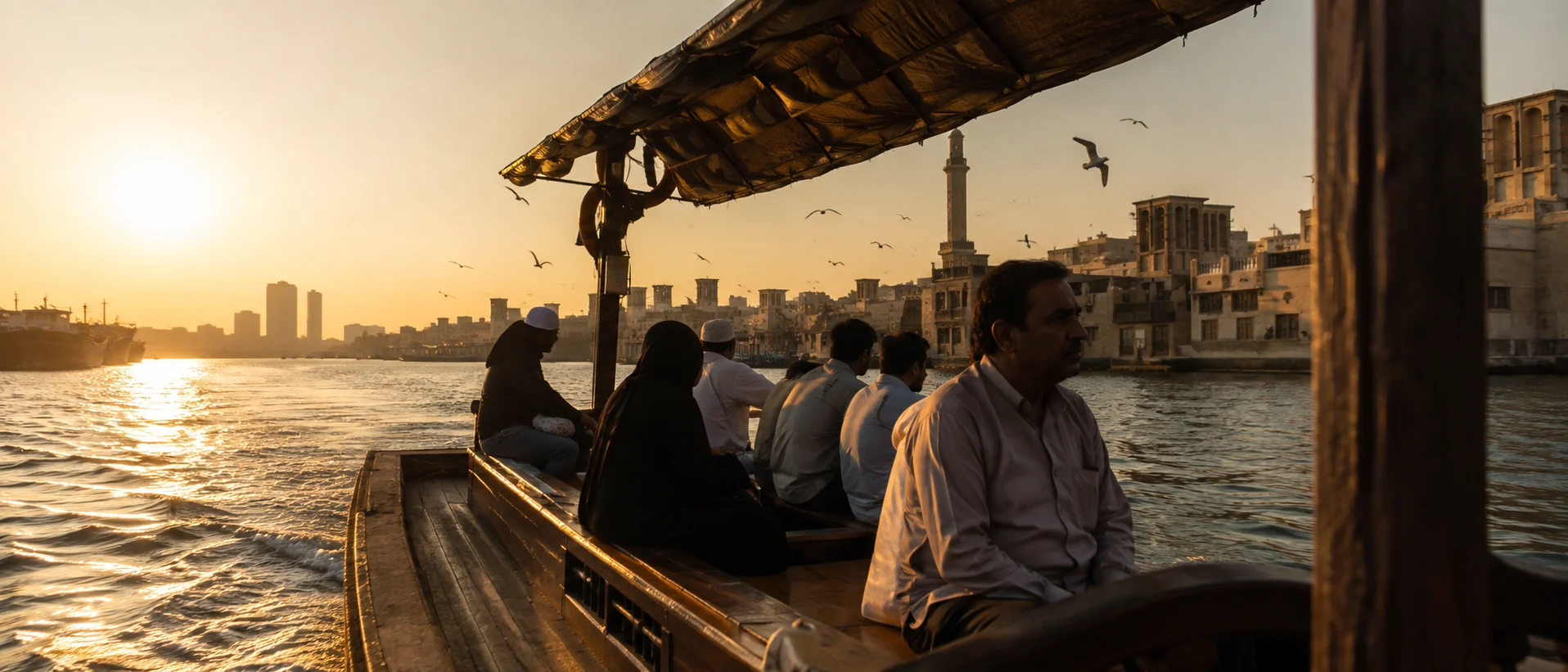
You sit low, almost at the level of the water.
The engine starts.
A small wooden abra moves away from the bank.
The towers are still there somewhere, but for a few minutes they are no longer the point.
The price is one dirham.
“Sometimes the cheapest ticket in a city takes you closest to its memory.”
Meskaoui
It Is Still Public Transport
The first thing I like about the abra is that it has not been turned entirely into theatre.
Dubai’s Roads and Transport Authority still operates motorised traditional abras between Bur Dubai, Deira Old Souq, Dubai Old Souq and Al Sabkha. On the classic routes, the fare remains AED 1 per passenger, paid in cash.
That detail changes the experience.
You are not boarding a luxury cruise built to imitate the old city. You are using a form of transport that still performs a simple function: getting people across the Creek.
A Few Minutes Between Two Dubais
The crossing is short.
That may be why it works so well.
You do not have enough time to become comfortable. The boat fills, people sit shoulder to shoulder, the water opens, the air changes, and before you have properly settled into the view, you are already approaching the other side.
For me, those few minutes create a transition.
I leave one rhythm and enter another.
Then I Walk
This is the part I love most.
Old Dubai is not a place I want to rush through with a checklist.
I like walking without knowing exactly which shop I will enter next.
One street gives you spices. Another gives you fabric. Then suddenly there are perfume shops, tiny restaurants, jewellery windows, people loading boxes, traders talking on phones, men carrying goods, tourists trying to orient themselves and residents who have no interest in your itinerary because they are simply going to work.
That mixture is important.
A real district should not exist only for the visitor.
The Smell Changes Before the Street Does
Sometimes I know I am approaching a certain kind of shop before I properly see it.
Spices have their own cloud.
Perfume shops have another.
Oud, musk, amber, rose, woods, smoke, oils. You enter and start smelling strips, bottles, raw materials and blends. In some shops, the interesting part is not choosing a perfume from a shelf. It is talking about what you like and letting someone build a scent around you.
I can spend a long time doing this.
It is shopping, yes. But it is also conversation.
Then There Is Food
I rarely walk for long in this part of Dubai without thinking about food.
Small traditional restaurants interest me more than polished menus that could belong to any international city.
I want rice, meat, bread, tea, something cooked the way the place recognises itself.
And sometimes something playful appears too, like camel milk ice cream. It is the kind of thing that makes me smile because it takes an ingredient strongly associated with the region and gives it a completely modern form.
Tradition does not always survive by staying unchanged.
Sometimes it survives because people keep finding new ways to enjoy it.
Why I Prefer This to a Perfect Itinerary
There are many guides telling you exactly what to photograph in Deira and Bur Dubai.
They are useful.
But if you follow them too carefully, you can miss the part I enjoy most: what happens between the landmarks.
A doorway.
A smell.
A shopkeeper explaining a perfume.
A restaurant you did not plan to enter.
A glass of tea.
A boat that costs less than almost anything else you will buy that day.
Dubai Did Not Begin With the Skyline
The Creek is also a useful correction to the idea that Dubai’s history begins with oil and towers.
Maritime trade, pearling and commerce were part of Dubai before the discovery of oil. Deira’s trading character did not appear because tourists wanted an “old Dubai experience”.
It existed because this was a commercial city before it became a global spectacle.
That history is one reason the abra feels so right here.
It crosses water, but it also crosses layers of the city.
One Dirham Is Not the Point
I like mentioning the price because it is almost absurd in modern Dubai.
But the one dirham is not what makes the experience valuable.
The value is contrast.
In the same city, you can spend an evening somewhere engineered to feel like the future, then the next morning hand over a coin, sit on a wooden boat and cross a waterway that helped shape the city long before the world knew its skyline.
I do not need to choose between those two Dubais.
I like that they both exist.
Dubai Creek Abra
RTA currently lists AED 1 per passenger for the classic motorised traditional abra routes between Bur Dubai, Deira Old Souq, Dubai Old Souq and Al Sabkha. Check RTA before travelling because fares and routes can change.
No. Traditional abras are part of Dubai’s public marine transport network. Visitors enjoy them, but the classic service still performs an everyday transport function across the Creek.
Deira and Bur Dubai reward slow walking. Souqs, perfume shops, spice traders, old commercial streets, creekside restaurants and small food stops are more interesting when you leave room for unplanned discoveries.