
Ramadan · Clothing & Arab Identity
The Qamis Across the Arab World:
One Spirit, Many Forms
The garment changes its name, collar, cut and details from one country to another. Yet across Ramadan streets, Friday prayers and family gatherings, something about it remains immediately familiar.
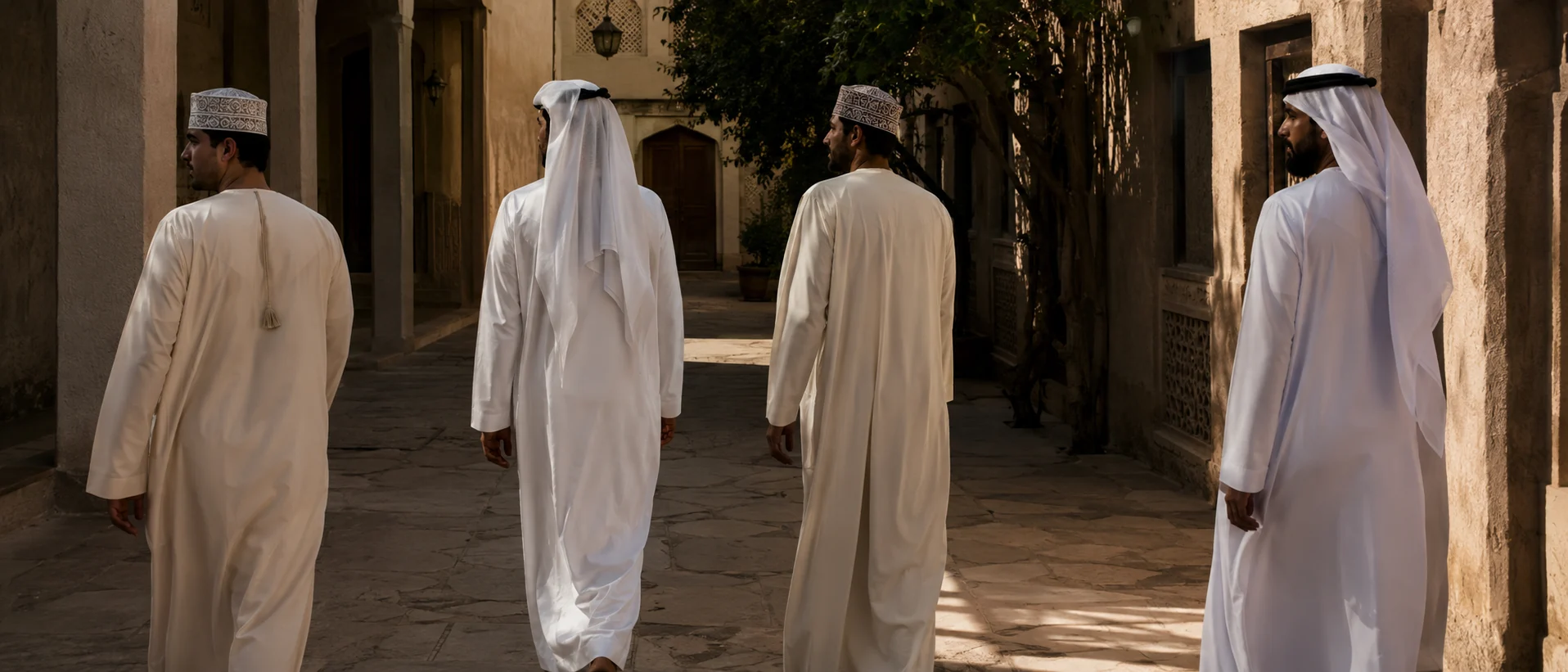
I have always been fascinated by these garments.
White. Cream. Sometimes coloured. With a collar. Without a collar. Simple. Embroidered. Narrower here. Wider somewhere else.
From Morocco to Egypt, Sudan, Qatar, Oman, Saudi Arabia and the UAE, the names change almost as quickly as the cuts.
And yes, I have collected quite a few.
Maybe one day I will have them all.
“Like the Arabic language, the garment keeps a familiar base while changing its accent from one country to another.”
Meskaoui
First: “Qamis” Is Not the Only Name
In French-speaking Muslim communities, qamis is often used as a broad word for a long men’s garment.
Travel across Arab countries and local vocabulary becomes more precise.
In Qatar and Saudi Arabia, thobe is widely used. In the UAE, kandura is common. In Oman, the traditional male garment is the dishdasha.
Egyptian galabeya and Sudanese jalabiya belong to related traditions of long dress but should not simply be treated as identical Gulf thobes under another name.
Oman Makes the Difference Easy to See
Omani dress has details that make it recognisable even before someone tells you the country.
Experience Oman explicitly identifies the dishdasha as traditional male attire.
The collar treatment, neckline, tassel detail and overall cut distinguish it from common Gulf thobes and Emirati kanduras.
Qatar: The Thobe as Everyday Elegance
In Qatar, the white thobe is part of the everyday visual landscape.
Visit Qatar even offers cultural sessions explaining why the thobe is white and how traditional clothing fits into Qatari social life.
The important word for me is everyday. The garment does not need a festival to appear legitimate. It belongs.
Why Ramadan Makes Me Notice It More
This part is personal observation.
During Ramadan, I notice traditional dress more intensely across Arab countries.
Freshly washed. Carefully ironed. White garments moving through streets toward prayer, family visits, iftar or ordinary errands.
Not every man wears one. Not every country uses it in the same way. But during Ramadan, the garment often seems to become even more visible in public life.
Friday, Ramadan and the Pleasure of Dressing Properly
There is also something I like about the care.
The garment can be extremely simple, yet simplicity demands precision.
Clean fabric. A straight line. A good iron. The right length.
The result is not necessarily luxury. It is dignity through presentation.
From Morocco to the Gulf, the Family Resemblance Changes
Morocco complicates the story in a useful way.
The djellaba, gandoura and jabador belong to different North African clothing traditions and should not be collapsed into the Gulf thobe.
Yet I still feel a broader visual and cultural relationship in modest long dress, especially around religious and family occasions.
The spirit can feel related even when the garment is technically different.
Language Works the Same Way
A Moroccan, an Egyptian, an Omani and a Qatari do not pronounce everything the same way. They do not always choose the same words.
Yet beneath those differences is a shared language.
Clothing can carry the same paradox.
I Have More Than One, Of Course
I like the differences enough that I have garments from several places and in several forms.
Some have collars. Some do not. Some are deliberately plain. Others carry embroidery or a detail that immediately changes the character.
And yes, there is always another one I do not have yet.
The Difference Is Visual. The Meaning Can Still Meet.
What fascinates me is that none of these differences prevent recognition.
The cut changes. The name changes. The pronunciation changes.
People still understand one another.
That may be one of the quiet beauties of the Arab world.
Qamis, Thobe, Kandura and Dishdasha
The words can overlap in informal usage, especially outside the Arab world, but local terminology differs. “Thobe” is common in countries including Qatar and Saudi Arabia, while other countries use names such as kandura or dishdasha.
Patterns vary by country and individual. Meskaoui’s repeated observation is that traditional men’s dress becomes especially visible around Ramadan, Friday prayers and family occasions. This is not presented as a fixed rule.