
Qatar · Sea, Labour & Memory
Qatar Before Gas:
The Men Who Dived for Pearls
Today the pearl is polished, displayed and remembered as heritage. Before it reached a necklace, someone had to descend into the Gulf and search for it with his own breath.
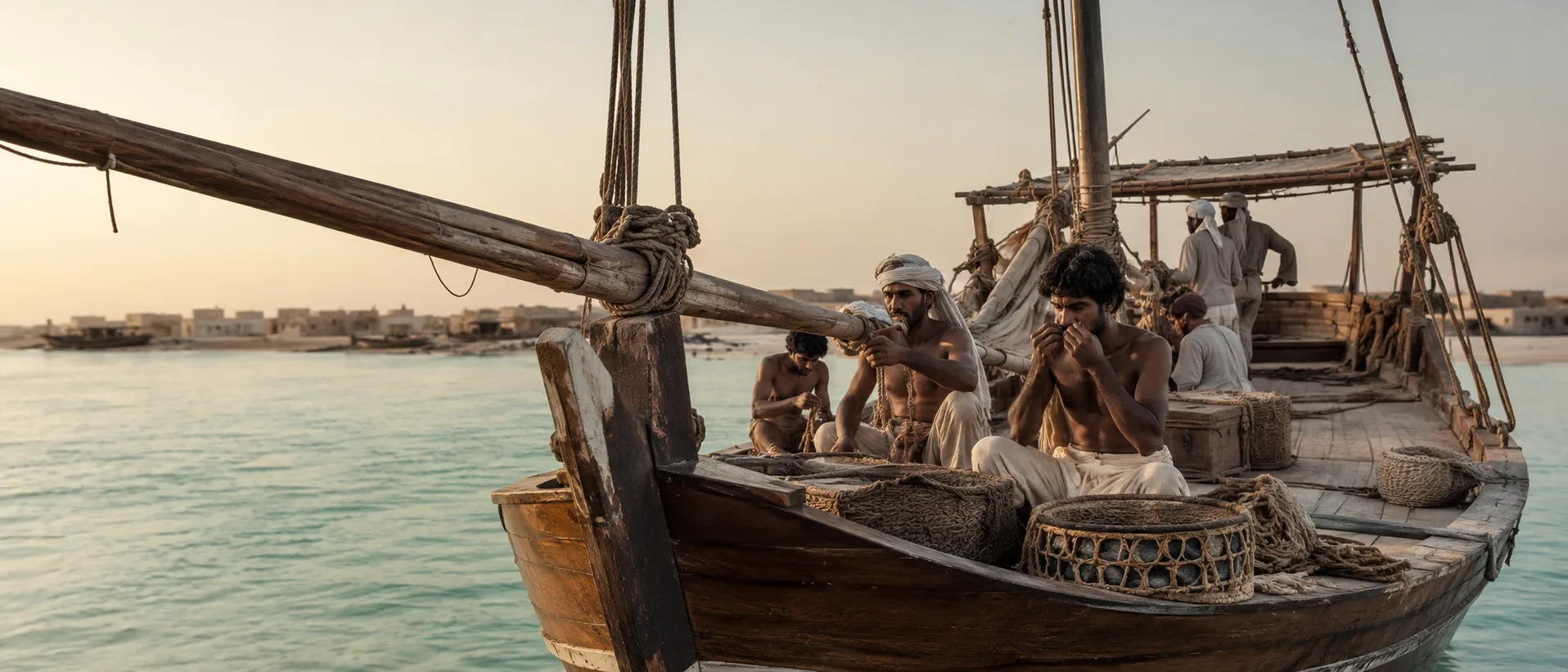
When people speak about Qatar today, the vocabulary is modern.
Gas. Aviation. Architecture. Sport. Doha.
But there was another Qatar whose calendar was tied to the sea.
In summer, men left home aboard wooden dhows and went looking for something small enough to disappear inside a closed hand.
A natural pearl.
“Before a pearl became an object of beauty, it was first an act of endurance.”
Meskaoui
The Sea Was Work
Visit Qatar describes pearling expeditions as physically demanding and dangerous journeys that could keep crews at sea for months.
Divers worked with extremely simple equipment: ropes, weights and baskets.
There was no romantic distance between the worker and the sea. The sea was where income might be found, and where injury or death could also wait.
Going Down on One Breath
The natural pearl sits inside an oyster. The diver’s task was to reach the oyster beds, gather shells and return to the surface.
Visit Qatar notes dives to dangerous depths, sometimes around 30 metres.
That number feels different when you imagine descending without modern scuba equipment, then doing it repeatedly during a working season.
Most Shells Did Not Contain the Treasure
Natural pearling was uncertain by nature.
Only a tiny proportion of shells yielded pearls of value. A beautiful pearl does not show you all the empty shells opened before it.
That invisible labour is part of the object too.
Pearls Connected Qatar to the World
The trade did not end at the Qatari coast.
Pearls moved toward markets in India, Persia, the Ottoman world and beyond.
This is another reminder that the Gulf before hydrocarbons was not isolated. Ports, sailors, merchants and buyers connected local labour to international demand.
A Seasonal Life
Pearling shaped more than employment.
When men left for long periods, families remained on shore carrying another part of the burden.
The rhythm of departure and return entered songs, stories and collective memory.
Then the Economy Changed
The pearling economy eventually declined under several pressures, including the rise of cultured pearls and wider economic change.
Hydrocarbon wealth later transformed Qatar on a scale the old pearling communities could hardly have imagined.
The contrast is dramatic, but it should not tempt us into treating the earlier life as empty.
Why This Story Matters in Modern Doha
The modern skyline can make history look small. But the sea is still there.
Dhows are still visible. Pearling appears in museums, festivals, architecture and national symbolism.
When you know the labour behind the pearl, those references stop being decorative.
I Would Rather Remember the Diver Than Only the Jewel
The pearl is easy to admire. The diver requires imagination.
You have to reconstruct the heat, salt, repeated descents, uncertainty and distance from home.
That is the history I want to keep visible, because a comfortable present becomes more meaningful when we know what came before it.
Qatar’s Pearl Diving Heritage
Yes. Pearling was a major source of income and a defining part of Qatar’s maritime economy before the modern hydrocarbon era.