
In Meski, Nbeg was a thorny shrub, a tiny fruit and part of childhood long before it became Ziziphus lotus in my notes.
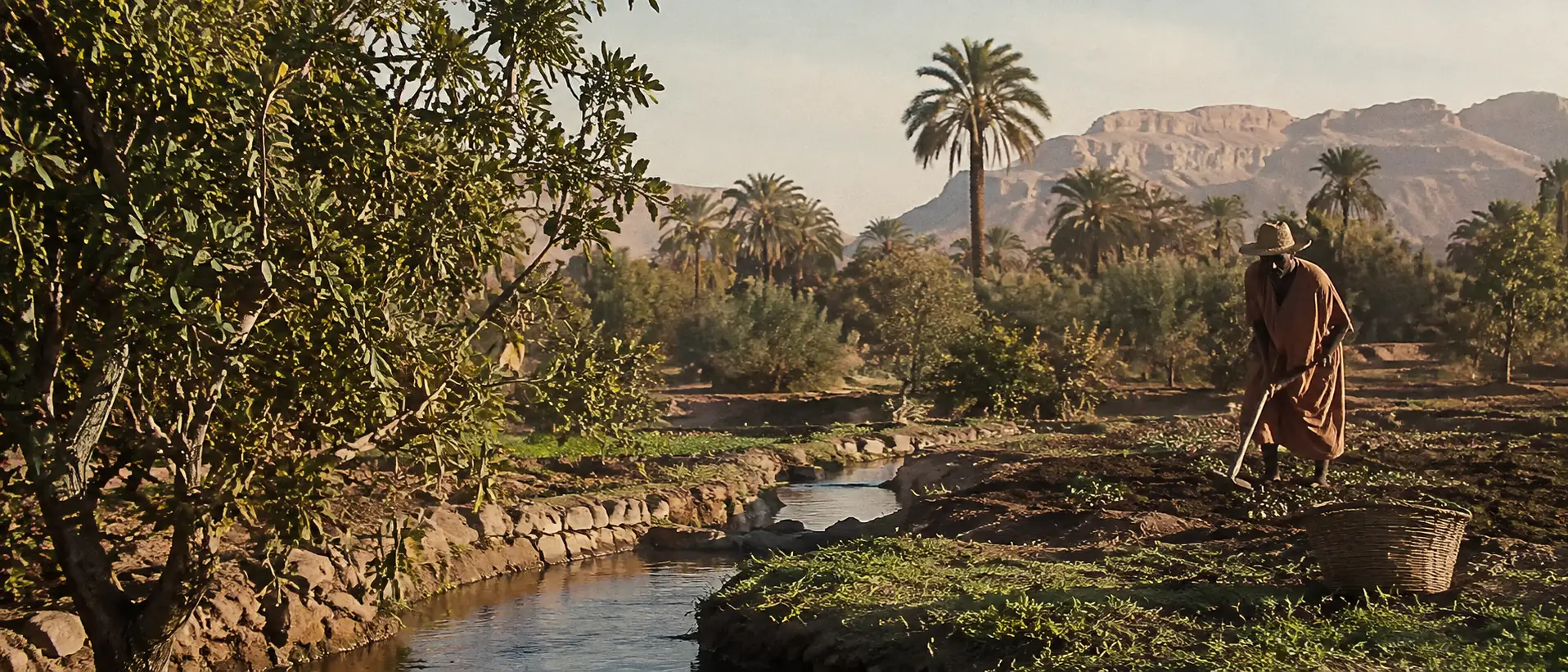
Africa changed this investigation because the plant stopped being only something I found in papers. Around Errachidia and Ksar Meski, I knew Nbeg before I knew Ziziphus lotus. I knew the thorns, the small fruit and the dry land where the shrubs survived. Only much later, while following Sidr honey from country to country, did I realise that something from childhood belonged inside a much larger botanical story stretching across Morocco, Algeria, Tunisia, Egypt, Sudan and the Sahel.
Part 1 followed Sidr through Arabia and Asia. This page moves across Africa. Part 3 will continue into Europe and the Mediterranean.
In Africa, the Botany Came Back Home
Part 1 was dominated by Ziziphus spina-christi across much of Arabia. North Africa brings Ziziphus lotus much more clearly into the centre.
Kew records Ziziphus lotus across a wide Mediterranean and dryland range that includes Morocco, Algeria, Tunisia, Libya, Egypt, Mauritania, Mali, Niger and Western Sahara, while extending beyond Africa as well.
The plant does not stop at a border because a map changed colour. Climate, altitude and water shift gradually. Languages and market names can change much faster.
That is where Sidr, jujube, Nbeg and local names begin to overlap. Commercial English may call a Moroccan jar “Sidr honey” because international buyers recognise Sidr. Scientific papers may call the same floral category Ziziphus lotus honey. Neither vocabulary should erase the other, but they should not be treated as identical without explanation.
For me, Africa is where the series stops being a journey away from home and suddenly comes back to it.
“Before I knew the name Ziziphus lotus, I knew the thorns, the tiny fruit and the place where it grew.”
Meskaoui
Morocco: This Is the Jujube I Can Place on a Map
Morocco is where geography becomes impossible for me to discuss from a distance.
The country contains Mediterranean and Atlantic coasts, mountain chains, plateaus, dry interior valleys, pre-Saharan zones and Saharan environments. Even within one country, a jujube shrub near the Middle Atlas does not live through the same year as one farther southeast.
Scientific work gives us unusually solid evidence for Moroccan jujube honey. Studies from the Middle Atlas have characterised monofloral honeys in which Ziziphus lotus pollen was dominant, and later work focused specifically on authenticating Ziziphus lotus honey through pollen, physicochemical and mineral analysis.
That means we can say something precise: genuine monofloral Ziziphus lotus honey is documented in Morocco.
What we cannot say is that every jar called “Moroccan Sidr” has automatically proved that botanical origin. A real category can still contain weak labels, mixtures or origin claims that need better traceability.
Before It Was Ziziphus lotus, It Was Nbeg
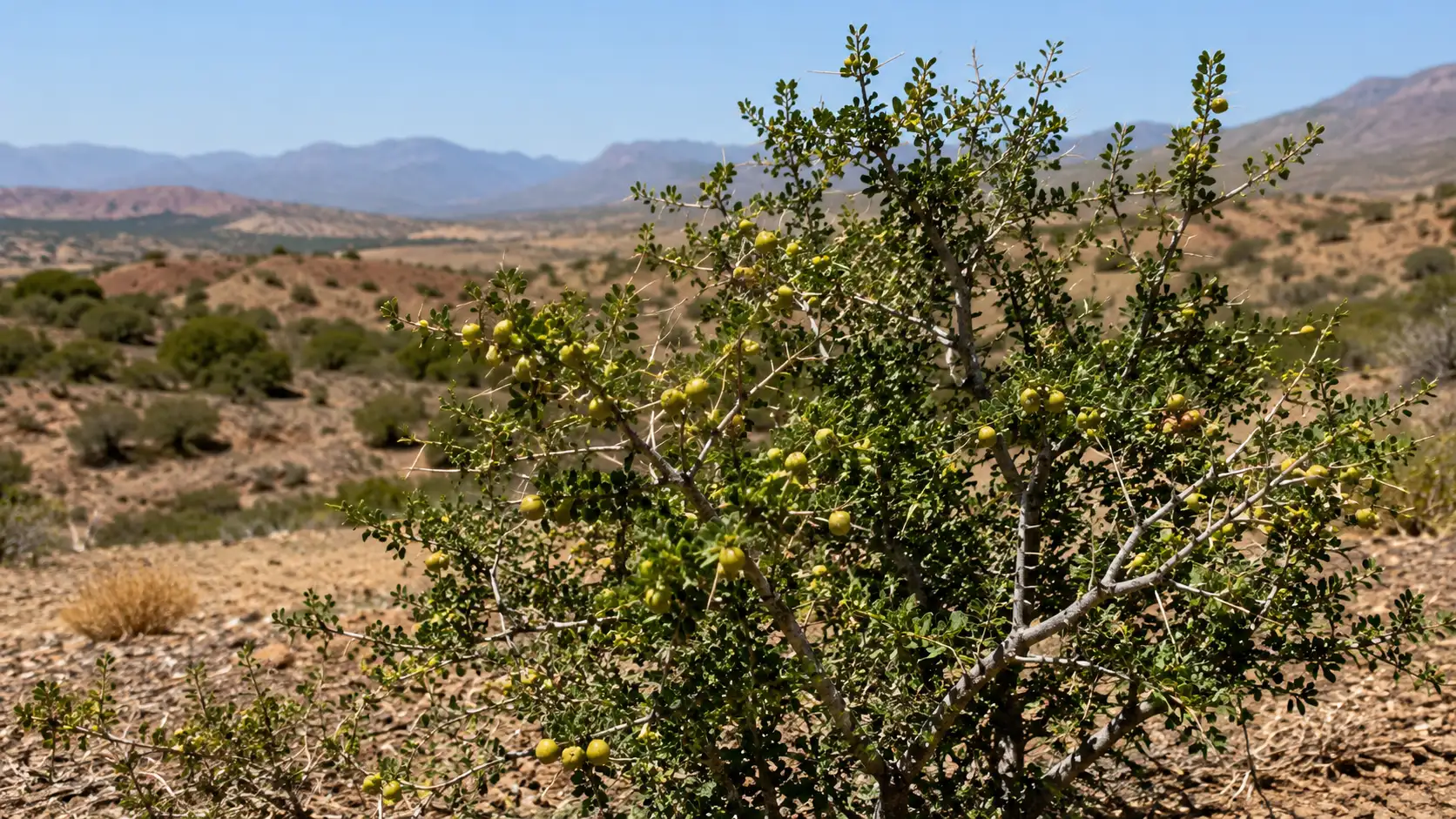
Around Errachidia and Ksar Meski, the wild jujube I remember was not a tall orchard tree.
It was a low, thorny shrub, sometimes around human height or lower, rough and old-looking in the dry landscape. The fruit was small, smaller than the cultivated jujubes people may picture today, and collecting it was never especially friendly to the hands because of the thorns.
As a child, I did not need a Latin name for it. It was Nbeg. You ate it because it was there, like dates and lben belonged to another part of the same world.
Years later, reading the botany changes the memory without replacing it. Ziziphus lotus helps me understand the plant scientifically, but the scientific name does not tell you what it felt like to know it as part of ordinary life.
I have also watched some of these wild shrubs become less visible around places I know. That is a personal observation, not a national survey. Still, it changes the way I read a honey label. If the plant disappears from a landscape, no amount of marketing can keep its floral origin alive.
This is why terroir is not a luxury word for me. In honey, terroir begins with the simple question: is the plant still there?
Algeria: The Science Becomes Harder to Ignore
Algeria makes the African part of this dossier easier to document.
Several studies have examined Algerian monofloral honeys, and Ziziphus lotus appears repeatedly among the country’s recognised botanical origins. Research comparing botanical origin and physicochemical characteristics has included multiple Algerian Ziziphus lotus samples. Other work on Algerian honey notes that Ziziphus is among the country’s better-studied monofloral honey types.
The geography helps explain why.
Northern Algeria faces the Mediterranean. Move south and the climate becomes progressively drier until the Sahara dominates. Between those extremes sit steppe landscapes, high plateaus, wadis and semi-arid zones where drought-adapted shrubs and trees become important.
Ziziphus lotus fits that world.
So when we see Algerian jujube honey or Algerian Sidr honey, there is a genuine botanical and apicultural basis for taking the category seriously. The same caution still applies: a category can be real while an individual jar can be poorly labelled, blended or impossible to trace.
Authenticity is never proved by the existence of the category alone.
Tunisia: A Smaller Honey Story, but a Real One
Tunisia is useful because it prevents us from treating Morocco and Algeria as isolated cases.
A 2022 study examining Tunisian honeys found one sample that met the study’s criteria for monofloral Ziziphus lotus honey, while the other samples were multifloral. That is a modest finding, but modest findings are often more useful than exaggerated claims.
It tells us that Tunisian jujube honey is not simply a theoretical product because the plant grows there. At least within the studied samples, a monofloral Ziziphus honey was identified.
It does not tell us that jujube is Tunisia’s dominant honey, that it is produced everywhere, or that every Tunisian beekeeper recognises it as a major category.
This is exactly the level of precision I want for The House of Meski.
Sometimes the correct sentence is smaller.
North Africa Is Not One Climate
Putting Morocco, Algeria and Tunisia under one heading can make the region look more uniform than it is.
Coastal Mediterranean zones receive winter rainfall. Mountain areas introduce altitude, cold and local moisture. Inland steppes become drier. Saharan margins can be brutally arid. River valleys and irrigated agriculture create another set of flowering opportunities again.
The jujube survives across parts of this gradient because different Ziziphus taxa are well adapted to dry environments. But survival is not the same thing as producing a commercial honey crop every year.
For bees, the key question is flowering abundance.
A shrub can be botanically present and still contribute little to a particular harvest. A strong flowering after favourable weather can change the opposite season completely. Nearby thyme, euphorbia, citrus, rosemary, acacia and cultivated plants can also enter the pollen and nectar picture depending on region.
This is why the future Honey & Climate articles will be useful. “Moroccan honey” and “Algerian honey” are too broad. Even “jujube honey” needs a place and a year beside it.
Egypt and Sudan: Where Ziziphus spina-christi Returns
Move east and south and another species comes back into focus.
Ziziphus spina-christi, the species so important to the Arabian Sidr story, is native in Egypt and Sudan as well. Ethnobotanical literature describes the tree’s long presence in northeastern Africa, and honey studies from the region include Ziziphus spina-christi as a floral source.
This matters because our three-part map is not a neat diagram where Arabia equals one species and Africa equals another.
Nature is messier.
Ziziphus lotus is important across North Africa and the Mediterranean. Ziziphus spina-christi occupies a huge belt through northeastern Africa and Arabia. Their ranges can approach or overlap within the broader region. Other Ziziphus species extend south into the Sahel and tropical drylands.
A continent heading is useful for reading.
It is not a botanical border.
The Sahel: Jujube Beyond the Mediterranean Story
If we continue south of the Sahara, the genus does not disappear.
Ziziphus mauritiana has a native range stretching across the African Sahara and Sahel to East Africa, then eastward through southern Iran and South Asia to Australia. Kew describes it as a tree of seasonally dry tropical biomes.
That distribution is extraordinary.
It also reminds us not to make North African Sidr vocabulary the language for the entire continent. In West Africa and the Sahel, local names, fruit uses and plant relationships can be completely different. Honey may be produced from landscapes containing jujube without being marketed internationally as “Sidr honey”.
This is one of the limits of researching honey only through the international market.
Search engines show us the words people type. They do not automatically show us the words a beekeeper in rural Mali, Niger or Senegal uses for the same plant.
So for those regions, I would rather expand this guide later with local sources than pretend the international honey market already tells the whole story.
Morocco and Algeria Share a Species, Not a Single Terroir
Morocco and Algeria give us a particularly useful comparison because Ziziphus lotus honey is documented in both countries.
That could tempt us to treat them as two versions of the same product.
Again, the map refuses to be that simple.
The Middle Atlas samples studied in Morocco belong to a particular mountain and plateau environment. Algerian Ziziphus honeys have been sampled from different western and inland locations, including dry steppe environments. The plant name can match while altitude, rainfall, soils and surrounding flora change.
Even within one country, the category is wider than a single taste.
This is the point at which the idea of terroir becomes useful without becoming romantic. Terroir does not mean that the honey magically absorbs the soul of a landscape. It means the plant grows under specific conditions, alongside specific vegetation, in a specific season, and the bees work inside that reality.
A botanical name tells us what flower mattered.
A region begins to tell us how that flower lived.
What Pollen Analysis Can Tell Us, and What It Cannot
Several of the African studies in this article use melissopalynology, the analysis of pollen grains found in honey.
It is an important tool because pollen can reveal which plant taxa were present in the bees’ foraging environment and help support a claimed floral origin. In the Moroccan Middle Atlas work, the dominance of Ziziphus lotus pollen was a major part of identifying the honeys.
But even this needs context.
Different plants do not contribute pollen to honey in identical proportions. Nectar and pollen are not the same thing. Processing can affect what remains in a sample. That is why strong authentication increasingly combines pollen with sensory observations, physicochemical measurements and, in some research, chemical markers.
For me, the useful lesson is simple.
Analysis should make the origin clearer, not make the conversation sound more complicated than it needs to be.
Sidr, Jujube, Nbeg, Nabq, Ber: I Do Not Want One Name to Erase the Others
I do not think one name should win.
A global article needs shared vocabulary, otherwise nobody finds anything. That is why Sidr honey and jujube honey appear throughout this dossier.
But a local name is part of origin too. Nbeg belongs naturally in my Moroccan memory. Ber makes cultural sense in South Asia. Arabic speakers may use Sidr or Nabq differently according to context and region. Scientific analysis may then identify Ziziphus lotus, Ziziphus spina-christi or another species.
Translation should connect these layers, not flatten them.
If every jujube honey in the world is renamed Sidr for export, we gain one easy keyword and lose half the story.
Why the Latin name matters here
Botanical names are not included to make honey sound more scientific. They are useful because common names travel. “Sidr”, “jujube”, “ber” and related terms can overlap without being exact equivalents. A verified species name helps separate marketing vocabulary from botanical origin.
Does Moroccan Sidr Taste Like Yemeni Sidr?
This is one of the questions a global guide naturally creates.
The answer is that they should not be expected to taste identical.
Much Yemeni Sidr is associated with Ziziphus spina-christi. Documented Moroccan jujube honey from the Middle Atlas is associated with Ziziphus lotus. That botanical difference alone is enough to make a direct “same honey, different country” comparison too simple.
Then add climate.
Add soil.
Add altitude.
Add surrounding flora and harvest timing.
The better tasting question is not “which one is the real Sidr?” It is “what does each origin taste like when the honey is genuine and well handled?”
That question leaves room for both.
What Does African Jujube Honey Actually Taste Like?
This is where I want to resist another shortcut.
Once a honey becomes associated with a famous plant, tasting notes begin to repeat themselves online. Dark. Caramel. Woody. Medicinal. Strong. Sometimes those words are useful. Sometimes one description is simply copied until it starts sounding like a rule.
I would rather treat flavour as part of the harvest, not as a botanical password.
A Moroccan Ziziphus lotus honey can differ from an Algerian one. Two Moroccan harvests can differ from each other. Moisture, storage, the strength of the target flowering, the proportion of accompanying flora and the time of extraction all matter. Even sensory studies work with samples, not with an eternal flavour profile that every future jar must reproduce.
This matters for authenticity too. A honey should not be rejected simply because it is lighter, darker, softer or more aromatic than a description found online.
Taste can raise a question.
It cannot identify the tree by itself.
From the Mediterranean to the Sahara, Water Changes the Meaning of “Dry”
There is a tendency to describe all of this as desert honey.
That phrase is too easy.
A dry Mediterranean hillside, a Middle Atlas valley, a high plateau in Algeria and a Saharan margin can all experience water scarcity, but they do not receive water in the same way or at the same time. Winter rain can wake one landscape. Snow and mountain runoff influence another. A wadi may stay empty for months and then briefly reorganise the vegetation around it. Irrigated orchards can create flowering islands beside land that looks almost bare.
For a jujube shrub, these differences influence growth and flowering.
For a beekeeper, they influence decisions.
Where should the colonies be placed? Is the jujube bloom strong enough this year? What is flowering before it? What will flower after it? Is there enough water nearby for the colonies during the heat?
This is why climate belongs in a honey article even when the jar never mentions it.
The climate is already inside the jar.
Africa Taught Me That a Familiar Tree Can Still Make Many Honeys
Part 1 began with a word. Africa brought me back to a plant I had known before I knew its botanical name.
Morocco gives us well-characterised Ziziphus lotus honey and, for me, the memory of Nbeg around Meski. Algeria gives repeated scientific documentation of the same floral origin. Tunisia adds a smaller but real monofloral example. Egypt and Sudan remind us that Ziziphus spina-christi is African as well as Arabian. The Sahel brings Ziziphus mauritiana into a wider dry-tropical story.
One genus crosses these places. One familiar family of trees connects them.
The honey still does not become one product.
That may be the most useful lesson in Part 2. A botanical relationship is not a passport, and a common name is not a terroir.
Part 3 takes that problem into Europe. Spain has genuine native Ziziphus lotus. Greece has it too. Then a jar sold as “Greek Sidr” led me to Paliurus spina-christi, another genus entirely, and made me question how far a successful honey name can travel before it starts hiding more than it reveals.
اللهم بارك لأهل الأرض في زرعهم ومائهم ورزقهم، واجعل فيما تنتجه الأرض خيراً ونفعاً.
Frequently Asked Questions About Jujube Honey in Africa
Not necessarily. The wild jujube documented in Morocco and strongly represented in Moroccan monofloral honey research is Ziziphus lotus. Yemeni Sidr honey is strongly associated with Ziziphus spina-christi. They belong to the same genus but are different species.
Because Sidr is a powerful cultural and commercial common name, while local naming and export vocabulary do not always follow botanical species boundaries. The best label adds the actual plant, region and harvest details instead of relying on the shared word alone.
Yes. Algerian Ziziphus lotus honey has been investigated in several scientific studies, and Ziziphus is among the better documented monofloral honey origins in Algeria.
There is scientific evidence for it. A study of Tunisian honeys identified a monofloral Ziziphus lotus sample. That supports the existence of the floral type without implying that it is produced everywhere or dominates Tunisian honey production.
Yes. Its native range extends widely through Africa, including northeastern African countries, and continues across the Arabian Peninsula to Pakistan. Sidr should therefore not be described as an Arabian tree only.
Sidr is a familiar Arabic and international market term for jujube or lote-tree honey, so sellers may use it for honey from Ziziphus species outside the Arabian Peninsula. The name is understandable, but the exact species should still be checked when botanical precision matters.
It is typically a thorny shrub or small tree adapted to dry conditions. In southeastern Morocco, Meskaoui remembers wild Nbeg as low, thorny shrubs with small fruit. That memory is personal, while botanical descriptions and regional studies independently document Ziziphus lotus across North African drylands.
Sources & Further Reading
Royal Botanic Gardens, Kew, Plants of the World Online: Ziziphus lotus
Royal Botanic Gardens, Kew: Ziziphus lotus subsp. saharae
Royal Botanic Gardens, Kew: Ziziphus mauritiana
Bouddine et al., Organic Honey from the Middle Atlas of Morocco
Bouddine et al., Authentication of Ziziphus lotus honey from the Middle Atlas Mountains of Morocco
Harbane et al., botanical origin and physicochemical characteristics of Algerian honey
Nakib et al., monofloral honey types from Algeria
Dafni et al., ethnobotany of Christ’s thorn jujube, Ziziphus spina-christi
Regional honey study including Ziziphus spina-christi honey among tested floral origins
Continue to Part 3: Europe & the Mediterranean
Spain has native Ziziphus lotus. Greece has it too. But the honey sold as “Greek Sidr” raises a different botanical question, and that is where the final part begins.