
I went to Oman to meet a beekeeper. I found Sidr and Samar, of course. But I also found mountain orchards, wadis, pomegranates, bananas, mangoes, frankincense and a country that seemed to change its season while I was still travelling through it.
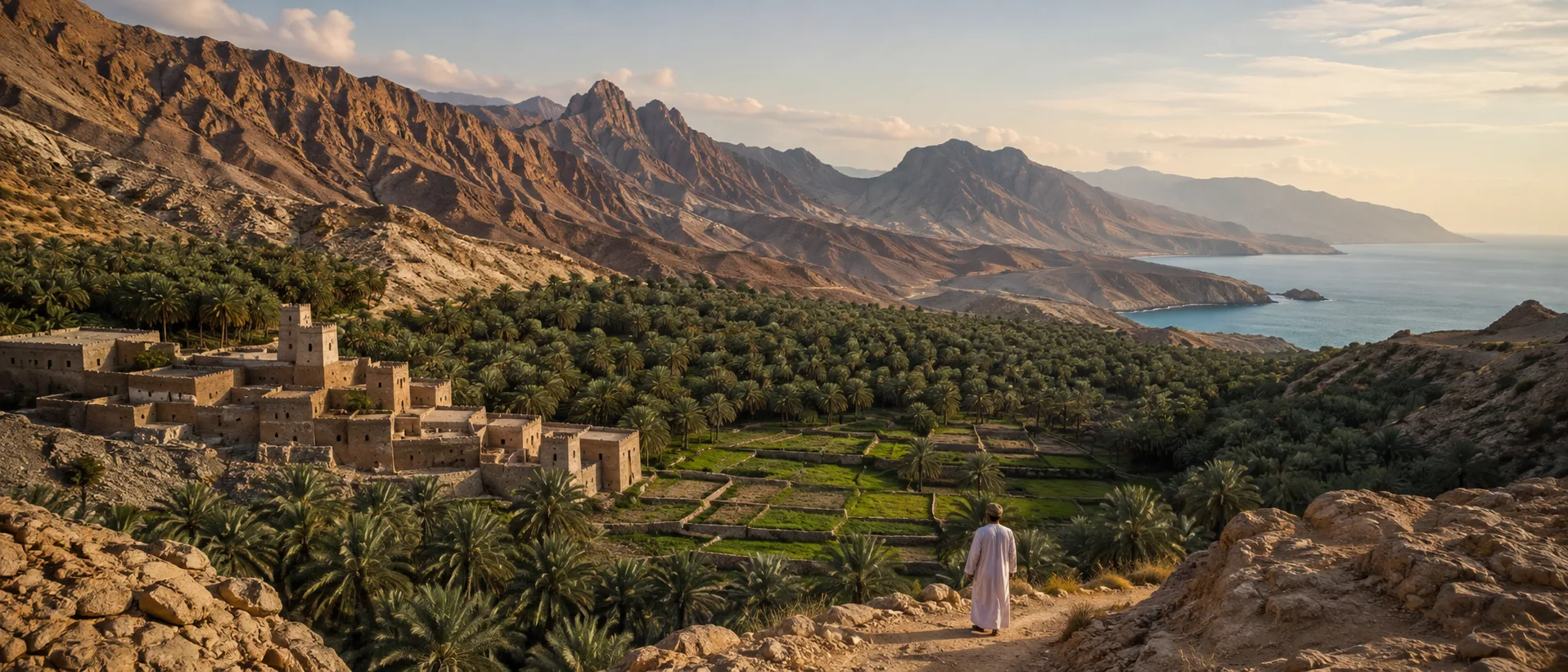
I did not go to Oman because I had already understood the country. It was almost the opposite. One of the reasons for the journey was simple: I wanted to meet an Omani beekeeper near Nizwa. Omani honey opened the door. Then Oman kept giving me reasons to walk farther.
I Went to Oman for a Beekeeper
I knew some of the names before I arrived.
Omani Sidr honey. Samar honey from Oman. Honey from a country with a reputation for old beekeeping traditions and difficult landscapes.
Names are easy to know.
A place is different.
Near Nizwa, Oman, the first thing that stayed with me was not a jar. It was the land around it. The climate around Nizwa can feel uncompromising, but the oasis and surrounding valleys show how quickly the same view can shift from bare rock to cultivated life. Mountains, heat, dry valleys, cultivated palms, wild ground. Some parts looked almost too hard for agriculture. Then, close by, an oasis could be full of life.
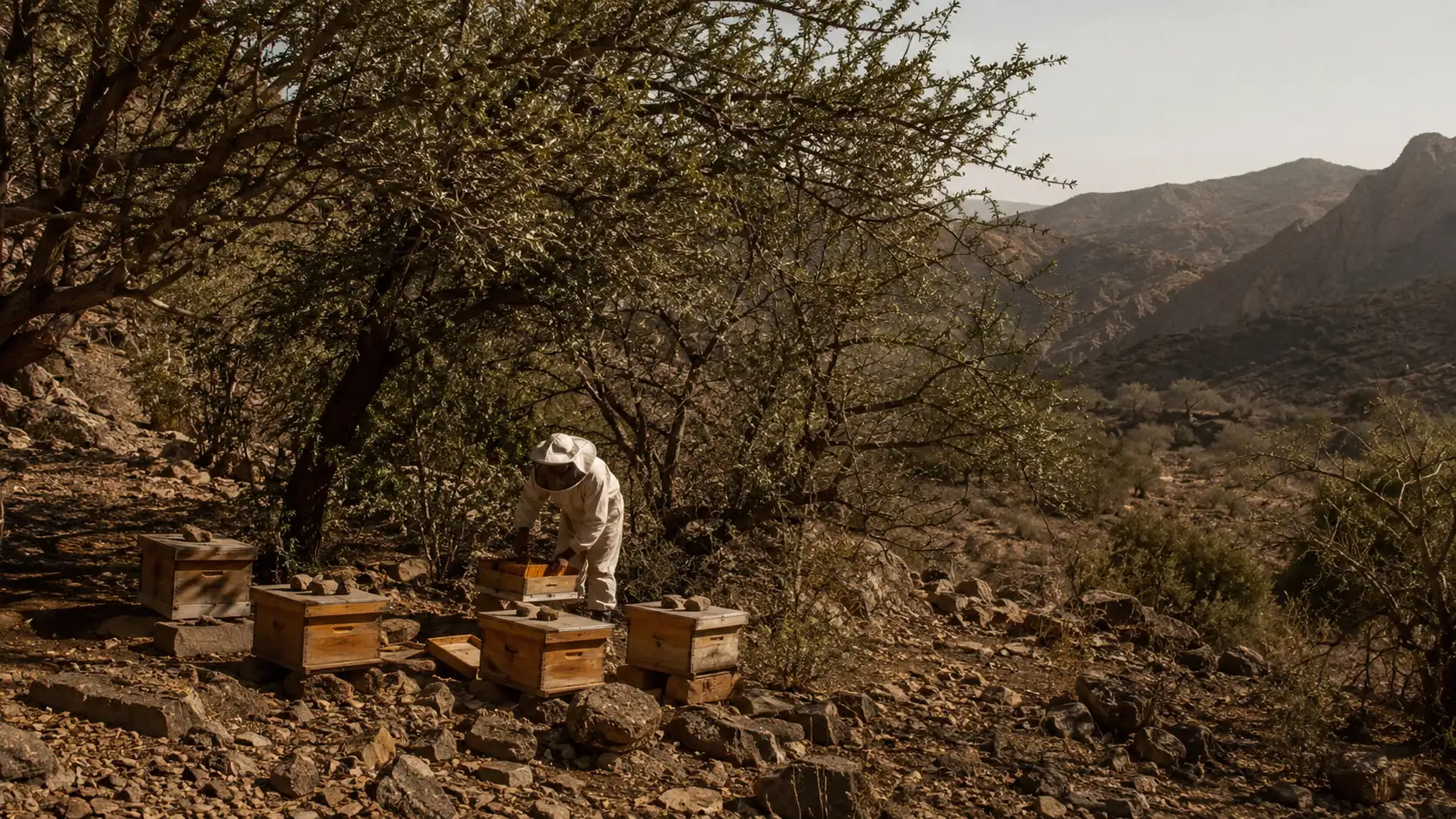
I was there to meet a beekeeper, and that changed the way I looked at the honey immediately. Beekeeping in Oman stopped being a subject on a screen and became a conversation beside the landscape that was feeding the hives. It was no longer an anonymous Oman honey arriving from a supplier I did not know. There was a person behind it. There were hives. There was a season. There were trees he watched and flowering periods he waited for.
That relationship later became important to The House of Meski. Our Omani Sidr is tied to this same Nizwa connection, a relationship we return to instead of simply searching the market each year for whoever has honey available.
But the more I visited Oman, the more I realised that Nizwa was not teaching me only about Sidr.
It was teaching me how little the word desert explains.
Nizwa Taught Me to Look Past the Dry Land
From a distance, dry land can look empty.
That is one of the easiest mistakes to make in Arabia.
You see rock, pale earth, heat, thorny trees and mountains that seem to have no interest in making life easy. Then you begin to learn the names.
Sidr.
Samar.
Date palm.
Wild shrubs that survive with little water.
Cultivated plants gathered where irrigation makes cultivation possible.
Suddenly the landscape is no longer empty. It is selective.
Sultan Qaboos University identifies Sidr and Sumer, another transliteration of Sumur or Samar, as the two principal floral types traditionally studied in honey from Oman. Sidr is associated with Ziziphus spina-christi. Samar is associated with Acacia tortilis, now widely classified as Vachellia tortilis. The university also recognises multifloral honey in Oman and a number of less studied market varieties.
This already gives Nizwa and the interior two different honey seasons.
Sidr honey in Oman does not come from the same flowering moment as Omani Samar honey. One tree, one season, one set of conditions. Then another tree and another part of the year.
I like that because it makes the landscape readable.
You stop seeing honey as something that appears after the harvest.
You start seeing the harvest months before the jar exists.
Sidr and Samar, Two Seasons in the Same Country
Sidr is the name many honey buyers already recognise.
Its fame makes the name easy to recognise. It can also make us lazy.
If someone discovers Sidr honey from Oman or Omani Sidr honey, I do not want to answer only with colour, texture and tasting notes. I want that person to see the tree standing outside Nizwa. I want them to understand why the beekeeper waits for flowering and why a season cannot simply be ordered from a factory.
Our own Honey Atlas entry for Omani Sidr describes the Nizwa harvest through a direct beekeeper relationship and the mountain and desert valleys surrounding the oasis. That part is personal to our sourcing. The wider botanical fact is documented independently: Sidr is one of Oman’s principal honey sources.
Samar changes the story.
Samar honey from Oman is darker in reputation and belongs to another flowering period. The tree itself is built for arid country. It survives where a large orchard would need irrigation, maintenance and protection.
That contrast interests me more than asking which honey is better.
Sidr and Samar can exist in the same national landscape while telling two different seasonal stories.
And then Sultan Qaboos University adds another layer. Its research on bee forage in Oman lists winter resources such as Ziziphus spina-christi and Prosopis, while summer forage can include Acacia tortilis, citrus, Maerua crassifolia, date palm and other plants.
That does not mean every flowering plant becomes a monofloral honey.
This distinction matters.
A bee visiting a pomegranate flower does not automatically create a jar called pomegranate honey. A date palm near a hive does not prove the existence of monofloral date honey. Bees work with the entire environment available to them.
Sometimes the most honest name is simply flower honey from Oman.
“Some people search for wealth in banks. I find myself searching for natural wealth, cultural wealth, and the people who still know how to pass both on.”
The Hajar Mountains Change the Rules
Then you start climbing.
This is where Oman becomes difficult to summarise.
The Hajar Mountains of Oman form the great northern mountain system that separates and reshapes much of the country. They are one of the clearest reasons the climate in Oman cannot be reduced to a single desert description. Around Al Dakhiliyah, the terrain rises toward Jabal Shams, the highest peak in Oman, while Jabal Akhdar offers cooler conditions and terraced agriculture.
I already knew that mountains change temperature.
What surprised me was what that simple fact allows people to grow.
Experience Oman describes Jabal Akhdar as an area of moderate temperatures and terraced farms producing unusual fruits for the region. Current agricultural reporting from Oman counts more than 27,000 pomegranate trees in Jabal Akhdar, where the fruit remains one of the mountain’s major crops.
Jabal Akhdar pomegranates above an Arabian desert landscape.
Figs, peaches, apricots and other temperate fruits are also part of Oman’s highland agricultural tradition.
This was the point where my idea of Oman biodiversity and the natural beauty of Oman began to change completely.
We often speak about biodiversity as something wild and distant from people. But cultivated diversity tells us something too. It tells us what a microclimate allows. It tells us what farmers learned over generations. It tells us where water can be carried and where a terrace can turn a mountain slope into an orchard.
And if there are orchards, flowers appear.
If flowers appear, bees notice.
That does not mean I am going to invent a Jabal Akhdar pomegranate honey because it sounds beautiful. I have not found enough evidence to present that as an established monofloral honey category in Oman.
But bees in a mountain agricultural landscape do not ignore thousands of flowering fruit trees.
That is exactly why multifloral honey can be so interesting.
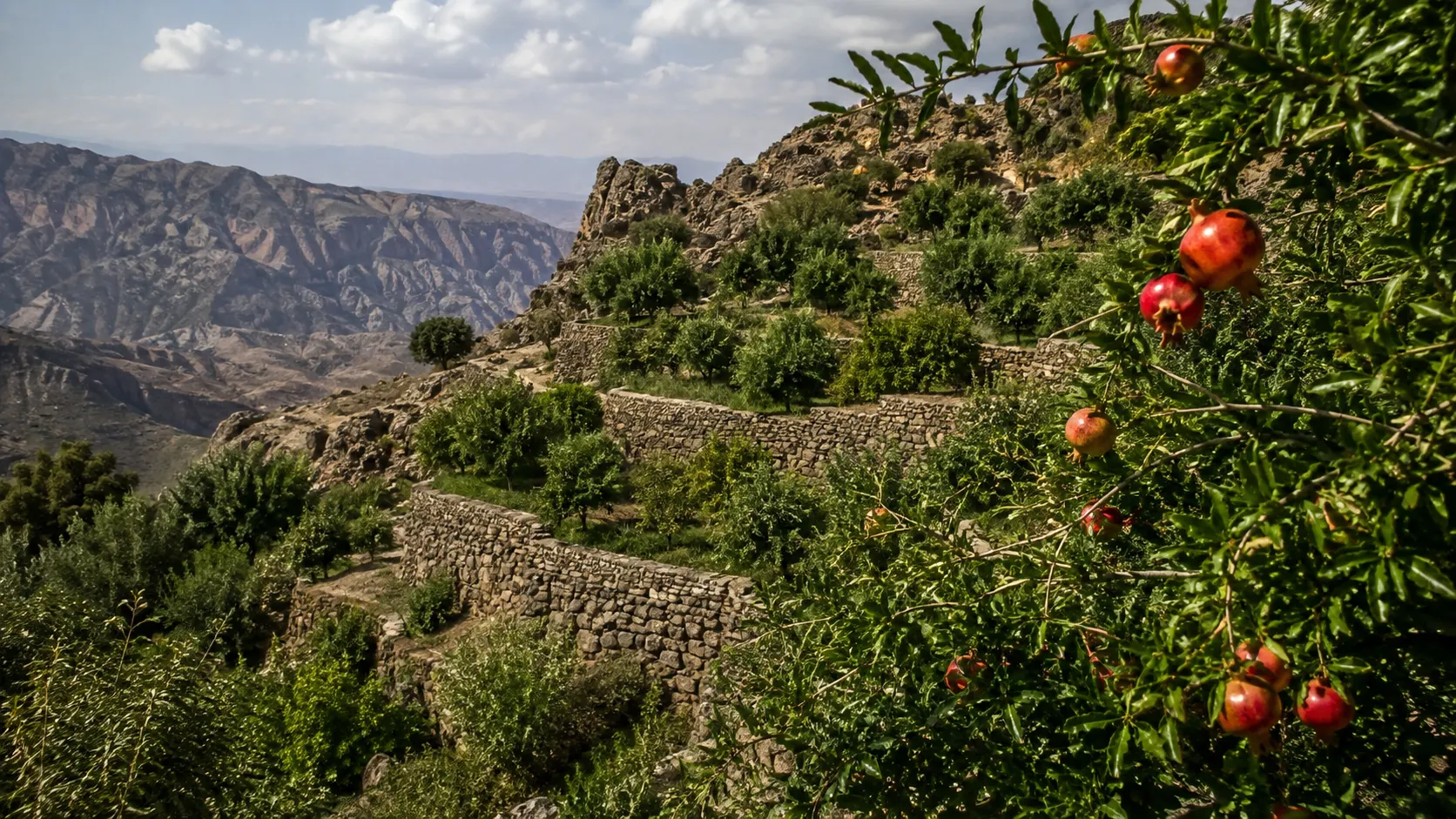
A Pomegranate Orchard Made Me Think About Flower Honey Differently
Monofloral honey is easier to explain.
Sidr honey comes with a tree. Samar honey comes with a tree. Luban honey comes with an idea that immediately catches attention because frankincense already carries centuries of history.
Flower honey from Oman sounds less spectacular.
I think that is unfair.
Imagine a hive placed in or near a traditional agricultural landscape. Date palms above. Fruit trees below. Aromatic plants at the edges. Wild vegetation where cultivation stops. Different plants opening and closing their flowers at different times.
The bees do not care which name is easiest to sell.
They work.
A multifloral honey from Oman can therefore become a record of coexistence. Not a perfectly pure botanical line, but a mixture of what the land was offering during that period.
Research from Sultan Qaboos University on traditional date-palm farms in northern and central Oman has documented a richer diversity of naturally growing medicinal and aromatic plants in traditional farming systems than in the modern farm system examined in the study. I find that detail fascinating.
It suggests something larger than honey.
The old agricultural landscape may feed more than the crop we came to harvest.
A palm garden can also shelter other plants.
A terrace can carry fruit, insects, shade and memory at the same time.
For a beekeeper, all of that can become forage.
Then Water Appears
Oman is one of those countries where water can change your mood before you even drink it.
You leave dry ground and enter one of the wadis of Oman.
You hear water.
Palms gather around it.
The shade changes.
I have this feeling in oasis landscapes in different countries. Morocco, Oman, Saudi Arabia. From far away they can look related. Palms, cultivated ground, dry land around them.
Then you walk inside and every oasis has its own sound.
Its own fruit.
Its own way of moving water.
Its own relationship between cultivated land and everything growing at the edges.
In Oman, the aflaj irrigation systems made me look at that relationship differently. I am not saying the hydraulic traditions of Oman and Morocco are identical. They are not. But the basic human problem is familiar: in a dry environment, finding water is only the first victory. You still have to guide it, share it and make it last.
Experience Oman describes parts of North Al Sharqiyah where mountains above 2,000 metres overlook sand dunes while palm-filled oases surround villages. Wadi Bani Khalid is described as one of the Sultanate’s fertile valleys.
Mountains.
Dunes.
Water.
Palms.
In the same region.
Once you have seen that, the variety of Oman honey becomes less surprising.
Al Batinah Adds Farms to the Story
Not every bee in Oman lives beside an isolated mountain tree.
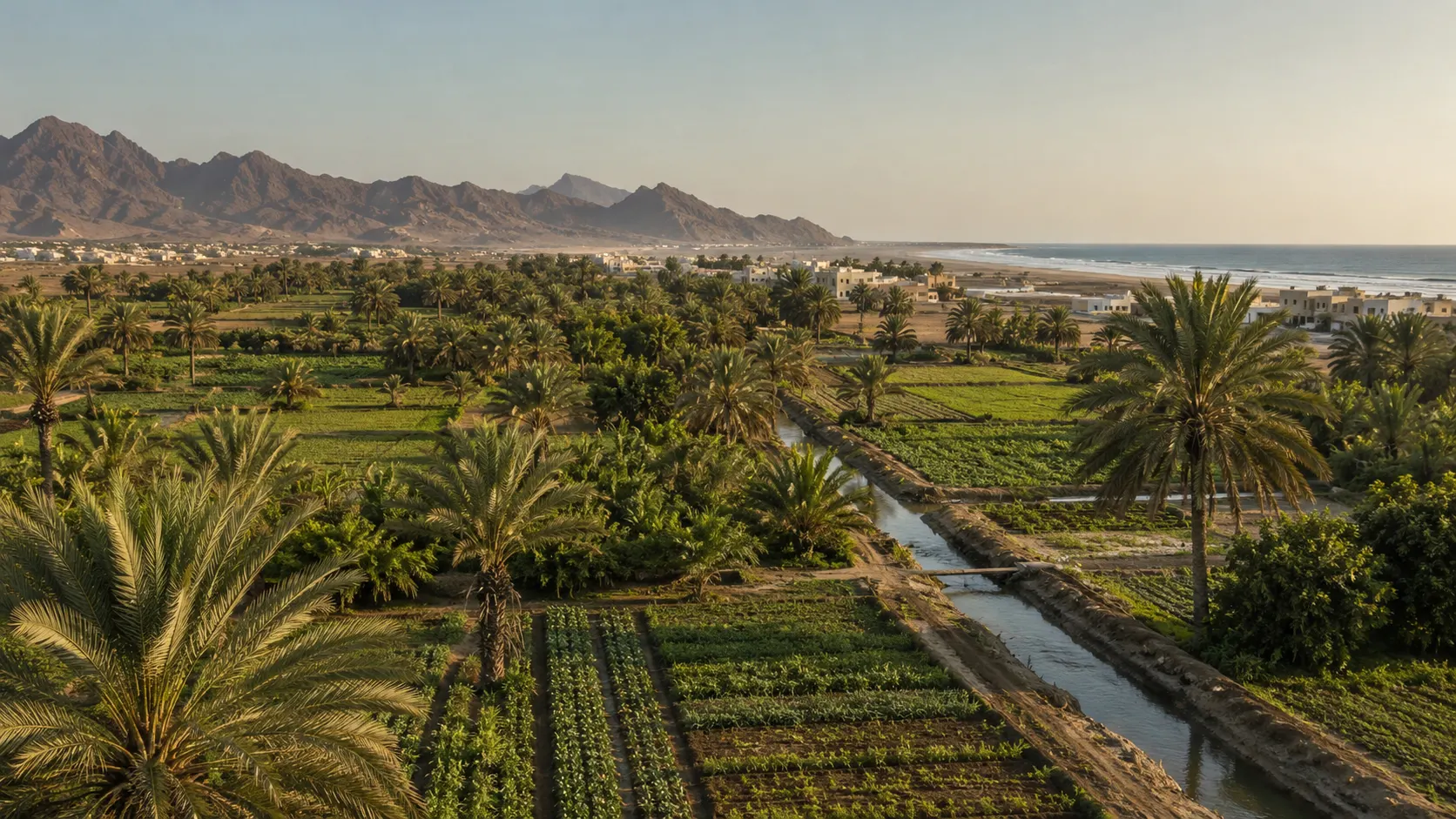
Al Batinah agriculture adds another landscape entirely. The fertile Al Batinah plain is one of the country’s important agricultural areas, running between mountains and the coast. Dates remain the iconic crop, but the list of fruits grown in Oman is much wider: pomegranates in the highlands, mangoes and bananas in warmer regions, along with limes, figs, peaches, apricots and other crops where local conditions allow them.
This matters because honey in Oman does not exist only in the wild.
A bee can work between cultivated and uncultivated worlds without recognising the border we created between them.
Citrus blossom on a farm is still nectar.
A flowering wild shrub beside the field is still nectar.
Date-palm pollen can still be collected.
A multifloral honey from Oman can therefore emerge from an agricultural mosaic just as naturally as a mountain flower honey can emerge from a wadi landscape.
There is also a less romantic side.
Water scarcity and salinity are serious agricultural constraints in Oman, especially along parts of the Al Batinah coast. Sultan Qaboos University research describes salinity as a major pressure on agricultural production there.
This belongs in a honey article because the bee does not live outside agriculture’s problems.
If farms lose trees, floral resources disappear.
If drought shortens flowering, the hive receives less.
If a famous tree survives but flowers poorly, the label may remain famous while the harvest becomes small.
Climate is not decoration behind a jar.
It decides whether the jar can be filled.
Then Salalah Changed Oman Again
I could have stopped with Nizwa and already had a country worth writing about.
Then there was Salalah.
This is the part that still makes me smile when people reduce the Arabian Peninsula to sand and heat. Arrive in Salalah, Oman during the green season and the image can almost seem to belong to another country.
Bananas.
Coconut palms.
Mangoes grown elsewhere in Oman too, alongside the country’s better-known dates and limes.
Green mountains during the khareef.
Mist.
Light rain.
Frankincense trees on rocky slopes.
Who would have thought?
I knew before arriving that Dhofar was different. Knowing something and seeing it are not always the same thing.
Experience Oman describes Dhofar, Oman as a region of beaches, deserts, fertile plains and green mountains. The Dhofar khareef, generally from June to September, brings mist and light showers to the southern plains and mountains. UNEP goes even further in describing Oman’s natural variety and specifically points to tropical fruits around Salalah, including bananas and coconuts, below the frankincense country of the Qara foothills.
Sultan Qaboos University research on Gulf agriculture also notes something that explains a lot: Oman, unlike many people imagine, has enough topographic and climatic variation to support tropical, subtropical and temperate crops.
That sentence could almost be the whole article.
Tropical.
Subtropical.
Temperate.
Inside a country many people first imagine as simply arid.
And for bees, every change in vegetation is another possible menu.
Luban Honey Was a Honey I Did Not Know Existed
This is where the story returns to the beekeeper.
I had never heard of frankincense honey.
Not in France.
Not in a shop.
Not in the way I already knew Sidr.
An Omani beekeeper introduced it to me.
Luban honey from Oman immediately interested me because frankincense itself already belonged to the country I was beginning to understand. I had smelled it in Oman. I had seen how deeply luban sits inside Omani culture and trade history.
Then someone put the honey in front of me.
I liked it.
And because I liked it, I wanted to understand where it came from.
That is usually how these things begin for me.
Razat Royal Farm in Salalah identifies the frankincense tree as Boswellia sacra, growing on the rocky slopes of the Dhofar Mountains, and explicitly notes honey production from its flowers. Sultan Qaboos University also lists Luban among the Omani unifloral honey types sold in the market and included in its authentication research.
So the honey exists beyond the conversation I had with one beekeeper.
But my discovery of it remains personal.
I did not find frankincense honey from Oman because I was searching a catalogue for another rare honey.
I found it because someone opened a jar.
Samar and Luban: What the Beekeeper Explained to Me
Then he showed me something else.
A honey he described to me as Samar and Luban honey.
His explanation was that there can be a transition between flowering resources available to the bees, and that a harvest can reflect that change rather than fit perfectly inside one floral name.
I found the idea logical.
But logical is not the same as proven.
I have not found enough independent botanical documentation to present Samar Luban honey as a standard honey category in Oman with one fixed definition across the country.
So I keep the story where it belongs.
This is what my beekeeper explained to me about his harvest.
The broader science supports the underlying principle that bees forage according to the flowering resources available around them and that multifloral honeys can reflect several nectar sources. It does not allow me to turn one beekeeper’s explanation into a national rule.
I actually prefer it that way.
There is something reassuring about being able to say, “This is what I was told, and this is what I can verify.”
The goal is not to make every story sound certain.
The goal is to make it honest.
What Oman officially and academically documents
Sultan Qaboos University identifies Sidr and Sumer/Samar as Oman’s principal honey types and also studies multifloral honey. Its recent authentication work lists other Omani market varieties including Ghaf, Luban, Shawe, Eatam and Talh. These names do not remove the need for botanical and geographic verification of individual commercial jars.
The Rare Honey Names Made Me More Curious, Not More Certain
Ghaf.
Talh.
Shawe.
Eatam, or Aitman in another recent paper.
These names appear in current honey research from the Sultanate, and some are much less familiar outside the Sultanate than Sidr, Samar or Luban.
The easy thing would be to turn that into a list called “10 rare honeys of Oman.”
I do not want to do that.
Some of these varieties are only beginning to receive detailed physicochemical and sensory study. Sultan Qaboos University’s 2025 research on rare honeys from Oman explicitly describes several as under-studied compared with Sidr and Sumur.
That is more interesting than pretending the subject is finished.
It tells us that Oman honey varieties are broader than the international market usually sees, but also that local names, floral claims and scientific authentication do not always advance at the same speed.
I would rather leave a question open than close it with invented certainty.
There will always be another beekeeper to ask.
Another flowering season to understand.
Another jar whose name means more locally than it does in English.
“The more a country teaches me, the less I want to pretend that I already know it.”
Oman Became Richer the More I Walked
Muscat had already surprised me for another reason.
I wrote before about my first arrival into Muscat, the mountains, the descent toward the sea, Muttrah and the feeling that the city did not need to shout in order to leave an impression.
But outside the capital, Oman opened differently.
Nizwa gave me the beekeeper.
The dry valleys gave me Sidr and Samar.
The Hajar Mountains gave me altitude.
Jabal Akhdar gave me pomegranates and orchards where I had not expected them.
The wadis and aflaj gave me water running through landscapes that seemed dry from only a few kilometres away.
Al Batinah gave me another agricultural Oman.
Then Salalah gave me bananas, coconuts, mangoes, mist and green mountains.
Dhofar gave me frankincense.
The beekeeper gave me Luban honey.
And after all of that, flower honey from Oman stopped sounding like the generic option.
It started sounding like a country refusing to fit into one flower. By then, Omani honey no longer meant one product to me. It meant a landscape, a season and a person who knew when to wait.
Go Farther Than the First Picture of Oman
Some people travel to count monuments.
Some travel for restaurants, hotels or a photograph they already know they want to take.
I understand that.
But Oman makes more sense to me when I travel slowly.
Go beyond Muscat.
Spend time in Nizwa. Look at the Hajar Mountains without seeing only rock. Walk through a wadi and notice what changes when water appears. Look at the terraces of Jabal Akhdar. Pay attention to what farmers grow. If you travel south, let Salalah and the khareef challenge the picture of Arabia you arrived with.
And taste the honey with the same curiosity.
Ask where the Sidr grew.
Ask when the Samar flowered.
If someone offers you Luban honey, ask about the frankincense trees and the harvest. If the jar simply says flower honey, do not assume it is the less interesting one. Ask what was flowering around the hives.
At The House of Meski, we can only encourage you to visit Oman beyond the obvious places and discover the country in its natural and cultural depth.
I have been to Nizwa, Muscat, Salalah and other parts of the Sultanate, and I still feel that I know very little.
I like that feeling.
It gives me a reason to return.
And to anyone reading this from Oman, I have one request.
If I have missed a honey, a plant, a village, a fruit, a custom, or simply misunderstood something that you know better because it is part of your home, write to me.
Teach me.
I am still learning, and I hope I always will be.
Meskaoui
Questions People Ask After Discovering Oman Beyond the Desert
Yes, but not in the same environment. Jabal Akhdar’s elevation supports pomegranates, apricots and other temperate crops, while the warmer south around Salalah is known for tropical fruits including bananas and coconuts, with mangoes also cultivated in Oman. The contrast comes from altitude, coastal influence, irrigation and the khareef climate of Dhofar.
Sultan Qaboos University has extensively studied Sidr, Sumer or Samar, and multifloral honey. Its more recent authentication work also includes local market varieties such as Luban, Ghaf, Talh, Shawe and Eatam. Some rarer names remain less scientifically characterized, so a local category is not automatically proof that every jar sold under that name is strictly monofloral.
I have not found enough reliable evidence to present pomegranate honey as an established monofloral category from Jabal Akhdar. Honeybees can certainly visit flowering pomegranate and other fruit trees in the mountain orchards, but the presence of a crop does not prove that it dominates a harvest. A mixed orchard honey may be better described as multifloral unless botanical origin is demonstrated.
The khareef brings seasonal mist and light rain to the mountains and plains of Dhofar, changing plant growth and the availability of flowering resources. That creates a very different foraging environment from the dry interior of northern Oman. It does not mean every khareef landscape produces one specific honey, but it helps explain why southern bee forage can differ so strongly from Nizwa or the Hajar region.
I encountered a harvest described by an Omani beekeeper as Samar and Luban honey. He explained it through a transition between flowering resources available to his bees. The ecological principle is plausible, but I have not found enough independent documentation to present Samar and Luban as one standardized category across Oman. Here, I prefer to keep the distinction between what the beekeeper told me and what published research can confirm.
Ask for the region, floral source, harvest period and beekeeper or apiary when that information is available. For Sidr, Samar, Luban or any claimed monofloral honey, traceability is more useful than prestige words alone. For flower or multifloral honey, ask what was growing around the hives. A precise origin such as Nizwa, Al Dakhiliyah or Dhofar often tells you more than a generic national label.
Use contrast rather than a checklist. Muscat shows mountains meeting the sea. Nizwa and Al Dakhiliyah open toward oasis agriculture and the Hajar Mountains. Jabal Akhdar adds high-altitude orchards. Wadis show what water changes in an arid landscape. Dhofar and Salalah reveal the khareef and frankincense country. Speaking with farmers, beekeepers and residents adds the part no landscape photograph can explain.
Keep Exploring Oman
Follow the honey origins through the Honey Atlas, or return to Muscat through the memory that first made the country feel different to me.
Sources & Further Reading
- Sultan Qaboos University: Authentication of selected Omani honey using sensory, physicochemical analysis and E-nose
- Sultan Qaboos University Journal for Science: Assessment of physicochemical properties and antioxidant content in rare Omani honeys
- Experience Oman: Al Dakhiliyah, Jabal Akhdar, Jabal Shams and Nizwa
- Experience Oman: Ash Sharqiyah North, mountains, dunes, wadis and palm oases
- Experience Oman: Al Batinah North and the fertile Batinah plain
- Experience Oman: Dhofar and the khareef
- United Nations Environment Programme: Oman, a reality from a world of fantasy
- Razat Royal Farm: Frankincense tree and honey production
- Razat Royal Farm: Anogeissus dhofarica and honey production in Dhofar
- Sultan Qaboos University: Biodiversity of medicinal and aromatic plants in traditional date palm farms
- International Society for Horticultural Science: Traditional cultivation of pomegranate in Oman
- International Society for Horticultural Science: Deciduous fruit crops of Oman
Editorial note: The visits to Nizwa, Muscat and Salalah, the meeting with the beekeeper, the first tasting of Luban honey and the author’s reactions to Oman’s landscapes are personal experiences. Botanical, agricultural and honey-production claims are separated from those memories and supported by the sources above. The description of Samar and Luban honey is retained as the explanation given by the beekeeper and is not presented as a standardized Omani honey category.