
I have only been to Saudi Arabia twice, and both journeys were first connected to my religion. That is not enough to pretend I know the country. Fortunately, other people have known how to share what I have not yet had time to see.
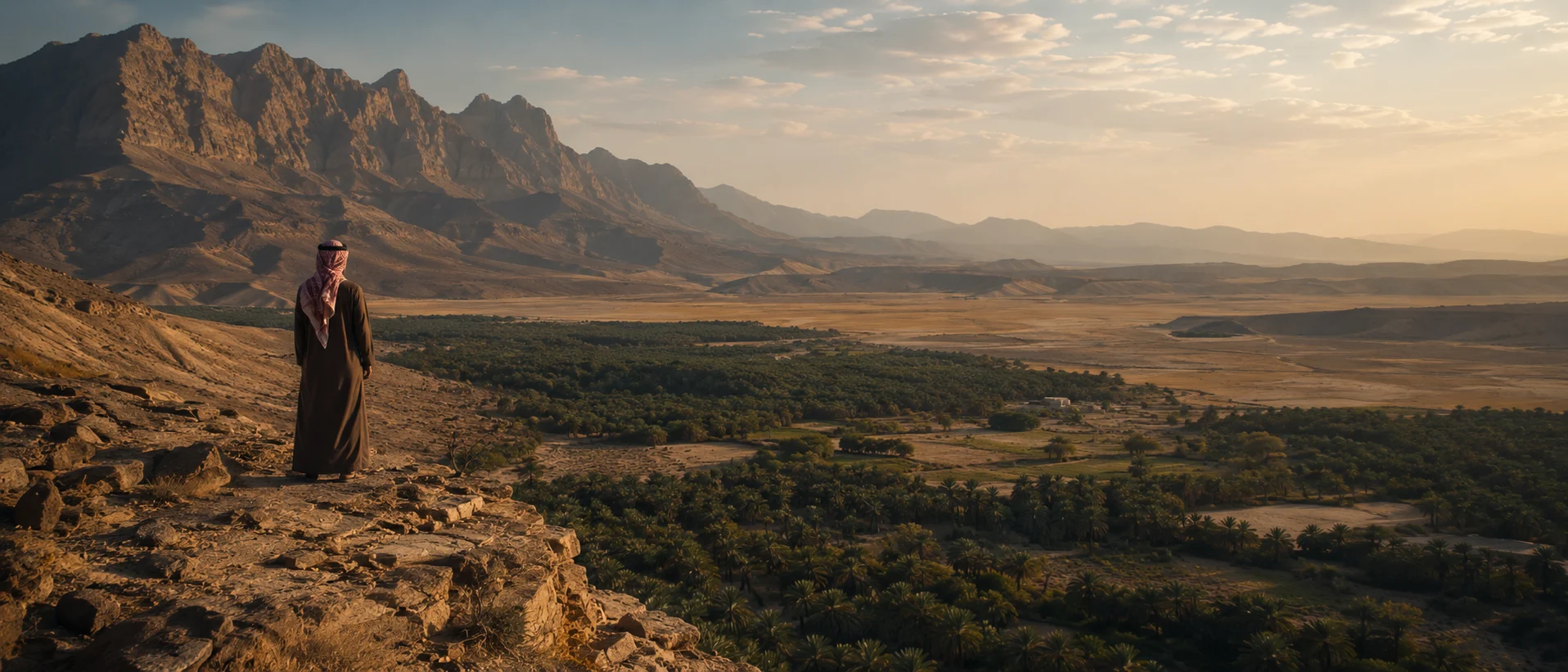
I have a personal conviction: seeing and living even a small part of a culture in its own country teaches me something that reading one hundred descriptions cannot completely replace. That is only my point of view. It is also a difficult principle to follow, because one life is probably not enough to discover a single country completely. Saudi Arabia reminded me of that very quickly. Even a bee would struggle to see it all. Yes, the honey is already back.
Two Visits Are Not Enough, So I Will Not Pretend They Are
I have visited Saudi Arabia twice.
Both times, religion came first.
That matters because I do not want to use two journeys to manufacture twenty years of personal experience.
I went to Makkah.
I went to Medina.
I moved through parts of the western region.
I saw mountains around the Makkah and Jeddah area.
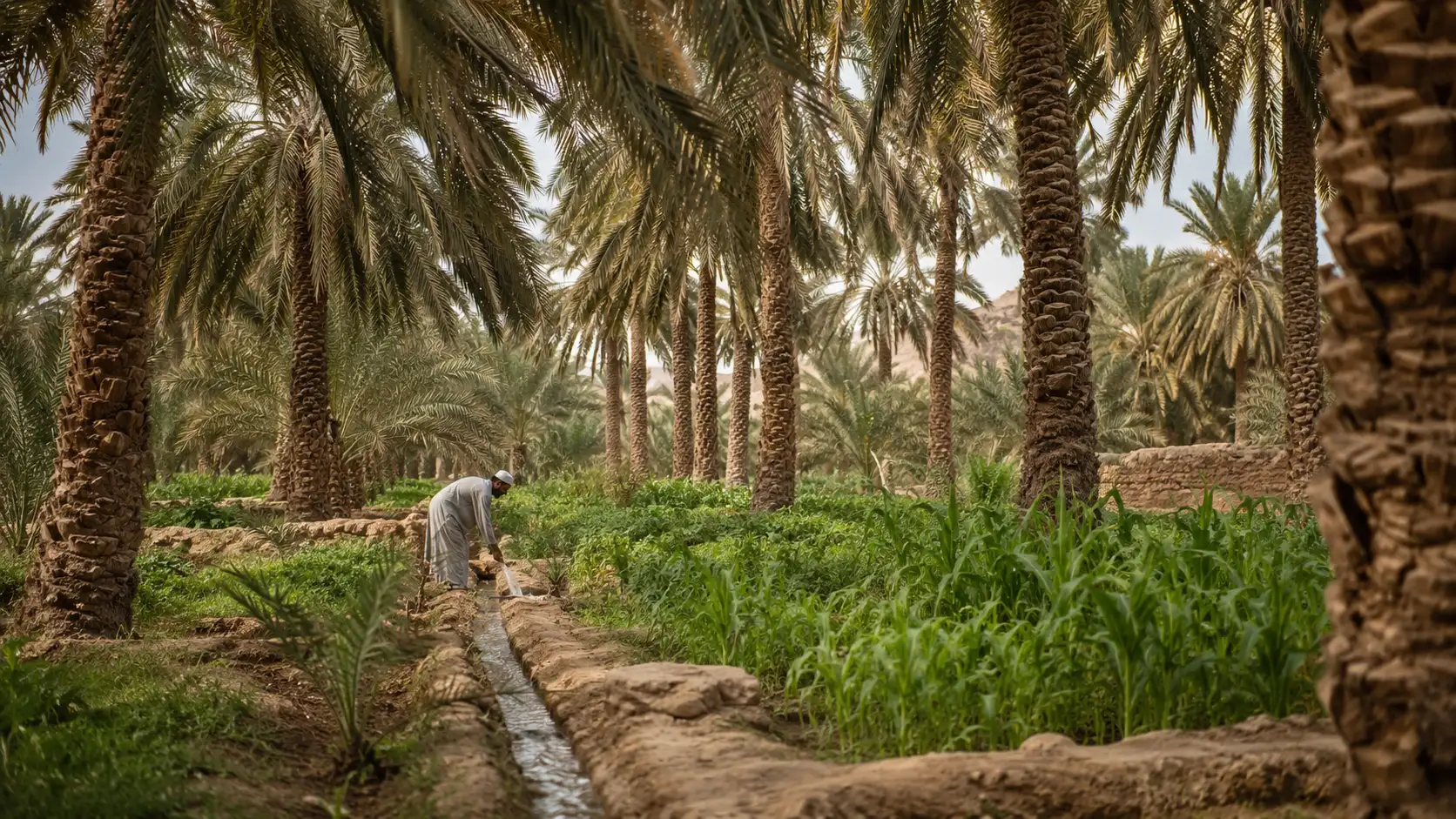
I walked through palm gardens around Medina.
I tried to look at local life whenever I could, even though that was not the main reason for the journey.
And then, as usual, food gave me a small surprise.
Dates.
I already knew dates well.
At least I thought I did.
Then I found varieties around Medina that I did not know. I even discovered dates sold to me without a stone.
I do not remember the variety name, so I will not invent one now.
That little memory is enough.
I told you already: there is always something new to learn.
“I still believe that seeing and living one small part of a culture in its own country can teach me more than reading a hundred descriptions of it. That is my personal belief, not a rule for everyone else.”
Medina First Taught Me Through the Palm
Religion brought me to Medina.
The landscape added another lesson.
Palm gardens.
Dates in forms and names I did not know.
A city whose relationship with the date palm is not a tourist invention.
Official Saudi documentation counts around 4.75 million palms in Al-Madinah Province and about seventy date varieties. Ajwa is the famous name many outsiders already know, with around nine hundred thousand Ajwa palms reported in the province, but the date vocabulary is much larger than Ajwa alone.
For someone who grew up with dates in Meski, this interested me immediately.
A date is never just “a date” once you begin listening to people who grow them.
Variety.
Ripeness stage.
Texture.
Fresh or dried.
Colour.
Season.
Local preference.
Even within one region, knowledge becomes precise.
That is the same lesson honey keeps giving me.
“Saudi honey” can be useful as a broad phrase.
But which Saudi honey?
From which region?
From which flowering?
From which beekeeper?
The Mountains Between Jeddah and Makkah Made Me Look Up
My mountain memories are from the western side of the country, around the broader Jeddah and Makkah region.
This is Hijaz country.
Makkah itself sits among hills, mountains and valleys. Farther through the western highlands, the Hijaz Mountains form the central part of the great western mountain system and give rise to wadis descending toward the Red Sea.
I saw only a fragment.
That is important to say.
But even the fragment was enough to make the usual image of Saudi Arabia feel incomplete.
People often picture a flat desert.
The western side quickly corrects that idea.
Rocky massifs.
Valleys.
Volcanic landscapes.
Then the Red Sea not far away.
And if you keep travelling south, the mountains do not disappear.
They become higher, greener and biologically richer.
This is where my own experience stops being enough.
So the article has to change voice.
From here, I listen.
Saudi Arabia Became Much Larger When I Started Asking
The Kingdom is enormous.
Western highlands and Red Sea coast.
Najd plateau.
Northern deserts.
The Empty Quarter in the south-east.
Mountain environments in Asir, Al-Baha and Jazan.
Oases such as Al-Ahsa.
Coastal and marine ecosystems along both the Red Sea and Arabian Gulf.
Saudi documentation records roughly 2,100 plant species and identifies the south-western mountain systems as the country’s richest terrestrial environments for biodiversity.
That surprised me less once I began reading the geography properly.
Altitude changes rain.
Rain changes vegetation.
Vegetation changes agriculture.
And eventually, inevitably, the bee arrives.
This is why I no longer find it useful to ask whether Saudi Arabia has “good conditions for honey.”
Which conditions?
Which region?
Which month?
The country is too large for one answer.
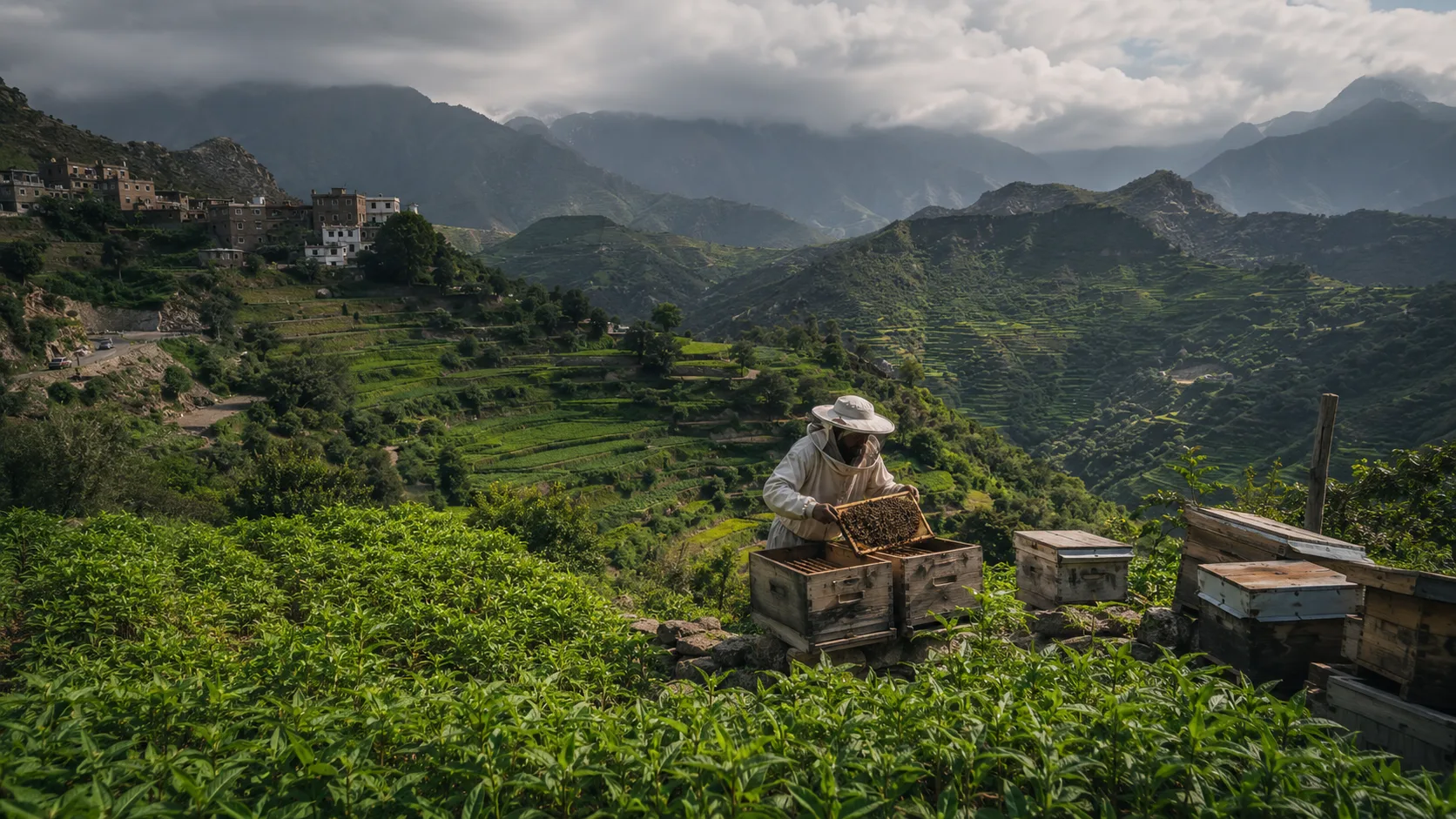
In Asir, Beekeepers Follow the Mountain
Asir is where the honey map becomes vertical.
The Sarawat Mountains contain some of Saudi Arabia’s highest elevations and highest terrestrial biodiversity. Juniper forests grow on the upper slopes. Acacias and wild olives appear in the mountain ecosystems. Medicinal and aromatic herbs add another layer.
Beekeeping is common in this region.
And the bees do not stay loyal to our administrative map.
Saudi beekeepers in Aseer move colonies between elevations and coastal plains to follow different floral seasons. Recent Saudi reporting describes Sidr harvest peaking in late summer and early autumn, while Talh and spring wildflower honey belong to other periods.
That is already enough to make the term Asir honey too broad on its own.
Sidr honey Saudi Arabia can be one story.
Talh honey Saudi Arabia another.
Saudi wildflower honey another again.
Older scientific and technical literature also documents names such as Sumra, Dharm and Majra among Saudi floral honeys.
Each name should make us ask what plant and landscape sit behind it.
Not which one has the most expensive box.
Fayfa Sounds Like the Saudi Arabia Many People Never Imagine
Then I came across Fayfa.
I have not been there.
I want that sentence to stay visible.
What I know comes from Saudis who document the region and from official sources, not from a memory I can call my own.
But look at the list.
Mountain terraces.
Dense vegetation.
Aromatic plants.
Coffee.
Grapes.
Lemon.
Guava.
Tamarind.
And beekeeping.
Fayfa is even described locally as the land of hanging gardens because of its mountainous agricultural terraces.
Its honeys include Sidr, Qatad and Samrah.
This one region alone is enough to break the lazy formula “Saudi Arabia equals desert.”
It also gives us another useful connection.
Saudi coffee and Saudi honey can come from the same broader mountain world.
Not necessarily the same farm or the same flower, of course.
But the environment capable of supporting coffee terraces, aromatic plants and fruit cultivation is clearly different from the environment of the Empty Quarter.
Jazan Adds the Coast Without Losing the Mountains
Jazan makes the contrast even sharper.
Part of the region lies along the Red Sea.
Part rises into mountain highlands where temperatures become more moderate and rainfall is greater.
Agriculture is important.
Coffee grows in the highlands.
Bananas, olives and aromatic plants are cultivated in parts of the mountainous landscape.
And honey is not marginal.
Saudi sources report more than fifteen honey types in Jazan and a regional honey festival where Sidr appeared alongside Qatad, Salam, Samra, Dom, Dahyan, Talh, Majar and other local names.
I am not going to explain every one of those honeys as if I have tasted them all.
I have not.
But this diversity tells us something important.
People who search only for Saudi Sidr honey may be entering a much larger local beekeeping culture than they realise.
Sometimes the famous honey is only the door.
Najran Reminds Us That Sidr Is Not One Single Saudi Origin
Sidr is famous enough to hide its own geography.
People say “Saudi Sidr” as though the whole Kingdom were one valley.
It is not.
Najran has its own Sidr harvests. Saudi reporting has documented substantial seasonal production from Sidr flowering in the region’s valleys and wadis.
Asir has Sidr.
Jazan has Sidr.
Northern reserves also document wild Sidr honey.
So the phrase Sidr honey Saudi Arabia is only the beginning of the question.
A serious jar should lead us farther.
Najran?
Aseer?
Jazan?
Another region?
Which flowering season?
What did the beekeeper move the colonies toward?
Traceability does not make honey less romantic.
It makes the story believable.
Talh, Sumra, Majra and the Names I Still Need to Learn Properly
Sidr is the easiest Saudi honey name for an international buyer.
Then the vocabulary becomes more local.
Talh honey.
Sumra honey, sometimes written Samra or Sumrah in English.
Majra honey.
Dharm honey.
Qatad honey.
The Ministry of Environment, Water and Agriculture reports around twenty honey varieties produced across the Kingdom, with Sidr, Talh and Samar among the most notable. Saudi honey markets and festivals document additional regional names.
I like discovering these words, but I also know the danger.
A local Arabic plant name gets transliterated three ways.
A trade label simplifies it.
Then an English shop copies another English shop until the original botanical meaning disappears.
So when I do not know, I prefer to write that I do not know yet.
If a Saudi beekeeper tells me that my transliteration is wrong, I will listen.
That is part of the work.
The North Changes the Honey Calendar Again
Then the north adds another correction.
Not every Saudi apiary belongs to the humid highlands of the south-west.
At the Imam Turki bin Abdullah Royal Nature Reserve in the north, Saudi authorities document thousands of hives producing wild Sidr honey, acacia honey and spring flower honey.
That last name interests me.
Spring flowers.
It sounds almost ordinary until you remember where you are.
Rain in an arid country can transform the meaning of a season. Annual plants emerge. Pastures respond. Valleys and low areas briefly collect what the sky gives them. A landscape that looked quiet can suddenly offer forage.
So a Saudi spring honey tells a different story from mountain Sidr in Aseer or Qatad in Fayfa.
It also reminds me not to confuse permanent vegetation with the whole floral calendar.
Some honey depends on trees that survive year after year.
Some depends on what rain allows to appear for a much shorter window.
Again, the beekeeper has to know when to move, when to wait and when the season simply did not give enough.
That knowledge rarely fits on the front of a jar.
Then the Country Gives Us Al-Ahsa, Another World of Palms
My own date-garden memory belongs to Medina.
But the national story of the palm is much larger.
Al-Ahsa Oasis in the Eastern Province contains millions of date palms and is one of the great historic oasis landscapes of Arabia. It also contains springs, canals, settlements and agricultural land accumulated through a very long human relationship with water.
I have not visited Al-Ahsa.
So I do not need to describe what the shade “felt like” to me.
It did not.
What I can say is that I recognise the logic.
Water gathers life.
Palms create structure.
Agriculture settles around the possibility of continuing to irrigate.
That logic exists in Meski.
It exists around Medina.
It exists in Al-Ahsa.
The histories are different.
The human problem is familiar.
How do you make life continue in an arid place?
And Then Saudi Arabia Removes Almost Everything
The Empty Quarter.
Rub al-Khali.
Even the name creates space.
After palm gardens, mountain terraces, coffee farms and juniper forests, the country opens into one of the world’s great sand deserts.
This is another reason I dislike simple national descriptions.
The same country can contain Fayfa’s green slopes and the Rub al-Khali.
Both are Saudi landscapes.
One receives enough mountain rainfall to support farms and dense vegetation.
The other exists under extreme aridity.
And between them are plateaus, wadis, gravel plains, volcanic fields, pastoral lands and cities.
Saudi climate is not one experience.
Neither is Saudi nature.
If rainfall changes from one region to another, flowering changes too.
If flowering changes, the beekeeping calendar changes.
This is why climate belongs inside a honey article without needing a section called “The Effect of Climate on Honey Production.”
The bees already explained it.
“One lifetime is probably not enough to discover a single country completely. I am beginning to think even a bee would struggle.”
The Red Sea Proves the Country Is Bigger Than the Honey Story
Not every landscape needs to give me a jar.
That is important too.
Saudi Arabia’s Red Sea coast contains coral reefs, seagrass beds, islands and marine habitats that belong to a completely different ecological story from Asir’s apiaries.
Saudi environmental sources describe the Red Sea as one of the country’s great centres of marine biodiversity, with hundreds of coral species and rich fish communities.
I mention it because biodiversity should not become another excuse to talk only about products.
A coral reef does not need to produce honey to deserve a place in an article about the natural richness of Saudi Arabia.
The same country can hold a beekeeper moving hives toward Sidr flowers inland and a reef ecosystem growing below the Red Sea surface.
That difference is the wealth.
The Bee Does Not Care About Our National Shortcuts
We like categories because they make shopping easier.
Saudi honey.
Yemeni honey.
Omani honey.
Moroccan honey.
The bee is less interested.
It has a flight radius.
Flowers available now.
Temperature.
Water.
Colony strength.
A landscape that changes through the year.
This is why a beekeeper in Asir may move hives with flowering seasons.
Why a Sidr harvest in Najran belongs to Najran before it belongs to a national label.
Why spring flower honey Saudi Arabia can tell another story from Talh.
Why a market in Mahayel can bring Sidr, Sumra, Talh and Majra together even though the flowers did not all grow in one place at one time.
Honey is useful because it makes geography edible.
But only if we keep the geography.
Two Trips Gave Me Questions, Not Authority
I am happy with that.
My Saudi memories are real.
Religion first.
Medina.
Palm gardens.
Dates I did not know.
A strange little moment of discovering a date without a stone and realising that even a fruit I had eaten all my life could still surprise me.
Mountains in the broader Jeddah and Makkah region.
An effort to look beyond the main purpose of the journey whenever time allowed.
That is what I can claim personally.
Asir, Fayfa, Jazan, Najran, Al-Ahsa and the Empty Quarter belong, for now, to what others have shared and what reliable sources allow me to understand.
I would rather keep that distinction than pretend the entire Kingdom passed in front of my eyes.
Maybe one day I will visit some of those places.
Then the article may change.
It should.
Saudi Readers, This Time You Have the Advantage
After only two visits, I am certainly not going to finish by telling Saudis that I have understood their country.
I have not.
Perhaps ten visits would still leave me with the same problem.
So this time, you have the advantage.
If there is a mountain village I should see, tell me.
If there is a honey I have missed, tell me.
If Majra, Dharm, Qatad or another local name deserves a better explanation than the one I have found in English, teach me the right one.
If a date variety around Medina should have been on my table and somehow escaped me, I am listening.
If there is a family tradition connected to bees, dates, coffee, hospitality or the land that almost nobody writes about, share it.
I still believe that living a culture in its place teaches something books cannot reproduce completely.
But I also know that I will never live everywhere.
So we need both.
Go.
See.
Listen.
And when someone knows something worth keeping, let them pass it on.
Saudi Arabia alone seems capable of keeping me busy for a while.
Meskaoui
Frequently Asked Questions About Saudi Honey, Landscapes and Regional Diversity
Saudi Arabia spans Red Sea coastal plains, western mountain systems, interior plateaus, northern and central deserts, the Empty Quarter, eastern oasis landscapes and high-rainfall zones in the south-west. Altitude, distance from the sea and regional rainfall patterns create very different conditions between places such as Jazan, Asir, Medina, Najd and the Rub al-Khali.
Saudi authorities report around twenty local honey varieties, with Sidr, Talh and Samar or Sumra among the most notable. Regional markets and festivals additionally document names such as Majra, Qatad, Salam, Dharm, Dahyan and other local floral honeys. Exact botanical identification can vary with transliteration and local naming, so producer-level traceability remains important.
No. Sidr grows and is harvested for honey in several Saudi regions, including Najran, Aseer, Jazan and northern protected areas. “Saudi Sidr honey” therefore describes a national origin but not a single terroir. Region, harvest period and beekeeper information can make the origin much more precise.
The south-western highlands combine greater rainfall, altitude, forests, acacias, aromatic plants, agricultural terraces and long flowering seasons compared with much of the interior desert. Beekeepers can move colonies between highlands and lower Tihama areas to follow Sidr, Talh and spring floral resources at different times.
Al-Madinah Province has about 4.75 million date palms and roughly seventy documented varieties. Ajwa is internationally famous, but the region also produces many other cultivars. The diversity of dates in Medina is therefore much broader than the single variety most visitors already know.
No. The Rub al-Khali is one major Saudi ecosystem, but the country also includes juniper forests in the Sarawat Mountains, agricultural highlands in Jazan and Asir, palm oases, seasonal meadows, Red Sea coral reefs, wadis and coastal ecosystems. The national landscape is far more varied than the image of one continuous sand desert.
Look beyond the national label. Ask for the harvest region, floral source, season, beekeeper or apiary information and batch traceability. For a strong monofloral claim such as Sidr or Talh, credible producer knowledge and analytical documentation can add confidence. A famous honey name is not a substitute for origin information.
Follow the Flower, Not Just the Label
The Honey Atlas follows honey through plant, season and place. Saudi Arabia is a reminder that a national name is only the beginning of the map.
Sources & Further Reading
- Saudipedia: Geography of Saudi Arabia
- Saudipedia: Saudi Mountains, Hijaz and Sarawat
- Saudipedia: Geography of Makkah Al-Mukarramah
- Saudipedia: Al-Madinah Al-Munawwarah Dates
- Saudipedia: Date Varieties in Saudi Arabia
- Saudipedia: Natural Resources, Plant Diversity, Forests and Marine Ecosystems
- Saudipedia: Fayfa Mountains, Agriculture and Honey
- Saudipedia: Jazan Province, Climate, Agriculture and Natural Diversity
- Saudipedia: Jazan Honey, Mountain Agriculture and Regional Flora
- Saudipedia: Coffee Cultivation in Jazan, Aseer and Al-Baha
- Saudi Press Agency / Ministry of Environment, Water and Agriculture: Saudi Beekeeping and Honey Varieties
- Saudi Press Agency: Mahayel Honey Market, Sidr, Sumra, Talh and Majra
- Saudi Press Agency: Jazan Honey Festival and Regional Honey Types
- Saudi Press Agency: Aseer Beekeepers and Seasonal Hive Migration
- Saudi Press Agency: Wild Sidr, Acacia and Spring Flower Honey in Imam Turki Reserve
- Saudipedia: Al-Ahsa Oasis
Editorial note: Meskaoui has visited Saudi Arabia twice, primarily for religious reasons. His memories of palm gardens and unfamiliar date varieties belong to Medina, while his mountain memories belong to the broader Jeddah-Makkah western region. He does not identify the seedless date variety because he does not remember its name. Sections on Asir, Fayfa, Jazan, Najran, Al-Ahsa, the Empty Quarter and other regions are explicitly based on Saudi sources and shared knowledge rather than claimed personal experience. The statement about lived experience teaching more than reading is Meskaoui’s personal opinion, not a factual hierarchy of knowledge.