
Oman · Water, Oasis & Memory
The Aflaj of Oman:
When Water Became a Way of Living
In an arid country, water is never only water. It can decide where people settle, what they grow, how they share and how a village understands fairness.
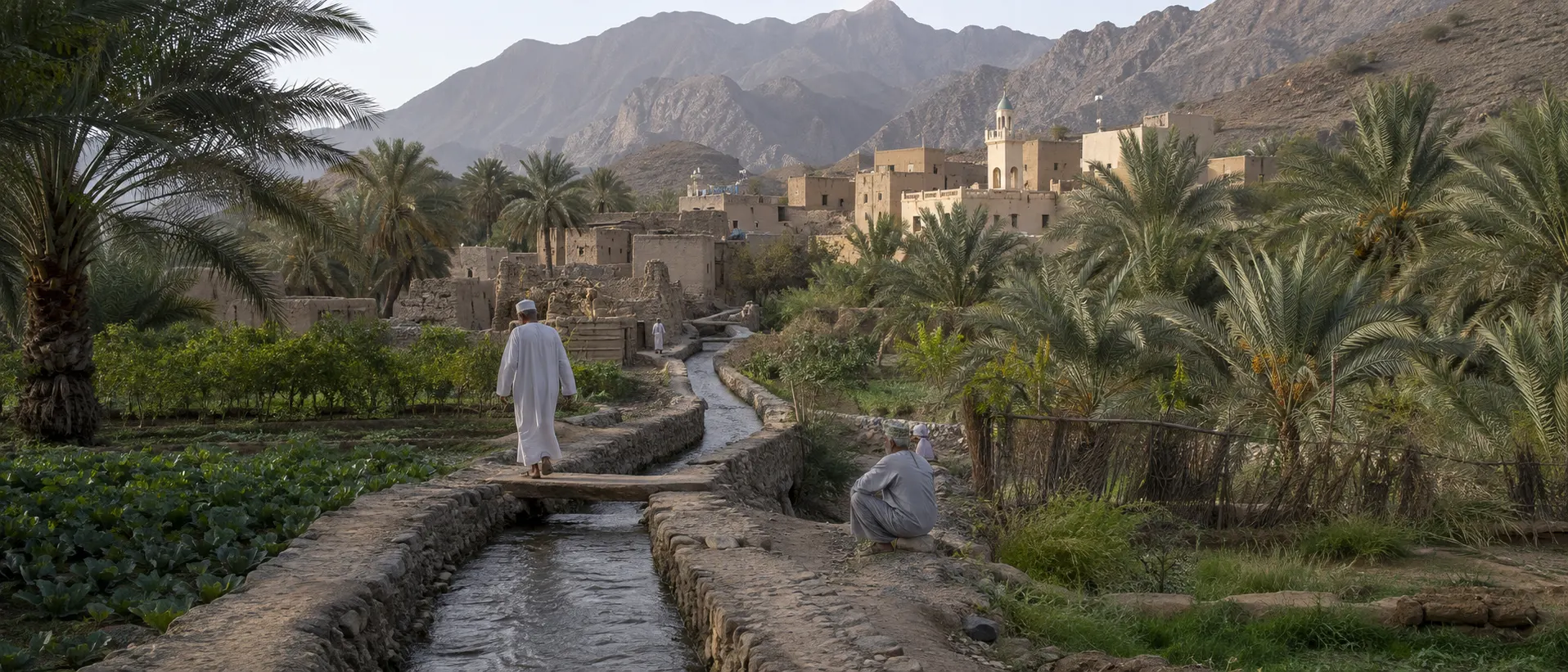
I have always felt something particular when I walk through an oasis.
It does not matter whether I am in Morocco, Oman or somewhere else. There is a moment when the heat softens beneath the palms. The air changes. Water appears where the surrounding land tells you it should be precious.
From a distance, many oases can look similar.
Walk inside them and they begin to speak differently.
“Water gives many oases the same feeling of relief. What people build around that water gives each oasis its own voice.”
Meskaoui
What Is a Falaj?
In Oman, a falaj is a traditional system that collects and carries water to where people need it. The plural is aflaj.
The principle can appear simple: water moves by gravity from underground sources, springs or surface flows through channels toward homes and agricultural land.
But simplicity of appearance should not be confused with simplicity of knowledge.
The UNESCO-listed Aflaj Irrigation Systems of Oman contain five representative systems and stand for more than 3,000 aflaj that are still functioning in the country.
A Technology Built Around Gravity
No electric pump is needed to explain the original idea.
The land itself does much of the work.
A carefully understood slope allows water to travel through underground or open channels. UNESCO broadly groups Omani aflaj into three hydrological types: aini, daoudi and ghaili, depending on the source of the water.
The result is not simply irrigation. It is a landscape designed around the movement of a scarce resource.
Falaj Daris and the Landscape Around Nizwa
One of the five UNESCO-listed systems is Falaj Daris, near Nizwa.
Nizwa is often introduced through its fort, souq and mountain setting. Yet the water system beneath and beside the visible heritage tells another story: agriculture and settlement could not be separated from the management of water.
You begin to understand the town differently when you stop seeing water as scenery.
Water Had to Be Shared
This is the part I find most interesting.
UNESCO describes the management of aflaj as being supported by mutual dependence, communal values and systems of equitable water sharing. Historically, the timing of water rights could even be guided by astronomical observations.
If several families depend on one flow, water becomes a question of time, responsibility and trust.
Who receives it first? For how long? Who maintains the channel? What happens when there is less than expected?
The Oasis Is Never Only Date Palms
Date palms dominate the image of many Arabian oases, but an oasis is usually more complicated when you walk through it.
Beneath and between the palms, other crops can appear. Trees provide shade for plants that would struggle in direct heat. Paths, walls, channels and plots reveal generations of decisions.
This is something I recognise emotionally from Meski, even though the local water systems and agricultural histories are not identical to those of Oman.
The first lesson is similar: when water is limited, a green place exists because people learned how to live with limits.
Two Oases Can Look Familiar and Taste Completely Different
I often think about this when I taste dates.
The fruit looks familiar. The palm looks familiar. The gesture of offering dates to a guest can feel familiar across the Arab world.
Then the flavour changes. So does the texture, sweetness and the stage at which people prefer to eat it.
The palm is shared language. The variety is local accent.
The Aflaj Are Still Alive
The most important thing about the aflaj is that they are not merely archaeological remains.
Thousands remain in use and continue to support agriculture and domestic needs. At the same time, UNESCO notes threats including declining groundwater levels.
They are heritage precisely because they still have work to do.
Why I Find Water Heritage So Powerful
A fort can impress you immediately. A palace can announce its history. A canal is quieter.
Yet a modest flow of water may have sustained more everyday lives than the grandest monument nearby.
That is why I like the aflaj. They remind us that civilisation is not only what people built to be seen. It is also what they built so life could continue.
Aflaj of Oman
Aflaj is the plural of falaj, the Omani term for traditional water systems that collect and channel water for agriculture and domestic use.
UNESCO says the five World Heritage-listed systems represent more than 3,000 functioning aflaj across Oman.