
Sidr crosses borders. The landscape does not. The useful comparison starts where the country name stops.
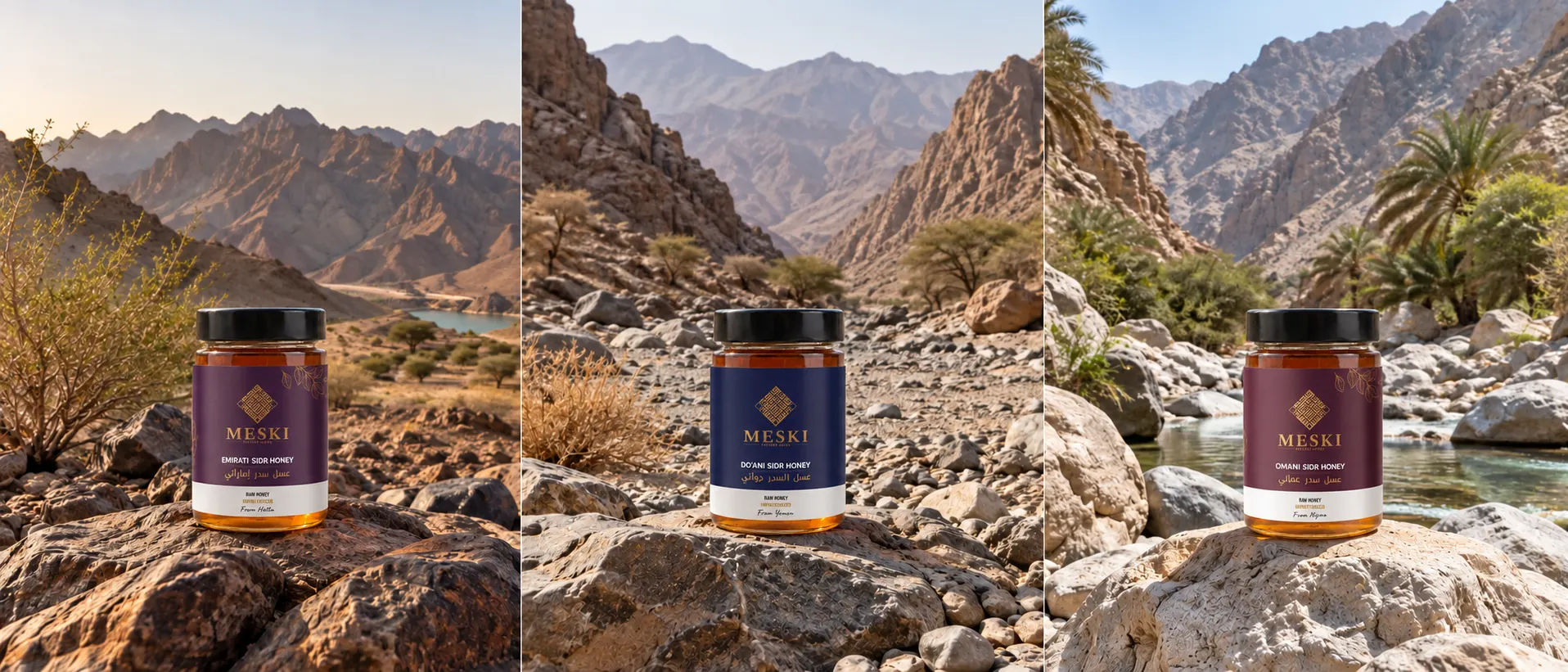
Sidr honey can come from Yemen, Oman or the UAE and still carry the same famous word on the label. That is exactly why country names are not enough. The difference begins with the flowering landscape and continues through the beekeeper, season and batch.
Three countries, one famous word: Sidr
Put a Yemeni Sidr, an Omani Sidr and an Emirati Sidr beside one another and the labels can make them look like variations of the same product. That is the wrong starting point. The shared tree name does not erase geography.
Yemen, Oman and the UAE contain different mountain systems, wadis, rainfall patterns, coastal influences, agricultural zones and beekeeping traditions. Honey carries some of that difference because nectar availability, surrounding flora, colony management and harvest timing all change with place.
Emirati honey is broader than Sidr
ADAFSA now describes a local honey sector that includes Sidr, Samar, Ghaf, Mangrove, Harmal and wildflower honey. That list is important. It tells us that Emirati honey should not be reduced to a local version of a famous Yemeni product.
The UAE’s own botanical identity matters. Ghaf ties honey to the national tree. Mangrove honey brings a coastal ecosystem into the jar. Hatta adds mountain and wadi environments. Abu Dhabi adds desert and coastal landscapes very different from the Yemeni valleys most consumers imagine when they hear Sidr.
Sidr crosses borders. Terroir does not.
Meskaoui
Yemeni Sidr carries a reputation built over decades
Yemeni Sidr is one of the most famous high-value honeys in the Arab world. Scientific work on Yemeni samples has examined botanical origin, pollen profiles and elemental composition, including samples from Hadramout and Shabwah.
That reputation is real, but reputation can create its own risk. The more valuable a name becomes, the more incentive there is to sell ordinary honey under that name. Yemen therefore teaches two lessons at once: exceptional origin can build a global reputation, and global reputation makes authentication more important.
Oman gives us scale and regional diversity
Oman produced 934,443 kilograms of honey in 2025, with North Al Sharqiyah, Al Dakhiliyah and North Al Batinah among the leading producing governorates. Its sector includes major Sidr and Samar harvests and smaller regional honeys such as frankincense blossom honey in Dhofar.
This makes Oman useful as a contrast. It is not one rare valley story. It is a large national beekeeping landscape with multiple governorates, mountains, plains, wadis and southern ecosystems.
The UAE adds mangroves to the comparison
One of the clearest differences is coastal honey. ADAFSA explicitly recognises Mangrove, or Qurm, honey among local Emirati varieties. Hatta Honey also markets mangrove honey harvested from mangrove nectar.
That matters because mangrove ecology is a different botanical world from a dry Yemeni Sidr valley or an Omani mountain wadi. The jar can come from the same country as desert honey while representing an entirely different habitat.
Hatta changes what ‘Dubai honey’ means
Dubai is often imagined through towers and coast. Hatta sits in rugged mountain country and has become a centre for honey events, agriculture and local producers. Dubai Municipality’s Hatta Honey Festival explicitly celebrates local production and the area’s natural and rural heritage.
An Emirati honey from Hatta therefore carries a mountain story that has very little to do with downtown Dubai. Country and emirate are still too broad if we want to understand the harvest.
The best country is the wrong question. The better question is: which harvest can you actually trace?
Meskaoui
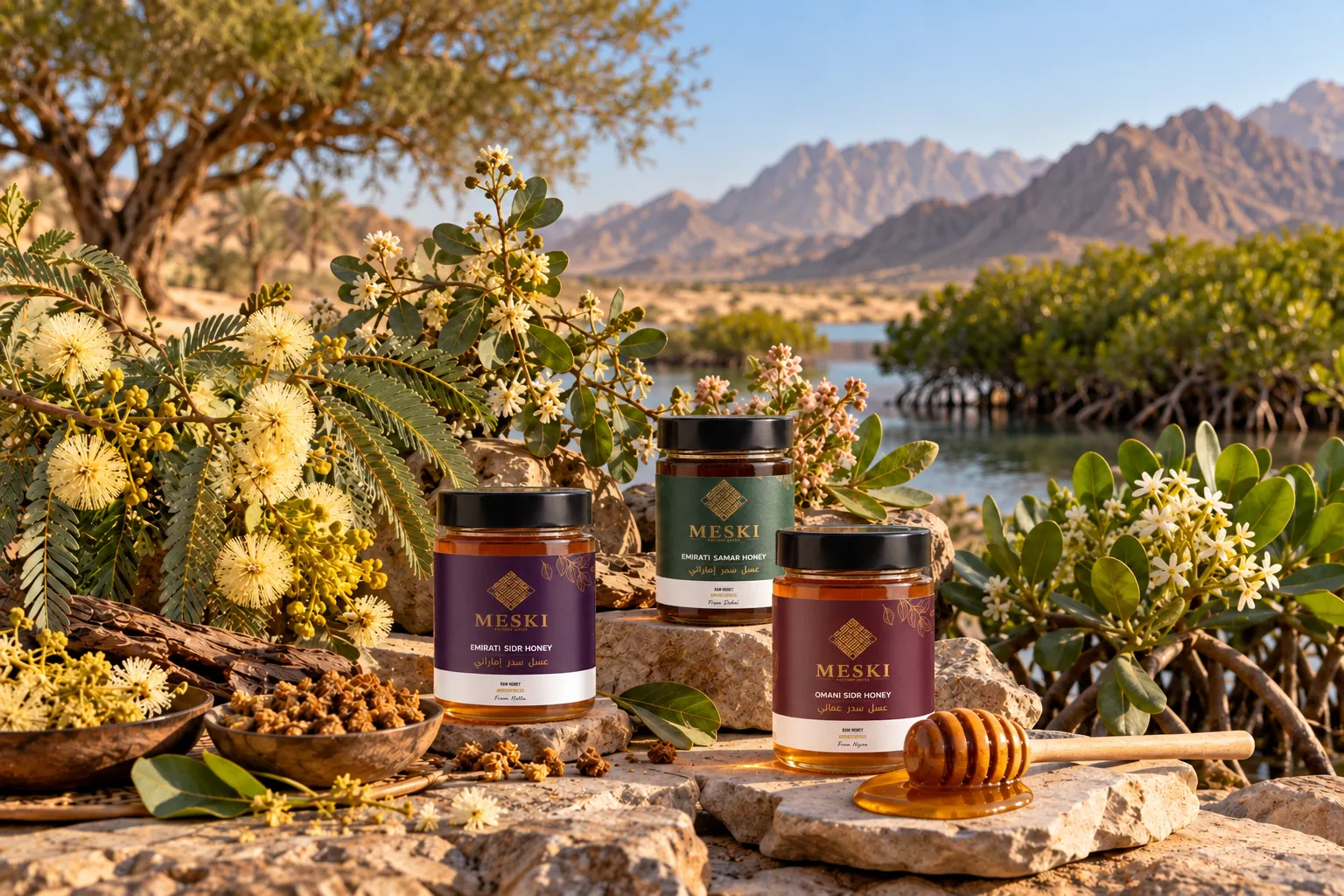
Samar links Oman and the UAE but not identically
Samar is important in both Oman and the UAE. In Oman, official production data show Samar as a major commercial harvest. In the UAE, ADAFSA recognises Samar among premium local honeys and won Gold for Samar at the 2026 Paris International Honey Awards.
The shared vernacular name does not guarantee identical flowering conditions, species composition or sensory profile. The useful comparison is not ‘which country’s Samar is best?’ but ‘what environmental and harvest conditions shaped this batch?’
Ghaf is where the Emirati identity becomes distinctive
Ghaf, Prosopis cineraria, is the UAE national tree. Commercial Ghaf honey is documented in Hatta, with a listed harvest season from June to July, and ADAFSA won a Silver award for crystallised Ghaf honey in 2026.
That gives Emirati honey a story that cannot simply be copied from Yemen or Oman. The national tree is not exclusive to UAE territory, but its cultural position inside the Emirates makes the honey locally meaningful.
Yemen’s advantage is not magic, it is specificity
When Yemeni Sidr is extraordinary, I do not think it is because the passport itself improves the honey. The strength comes from specific flowering landscapes, established local knowledge, recognised valleys and a market that learned to value certain harvests.
Scientific studies from Yemen have also shown that botanical and geographical origin can leave measurable differences in honey. That is a more useful explanation than saying Yemeni honey is simply ‘the best’.
Oman’s advantage is not volume either
Oman’s large recent production figures show a strong sector, not automatic superiority. A country can produce more honey and still contain average and exceptional batches side by side.
What Oman offers is diversity at scale. The buyer can compare Sidr, Samar, mountain areas, plains and Dhofar. The map becomes part of the tasting.
The UAE’s advantage is environmental contrast
The Emirates place desert trees, mountains, irrigated agriculture and mangrove coast within a compact geography. That diversity supports several honey stories without needing to imitate Yemen or Oman.
ADAFSA’s queen-bee programme also shows a state-backed effort to strengthen local beekeeping capacity. By 2026, the authority reported thousands of Emirati queens distributed over multiple generations and a new Abu Dhabi Honey initiative focused on quality and local environments.
Do the honeys taste different?
Often yes, but taste should be used carefully. Botanical origin, surrounding flora, moisture, storage and year influence colour, aroma, sweetness, bitterness and texture. A darker honey is not automatically Yemeni. A floral honey is not automatically Emirati.
Sensory comparison is most interesting when we already trust the origin. Taste then becomes a way to understand place rather than a game of guessing passports.
Which one should you buy?
Buy the harvest that is traceable and suits your taste. If you want classic high-reputation Sidr with a strong valley tradition, Yemen may attract you. If you want regional variety at scale, Oman offers a broad map. If you want Gulf desert, Ghaf, mangrove or Hatta stories, the UAE offers its own distinctive choices.
That is not a ranking. It is a way to match curiosity to origin.
MESKI should compare without making a winner
Our Honey Atlas is built for this kind of comparison. The point is to make origin more precise, not to create national competitions.
You can continue with our guides to Ghaf honey, Hatta honey and Omani honey. The more specific the map becomes, the less useful slogans become.
Climate is not a flavour chart
It is tempting to write a simple table saying hot desert equals dark honey, mountain equals thick honey and coastal equals mineral honey. Nature does not work that neatly. Climate affects flowering and water, but sensory outcomes depend on the actual nectar sources and harvest conditions.
We should use geography to ask better questions, not to manufacture stereotypes.
Beekeeping systems also change the jar
Traditional hives, movable-frame hives, migratory beekeeping, queen selection, feeding during scarcity and extraction practice can all differ between producers and regions. Country comparison that ignores beekeeping becomes tourism writing rather than honey analysis.
The same flowering tree managed by two beekeepers can still produce batches that differ in condition and presentation.
Why comparison should make provenance more valuable
The point of placing UAE, Yemen and Oman side by side is not to reduce them to three flavours. It is to make the buyer less satisfied with vague labels.
Once you know how much variation exists inside each country, ‘Product of Oman’ or ‘Yemeni Sidr’ begins to feel like a starting line rather than a complete answer.
One last MESKI rule
I would rather leave a documented limit visible than fill it with a perfect story. A tree can be real and a honey claim still need proof. A brand can be prestigious and a historical anecdote still need sourcing.
That distinction is part of the Journal’s voice. Curiosity is stronger when it is allowed to say: this is what we know, and this is where the evidence stops.
What makes the story worth publishing
The subject earns its place when it teaches something beyond the product: how a landscape works, how a gift carries meaning, how a material moves through history or how a beekeeper reads a season.
If the reader only remembers the jar, we have written an advertisement. If the jar becomes more interesting because the world around it is clearer, we have written MESKI.
One last MESKI rule
I would rather leave a documented limit visible than fill it with a perfect story. A tree can be real and a honey claim still need proof. A brand can be prestigious and a historical anecdote still need sourcing.
That distinction is part of the Journal’s voice. Curiosity is stronger when it is allowed to say: this is what we know, and this is where the evidence stops.
What makes the story worth publishing
The subject earns its place when it teaches something beyond the product: how a landscape works, how a gift carries meaning, how a material moves through history or how a beekeeper reads a season.
If the reader only remembers the jar, we have written an advertisement. If the jar becomes more interesting because the world around it is clearer, we have written MESKI.
Questions People Ask
The UAE combines desert trees, Hatta mountain environments, irrigated areas and mangroves, supporting honeys such as Sidr, Samar, Ghaf, Mangrove and wildflower.
No. Even when the botanical source is similar, geography, climate, surrounding flora, season and beekeeping practice can produce different harvests.
Yemeni Sidr has a long premium-market reputation and has been studied for botanical and geographical authenticity, especially in regions such as Hadramout and Shabwah.
Oman has a large, regionally diverse sector with major Sidr and Samar production across several governorates and distinctive southern environments in Dhofar.
Ghaf honey has a strong Emirati identity because Ghaf is the UAE national tree. Mangrove honey also reflects a distinctive coastal habitat.
Yes. ADAFSA recognises Samar as a local premium variety and won a Gold Award for Samar honey in 2026.
There is no useful universal winner. Compare traceable batches, regions, seasons and sensory quality rather than country names alone.
No. Taste can support sensory understanding but cannot prove geographical origin by itself.
Compare the exact region, botanical claim, harvest season, beekeeper or supplier chain, batch documentation, storage and analysis when available.
Compare origins without inventing a winner
Move from country names into Hatta, Ghaf, Oman and the Honey Atlas, where the map becomes specific enough to be useful.