
The Ghaf was important long before the honey became fashionable. That is exactly why its honey deserves a careful story.
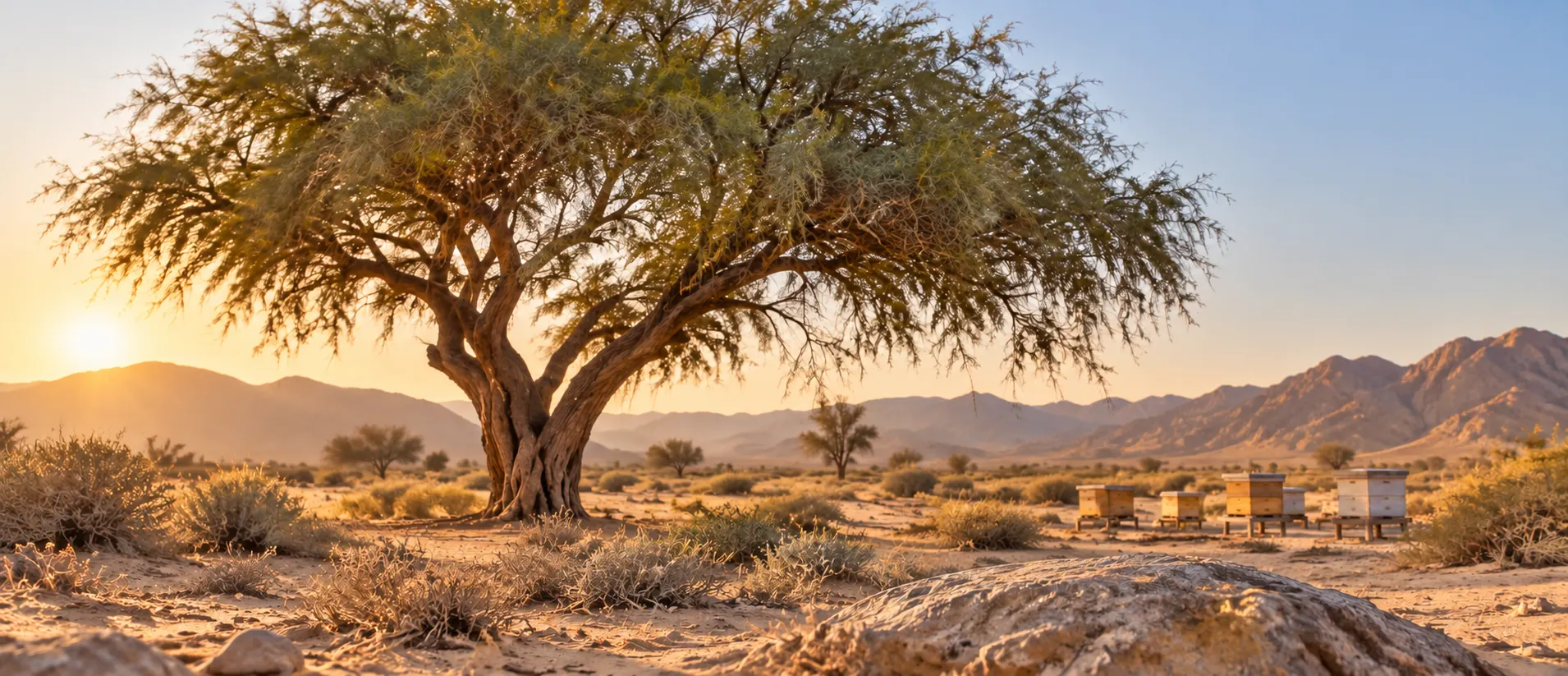
The Ghaf can stay green in a landscape that looks almost hostile to life. When it flowers and bees have enough access to it, that national tree can also become a distinct honey harvest. The botanical fact is real. The marketing still needs to be checked.
The Ghaf is famous before the honey is
The Ghaf, Prosopis cineraria, is the national tree of the United Arab Emirates. The Environment Agency Abu Dhabi describes it as a drought-tolerant tree able to remain green in harsh desert conditions and as a historic cultural symbol of stability and peace. Long before anybody put Ghaf honey into a premium jar, the tree already mattered for shade, livestock, food and survival.
That order matters. I do not want the honey to become an excuse for learning about the tree. The tree comes first. The honey is one of the newer ways many consumers are discovering a species that Emirati communities knew for generations.
Does the Ghaf really produce honey?
Yes. This is not only a marketing invention. Hatta Honey sells a monofloral Ghaf honey and identifies the nectar source as the Ghaf tree, with a harvest season from June to July. Abu Dhabi Agriculture and Food Safety Authority also includes Ghaf among premium honey varieties associated with the UAE’s natural environments.
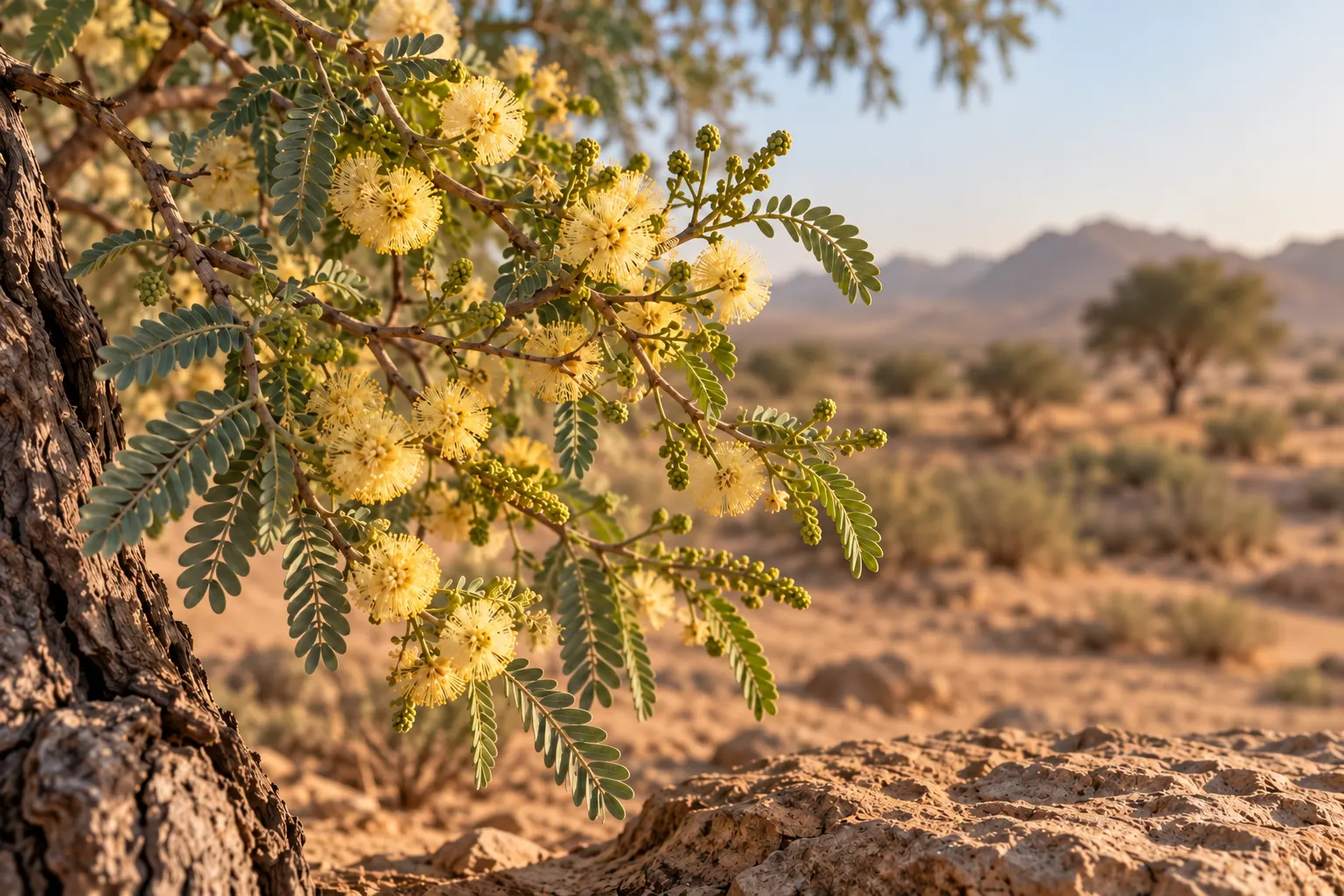
That does not mean every Ghaf tree automatically creates a jar of Ghaf honey. Bees need enough flowering trees within forage range, the weather has to support nectar secretion, colonies must be positioned in the right place and competing flowers matter. Botanical possibility is the first condition, not the full proof.
The national symbol belongs to the tree. The origin claim belongs to the batch.
Meskaoui
June and July change the picture
Hatta Honey lists Ghaf harvest from June to July. That is interesting because these are not gentle spring conditions. Summer in the UAE changes the way we imagine bees working. Heat management becomes part of the colony’s daily reality, and flowering that remains useful under those conditions becomes especially important.
This is one reason desert honey fascinates me. The landscape looks severe to us, but the bee reads it in a more precise way. One tree flowering at the right time can matter more than a green landscape photographed in the wrong season.
What does Ghaf honey taste like?
Hatta Honey describes its Ghaf honey as light brown at harvest, gradually darkening over time, with a floral aroma and a rich sweet taste. Those descriptions are useful as sensory notes, not authenticity tests.
A genuine Ghaf honey from another season or location may not match one producer’s exact colour or texture. Storage and crystallisation can also change appearance. The moment somebody says real Ghaf must always look exactly like this, I become suspicious. Nature is rarely that obedient.
A national tree does not make the honey automatically national
The phrase ‘UAE national tree in a jar’ is poetic, but it needs discipline. Ghaf is the national tree. A jar labelled Ghaf honey still needs an actual harvest origin. Was it collected in Hatta, Abu Dhabi, another emirate, or imported from elsewhere where Prosopis cineraria also grows?
National symbolism belongs to the tree. Commercial provenance belongs to the batch. Mixing those two ideas makes excellent advertising and weak traceability.
The 2026 Paris result made Ghaf honey harder to ignore
In 2026, ADAFSA won a Silver Award at the Paris International Honey Awards for crystallised Ghaf honey, alongside Gold Awards for Sidr and Samar. Emirati beekeepers also entered Ghaf samples among a wider group of local honeys.
I would not use an award as proof that every Ghaf honey is excellent. Competitions judge submitted samples. But the result is useful evidence that Ghaf is no longer merely an obscure local curiosity. It is part of a developing Emirati honey sector with serious producers, testing and international ambitions.
A desert tree does not need a miracle story. Surviving the desert and feeding bees in summer is already enough.
Meskaoui
Crystallised Ghaf is a useful lesson
Consumers often panic when honey crystallises. The 2026 award for crystallised Ghaf is a nice reminder that crystallisation is not automatically a defect. Honey crystallisation depends on sugar composition, water content, temperature and time.
A seller who promises that genuine Ghaf honey never crystallises is not protecting tradition. He is repeating a myth. The physical state of honey should be understood, not moralised.
Ghaf, Sidr and Samar should not be collapsed into one Emirati taste
The UAE now has an increasingly visible honey vocabulary: Sidr, Samar, Ghaf, mangrove, wildflower and other regional harvests. ADAFSA explicitly lists Sidr, Samar, Ghaf, Mangrove, Harmal and wildflower honey among local types connected to different natural environments.
This diversity is important commercially because it prevents one famous word, Sidr, from swallowing the whole sector. Ghaf honey gives the UAE a product directly tied to a nationally significant tree and a harsh desert ecology.
What would I ask before buying Ghaf honey?
First: where was it harvested? Second: what was the harvest period? Third: who produced it or supplied it? Fourth: is the Ghaf claim based on beekeeper knowledge only, or is there pollen or other analytical support? Fifth: does the batch identity connect to the documents being shown?
I would also ask how it was stored. Authentic honey can still be damaged by heat or poor handling. A national tree deserves better than a beautiful label covering a weak supply chain.
Is Ghaf honey rare?
That depends on what we mean by rare. Ghaf trees are culturally prominent in the UAE, but a commercial monofloral harvest still depends on sufficient flowering density and managed apiaries. It is not as globally famous as Yemeni Sidr or Manuka, and that relative obscurity can make genuine local batches feel unusual.
But scarcity should be demonstrated, not declared. I prefer ‘limited seasonal harvest from a named area’ to vague phrases like ‘one of the rarest honeys in the world’. The first can be checked. The second usually cannot.
Why MESKI should talk about Ghaf
MESKI already speaks about Sidr across Yemen, Oman, the UAE, Morocco and other regions. Ghaf prevents us from becoming a one-tree house. It reminds us that the Gulf’s botanical identity is larger than Sidr.
Our Honey Atlas can use Ghaf to explain a basic principle: every tree creates a different question. With Sidr we often ask which region. With Ghaf we first ask whether flowering density and apiary placement made a distinct harvest possible.
The tree survives first, the product comes second
The Environment Agency Abu Dhabi also warns that Ghaf faces pressure from urbanisation, infrastructure development and overgrazing. Conservation therefore belongs in the honey story whether brands like it or not.
If demand for Ghaf honey grows, the best outcome is not simply more jars. It is stronger incentives to understand, conserve and responsibly use the tree’s habitat. A product linked to a national tree should make the landscape more visible, not consume its symbolism and forget the roots.
Why flowering density matters more than one beautiful tree
A photograph of one mature Ghaf can prove that the species is present. It cannot prove that bees had enough Ghaf flowers across their forage area to produce a distinct monofloral harvest. For that, density and timing matter.
This is one of the most useful lessons in honey authenticity. Botanical presence is not botanical dominance. The beekeeper has to know what else was flowering and how concentrated the Ghaf stands were around the colonies.
Why the UAE’s local queen programme belongs in this story
ADAFSA’s development of an Emirati honeybee strain is not directly a Ghaf project, but it changes the local production context. By 2026 the authority reported ten completed generations since 2015 and an eleventh generation in production, with thousands of queens distributed to beekeepers.
A locally adapted beekeeping sector is part of how distinctive local honeys become repeatable commercial products. Trees alone do not create a sector. Beekeepers, colonies, standards and markets do.
What I would like to see next from Ghaf honey
I would like more batch-specific pollen work, harvest maps and year-to-year comparisons. Not because every jar needs a laboratory thesis, but because Ghaf is interesting enough to deserve documentation before marketing gets ahead of botany.
If the category grows carefully, Ghaf could become one of the best examples of an Emirati honey that is not borrowing its identity from somewhere else.
One last MESKI rule
I would rather leave a documented limit visible than fill it with a perfect story. A tree can be real and a honey claim still need proof. A brand can be prestigious and a historical anecdote still need sourcing.
That distinction is part of the Journal’s voice. Curiosity is stronger when it is allowed to say: this is what we know, and this is where the evidence stops.
What makes the story worth publishing
The subject earns its place when it teaches something beyond the product: how a landscape works, how a gift carries meaning, how a material moves through history or how a beekeeper reads a season.
If the reader only remembers the jar, we have written an advertisement. If the jar becomes more interesting because the world around it is clearer, we have written MESKI.
Questions People Ask
Ghaf honey is honey produced when bees collect nectar from flowering Ghaf trees, Prosopis cineraria, in sufficient concentration.
Yes. The Ghaf was declared the UAE’s national tree in 2008 and is recognised for its cultural and ecological importance.
Hatta Honey lists its Ghaf harvest season as June to July. Timing can vary by location and year.
One UAE producer describes its harvest as light brown and darkening with time, but colour alone cannot authenticate Ghaf honey.
It can. ADAFSA won a Silver Award in 2026 for crystallised Ghaf honey, and crystallisation is a natural process in many honeys.
It is less internationally known and commercial monofloral batches can be limited, but rarity should be supported by harvest information rather than marketing language.
Taste can describe a batch but cannot prove botanical origin on its own. Traceability and, when available, analytical evidence are more useful.
Commercial Ghaf honey is documented in Hatta, and Ghaf is also one of the local honey environments recognised by ADAFSA in Abu Dhabi.
This article does not treat traditional or commercial health claims as medical proof. Ghaf honey should be understood first as a food and a botanical harvest.
Follow Ghaf from symbol to flowering tree
Continue into Emirati honey, Hatta and the Honey Atlas to see how the UAE’s desert and mountain plants become different harvests.