
Oman produced nearly a million kilograms of honey in 2025, but the more interesting story begins when the national total breaks into seasons, wadis and trees.
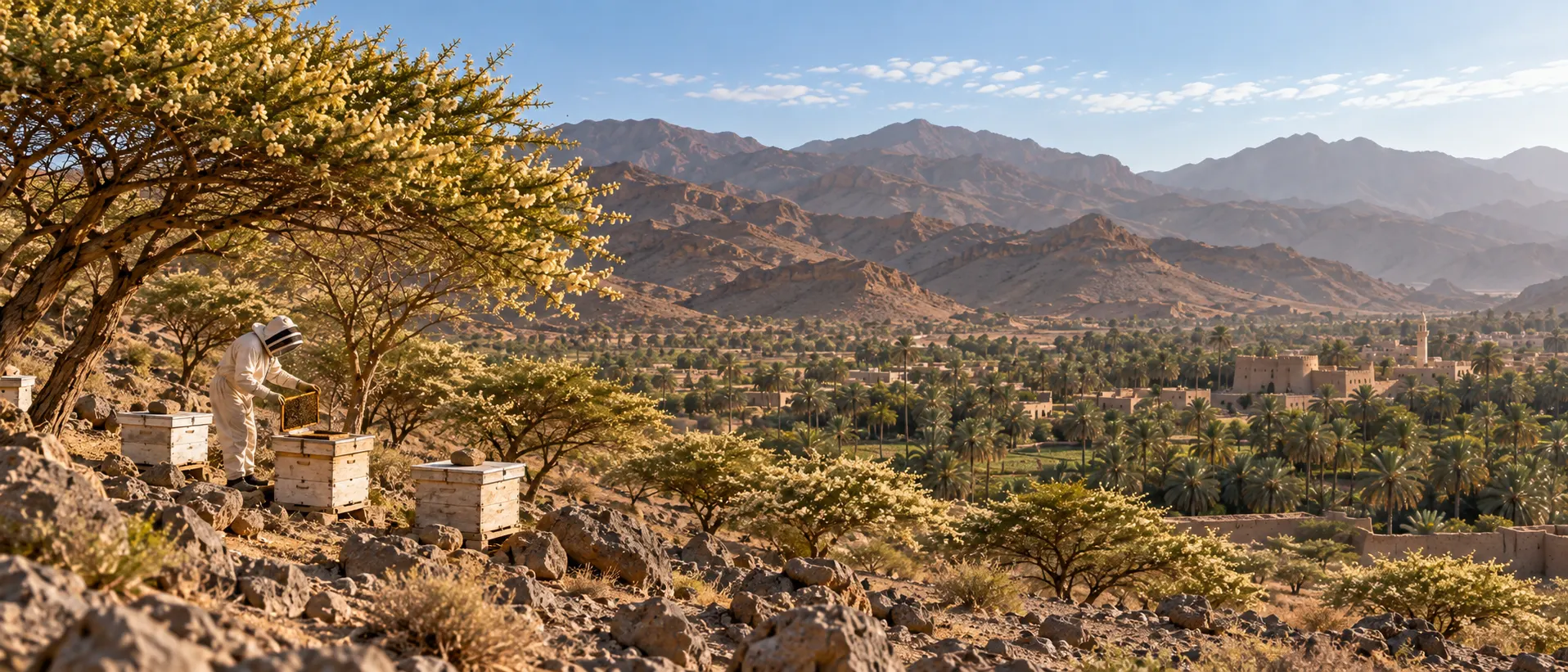
An Omani honey label can look simple. Sidr. Samar. Dhofar. Nizwa. But behind each word is a different flowering calendar, a different landscape and a beekeeper making decisions in heat, wind and scarcity.
Oman is not one honey country
Oman is often introduced to honey buyers through two names: Sidr and Samar. They matter, but they do not explain the whole country. Honey in Oman is shaped by a landscape that changes quickly between coast, gravel plain, wadi, oasis, mountain and monsoon-influenced south. The useful question is not simply which Omani honey is best. It is where the bees were working, what was flowering, what the season did and how the beekeeper managed the colonies.
In 2025 Oman produced 934,443 kilograms of honey according to figures reported from the National Centre for Statistics and Information. North Al Sharqiyah led production, followed by Al Dakhiliyah, North Al Batinah and South Al Sharqiyah. Those numbers are useful because they immediately break the lazy idea that Omani honey comes from one famous mountain village.
Sidr and Samar are seasons before they are labels
Sidr honey is associated with Ziziphus flowering, while Samar honey in Oman is tied to acacia-type forage that blooms under a different seasonal rhythm. In North Al Batinah alone, official 2025 figures separated 86,433 kilograms of Sidr honey from more than 71,567 kilograms of Samar honey. That is not a small niche hidden behind tourism language. These are working harvests in a living agricultural sector.
The difference between them begins before taste. Flowering time, temperature, rainfall, water availability and competing flora influence what bees can collect. A label may say Sidr or Samar, but the jar is the end of a biological event, not the beginning.
Oman is not one honey country. It is several flowering landscapes sharing one flag.
Meskaoui
Why mountains matter without becoming magic
I like mountain honey. That is a preference, not a scientific certificate. Mountain apiaries can be farther from dense urban activity, can sit near concentrated flowering in wadis and slopes, and can experience cooler nights or sharp changes in altitude. They can also be difficult to reach and expensive to manage. All of that can create distinctive harvest conditions.
But mountains do not automatically mean pure, organic, pesticide-free or superior. Bees still fly. Roads, farms and settlements exist. A remote-looking photograph cannot replace traceability. The landscape matters because it changes forage and management, not because the word mountain turns honey into a miracle.
North Al Sharqiyah, Al Dakhiliyah, Al Batinah: different honey geographies
North Al Sharqiyah was Oman’s largest honey-producing governorate in 2025 with 248,547 kilograms. Al Dakhiliyah followed with 176,428 kilograms, then North Al Batinah with 158,097 kilograms. Each of those regions contains a different combination of settlement, wadi systems, agricultural zones and access to uplands.
This is why a national guide should resist flattening. Honey from around Nizwa belongs to Al Dakhiliyah but does not automatically taste like honey from every other wilayat in the governorate. North Al Batinah combines fertile plains, valleys and mountains. North Al Sharqiyah includes its own dry interiors and seasonal forage. Country of origin is only the first layer.
The beekeeper moves through time as much as space
Beekeeping in a dry country is a calendar profession. A beekeeper watches bloom, wind, heat, rainfall and water. Colonies may need to be positioned where flowering will support them, then managed through periods when forage changes. Traditional knowledge and modern hive management can coexist in the same operation.
That seasonal attention explains why one year’s production can differ from another. Oman produced 623,313 kilograms in 2023, 765,054 in 2024 and 934,443 in 2025. Growth is real, but honey remains agricultural. A strong national number does not mean every micro-region or flowering season performed equally.
Traditional hives, modern frames and the temptation to romanticise
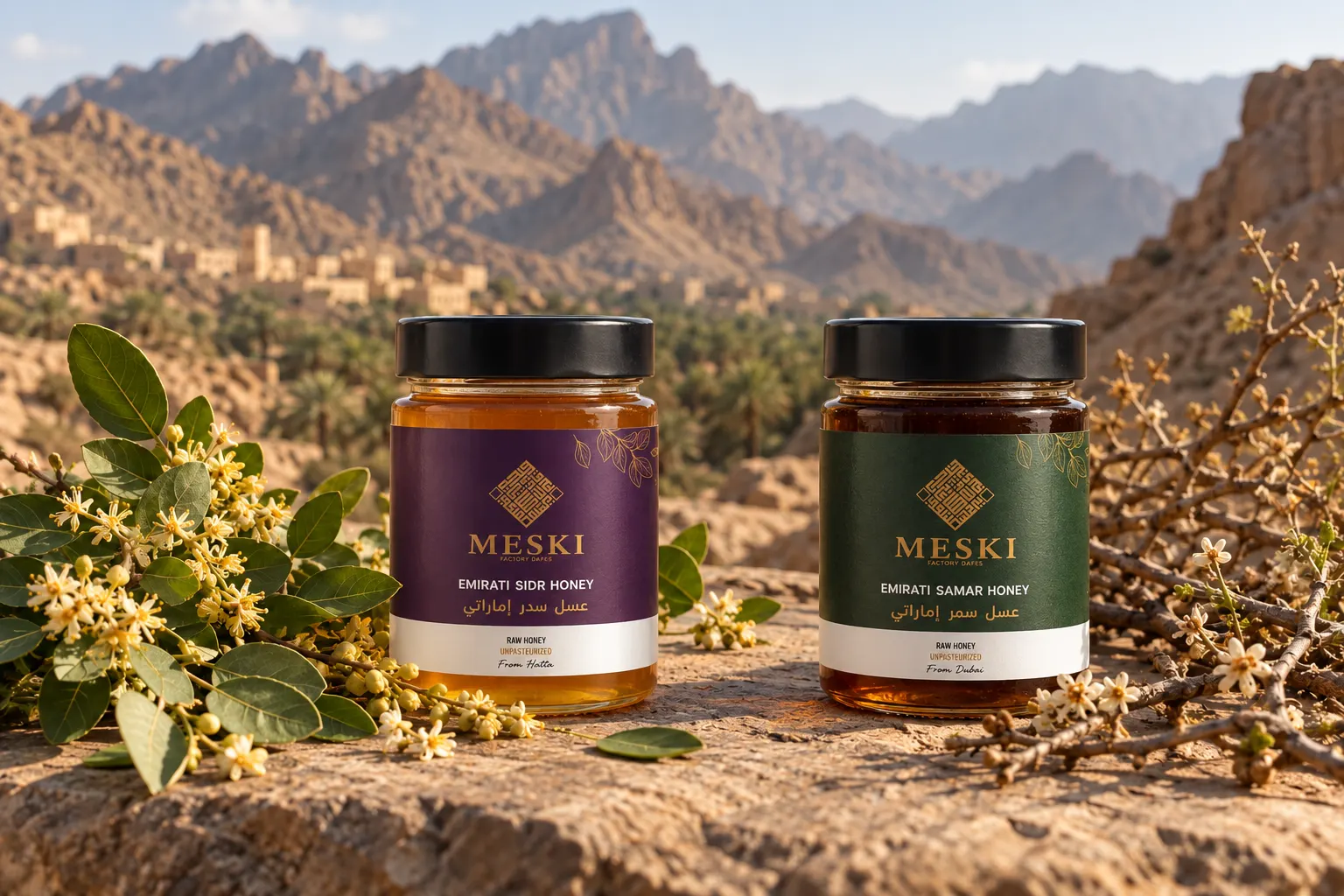
Omani beekeeping is often photographed through traditional palm-trunk hives or rustic mountain scenes. Those images are important, but tradition should not be used to imply automatic quality. Modern movable-frame hives can make inspection, colony management and hygienic extraction easier. Traditional systems can preserve local knowledge and practical adaptations. Neither system deserves blind worship.
What matters is whether the beekeeper understands colony health, harvest timing, storage and the forage around the apiary. I do not want to romanticise a wooden hive just because it looks older. Bees do not care whether our photograph feels authentic.
A famous tree name is useful. A famous tree name without a traceable harvest is just very efficient marketing.
Meskaoui
Samar deserves more attention
Samar honey is sometimes treated as the second name after Sidr. That is unfair. In hot environments, the flowering associated with Samar can support a very different harvest window, and its honey may show a darker, deeper sensory profile depending on region and year. In several Omani governorates it is a major commercial honey in its own right.
This also matters for buyers. If everybody asks only for Sidr, the market learns to print Sidr on everything. Paying attention to Samar, mixed floral harvests and regional variation makes the conversation healthier and rewards real diversity instead of one famous word.
Dhofar adds another Oman entirely
Dhofar changes the national story again. The south has a monsoon-influenced ecological system unlike much of northern Oman, and it is the natural home of Boswellia sacra, the frankincense tree. Dhofar produced 64,216 kilograms of honey in 2025 according to national figures, but its importance cannot be reduced to volume.
Frankincense blossom honey is documented by Razat Royal Farm, which notes honey produced from Boswellia sacra flowers. That does not mean every jar labelled frankincense is automatically verified, nor that all Dhofar honey comes from frankincense. It means the botanical possibility is real and deserves careful sourcing.
How to read an Omani honey label
Start with governorate and, if possible, wilayat or apiary area. Ask which flowering the seller is claiming, and whether the harvest period makes sense for that forage. Look for a meaningful batch. If laboratory results are offered, they should relate to the batch rather than float as a generic certificate beside every jar.
Then consider storage and condition. A genuine Omani honey can still be badly stored. Crystallisation is not fraud. Darkness is not proof. Density is not geography. The strongest story is one where place, season, beekeeper, batch and analysis agree with one another.
What Oman teaches about terroir
Wine made the word terroir famous, but honey often deserves it more than we admit. Bees move through an actual flowering landscape. If that landscape changes, the harvest changes. Soil does not enter honey directly in a simple way, but soil, water, altitude and climate affect the plants that produce nectar and pollen.
This is why our Honey Atlas treats origin as more than a flag. Oman is especially useful for this approach because the country contains multiple ecological worlds within a relatively compact geography.
Sidr versus Samar is the wrong final question
People often ask which is better, Sidr or Samar. I understand the question, but I prefer another one: which harvest is most coherent, alive and traceable? A careful Samar from a strong season can be more interesting than a tired Sidr sold only on reputation. A remarkable Sidr can show why the name became famous in the first place.
The tree matters. The beekeeper matters. The season matters. The jar matters. Honey becomes boring when we let one famous word do all the thinking for us.
A national production record is not a quality score
Nearly one million kilograms sounds impressive, and it is important for the Omani beekeeping sector. But production volume should not be confused with a sensory ranking. A governorate can produce more because it has more beekeepers, more hives, stronger forage, better organisation or a good season. None of those facts automatically tells us which individual jar we would prefer.
This distinction matters for MESKI because numbers can easily become marketing weapons. We should use them to understand scale and geography, not to declare that a country or region is superior.
Why year-to-year comparison matters
Oman’s recent figures moved sharply: 623,313 kilograms in 2023, 765,054 in 2024 and 934,443 in 2025. Agriculture behaves like this. Rainfall, heat, flowering and colony condition change. A beekeeper who says every year is identical is not describing nature.
For buyers, vintage thinking can be useful even in honey. Not every harvest needs to taste exactly like the previous one. Variation can be evidence that the product still belongs to a season rather than a factory formula.
A note on certainty
One rule matters across all MESKI field articles: separate what the source proves from what the landscape merely suggests. A flowering tree does not prove a monofloral honey. A famous market does not prove harvest origin. A mountain photograph does not prove remoteness.
This restraint can make the prose less dramatic, but it makes the story stronger. The reader should know where evidence ends and interpretation begins.
Why this matters commercially too
Good editorial work and good commerce are not enemies. A customer who understands season, tree and origin is more difficult to impress with empty packaging, but also more capable of appreciating a genuinely rare harvest.
That is the kind of customer MESKI should want. Authority built through careful explanation lasts longer than a slogan.
Questions People Ask
Official figures reported by Omani media from the National Centre for Statistics and Information put 2025 production at 934,443 kilograms.
North Al Sharqiyah led with 248,547 kilograms, followed by Al Dakhiliyah, North Al Batinah and South Al Sharqiyah.
Sidr and Samar are among the best-known commercial types, alongside mixed floral honeys and smaller regional harvests including frankincense blossom honey in Dhofar.
No. The botanical claim may be similar, but region, flowering density, weather, water, surrounding flora and beekeeper practice can change the harvest.
Samar honey is associated with nectar gathered during flowering of local acacia-type trees commonly called Samar in Oman and neighbouring Gulf regions.
A government-linked Omani source, Razat Royal Farm, states that honey is produced from Boswellia sacra flowers in Dhofar. Individual jars still require normal traceability.
No. Mountains can create distinctive forage and remoteness, but they do not guarantee purity, authenticity or superior quality.
Choose the harvest you enjoy and can trace. The name of the tree should not replace information about origin, season, storage and batch.
MESKI’s Honey Atlas and our separate Nizwa honey article continue the story by focusing on landscapes rather than national labels alone.
Follow the honey back to the landscape
Continue with Nizwa, Dhofar and the Honey Atlas to see why Omani honey makes more sense region by region.