
Arabian Life · Food & Hospitality
Corporate, Client & VIP Gifts in Dubai and the Gulf:
A Cultural Gift With a Story
Employee, client, conference, delegation or VIP: the best corporate gift begins by understanding the relationship, then builds the story from origin to guest.
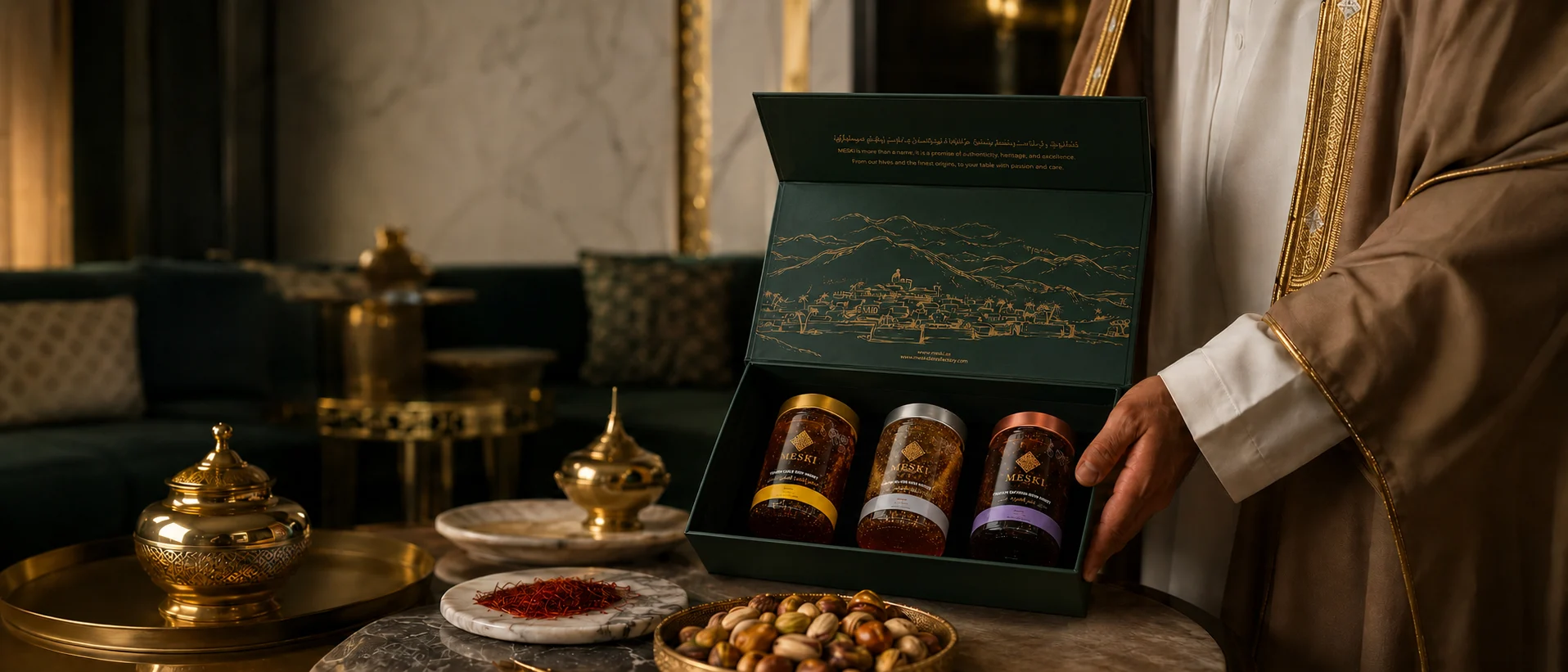
Most corporate gift catalogues begin with quantity.
50 pieces. 100 pieces. 300 pieces.
I understand why. Logistics matter.
But if you begin only with the number, you can end with a gift that is perfectly delivered and completely forgettable.
I prefer another first question:
Who are you trying to honour?
An employee? A client? A speaker? A visiting delegation? A VIP guest?
Once we know that, the box can begin to mean something.
Are you giving to an employee, a client, a speaker or a VIP?
The phrase corporate gifts Dubai sounds simple until you ask who is actually receiving the gift. An employee receiving a Ramadan thank-you is not in the same relationship as a new client. A conference speaker is not the same as a visiting delegation. A senior partner is not the same as 200 seminar participants. The object may be similar, but the meaning cannot be.
That is why we prefer to begin with the relationship. Employee gifts UAE can express recognition. Client gifts Dubai can carry the image of a company. VIP gifts Dubai need to feel considered without becoming theatrical. Conference gifts Dubai have to survive scale and logistics. A cultural gift for a client has another responsibility: it should say something true about the place or culture you want to share.
The old Gulf language of hospitality gives us a useful reference point. UNESCO describes Arabic coffee as a symbol of generosity across the UAE, Oman, Qatar, Saudi Arabia and Jordan, and describes the majlis as a social space for receiving guests, exchanging news and maintaining community relationships. UNESCO on Arabic coffee and UNESCO on the majlis are reminders that receiving someone well is older than the modern corporate gift catalogue.
Most corporate gifts begin with the box. Ours begins with a place.
This is the idea I want MESKI to protect even when an order becomes large. A box can be manufactured quickly. A story cannot be invented at the last minute without feeling false.
For us, the route is longer: the landscape, the tree, the bee, the beekeeper, the harvest, the honey, the jar, the finishing ingredients, the box, then the guest. Each stage should be able to answer a question. Where is this honey from? Why this variety? Why this gold? Why this saffron? Why these nuts? Why this presentation?
From the landscape to the tree. From the tree to the bee. From the bee to the beekeeper. From the beekeeper to the jar. From the jar to the box. And from the box to your guest.
Meskaoui
That sequence matters because it reverses the normal corporate process. Instead of choosing a box and finding something to fill it, we begin with what is worth giving and build the presentation around it.
Tradition does not have to look old
A cultural gift does not need to imitate an antique souq. It does not need a camel silhouette, a skyline printed on the lid or a decorative object that nobody knows what to do with. Tradition can remain alive inside modern materials and precise presentation.
Arabic coffee itself is a good example. UNESCO recognises the practice as living heritage, not as a museum object. The rules of serving, the respect shown to guests and elders, and the exchange of conversation remain meaningful even in contemporary settings. MESKI approaches gifting with the same idea: preserve the meaning, not a costume.
Honey is old. The way we select it can be modern. Hospitality is old. The way a box is finished can be contemporary. Gold can add ceremony without pretending to create value by itself. Saffron can connect a familiar Gulf aroma to another place. A carefully selected nut can bring a different texture and origin. Tradition and modernity do not have to fight inside the same gift.
Offer Oman through taste, not through a souvenir
If your company wants a VIP gift Oman or a gift that evokes Oman, I would rather begin with flavour than with a generic symbol. Oman’s official tourism platform describes Omani coffee and halwa as integral to hospitality, with dates, saffron, almonds, rose water and kahwa forming part of that sensory language. Experience Oman presents hospitality through taste and serving traditions.
That gives us a more interesting idea for luxury gifts Muscat, corporate gifts Oman or client gifts Oman: offer a carefully selected Omani honey and explain the origin. Let the recipient taste a place rather than receive a miniature of it.
For MESKI, an Omani jar can be connected to Nizwa or another documented origin when the specific honey supports that story. The gift becomes a small journey: not “here is an Omani-themed object”, but “here is something whose taste came from a real Omani landscape.”
France through saffron. Italy through nuts. The Gulf through honey.
A MESKI gift does not have to pretend that every element was born in the same country. In fact, one of the most beautiful things about a carefully built gift is that it can tell the truth about several origins at once.
When a collection uses French saffron, we can say so. When selected nuts come from Italy, that origin can become part of the story rather than disappearing behind the word “premium”. Gold and silver used in particular MESKI collections are sourced through European partners, including France and Germany. The exact composition should always be stated for the actual collection being ordered, not generalized across every MESKI box.
This is what I mean by changing gifting habits through the culture of MESKI. Do not hide the journey. Make it part of the pleasure. Offer Oman through taste, France through saffron, Italy through selected nuts, and bring those places together through a house that explains why each one is there.
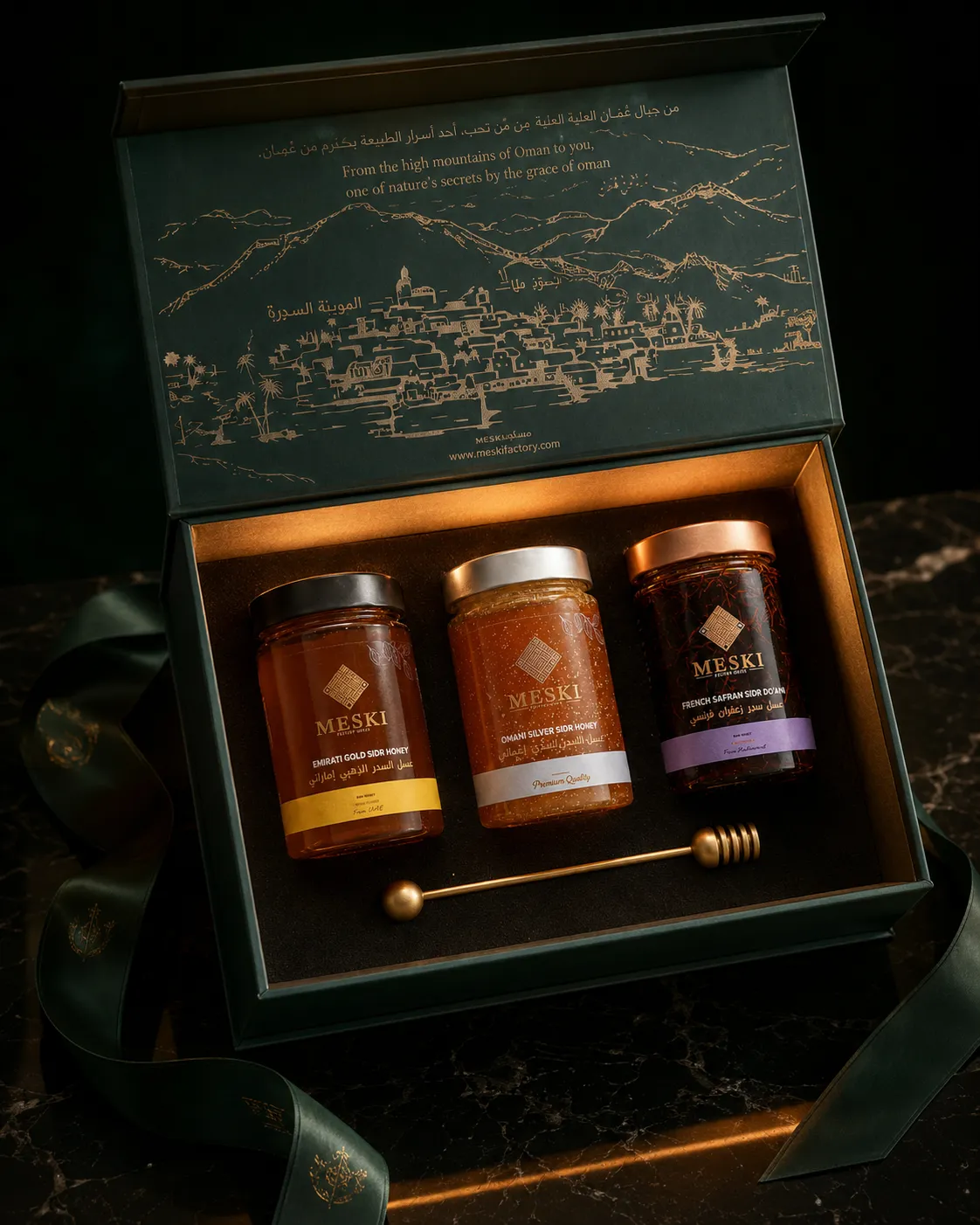
Gold corporate gifts: luxury should arrive after the story, not before it
Searches such as gold corporate gift Qatar, gold corporate gifts Dubai or luxury VIP gifts UAE are understandable because gold communicates ceremony immediately. But gold can also become a shortcut. If the only memorable thing about the gift is that it contains gold, the story underneath may be too weak.
Our view is the opposite: gold does not make the honey precious. It dresses something that was already worth selecting. The floral origin, the beekeeper, the harvest and the taste must come first. Gold, silver or saffron can then create a moment around the jar.
This matters particularly for VIP gifting. A senior guest is likely to have received many expensive objects. Rarity without explanation can still feel generic. A honey with a specific origin, presented with restraint and a short origin card, gives the recipient something to discover after the box is opened.
Dubai: seminars, conferences, delegations and the problem of scale
A seminar gift Dubai has to solve a different problem from a single VIP box. The story must remain intact when the quantity becomes 30, 80 or 200. Packaging has to be consistent. Delivery date matters. The recipient list may be international. The gift has to work without a ten-minute explanation from the person handing it over.
For that reason, we like the idea of a short story card: origin, honey type, one sentence about the beekeeper or landscape, and the reason the collection was assembled. That card can do more cultural work than a large logo.
For conference gifts UAE, delegate gifts Dubai, speaker gifts Dubai or event gifts UAE, planning also matters. Rare honey and special finishing materials are not supermarket stock. A serious quantity should be discussed early, with the exact event date, delivery location, quantity and desired presentation.
Qatar: when the modern event meets the old majlis
Qatar deserves its own dedicated article, but it belongs in this Gulf overview because the contrast is especially visible there. Visit Qatar describes the majlis as a central place for receiving guests, with dates and Arabic coffee as part of hospitality. Doha also hosts a dense calendar of conferences, exhibitions and hospitality events. Visit Qatar on majlis culture and its events calendar show those two worlds side by side.
That makes phrases like corporate gifts Qatar, VIP gifts Qatar, luxury corporate gifts Doha and cultural gifts Qatar more interesting than simple product keywords. The gift can sit between modern business and a much older etiquette of receiving the guest.
We explore that specifically in our Qatar gifting article, where gold, honey, the majlis and modern events become part of one conversation rather than four separate keywords.
A cultural gift for your client should not become a tourist cliché
If you search cultural gift for client, the temptation is to look for something visually “Arabian”. I would rather ask what cultural value you want the client to feel. Generosity? Welcome? Taste? Origin? Sharing?
A jar of rare honey can carry those ideas quietly. It can be opened at home. It can be placed on a breakfast table. It can be offered to family. It can be remembered through taste rather than through a corporate logo.
This is why we see a difference between a souvenir and a cultural business gift. A souvenir says “I was here.” A good cultural gift says “I thought about what it means to receive you here.”
The box still matters. It just should not be the first reason.
Luxury presentation matters in the Gulf. I do not want to pretend otherwise. Weight, closure, alignment, protection of the jars, the first view when the lid opens, the feel of the materials, all of that communicates care. A rare honey in weak packaging is disappointing. A perfect box around ordinary contents is empty theatre.
The standard should be simple: the packaging must not disappoint the product, and the product must justify the packaging. MESKI’s role is to make those two levels meet.
For larger corporate projects, exact customisation depends on quantity, lead time and the collection selected. We prefer to discuss what can genuinely be prepared rather than promise unlimited personalisation before understanding the event.
Change your gifting habits through the culture of MESKI
There are gifts that end at the moment of handover. The recipient says thank you, carries the bag away, and the object disappears into a drawer.
We want a different ending. Someone opens the box. They see a jar. They read where it came from. They taste it. Perhaps they notice the saffron, the nuts, the gold or silver detail. Perhaps they serve it to someone else. The corporate gesture continues as a small act of hospitality.
That is the ambition behind MESKI corporate gifts, VIP gifts in the Gulf and cultural gifts for clients. Not to make the loudest gift. To make one that has enough substance to be explained from beginning to end.
Procurement can be practical without making the gift impersonal
Corporate procurement needs deadlines, quotations, approvals and budgets. None of that is the enemy of meaning. The problem begins only when procurement becomes the only language of the gift.
A useful process is to separate the project into two tracks. Track one is operational: quantity, budget range, delivery city, event date, packaging constraints, recipient list and approval deadline. Track two is editorial: what is the story, what origin do we want to present, what does the company want the recipient to feel, and how much explanation is appropriate?
When the two tracks meet early, the project is easier. A 100-piece order can still feel considered because the story was designed before printing began. If the story is added the night before delivery, it usually sounds like advertising copy.
What should be written on the card inside a cultural corporate gift?
The card should not try to be the whole MESKI Journal. For a busy executive or conference guest, I would keep it to three levels: what this is, where it comes from, why it was chosen.
For example: “This Sidr honey was selected from Hatta in the UAE. We chose it for its origin and character as part of a gift built around Gulf hospitality. We hope you open it, taste it and share it.” That is enough. If a collection includes French saffron, Italian nuts, gold or silver, a second short line can identify them.
The strongest card is one the recipient actually reads. A beautiful essay that remains folded under the jar has failed its job.
When should a company choose one origin, and when should it choose a collection?
A single-origin gift is powerful when the place matters. A UAE company welcoming visitors may choose Hatta to give something locally rooted. An Oman event may prefer an Omani honey. A company with strong ties to Yemen may choose Do’ani Sidr. One origin creates clarity.
A collection is better when the idea is comparison or travel. Three honeys can become three landscapes. A corporate story about regional connections can move from UAE to Oman to Yemen. A box built around “the Gulf through taste” can justify multiple origins more naturally than a box that simply wants more jars.
Neither approach is automatically more luxurious. Luxury comes from selection and coherence.
Corporate gifting across cultures: avoid assumptions about the recipient
Dubai, Doha and Muscat business events bring together people from many backgrounds. A cultural gift should therefore explain itself without assuming that the recipient already knows Sidr, Samar, the majlis or the significance of Arabic coffee.
That is another reason food works well. The recipient does not need specialist knowledge to taste honey. The explanation can add depth without becoming a barrier. At the same time, companies should consider allergies, dietary restrictions and travel constraints for any food gift and plan alternatives where needed.
Respecting culture also means respecting the individual. A meaningful regional gift is strongest when it invites curiosity rather than demanding that every recipient interpret it the same way.
Corporate, Client & VIP Gifting: Practical Questions
No. Employee gifts usually express recognition or belonging, while client gifts represent a business relationship and the image of the giver. The product can overlap, but message, quantity and presentation should be chosen differently.
A strong VIP gift combines quality, provenance, presentation and a clear reason for choosing it. The recipient should be able to understand why the gift is special without relying only on price or visible luxury.
Yes, especially when its origin is explained honestly. Honey connects taste, landscape, beekeeping and hospitality. It becomes more meaningful when the recipient knows where it came from and why that origin was selected.
Large quantities can be discussed based on date, location, quantity and the specific collection. Advance planning is important because rare honeys and special materials may require preparation and sourcing time.
Instead of using a generic Omani souvenir, a gift can present an Omani honey with a documented origin and a short explanation of place and taste. It lets the recipient experience the country through something produced there.
Because a good gift can tell several truthful origin stories. When a specific collection uses French saffron or selected Italian nuts, MESKI can identify those origins instead of hiding them under a generic luxury label.
No. Gold can add ceremony, but it cannot compensate for weak contents. MESKI’s approach is to select the honey first, then use gold, silver, saffron or other elements to support the story and presentation.
The most useful starting details are quantity, required delivery date, delivery location, recipient type, occasion and desired level of presentation. Those details determine what can be prepared responsibly.
It is a gift that communicates something genuine about a place, tradition or value rather than relying on a decorative cliché. In the MESKI approach, honey, origin, hospitality and the story of selection carry that cultural meaning.
Build a Gift That Can Be Explained
For a seminar, client, delegation or VIP guest, start with the occasion and the story you want the recipient to carry away.