
In a Qatari welcome, the first memory may be a date in the hand and fragrance already moving through the room.
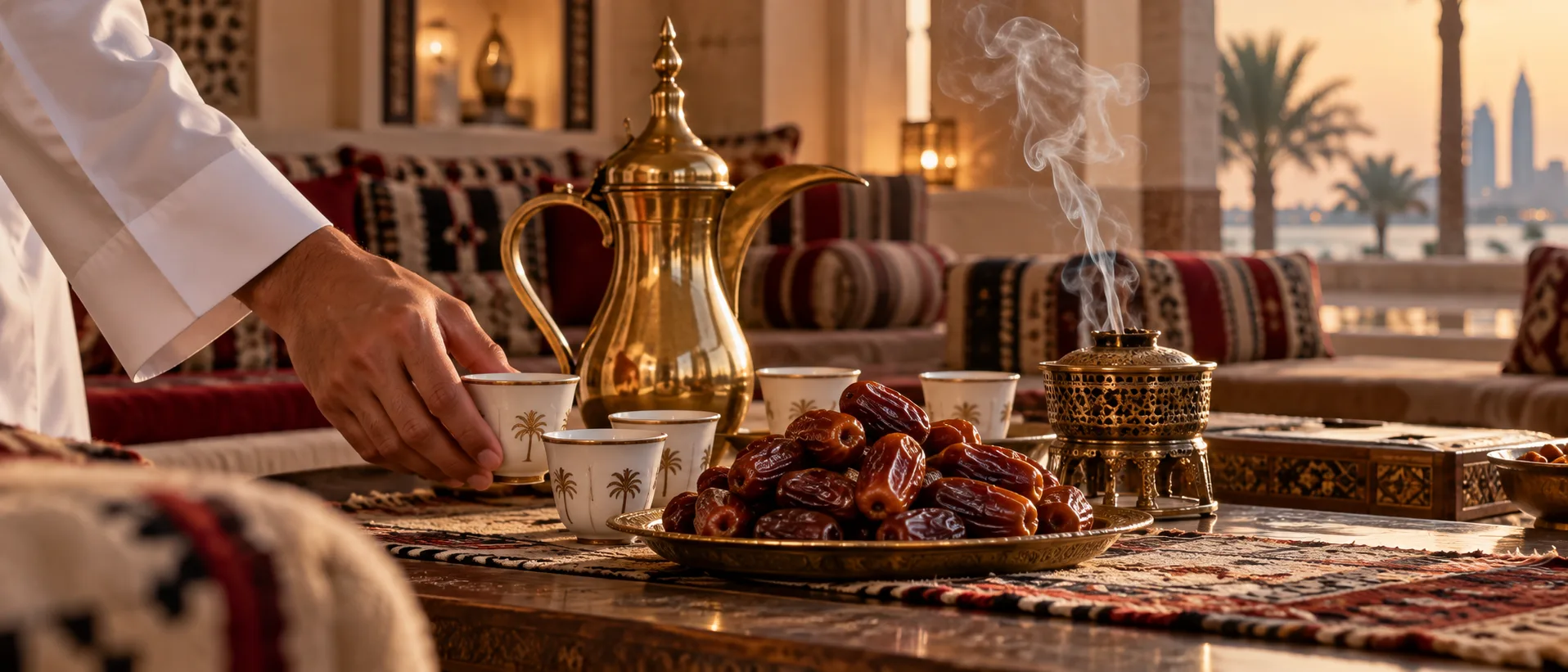
Before the main meal, before the long conversation, sometimes even before the guest is completely seated, the welcome has already begun. Dates, Arabic coffee and bukhoor form a quiet language of readiness.
Hospitality begins before the guest is fully seated
There is a particular kind of hospitality in which the welcome begins before anybody announces that the welcome has begun. A tray appears. Dates are already within reach. Coffee follows. Somewhere in the room, bukhoor has left a warm trail in the air. You have not yet reached the main conversation, but the house has already spoken.
This is the Qatar I want to write about here. Not an inventory of things Qataris serve, but the choreography of arrival. The date matters because it is small, immediate and generous. It does not ask the guest to wait for a kitchen.
The date palm is not decoration
The date palm belongs to a much larger cultural geography stretching across the Arab world and beyond. In 2022, the knowledge, skills, traditions and practices associated with the date palm were inscribed by UNESCO as intangible cultural heritage through a multinational nomination that includes Qatar.
That wording is useful. UNESCO did not inscribe a fruit as if it were an object in a museum. The inscription concerns knowledge and practices: cultivation, use, craft, social traditions and the relationships communities build around the palm. The tree is valuable because people kept knowing what to do with it.
A date offered immediately says something simple: we were ready for you.
Meskaoui
Khalas and the taste of caramel
Khalas dates are particularly loved across parts of the Gulf and are highly visible in Qatar. They are often appreciated for a balanced sweetness and caramel-like character. At Qatar’s 2026 Local Dates Festival, Khalas was reported as the best-selling variety, ahead of Shishi and Khenaizi.
I understand the preference. A good Khalas does not need to shout. Its sweetness can feel rounded rather than aggressive, and the caramel impression makes it particularly natural beside bitter Arabic coffee.
Coffee, dates and the first minutes of a visit
Visit Qatar describes dates and Arabic coffee as staples of majlis hospitality. The pairing works because the two foods correct one another. The coffee can be lightly bitter, aromatic and spiced. The date brings sweetness, texture and energy in one bite.
But the important part is not flavour science. It is readiness. These are foods that can be offered quickly and repeatedly. A guest can accept a little or stay longer. The ritual scales with the visit.
Then the room smells different: bukhoor
Bukhoor changes hospitality because scent reaches the guest before an object does. Visit Qatar notes the custom of passing bukhoor among guests so that the fragrance settles into hair, clothing and hands, and explicitly connects the practice to Qatari hospitality in the same world as coffee and dates.
This makes sense to me. Hospitality is remembered through more than taste. A room has temperature, sound, fabric, light and smell. If a fragrance remains on your clothes after you leave, the visit literally travels with you.
Honey does not need to be inserted into every tradition just because we sell honey. That would be very convenient for us haha.
Meskaoui
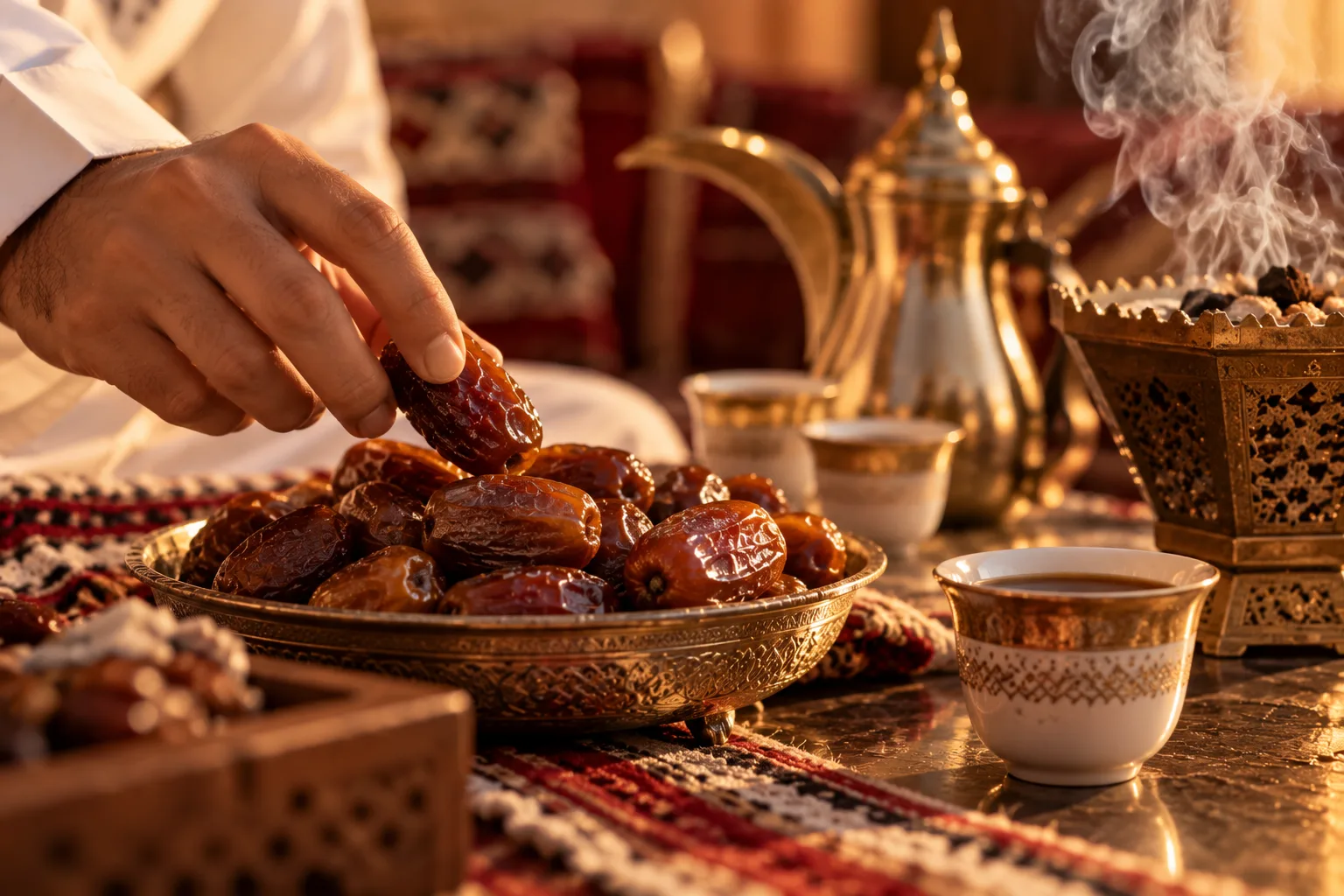
The mabkhara is not a decorative prop
A burner carrying charcoal and aromatic material can be beautiful, but its cultural role is not exhausted by decoration. Bukhoor may be used in homes throughout the year and becomes especially prominent around Eid, weddings and other important occasions.
There is also etiquette in passing fragrance. Guests may draw the smoke gently toward clothing or hair. The exact practice varies by family and setting. Again, the point is not to perform a perfect folkloric gesture. The point is to recognise that scent itself can be an offering.
Majlis hospitality is a system of small offers
The majlis was inscribed by UNESCO in 2015 as a cultural and social space shared by Qatar, Oman, the UAE and Saudi Arabia. Its importance comes from what people do there: receive guests, exchange news, discuss matters, socialise, teach younger generations and mark events.
Dates, coffee and bukhoor make sense inside that space because none of them monopolises the encounter. They accompany conversation. They can be renewed quietly. Hospitality is often strongest when the offering supports the relationship instead of becoming the performance.
Where honey enters this story
Honey is not required to make Qatari hospitality authentic. I want to say that clearly because MESKI sells honey and it would be very convenient to place a jar in every cultural scene haha. The tradition does not need us.
But honey can enter naturally at breakfast, with breads, desserts, cheese, yoghurt or tea, and as a gift. If you are curious about buying Sidr in Doha, our guide to Sidr honey in Doha focuses on origin and traceability rather than packaging. Our Honey Atlas then follows the honeys back toward landscapes and flowering trees.
The date palm as a whole household technology
Historically, palms offered far more than fruit. Leaves could be woven, fibres used, trunks incorporated into structures and the shade itself made cultivation and settlement easier in hot environments. Qatar’s modern urban context is different, but the cultural memory around the palm still belongs to this wider practical world.
This is why I prefer not to describe the palm as a symbol first. It became a symbol because it was useful for generations. Meaning often follows usefulness.
Scent, memory and why hospitality can outlast the meal
Food memories are powerful, but scent has a strange speed. One trace of oud or bukhoor years later can return a room before you remember the exact meal that was served there. Hospitality that includes fragrance works with this involuntary memory.
Perhaps this is why the smoke feels so appropriate at the beginning or end of a visit. It marks the room without requiring speech.
The first gesture is often the one remembered
Luxury hospitality often tries to impress through abundance. Traditional hospitality frequently understands something quieter: what matters is that the guest is noticed immediately. A date offered before you have settled into the cushion can say more than a complicated table arriving forty minutes later.
Perhaps that is why these small things survive. The date, the finjan, the fragrance in the air. None is enormous. Together they tell the guest: you were expected, and there is time for you here.
The palm before the polished gift box
Today dates can arrive in immaculate luxury packaging, and there is nothing wrong with that. But the cultural importance of dates did not begin with gifting. It began with agriculture, preservation, nourishment and a tree that could become part of daily survival.
Remembering that origin protects the fruit from becoming only a luxury symbol. A beautiful box is the latest chapter, not the first one.
Why Khalas works so well with coffee
The caramel comparison is useful because it explains why Khalas feels natural beside Arabic coffee. The date brings rounded sweetness while the drink keeps a lightly bitter, aromatic edge. Neither needs to overwhelm the other.
Of course, taste is personal. Some people prefer softer dates, darker varieties or a different level of sweetness. We are describing a pairing, not establishing a national ranking.
Bukhoor does something food cannot
A date disappears when you eat it. Coffee disappears when you drink it. Bukhoor can remain on fabric. That difference makes fragrance unusually good at extending a visit beyond the door.
You may leave the house and still notice the smoke on a sleeve later. The hospitality has become portable without anybody giving you an object.
Hospitality is not a luxury category
Expensive objects can be hospitable, but hospitality itself is not defined by price. A few dates, coffee poured attentively and time given without hurry can create a stronger welcome than a table designed for photographs.
This matters for a luxury honey house to remember. Luxury should never make us forget that generosity existed long before branded boxes.
A MESKI note on certainty 1
There is a temptation in cultural writing to turn every repeated habit into a rule. Real places are less obedient. Families differ, generations differ, occasions differ, and a practice that feels obvious in one house may be less important in another.
For MESKI, the useful discipline is to separate three things: what a reliable source documents, what can reasonably be observed, and what is personal interpretation. Keeping those layers visible makes the article less perfect and more trustworthy.
I would rather preserve one honest uncertainty than replace it with a beautiful sentence that nobody can prove. The archive tells us this. It does not tell us that.
A MESKI note on certainty 2
There is a temptation in cultural writing to turn every repeated habit into a rule. Real places are less obedient. Families differ, generations differ, occasions differ, and a practice that feels obvious in one house may be less important in another.
For MESKI, the useful discipline is to separate three things: what a reliable source documents, what can reasonably be observed, and what is personal interpretation. Keeping those layers visible makes the article less perfect and more trustworthy.
I would rather preserve one honest uncertainty than replace it with a beautiful sentence that nobody can prove. The archive tells us this. It does not tell us that.
Questions People Ask
Yes. Dates are commonly offered with Arabic coffee in majlis and home hospitality, and the practice sits within a wider Gulf tradition.
Khalas is especially prominent. At Qatar’s 2026 Local Dates Festival it was reported as the best-selling variety.
The sweetness of dates pairs naturally with the lighter bitterness and aromatics of Arabic coffee, while both are easy to offer immediately to guests.
Bukhoor refers to fragrant materials burned over heat or charcoal to perfume homes, clothing and gathering spaces.
In many Qatari homes it may be passed among guests so they can allow the fragrance to scent clothing, hair or hands.
No. It can be used throughout the year, although major occasions such as Eid and weddings can give it extra prominence.
A majlis is a cultural and social sitting space for receiving guests, conversation, community matters and family or social gatherings.
The knowledge, skills, traditions and practices associated with the date palm were inscribed on UNESCO’s Representative List in 2022 through a multinational nomination including Qatar.
No. Dates, Arabic coffee and other gestures have their own established roles. Honey can appear naturally in food and gifting without being forced into every tradition.
Hospitality is often made of small things
Continue through Qatar with the majlis, machboos, karak and the foods that accompany conversation rather than interrupt it.