
The more a honey is desired, the more carefully its story deserves to be checked.
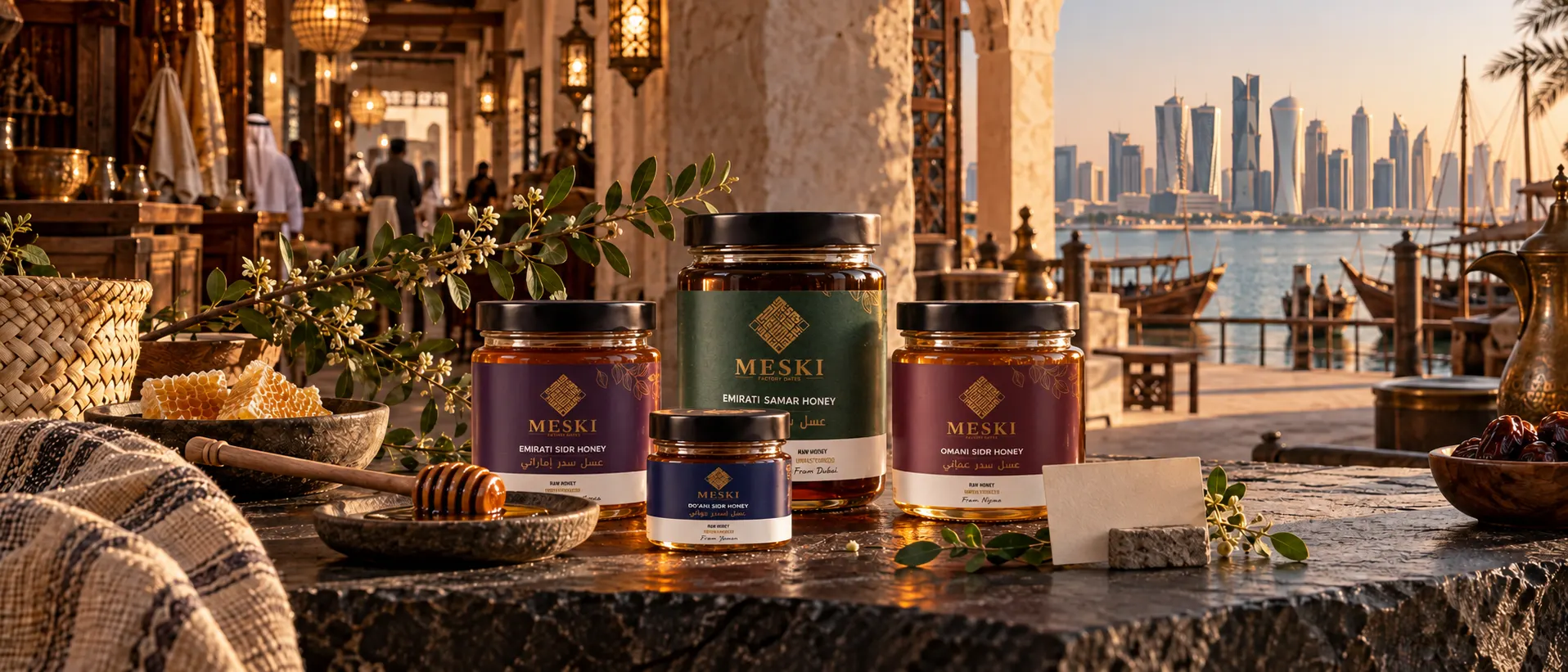
Sidr honey is easy to desire and surprisingly difficult to verify. In Doha, where local Gulf honey sits beside famous imported origins, the smartest buyer is not the person who knows the darkest colour or the highest price. It is the person who knows which questions to ask.
The most difficult thing about Sidr honey is not finding a jar
Doha is not short of honey. You can find jars in specialist shops, supermarkets, market stalls, online stores and gift counters. The harder question is what sits behind the label. Sidr has become one of the most desired honey names in the Gulf, and demand changes a market. The more people are willing to pay for an origin, a tree or a reputation, the more incentive there is for honest producers to protect it and for dishonest sellers to imitate it. That does not mean every expensive jar is suspicious. It means the buyer should stop treating price, packaging and dramatic colour as proof.
Honey is unusually difficult because much of what matters happened before the jar existed: where the colonies were placed, what was flowering, whether lots were mixed, how the honey was stored, whether the claimed region is real and whether the seller can connect the finished jar to a harvest rather than only to a marketing story. The consumer sees the final object. The important evidence sits upstream.
Price is information, not a certificate
A cheap honey can be poor. It can also be a small beekeeper’s honest harvest sold without marble boxes, gold foil or an advertising budget. A high price can reflect rarity, difficult logistics, low yield, laboratory work, careful storage and genuine selection. It can also reflect rent, branding, retail margins and packaging. Those two realities can exist at the same time.
This is why I dislike the lazy rule that says expensive means authentic and inexpensive means fake. A beekeeper may be satisfied with a modest margin because he has little overhead and wants to sell his harvest quickly. A sophisticated brand may do excellent sourcing. Another sophisticated brand may simply buy from wholesalers and become very good at presentation. The jar does not tell you which story is true.
A high price does not certify a great honey. A low price does not condemn one.
Meskaoui
Do not buy the colour
Sidr honey is often described with seductive language: dark amber, red amber, golden, almost black, caramel, woody, deep. Some of those descriptions are useful for tasting. None of them can independently prove botanical or geographical origin. Natural honey varies with flora, season, moisture, storage, temperature and crystallisation. Colour can be beautiful, but beauty is not traceability.
Taste has the same limitation. A convincing flavour may tell an experienced taster that something is plausible. It cannot prove that the honey came from a particular valley, country or Sidr stand. European honey control work makes the broader point clearly: origin and botanical declarations can be falsified, and consumers cannot reliably detect sophisticated adulteration with their senses alone.
Ask boring questions. Boring questions are useful
Where was it harvested? Which country? Which region? Which season? Is it one beekeeper, one apiary, one lot, or a blend of several purchases? Is the batch number meaningful? Can the seller show a recent analysis tied to the same lot? If the answer is simply premium Sidr from the mountains, ask again.
A serious seller does not need to know every flower visited by every bee. That would be theatre. But the chain should make sense. A named origin should correspond to records. A laboratory report should correspond to the lot in your hand. A monofloral claim should be treated as a botanical claim, not a poetic adjective.
What laboratory testing can and cannot tell you
Laboratory testing is useful, but a laboratory report is not a magic shield. Moisture can help describe stability. HMF and diastase can contribute information about heating and ageing when interpreted correctly. Sugar profiles, electrical conductivity, pollen analysis and more advanced authenticity work can add pieces to the picture. The value comes from combining evidence.
A perfect looking PDF attached to no clear batch is weaker than many consumers imagine. Even sophisticated analytical methods have limits. European anti-fraud work has documented operators adapting adulteration techniques to evade known tests. That is exactly why documents, traceability, sourcing and analysis need to support one another instead of being treated as separate marketing trophies.
Never buy the colour. Never buy the story alone. Buy the provenance you can trace.
Meskaoui
Doha adds another layer: local honey and imported prestige honey
Qatar has its own beekeeping and locally produced honey, while Doha is also a market for honeys arriving from Yemen, Oman, the UAE, Saudi Arabia and beyond. That creates a fascinating shelf but also a confusing one. Sidr can refer to honey produced from related trees across very different landscapes. The word alone does not tell you the valley, climate, season or beekeeper.
This is one reason we are building our Honey Atlas. A Sidr harvested in Yemen should not be mentally flattened into the same product as Sidr from Oman, Hatta or another region. The tree matters. So do the place and the people around it.
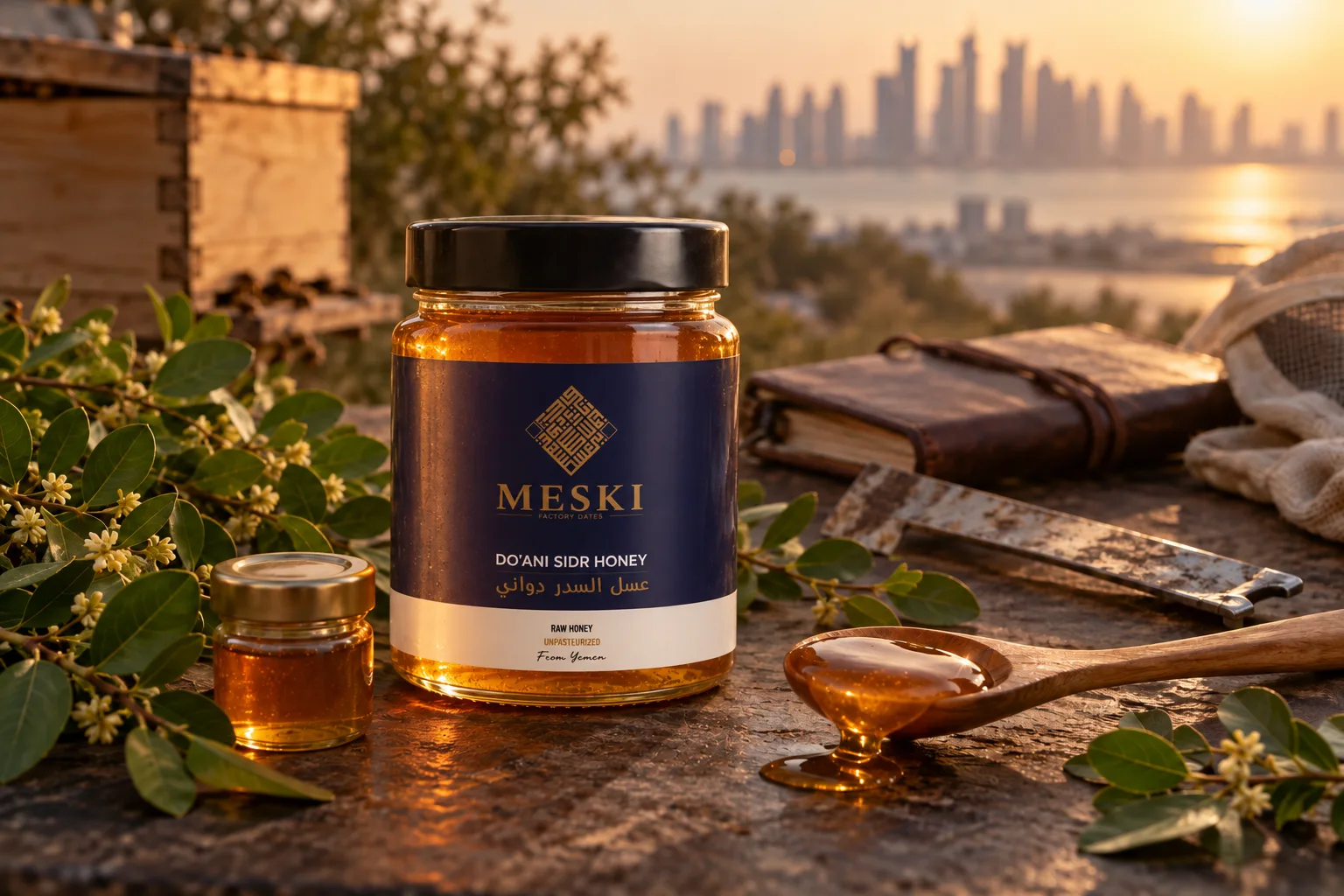
The condition of the honey matters too
Authenticity is not the only question. A genuine honey can be badly stored. Heat and time matter. Fermentation, excessive moisture, damaged aroma or poor handling can turn a real harvest into a disappointing jar. Crystallisation by itself is not a defect. Neither is remaining liquid proof of quality. The important thing is to understand the product rather than judging it through internet myths.
Look for a jar that has been treated as food, not jewellery. Ask how it was stored. Check whether the seal is intact. Notice whether the seller can explain the batch without improvising. Good honey deserves a good chain after harvest as much as before it.
A practical buying sequence in Doha
When you stand in front of several jars, begin with the claim that would be hardest to fake, not the claim printed in the largest type. If the jar says Yemeni Sidr, ask for the region. If it says local Qatari Sidr, ask where the apiary or farm is. If it says raw, ask what the seller means by raw, because the word is used loosely in marketing and does not have one universal consumer definition.
Then move to the batch. A premium honey without a meaningful lot identity is asking you to trust a category rather than a product. The more expensive the jar, the more reasonable it is to expect the seller to connect it to paperwork, storage information and a supplier chain. Finally, taste if tasting is offered, but taste last. Taste should help you decide whether you enjoy the honey, not whether the origin story is true.
What I would rather hear from a seller
I would rather hear an honest limitation than an impossible certainty. This is what our beekeeper told us, this is the region, this is the harvest period, and this is the analysis we have. That is stronger than a speech claiming the bees visited only one tree for kilometres and that the colour proves everything.
Trust grows when a seller knows the difference between what is documented, what is probable and what is simply part of the sensory description. That distinction is one of the quiet signs of a serious honey house.
What a small beekeeper can have that a big brand cannot buy
A small beekeeper can have extraordinary location knowledge. He may know exactly which wadi flowered, which week the rain changed the season, which colonies performed well and which harvest is worth keeping separate. He may not have luxury packaging or a polished website. That lack of polish does not reduce the quality of the honey.
But small does not automatically mean pure either. Romanticising the beekeeper is another mistake. Good buying means refusing both prejudices: big brand equals quality, small producer equals authenticity. Judge the evidence and the harvest in front of you.
What a good brand should add
A serious brand should add value beyond a label. It can select, reject, store correctly, test, document, compare seasons, protect batches and explain limits. If it buys honey from different beekeepers, that is not automatically a problem. Many good food houses work through selection. The problem begins when the brand hides the chain or sells a vague story as if it were a precise origin.
The best brands make sourcing clearer, not more mysterious. They use packaging to protect the product and communicate it, not to distract from unanswered questions.
So where should you buy Sidr honey in Doha?
There is no single correct answer. A specialised honey shop can be excellent. A market seller can have a remarkable small batch. An online brand can provide better documentation than a physical store. A farm can offer something very direct. The best place is the place where the story, the jar and the evidence remain coherent when you start asking questions.
And yes, MESKI sells Sidr honey. It would be very convenient for us to finish by saying that this settles the matter haha. It does not. Buy from us, buy from somebody else, buy from a beekeeper you meet in Qatar. Just buy with curiosity. Provenance is an amanah. The customer should not have to choose between romance and evidence.
Questions People Ask
No. Price can reflect rarity, sourcing and quality, but it can also reflect packaging, rent, branding and margins. Use price as one clue, not as proof.
No. Colour varies naturally and can be influenced by origin, season, storage and other factors. It is not a reliable authenticity test on its own.
Sidr honeys often have recognisable sensory families, but taste cannot prove a country, valley or botanical origin by itself.
Yes when available, especially for premium honey. The report is most useful when it is recent, understandable and tied to the exact batch you are buying.
No. Crystallisation is a natural process in many genuine honeys. Its speed depends on sugar composition, temperature and other factors.
No. Locality and quality are different questions. A local honey can be excellent, and so can a carefully sourced imported harvest.
At minimum, the claimed country and region, harvest period or season, supplier or beekeeper chain, batch identity and storage should make sense.
Usually no. Strong assurance comes from several pieces of evidence that agree: traceability, documentation, analytical results and a credible supply chain.
Do not buy the colour or the story alone. Buy the provenance you can trace, and judge the condition and documentation of the actual jar.
Buy with curiosity, not with theatre
Explore how MESKI approaches origin, terroir and traceability, then compare that standard with any honey you are considering.