
A national dish becomes easier to understand when you understand the room in which people share it.
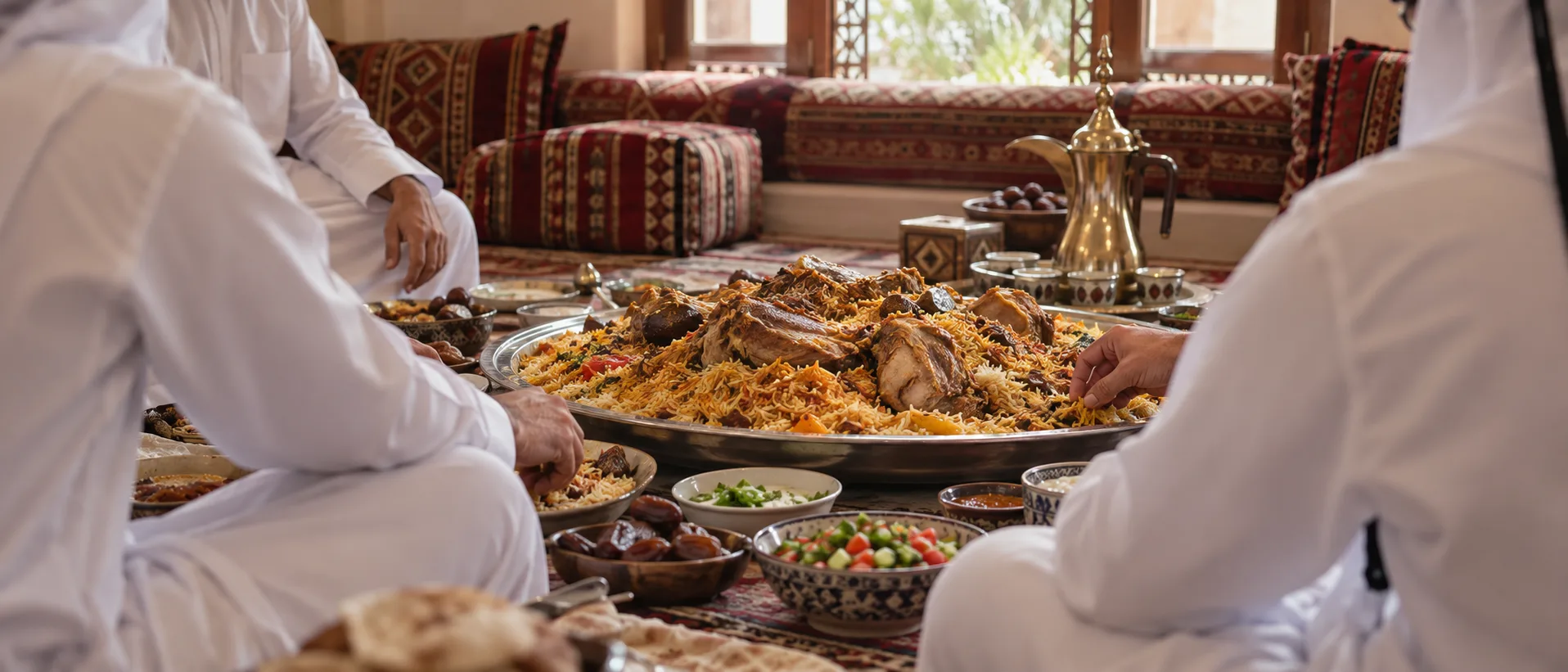
Machboos is Qatar’s national dish. But if we reduce it to rice, meat and spices, we miss the part that makes it belong to a place: the people around the platter, the majlis, the sequence of hospitality and the time given to a guest.
Before the first spoon, there is the room
Machboos is often introduced in one sentence: Qatar’s national dish, rice cooked with spices and served with meat or fish. That sentence is correct and still somehow misses the point. Food does not arrive in a vacuum. In Qatar, the room, the people, the rhythm of serving and the conversation around a dish can carry as much meaning as the recipe.
This is why I wanted to write about machboos through the majlis rather than through a recipe card. The majlis is not simply attractive furniture for a photograph. UNESCO describes it as a social and cultural space where people receive guests, exchange news, discuss community matters and pass knowledge between generations. If you want to understand why a large platter belongs naturally in this environment, begin with sharing.
A national dish, but not a museum object
Visit Qatar calls machboos the national dish of Qatar. The broad idea is familiar across the Gulf: rice, spices and a central protein, built for a table that may include several people. Yet recipes are not frozen. Families vary spice mixes, cuts of meat, cooking methods and accompaniments. A home version and a restaurant version can both be Qatari without being identical.
That flexibility matters. Calling something national can accidentally make it sound ceremonial, as though people only encounter it on heritage days. Machboos is more alive than that. It belongs to family meals, gatherings, invitations and the larger language of Gulf hospitality.
A national dish is not only a recipe. It is also the way a place teaches you to sit, share and stay a little longer.
Meskaoui
Why the majlis changes the dish
In a majlis, food is part of receiving. Guests are not only fed. They are placed inside a sequence of gestures: greeting, seating, coffee, dates, conversation, perhaps incense, then the meal depending on the occasion. The sequence tells the guest that time has been made for them.
A shared platter makes sense here because it resists the isolated restaurant logic of one plate, one person, one boundary. People reach toward the same centre. Older people, younger people, relatives, friends and visitors occupy the same field of food. That does not mean every Qatari meal is eaten communally or that everyone follows one etiquette. It means the architecture of machboos fits remarkably well with the social architecture of the majlis.
The rice carries the memory
A good machboos is not plain rice with decoration on top. The rice absorbs stock, fat, spices and the flavour of the protein. Cardamom, black lime and other spices may appear, but the exact balance changes from household to household. This is where the dish becomes interesting. The rice is not background. It is the part that remembers everything that happened in the pot.
That is also why recipes copied without context can feel flat. You can reproduce an ingredient list and still miss the patience, the order and the calibration that experienced cooks perform without measuring every movement.
Loomi, spice routes and a Gulf pantry
Machboos opens a wider historical door. The Gulf pantry has always been connected to trade. Spices, rice and preserved ingredients travelled. Dried black lime, known widely as loomi, became one of those flavours that can make a Gulf kitchen recognisable before you see the pot.
I like this detail because national cuisine is often presented as if borders invented every ingredient. They did not. What communities do is more interesting: they receive ingredients, adapt them, repeat them, attach memory to them and eventually make a combination feel like home.
Machboos in a restaurant is food. Machboos shared in a majlis can become memory. Now we are talking haha.
Meskaoui
Eating with the hand is not a performance
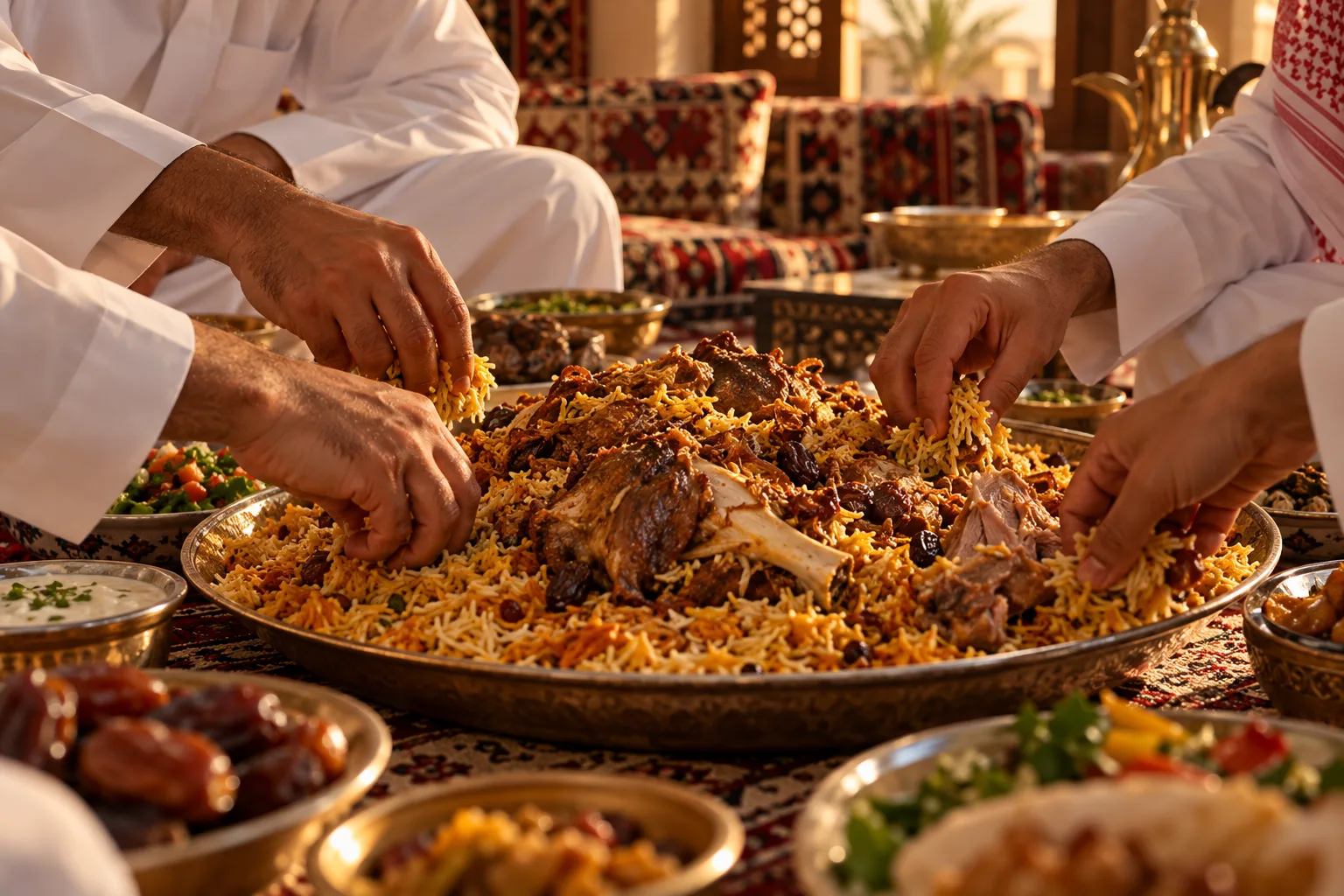
Visitors sometimes become so focused on doing things traditionally that the meal turns into theatre. That is the opposite of hospitality. If your host eats with the right hand from a shared platter and invites you to do the same, you can follow with respect. If cutlery is provided, using it does not invalidate the experience.
The point is not to pass an authenticity exam. Watch the people around you. Take from the area nearest to you. Do not reach dramatically across the platter. Eat comfortably. Hospitality works when the guest is at ease, not when the guest is terrified of making a mistake.
The platter teaches proportion
A communal platter changes the visual logic of the meal. Rice forms a landscape rather than a side dish. Meat or fish becomes the centre, but not necessarily an individual entitlement. The meal is designed to be seen as abundance shared, not portions divided before anyone sits down.
This does not erase modern habits. Families may plate food individually, restaurants may serve refined portions and younger people may move between styles easily. Culture is strongest when it can change format without losing recognition.
What comes before and after machboos
A Qatari table is larger than one national dish. Dates and Arabic coffee can frame hospitality. Karak has its own everyday universe. Sweets may follow. Bukhoor can shape the atmosphere of the room. These are not accessories arranged by a tourism board. They are parts of different social moments that sometimes meet in one visit.
That is why this article links naturally to our pieces on karak in Qatar and dates, coffee and bukhoor. The food makes more sense when the surrounding gestures are visible.
What visitors often get wrong
Visitors sometimes chase authenticity so aggressively that they stop being good guests. They photograph before greeting, ask people to repeat gestures for the camera or treat a private family space like a museum set. The better approach is simpler: notice, ask when appropriate, and let the meal remain a meal.
If somebody explains why a spice is used, listen. If nobody explains, you do not need to invent a story. The archive tells us this. It does not tell us that. The same discipline applies at the table.
Restaurant machboos versus majlis machboos
You can eat excellent machboos in a restaurant. I am not going to pretend otherwise. A skilled kitchen can make a beautiful version, and restaurants are often the easiest doorway for visitors. But the emotional experience changes when the dish is connected to an invitation, to people who know one another, to a room where conversation has already started before the platter arrives.
Maybe I am biased toward context. I usually am. Machboos in a restaurant is food. Machboos shared in a majlis can become memory. Now we are talking haha.
Why this is not a recipe article
There are many excellent recipes online, and I do not think MESKI needs to pretend it can improve every family pot in Qatar. What interests me is the social life of the dish. A recipe tells you how to reproduce flavours. A cultural article asks why this food sits so naturally at the centre of a shared gathering.
That difference matters for our Journal. We are not trying to turn every subject into instructions. Sometimes understanding the room is more useful than knowing the exact number of cardamom pods.
The meal as a form of time
Hospitality is often measured in food, but perhaps it should also be measured in time. A host who asks you to stay, brings coffee, continues the conversation and finally opens the meal is giving more than calories. The meal becomes evidence that your presence was not an interruption.
That is what I mean when I say immersion matters. Not because visitors need to perform Qatar correctly, but because context turns a famous dish into a lived experience.
The majlis is not a restaurant setting
The majlis matters because the relationship comes first. A restaurant can reproduce the cushions, lamps and servingware, but it cannot reproduce the history between the people in the room. This is why I do not want to romanticise a decorative majlis as if furniture alone created hospitality.
What gives the space meaning is use: who is welcomed, who speaks, who listens, how younger people learn, how food appears without becoming the only reason everybody gathered.
A MESKI note on certainty 1
There is a temptation in cultural writing to turn every repeated habit into a rule. Real places are less obedient. Families differ, generations differ, occasions differ, and a practice that feels obvious in one house may be less important in another.
For MESKI, the useful discipline is to separate three things: what a reliable source documents, what can reasonably be observed, and what is personal interpretation. Keeping those layers visible makes the article less perfect and more trustworthy.
I would rather preserve one honest uncertainty than replace it with a beautiful sentence that nobody can prove. The archive tells us this. It does not tell us that.
A MESKI note on certainty 2
There is a temptation in cultural writing to turn every repeated habit into a rule. Real places are less obedient. Families differ, generations differ, occasions differ, and a practice that feels obvious in one house may be less important in another.
For MESKI, the useful discipline is to separate three things: what a reliable source documents, what can reasonably be observed, and what is personal interpretation. Keeping those layers visible makes the article less perfect and more trustworthy.
I would rather preserve one honest uncertainty than replace it with a beautiful sentence that nobody can prove. The archive tells us this. It does not tell us that.
Questions People Ask
Visit Qatar presents machboos as Qatar’s national dish. It is a spiced rice dish commonly served with meat, chicken or fish, with household variations.
They belong to a wider family of Gulf and Arabian rice dishes, but names, spice balances and local methods differ. Treating them as identical erases regional practice.
Loomi is dried lime used across Gulf cooking. It gives dishes a distinctive sour, aromatic depth and appears in many machboos recipes.
No. Machboos is eaten in many settings. The majlis is used here as a cultural lens because communal food and hospitality naturally meet there.
It can be eaten with the right hand in communal settings, but cutlery is also normal in many contexts. Follow your host and the setting.
A majlis is a social sitting space used to receive guests, exchange news, discuss community matters and socialise. It is recognised by UNESCO as intangible cultural heritage.
Accompaniments vary. Salads, sauces, yoghurt or other side dishes may appear depending on the household and occasion.
No single household formula represents all Qataris. The dish has a recognisable structure, but families differ in spice, protein and technique.
Traditional Qatari restaurants are the most accessible starting point. If you are invited to a family gathering, the social context adds another dimension that a restaurant cannot reproduce.
Stay at the table a little longer
Continue through Qatar with karak, dates, coffee and the small gestures that turn food into hospitality.